niyad
niyad's JournalDocumentary 'Yours in Freedom, Bill Baird' Explores the Fight for Birth Control Access and the Road Ahead
Documentary ‘Yours in Freedom, Bill Baird’ Explores the Fight for Birth Control Access and the Road Ahead
12/29/2023 by Eleanor J. Bader

Bill Baird and Jada Portillo in Yours in Freedom, Bill Baird.
Bill Baird, the man who successfully challenged the U.S. law banning the distribution of contraceptives to unmarried people, is the subject of Rebecca Cammisa’s powerful documentary, Yours in Freedom, Bill Baird. While much of the film focuses on Baird’s six-decade career—he is now 91—as a reproductive justice advocate and activist, the narrative juxtaposes his efforts with that of burgeoning Arkansas organizer, Jada Portillo. Portillo and Baird met in 2019 when she was participating in that year’s National History Day competition, an annual event for high school students. As the then-16-year-old worked to come up with a topic that fit the year’s theme, Breaking Barriers in History, Portillo decided to focus on the political struggle to legalize birth control in the United States. Although she had never heard of Baird before this, after she read an account of his work, she found his website and emailed him.
For his part, Baird told the filmmakers that he was thrilled by Portillo’s interest and quickly agreed to an interview. Their unfolding relationship—she eager and energetic, he slow and somewhat unsteady—included numerous phone calls as well as a trip to the U.S. Supreme Court where Eisenstadt v. Baird, the landmark birth control case, was argued. The 7-2 decision that resulted from the litigation was groundbreaking. In fact, the Court’s finding, issued a year before Roe, was foundational in the fight for personal privacy and established the government’s limited role in dictating what we can do with our bodies. As Justice William Brennan wrote in the majority opinion, “If the right to privacy means anything, it is the right of the individual, married or single, to be free from unwarranted government intrusion into matters so fundamentally affecting a person as the decision whether to bear or beget a child.”
But why, Portillo wondered, was this idea so contentious? After all, birth control had been legal for married people since Griswold v. Connecticut was decided in 1965. Why did this right not automatically extend to single people? Yours in Freedom unravels this history. It begins in the early 1960s when Baird became the clinical director of EMKO Pharmaceuticals, a company that manufactured and sold contraceptive foam. He saw a great deal of suffering in the hospitals he visited but was profoundly changed after witnessing a woman die following a botched coat hanger abortion and subsequently committed himself to doing everything he could to promote low-cost birth control and access to safe, legal abortion—healthcare that was available to those with financial means. In short order, Baird became a whirlwind organizer, creating a group he called the Parents Aid Society and driving a truck, dubbed the Plan Van, into impoverished communities where he distributed condoms and foam to residents regardless of their marital status.
. . . .
A clip from Yours in Freedom, Bill Baird.
. . . .
In addition, the film sounds a loud and dire warning about the need for reproductive justice advocates to remain vigilant and active if we want to keep the rights we currently have. This, Baird cautions, requires us to pay attention to politics at the local, state and federal levels.
It’s an important, prescriptive reminder. But Yours in Freedom is also more than this and is an inspiring and deeply felt look at what one person can achieve in the pursuit of justice.“The world is on fire,” Baird says in the film’s final frame. “Freedom is on fire.” Nonetheless, he makes clear that he has already done what he could. It’s now our job to drown the flames and continue the fight for bodily autonomy, human rights and liberation.
Yours in Freedom, Bill Baird is directed by Rebecca Cammisa; edited by Sebastian Jones and Sonja Lesowsky-List; cinematographer Claudia Raschke; Terra Mater Studios; 106 minutes.
https://msmagazine.com/2023/12/29/documentary-yours-in-freedom-bill-baird-explores-the-fight-for-birth-control-access-and-the-road-ahead/
Britney Spears and the Right to Reproductive Justice: Regulation and Conservatorship in the Child Welfare System
Britney Spears and the Right to Reproductive Justice: Regulation and Conservatorship in the Child Welfare System
10/26/2021 by Shanta Trivedi
After the outrage surrounding Britney Spears’s conservatorship, activists have seized the opportunity to draw attention to the daily struggles faced by many trapped in the “child welfare” system—or, as advocates rightly dub it, the family regulation system.
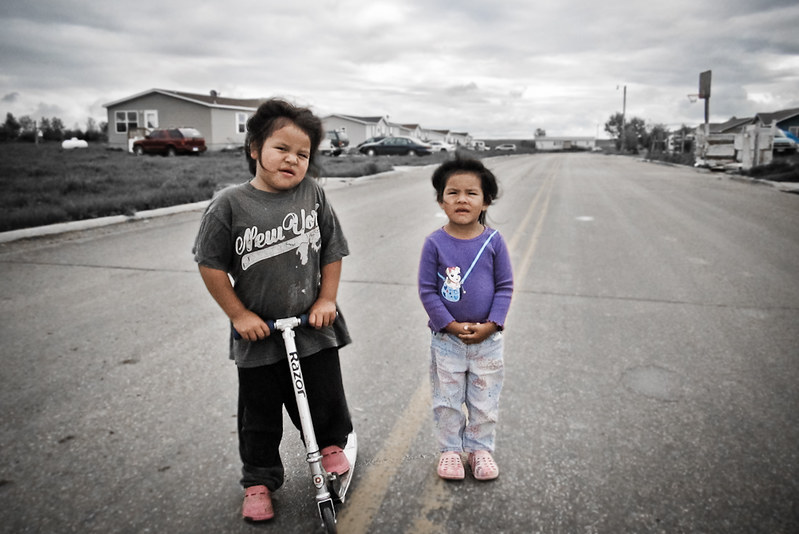
Black and Native families are more likely to be reported to child protective services, to have their cases substantiated and to have their children removed and placed into foster care. (yesy belajar memotrek / Flickr)
In the last few months, the world has become re-obsessed with Britney Spears and the conservatorship that has controlled her life for the last 13 years. We felt collective outrage when we learned her father, as conservator, forced her to have an intrauterine device (or IUD) in her body to prevent her from having more children, even though that was her wish. We were stunned and horrified at the recent revelation that her father monitored her phone and installed an audio-listening device in her bedroom. Without a doubt, we should be incensed the law allowed a woman who was competent enough to manage a million-dollar residency in Vegas, to be subjected to this level of surveillance and control.
As we express our rage the law allowed this to go on for so many years, we should take the opportunity to question any and all legal regimes that sanction control over another person. One in particular you may not be familiar with is the child welfare system. It’s Jamie Spears on steroids. Twenty years ago, in her groundbreaking book, Shattered Bonds, Professor Dorothy Roberts wrote:
“If you came with no preconceptions about the child welfare system’s purpose, you would have to conclude that it is an institution designed primarily to monitor, regulate and punish poor black families.”
Two decades later, the “child welfare” system—or, as advocates now rightly dub it, the family regulation system—continues to surveil and control primarily Black and Brown parents. The state questions every parenting decision they make and in too many cases, removes their children, preventing parents from exercising their constitutional right to parent and denying children their constitutional right to be with their parents if they choose. The state questions every parenting decision they make. Surveillance is inherent—constantly under the watchful eye of others who can anonymously report suspected child abuse with few facts, no understanding of what legally constitutes neglect, or simply out of malice. Surveillance is inherent if you live in poverty in the United States and that is not limited to family regulation issues. This is true if you live in low-income housing, take public transportation, send your children to schools, get medical care at an emergency room or happen to live in what police have conveniently dubbed a “high-crime” neighborhood.
. . .
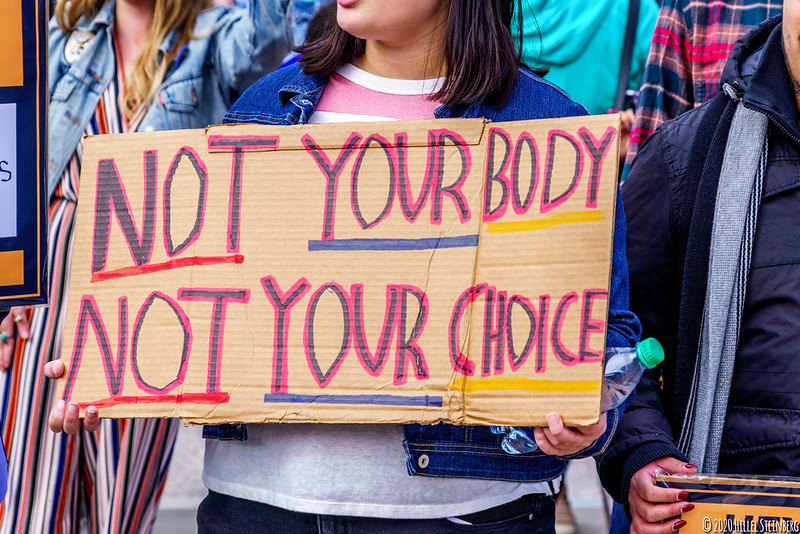
A January 2020 abortion rally in D.C. (Hillel Steinberg / Flickr)
. . . .
The family regulation system therefore impacts women’s reproductive autonomy every day. It prevents parents from making decisions about their children because, once you have made contact with the system, you can remain entangled in that system for years. Many choose not to have more children for fear they will immediately be taken into foster care. Just like conservatorship, it is an invisible but looming threat over reproductive decision-making in the guise of child protection. Disability rights advocates rightly seized upon the #FreeBritney conversation to bring awareness to people who aren’t celebrities, but struggle the same way she does. But anyone who cares about families and family integrity should be having the same conversation. As a family law professor and a lawyer who used to represent indigent parents accused of abuse and neglect, I can tell you this is larger than one woman—it is about the millions of parents who are under relentless state surveillance and whose decision-making is dissected by the state because they are disabled, they are poor or they are minorities.
#FreeThemAll.
https://msmagazine.com/2021/10/26/child-welfare-system-britney-spears-reproductive-justice-regulation-conservatorship/
Britney Spears's Case Exposed a Systemic History of Reproductive Control
Britney Spears’s Case Exposed a Systemic History of Reproductive Control
9/8/2021 by Krystale E. Littlejohn
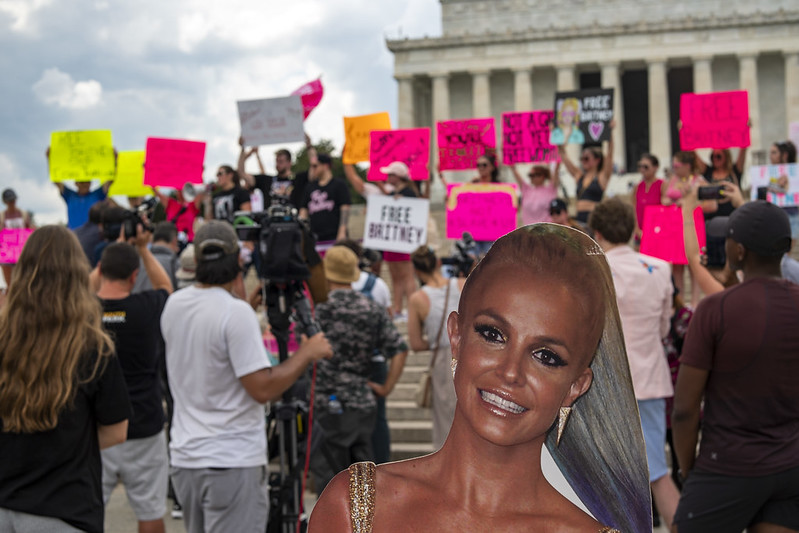
A ‘Free Britney’ rally in front of the Lincoln Memorial in D.C. on July 14, 2021. A cardboard Britney is in the foreground. (Mike Maguire / Flickr
Two months after Britney Spears first revealed that she wanted to end the conservatorship that gave third parties control over her life and finances, her father, Jamie Spears, has filed to end her 13-year-long conservatorship. Being forced to get and keep IUD are among the allegations that Spears made against her team in a statement to a Los Angeles Superior Court judge on June 23. Men have an extensive history of inappropriate involvement in birthing people’s reproduction—making Britney Spears’s father only the latest person at the center of allegations involving reproductive control. As a sociologist who studies fertility, I’ve found myself regularly running through the list of egregious ways that men have been involved in violating the reproductive rights of cis women and trans men. Whether it’s contraceptive sterilization or abortion, cis men have behaved badly when adjudicating birth control both historically and contemporarily.
In the 1950s, hospitals in the United States were in the throes of establishing committees to curb and control abortion. Only 6 percent of doctors were female at the time. Yet, as part of the process of obtaining an abortion, women might see multiple doctors and face both intrusive questions and physical exams before they could receive an abortion. While much has changed since facing hospital abortion committees was the only way to obtain an abortion, the centrality of men’s decision-making over women’s bodies hasn’t. In the nearly 50 years since an all-male Supreme Court decided that women did indeed have a constitutionally-protected right to abortion in Roe v. Wade, a majority-male court is set to reconsider the issue.
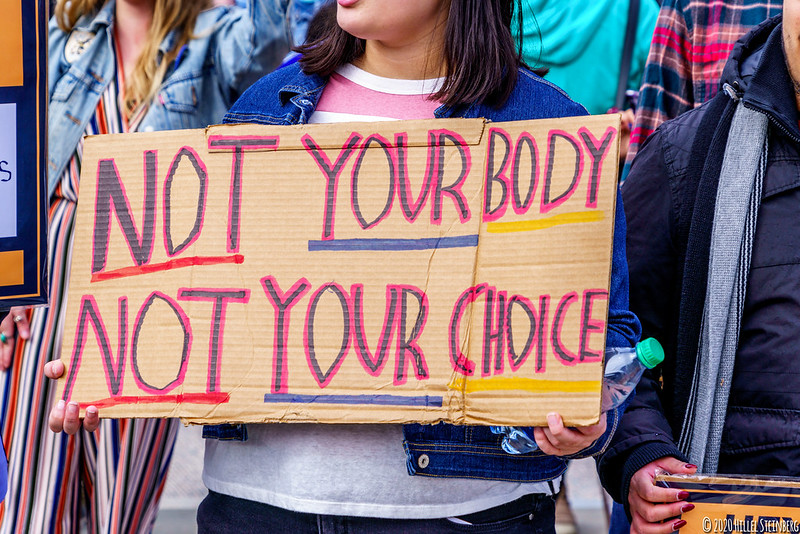
A January 2020 abortion rally in D.C. (Hillel Steinberg / Flickr)
. . .
As if external threats to their reproductive autonomy were not enough, people also face more personal threats to their reproductive freedom. My research shows women undergo battles for autonomy with their partners and families too. Whether it’s people pressuring them to stay on birth control (as Britney Spears recounts), or boyfriends convincing them to “just get on the pill” to avoid using condoms, my book shows that women also face gendered birth control threats outside the public eye. Whether it’s people pressuring them to stay on birth control (as Britney Spears recounts), or boyfriends convincing them to “just get on the pill” to avoid using condoms, women face gendered birth control threats outside the public eye.
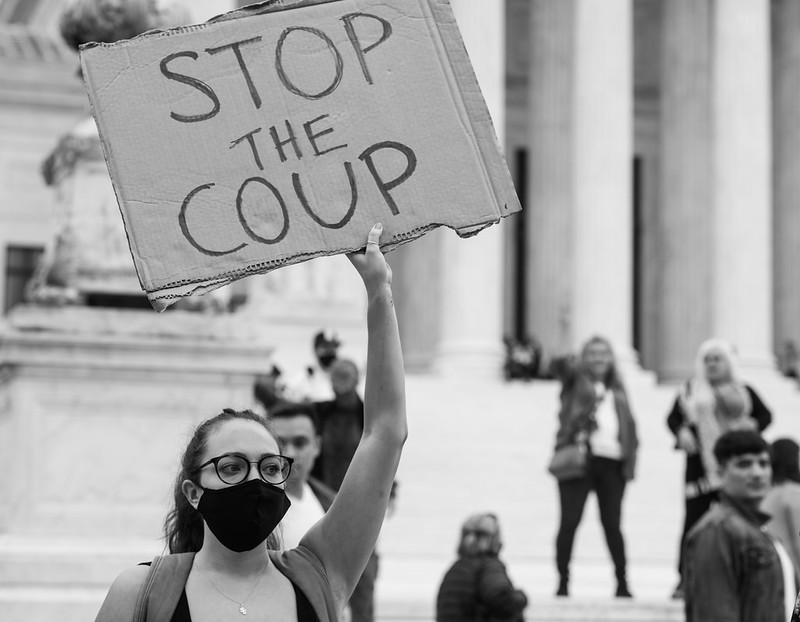
Scenes at the Supreme Court right after the announcement of the nomination of Amy Coney Barrett on Sept. 26. (Victoria Pickering / Flickr)
Of course, men aren’t the only ones with the power to interfere with people’s reproductive freedom. Justice Amy Coney Barrett’s confirmation to the Supreme Court spurred fears of turmoil for abortion rights precisely because a judge with unfavorable abortion attitudes could do considerable damage on a conservative court regardless of their gender. That cis women can (and do) harm other women, however, is no excuse for ignoring the inappropriate ways that men regulate women’s reproduction. Spears’s very public battle with her father is just the latest reminder that birthing people’s voices are the only ones that we should listen to in the gendered battle for reproductive control over their bodies. To do otherwise is not just misguided. It’s toxic.
https://msmagazine.com/2021/09/08/free-britney-spears-reproductive-control-end-conservatorship/
Britney Spears's Case Exposed a Systemic History of Reproductive Control
Britney Spears’s Case Exposed a Systemic History of Reproductive Control
9/8/2021 by Krystale E. Littlejohn
A ‘Free Britney’ rally in front of the Lincoln Memorial in D.C. on July 14, 2021. A cardboard Britney is in the foreground. (Mike Maguire / Flickr
Two months after Britney Spears first revealed that she wanted to end the conservatorship that gave third parties control over her life and finances, her father, Jamie Spears, has filed to end her 13-year-long conservatorship. Being forced to get and keep IUD are among the allegations that Spears made against her team in a statement to a Los Angeles Superior Court judge on June 23. Men have an extensive history of inappropriate involvement in birthing people’s reproduction—making Britney Spears’s father only the latest person at the center of allegations involving reproductive control. As a sociologist who studies fertility, I’ve found myself regularly running through the list of egregious ways that men have been involved in violating the reproductive rights of cis women and trans men. Whether it’s contraceptive sterilization or abortion, cis men have behaved badly when adjudicating birth control both historically and contemporarily.
In the 1950s, hospitals in the United States were in the throes of establishing committees to curb and control abortion. Only 6 percent of doctors were female at the time. Yet, as part of the process of obtaining an abortion, women might see multiple doctors and face both intrusive questions and physical exams before they could receive an abortion. While much has changed since facing hospital abortion committees was the only way to obtain an abortion, the centrality of men’s decision-making over women’s bodies hasn’t. In the nearly 50 years since an all-male Supreme Court decided that women did indeed have a constitutionally-protected right to abortion in Roe v. Wade, a majority-male court is set to reconsider the issue.
A January 2020 abortion rally in D.C. (Hillel Steinberg / Flickr)
. . .
As if external threats to their reproductive autonomy were not enough, people also face more personal threats to their reproductive freedom. My research shows women undergo battles for autonomy with their partners and families too. Whether it’s people pressuring them to stay on birth control (as Britney Spears recounts), or boyfriends convincing them to “just get on the pill” to avoid using condoms, my book shows that women also face gendered birth control threats outside the public eye. Whether it’s people pressuring them to stay on birth control (as Britney Spears recounts), or boyfriends convincing them to “just get on the pill” to avoid using condoms, women face gendered birth control threats outside the public eye.
Scenes at the Supreme Court right after the announcement of the nomination of Amy Coney Barrett on Sept. 26. (Victoria Pickering / Flickr)
Of course, men aren’t the only ones with the power to interfere with people’s reproductive freedom. Justice Amy Coney Barrett’s confirmation to the Supreme Court spurred fears of turmoil for abortion rights precisely because a judge with unfavorable abortion attitudes could do considerable damage on a conservative court regardless of their gender. That cis women can (and do) harm other women, however, is no excuse for ignoring the inappropriate ways that men regulate women’s reproduction. Spears’s very public battle with her father is just the latest reminder that birthing people’s voices are the only ones that we should listen to in the gendered battle for reproductive control over their bodies. To do otherwise is not just misguided. It’s toxic.
https://msmagazine.com/2021/09/08/free-britney-spears-reproductive-control-end-conservatorship/
'Dying every two hours': Afghan women risk life to give birth (possible trigger warning)
(this is a very image-heavy article, so I only posted a few of them. they are heartbreaking)
‘Dying every two hours’: Afghan women risk life to give birth (possible trigger warning)
Afghanistan is among the worst countries in the world for deaths in childbirth, with one woman dying every two hours.
 ?resize=1170%2C780&quality=80
In this photograph taken on December 8, 2023, Afghan woman Basa holds her newborn child at the Doctors Without Borders (MSF)-run maternity hospital in Khost. An estimated 40 percent of Afghan women give birth at home, but that figure increases to 80 percent in remote areas, where they go through the process often with the help of their mother-in-law or a local matriarch, but sometimes alone. [Kobra Akbari/AFP]
Published On 27 Dec 202327 Dec 2023
Zubaida travelled from the rural outskirts of Khost in eastern Afghanistan to give birth at a maternity hospital specialising in complicated cases, fearing a fate all too common among pregnant Afghan women – either her death or that of her child. She lay dazed, surrounded by the unfamiliar bustle of the hospital run by international medical charity Doctors Without Borders, known by its French initials MSF. She was exhausted from the delivery the day before, but also relieved. Her still-weak newborn slept nearby in an iron crib with peeling paint, the child’s eyes lined with kohl to ward off evil. “If I had given birth at home, there could have been complications for the baby and for me,” said Zubaida, who doesn’t know her age.
Not all women who make it to the hospital are so lucky. “Sometimes we receive patients who come too late to save their lives” after delivering at home, said Therese Tuyisabingere, the head of midwifery at MSF in Khost, the capital of the eastern province of Khost. The facility delivers 20,000 babies a year, nearly half of those born in the province, and it only takes on high-risk and complicated pregnancies, many involving mothers who haven’t had any check-ups. “This is a big challenge for us to save lives,” said Tuyisabingere. She and the some 100 midwives at the clinic are on the front lines of a battle to reduce the maternal mortality rate in Afghanistan, where every birth carries major risks and with the odds against women mounting.
Afghanistan is among the worst countries in the world for deaths during childbirth, “with one woman dying every two hours”, said Stephane Dujarric, the spokesperson of United Nations Secretary-General Antonio Guterres, this month. The Afghan Ministry of Public Health did not respond to requests for comment. According to the latest World Health Organization (WHO) figures, from 2017, 638 women died in Afghanistan for every 100,000 viable births, compared with 19 in the United States. That figure conceals the huge disparities between rural and urban areas. Terje Watterdal, country director for the non-profit Norwegian Afghanistan Committee (NAC), said they saw 5,000 maternal deaths per 100,000 births in remote parts of the country. “Men carry the women over their shoulders, and the women die over the mountain trying to reach a hospital,” he said.
 ?fit=1170%2C780&quality=80
In this photograph taken on December 8, 2023, Afghan woman Basa holds her newborn child at the Doctors Without Borders (MSF)-run maternity hospital in Khost. Before the return to power of the Taliban in August 2021, women would sometimes have to brave the front lines to reach help, but now there are new challenges - including a 'brain drain' of expertise. [Kobra Akbari/AFP]
 ?fit=1170%2C780&quality=80
In this photograph taken on December 8, 2023, Afghan women sit beside their newborns at the Doctors Without Borders (MSF)-run maternity hospital in Khost. 'A lot of gynaecologists have left the country,' said Terje Watterdal, country director for the non-profit Norwegian Afghanistan Committee (NAC). Taliban authorities also want to get rid of the mobile medical teams visiting women because 'they cannot control the health messages they were giving', he added. [Kobra Akbari/AFP]
. . . . . .
'This type of clinic doesn't exist in the majority of provinces,' Khair Mohammad Mansoor, the Taliban-appointed provincial health director, told an all-male audience. 'We have created a system for them in which sharia law and all medical principles will be observed.' [Kobra Akbari/AFP]
In this photograph taken on December 7, 2023, Nasrin Oryakhil, manager at Norwegian Afghanistan Committee (NAC)-run Comprehensive-Continuum of Care Centre, a maternity hospital, speaks during an interview with AFP at her office in the facility at Gardez, the capital of Afghanistan's Paktia province.The NAC facility aims to help 'many of our sisters who live in isolated areas', manager Nasrin Oryakhil said, with similar clinics planned for four other provinces in the coming months. [Kobra Akbari/AFP]
https://www.aljazeera.com/gallery/2023/12/27/photos-dying-every-two-hours-afghan-women-risk-life-to-give-birth
Six Things You May Not Know About Abortion
Six Things You May Not Know About Abortion
1/3/2024 by Kendall Turner
Abortion is a very common procedure—one in four U.S. women will have one—yet most people still know so little about it.

An abortion-rights supporter attends the National Women’s March on Jan. 22, 2023, in Washington, D.C., marking the 50th anniversary of Roe v. Wade. (Probal Rashid / LightRocket via Getty Images)
After reading about Kate Cox’s unsuccessful efforts to obtain an abortion in Texas, I needed an outlet for my ire. I took to social media, where I found reprehensible comments about abortion on Threads. I responded to them. I schooled my interlocutors with facts and links to research. I dazzled them with my correct grammar. I received tens of likes. You may be shocked to learn that I changed no one’s mind. I was nevertheless surprised by some people’s misconceptions about abortion—many of which appeared to be shared by pro- and anti-abortion individuals. For example, people seemed unaware that most individuals who seek abortion care were using contraception when they became pregnant. Some of the misconceptions that I read, especially those about the safety of abortion procedures, have been comprehensively addressed elsewhere, but others have not. Abortion is a very common procedure—one in four U.S. women will have an abortion by the time she reaches age 45—yet most people still know so little about it. In the spirit of clearing the cobwebs out of our collective discourse, here are a few facts about abortion that have not been widely reported.
1. Most people who obtain abortion care in America report using contraception in the month in which they became pregnant.
“Many people think abortion is used as a primary form of birth control, but that is incorrect,” said Dr. Daniel Skora, a fertility specialist in Texas. Data confirm this point.
A slim majority of abortion patients (51 percent in 2014, and 54 percent in 2000) in the United States reported that they used contraception in the month in which they became pregnant, according to the Guttmacher Institute.
The most common form of contraception was the condom (28 percent and 24 percent in 2000 and 2014, respectively).
The second most common form was the pill (14 percent and 13 percent in 2000 and 2014, respectively).
. . . . .
3. Most people who obtain an abortion in America are religious. Roughly 60 percent of Americans who have an abortion identify as religious. The largest fraction (24 percent) of these believers identify as Catholic, while 17 percent are mainline Protestant, and 13 percent are evangelical Christians. The remaining 8 percent of the believers report some other affiliation. Around 38 percent of abortion recipients do not identify as religious.
. . . .

These photos show pregnancy tissue extracted at five to nine weeks of pregnancy, rinsed of blood and menstrual lining. The images show the tissue in a petri dish next to a ruler to indicate its size. (MYA Network)
.. . .

Abortion rights demonstrators rally to mark the first anniversary of the U.S. Supreme Court ruling in the Dobbs v. Women’s Health Organization case in Washington, D.C., on June 24, 2023. (Andrew Caballero-Reynolds / AFP via Getty Images)
No matter what you think about abortion access, it helps to understand the realities of someone facing the decision of whether to terminate. “It is really easy to say you condemn abortion when you have never met someone who has had one.” Dr. Talib said. “I have been doing this for a long time, since 2013, and I have never met a single patient who went forward with a pregnancy termination who did not have an emotional discourse about it.” If you do oppose abortion rights, there is one more thing you should know: Banning the procedure is not the best way to achieve your desired ends. Abortion restrictions do not lower abortion rates; they only make abortion less safe. “The most important thing the country can do to lower the abortion rate is increasing access to pregnancy healthcare, contraception and education,” Dr. Skora said. Anti-choice advocates should do those things if they want to have a leg to stand on in the ongoing abortion debate.
https://msmagazine.com/2024/01/03/abortion-facts-misconception/
Britney Spears and the Punishment of Women's Pain
(an important, disturbing article. I read her book, and was absolutely horrified at the treatment she received from her family, from the medical profession, and from the judicial system, let alone the fucking media!)
Britney Spears and the Punishment of Women’s Pain
12/20/2023 by Kendall Ciesemier
A new podcast from Ms., United Bodies will explore the lived experience of health through the lens of gender, disability, culture and politics—because more women suffer like Britney Spears has, and we need to free them too.

Britney Spears supporters gather to protest at the #FreeBritney Rally on Sept. 29, 2021, in New York City. The Free Britney Rally coincided with Spears’ conservatorship hearing which was held in Los Angeles at the same time. (Alexi Rosenfeld / Getty Images)
I remember seeing photos of a bald Britney Spears papered all over magazine covers at the grocery checkout aisle as a teenager. I assumed, like many, that Spears was sick—and by sick, I meant crazy. I would never do that. Why would she ruin her reputation? I felt pity for her. Over 16 years later, I have a different take. After reading Britney Spears’ tell-all memoir, The Woman In Me, and navigating my own young womanhood and chronic illness, I now see myself and the women around me in her story. In many ways, her struggles represent the underbelly of young womanhood, the trials and pain many of us face in private, only exaggerated and amplified due to her position in pop culture and the abusive forces around her. In her memoir, Spears tells the story of her reproductive and familial trauma and the ways in which she has struggled to keep herself and her pain palatable. The repercussions of not being able to hide her suffering as an uber-famous pop star with sex appeal and talent, was a 13-year conservatorship put in place by her father that stripped her of her legal personhood. This outcome is extreme, yes, but her story follows the trajectory of women who experience pain, traveled by women as far back as ancient Greece and Rome who were deemed hysterical, and as recent as women who have fought for their pain to be believed in 2023.
At a time when we are reclaiming women’s progress after the overturn of Roe and reliving the pleasures of girlhood—through this summer’s multi-million dollar success of Taylor Swift, Beyonce and Barbie—Britney’s memoir of her coming of age in the same industry reveals a glaring barrier to women’s advancement: a disrespect, pathologization, and punishment of women’s pain. While we have expanded the ways in which one can be a good woman or a “good girl”—we can now be successful, wealthy, and in charge—we haven’t moved the needle on our definition of an unsettling or unsavory woman: one who can’t collapse her needs, who asks us to care for her pain, rather than brand her for having it.

The Woman in Me, a memoir by Britney Spears, was released in October.
At the time Spears shaved her head in February of 2007, she had four released studio albums with one on the way. She was the center of the pop music machine living in the service of fame and fortune, both her own and the entourage of people surrounding her. After a string of traumatic yet woefully common life events, grief and depression overwhelmed her life. Her first serious long term relationship had ended. She had terminated a pregnancy she wanted at the request of her then boyfriend Justin Timberlake. (and the story of that termination should make your blood boil. F*** justin!!) She had two baby boys and experienced severe postpartum anxiety and depression. Her aunt—the family member she was closest to—had died suddenly, and now she was being separated from her children in a custody battle with her ex Kevin Federline. Throughout these experiences, Spears, like many of us, questioned her reality, writing that she had been made “the bad guy” and was beginning to believe it true, thinking of herself as under some “sort of curse.”
. . . . .
Britney Spears is now free from her conservatorship and is able to tell us her story, but I worry we might miss her point. Instead of claiming her memoir devastatingly sad or salaciously juicy, we should receive it as awfully predictable and a sign of what still holds women back. Sure, it’s more fun to celebrate when women can hide or package their pain well with a smile and a new bop, but far more women suffer like Spears has, and we need to free them too. It’s stories like Britney’s that so often go underexplored in modern discourse, the ones that impact our lived experience of health, that engage gender, disability, culture and politics. That’s why I created United Bodies, a podcast that explores how different components of our health—mental, physical, social and spiritual—interplay with one another and intersect with the whole of our identity.
United Bodies will launch early in the new year and new episodes will appear here. You can also listen in wherever you get your podcasts. Subscribe to Ms. emails to stay up to date on our launch.
https://msmagazine.com/2023/12/20/britney-spears-and-womens-pain/
Britney Spears and the Punishment of Women's Pain
(an important, disturbing article. I read her book, and was absolutely horrified at the treatment she received from her family, from the medical profession, and from the judicial system, let alone the fucking media!)
Britney Spears and the Punishment of Women’s Pain
12/20/2023 by Kendall Ciesemier
A new podcast from Ms., United Bodies will explore the lived experience of health through the lens of gender, disability, culture and politics—because more women suffer like Britney Spears has, and we need to free them too.
Britney Spears supporters gather to protest at the #FreeBritney Rally on Sept. 29, 2021, in New York City. The Free Britney Rally coincided with Spears’ conservatorship hearing which was held in Los Angeles at the same time. (Alexi Rosenfeld / Getty Images)
I remember seeing photos of a bald Britney Spears papered all over magazine covers at the grocery checkout aisle as a teenager. I assumed, like many, that Spears was sick—and by sick, I meant crazy. I would never do that. Why would she ruin her reputation? I felt pity for her. Over 16 years later, I have a different take. After reading Britney Spears’ tell-all memoir, The Woman In Me, and navigating my own young womanhood and chronic illness, I now see myself and the women around me in her story. In many ways, her struggles represent the underbelly of young womanhood, the trials and pain many of us face in private, only exaggerated and amplified due to her position in pop culture and the abusive forces around her. In her memoir, Spears tells the story of her reproductive and familial trauma and the ways in which she has struggled to keep herself and her pain palatable. The repercussions of not being able to hide her suffering as an uber-famous pop star with sex appeal and talent, was a 13-year conservatorship put in place by her father that stripped her of her legal personhood. This outcome is extreme, yes, but her story follows the trajectory of women who experience pain, traveled by women as far back as ancient Greece and Rome who were deemed hysterical, and as recent as women who have fought for their pain to be believed in 2023.
At a time when we are reclaiming women’s progress after the overturn of Roe and reliving the pleasures of girlhood—through this summer’s multi-million dollar success of Taylor Swift, Beyonce and Barbie—Britney’s memoir of her coming of age in the same industry reveals a glaring barrier to women’s advancement: a disrespect, pathologization, and punishment of women’s pain. While we have expanded the ways in which one can be a good woman or a “good girl”—we can now be successful, wealthy, and in charge—we haven’t moved the needle on our definition of an unsettling or unsavory woman: one who can’t collapse her needs, who asks us to care for her pain, rather than brand her for having it.
The Woman in Me, a memoir by Britney Spears, was released in October.
At the time Spears shaved her head in February of 2007, she had four released studio albums with one on the way. She was the center of the pop music machine living in the service of fame and fortune, both her own and the entourage of people surrounding her. After a string of traumatic yet woefully common life events, grief and depression overwhelmed her life. Her first serious long term relationship had ended. She had terminated a pregnancy she wanted at the request of her then boyfriend Justin Timberlake. (and the story of that termination should make your blood boil. F*** justin!!) She had two baby boys and experienced severe postpartum anxiety and depression. Her aunt—the family member she was closest to—had died suddenly, and now she was being separated from her children in a custody battle with her ex Kevin Federline. Throughout these experiences, Spears, like many of us, questioned her reality, writing that she had been made “the bad guy” and was beginning to believe it true, thinking of herself as under some “sort of curse.”
. . . . .
Britney Spears is now free from her conservatorship and is able to tell us her story, but I worry we might miss her point. Instead of claiming her memoir devastatingly sad or salaciously juicy, we should receive it as awfully predictable and a sign of what still holds women back. Sure, it’s more fun to celebrate when women can hide or package their pain well with a smile and a new bop, but far more women suffer like Spears has, and we need to free them too. It’s stories like Britney’s that so often go underexplored in modern discourse, the ones that impact our lived experience of health, that engage gender, disability, culture and politics. That’s why I created United Bodies, a podcast that explores how different components of our health—mental, physical, social and spiritual—interplay with one another and intersect with the whole of our identity.
United Bodies will launch early in the new year and new episodes will appear here. You can also listen in wherever you get your podcasts. Subscribe to Ms. emails to stay up to date on our launch.
https://msmagazine.com/2023/12/20/britney-spears-and-womens-pain/
Britney Spears and the Punishment of Women's Pain
(an important, disturbing article. I read her book, and was absolutely horrified at the treatment she received from her family, from the medical profession, and from the judicial system, let alone the fucking media!)
Britney Spears and the Punishment of Women’s Pain
12/20/2023 by Kendall Ciesemier
A new podcast from Ms., United Bodies will explore the lived experience of health through the lens of gender, disability, culture and politics—because more women suffer like Britney Spears has, and we need to free them too.
Britney Spears supporters gather to protest at the #FreeBritney Rally on Sept. 29, 2021, in New York City. The Free Britney Rally coincided with Spears’ conservatorship hearing which was held in Los Angeles at the same time. (Alexi Rosenfeld / Getty Images)
I remember seeing photos of a bald Britney Spears papered all over magazine covers at the grocery checkout aisle as a teenager. I assumed, like many, that Spears was sick—and by sick, I meant crazy. I would never do that. Why would she ruin her reputation? I felt pity for her. Over 16 years later, I have a different take. After reading Britney Spears’ tell-all memoir, The Woman In Me, and navigating my own young womanhood and chronic illness, I now see myself and the women around me in her story. In many ways, her struggles represent the underbelly of young womanhood, the trials and pain many of us face in private, only exaggerated and amplified due to her position in pop culture and the abusive forces around her. In her memoir, Spears tells the story of her reproductive and familial trauma and the ways in which she has struggled to keep herself and her pain palatable. The repercussions of not being able to hide her suffering as an uber-famous pop star with sex appeal and talent, was a 13-year conservatorship put in place by her father that stripped her of her legal personhood. This outcome is extreme, yes, but her story follows the trajectory of women who experience pain, traveled by women as far back as ancient Greece and Rome who were deemed hysterical, and as recent as women who have fought for their pain to be believed in 2023.
At a time when we are reclaiming women’s progress after the overturn of Roe and reliving the pleasures of girlhood—through this summer’s multi-million dollar success of Taylor Swift, Beyonce and Barbie—Britney’s memoir of her coming of age in the same industry reveals a glaring barrier to women’s advancement: a disrespect, pathologization, and punishment of women’s pain. While we have expanded the ways in which one can be a good woman or a “good girl”—we can now be successful, wealthy, and in charge—we haven’t moved the needle on our definition of an unsettling or unsavory woman: one who can’t collapse her needs, who asks us to care for her pain, rather than brand her for having it.
The Woman in Me, a memoir by Britney Spears, was released in October.
At the time Spears shaved her head in February of 2007, she had four released studio albums with one on the way. She was the center of the pop music machine living in the service of fame and fortune, both her own and the entourage of people surrounding her. After a string of traumatic yet woefully common life events, grief and depression overwhelmed her life. Her first serious long term relationship had ended. She had terminated a pregnancy she wanted at the request of her then boyfriend Justin Timberlake. (and the story of that termination should make your blood boil. F*** justin!!) She had two baby boys and experienced severe postpartum anxiety and depression. Her aunt—the family member she was closest to—had died suddenly, and now she was being separated from her children in a custody battle with her ex Kevin Federline. Throughout these experiences, Spears, like many of us, questioned her reality, writing that she had been made “the bad guy” and was beginning to believe it true, thinking of herself as under some “sort of curse.”
. . . . .
Britney Spears is now free from her conservatorship and is able to tell us her story, but I worry we might miss her point. Instead of claiming her memoir devastatingly sad or salaciously juicy, we should receive it as awfully predictable and a sign of what still holds women back. Sure, it’s more fun to celebrate when women can hide or package their pain well with a smile and a new bop, but far more women suffer like Spears has, and we need to free them too. It’s stories like Britney’s that so often go underexplored in modern discourse, the ones that impact our lived experience of health, that engage gender, disability, culture and politics. That’s why I created United Bodies, a podcast that explores how different components of our health—mental, physical, social and spiritual—interplay with one another and intersect with the whole of our identity.
United Bodies will launch early in the new year and new episodes will appear here. You can also listen in wherever you get your podcasts. Subscribe to Ms. emails to stay up to date on our launch.
https://msmagazine.com/2023/12/20/britney-spears-and-womens-pain/
Keith Olbermann's special bulletin podcast about President Biden's speech is up
on youtube, including the full speech. I was curious about what the comments would be. Interestingly, there were very few negatives about the speech, and the few there were were mocked instantly.
Profile Information
Member since: Tue Jul 29, 2003, 03:30 PMNumber of posts: 113,270
