 Handmaid’s Tale: The Strange History of “Nolite te Bastardes Carborundorum”
The key to unlocking this phrase’s origins might be in its final word.
https://www.vanityfair.com/hollywood/2017/05/handmaids-tale-nolite-te-bastardes-carborundorum-origin-margaret-atwood
https://archive.ph/U90UF
Handmaid’s Tale: The Strange History of “Nolite te Bastardes Carborundorum”
The key to unlocking this phrase’s origins might be in its final word.
https://www.vanityfair.com/hollywood/2017/05/handmaids-tale-nolite-te-bastardes-carborundorum-origin-margaret-atwood
https://archive.ph/U90UF
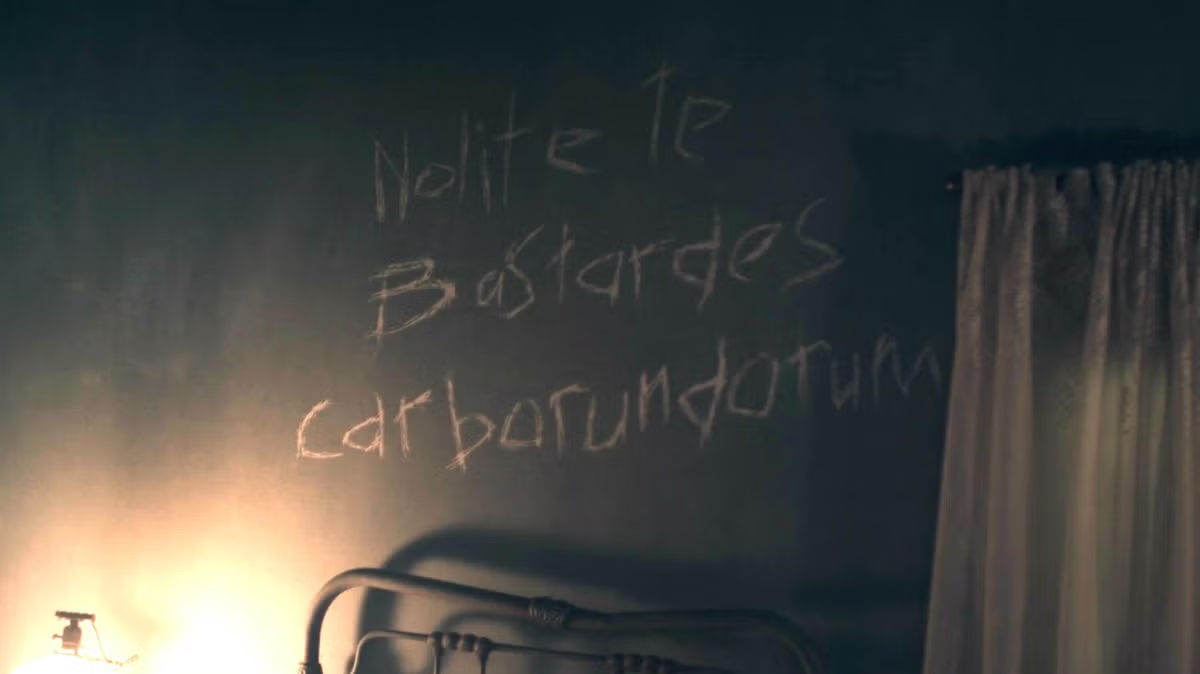
It’s one of the most iconic phrases in modern literature—as evidenced by the bevy of women who have it scrawled across their bodies in tattoo form. But what does it mean? Technically speaking, “
Nolite te bastardes carborundorum”—a phrase found in Margaret Atwood’s novel
The Handmaid’s Tale and, more recently, its TV adaptation that was just renewed for a second season on Hulu—means nothing. It’s a made-up phrase in mock Latin—a schoolboy’s joke, as it’s explained in both the novel and the series. If it were a real phrase, it would roughly translate to “don’t let the bastards grind you down.” Outside the world of the book, the phrase has taken on a life of its own, as a sort of feminist rallying cry for women—and even within the book, it inspires Offred to fight back against the repressive powers that be.
But various forms of the phrase actually go back much further than Handmaid itself; as Atwood herself said, the motto was a joke when she was in school, too. “I’ll tell you the weird thing about it,” Atwood told
Time magazine about the quote this spring. “It was a joke in our Latin classes. So this thing from my childhood is permanently on people’s bodies.” So, where did the original faux-aphorism come from?
Vanity Fair spoke with Michael Fontaine, a classics professor from Cornell University, who took his best guess. To Fontaine, the phrase “nolite te bastardes carborundorum” “looks like someone tried to put the English into Google Translate for Latin.” “
Nolite” means “don’t” (plural) in Latin, Fontaine wrote in an e-mail, while “
te” means “you.” “
Bastardes,” however, is a made-up word with a Latin suffix, and “
carborundorum” is not Latin either.
Per Fontaine, “
carborundorum” is an English word that originated around 120 years ago; the
Oxford English Dictionary, indicates that
carborundorum was an industrial product used as an abrasive. “That’s where the idea of ‘getting someone down’ or ‘wearing someone down’ originated,” Fontaine explained to
Vanity Fair, adding that the made-up, Latin-sounding name is similar to products like “Nexium” and “Crestor.” Since “
carborundorum” looks vaguely like Latin, it works as an approximation of the real thing—and the word ends in [the similar] “-
ndum,” a suffix that means “is needing to be.” (Think “referendum” as an example.) Another similar Latin joke phrase with the same supposed translation is “
illegitimi non carborundorum,” which Fontaine noted was equally fake—though it’s perhaps a little more legit as Latin, since it at least doesn’t use the made-up “
bastardes.” “
Illegitimi is a real Latin word,” Fontaine wrote. “It could indeed mean ‘bastards’ (though it’s not the usual word, which is
spurius or
nothos).”
“My guess is that c. 1890-1900, some American people thought it would be funny to pretend like ‘
carborundum’ was actually a Latin word meaning ‘needing to be worn down’ or (making allowances for ignorance, which is surely part of it) ‘to wear down.’ If the phrase was originally
illegitimis non carborundum, then the original idea was that ‘there must not be a wearing down (of you) by the bastards,’ or in plain English, ‘don’t let the bastards get you down.’ Either then or soon after,
illegitimis would have become
illegitimi, which changes the grammar, but most English speakers can’t tell because our grammar doesn’t work that way. That would pretty quickly give you
illegitimi non carborundum.
QED.” “The key to the mystery is knowing (from the
O.E.D.) that
carborundum was a trade name,” he continued. “Whatever it was, it’s not in use any more, so we’ve lost all memory of it. Nowadays it just looks like a strange, broken Latin word to us.” But to be fair, it
does make a pretty killer tattoo.
snip

 = new reply since forum marked as read