Latest Breaking News
In reply to the discussion: US Navy 'Game-Changer': Converting Seawater into Fuel [View all]happyslug
(14,779 posts)Tight oil production, the proper name for Fracking, is expected to peak around 2017-2018. At that point, the oil produced by then existing Tight oil wells will be dropping so much that they will be no way that the new wells put into production will prevent total oil production from dropping, slowly at first, then as a rock. The reason for this is tight oil wells are good for about five years, with most oil being produced within the first 18 months of production. Since the expected biggest wells are drilled first, and later on you move onto smaller oil fields, production of oil will increase till around 2017-2018 then drop.
At that point, oil is expected to go through the roof. Right now, oil has to be at least $80 a barrel of roughly $3.29 a gallon (including gasoline tax and cost of refining and distribution) for Tight oil wells to be profitable. When the price drops below $80 a barrel, production does NOT stop for most of the money into existing wells would have been already spent (thus you minimize loss by producing oil at whatever price you can get), but you do NOT drill any new wells (thus till the price goes over $80 a barrel, oil production drops, till it hits bottom and then spring back to a point when Tight oil is once again profitable). So far the price of oil has stayed over $80 a barrel so tight oil is being produced. No one is foreseeing a drop in the price in the near future.
On the other hand, come 2018, the price of oil is anyone's guess, for cost to produce will no longer be the restriction on price, the restriction will be how much will people pay? One of the reason for the economic collapse in 2008 was the price of gasoline per gallon was nearing Minimum wage per hour. In other countries, when the price of oil reached the prevailing lowest wage on a per hour basis, you saw a drop in gasoline usage, and thus a drop in demand (and the wreck of the economy). In the US, till 2008, you NEVER had a year where oil usage did NOT increase over the previous year. Since 2008, US usage of oil has actually DROPPED, do to the high price for gasoline. In 2008 the price of gasoline exceeded $4 in many parts of the US, when Minimum wage was $5.25 per hour. I did a calculation at that time period that showed that at $5 a gallon. people can NOT drive to work and pay for rent (if in public housing) and food. If the low income earner is NOT living in public housing (and most such workers are NOT is such public housing), the rent is much higher and the numbers are hit a lot sooner. Thus when the price of gasoline hit $4 a gallon, you had people who no longer could afford the gasoline to get to and from work. The economy tanked at about the same time (and I suspect this was the spark that caused the subsequent economic collapse, the actual cause was elsewhere, but minimum wage not being enough to someone to driver to work was the spark). Subsequent to that collapse minimum wage was increased to $7.15 a hour, and now there is talk of raising it again to $10 an hour and I suspect the reason for both increases is concern as to the future price of gasoline.
Now 2018 is four years away, but 2008 was Six years ago. Thus we are nearer 2018 then 2008. Thus $6 a gallon MAY not be that far away.
http://www.eia.gov/pressroom/presentations/sieminski_01212013.pdf
The Energy Information Agency (EIA), based in the Kingdom of Saudi Arabia (of my suspicions of them later), says the price of oil will be anywhere between $80 and $250 a barrel, with the most likely price $150 a barrel, or roughly a 1/3 more then it is at present (Worse case would be three times the present price).
Now the Kingdom of Saudi Arabia is the #1 oil exporter (#2 in production, #1 in production is Russia, which is the #2 exporter, the difference is internal use), but is NOT considered a reliable source for its own oil supply (and if Saudi Arabia production has peaked, which some suspect, then the bets will be on a price of at least $250 a barrel by 2035 if not 2025). The #3 producer of oil is the US. These three nations, The US, Russia (both as the present Russian Federation and the former Soviet Union) and Saudi Arabia have been the top three oil producers since the 1960s (if NOT the 1950s). US and Russia have been in the top three since oil production started in the 1860s. It was popular to say as late as the 1990s that the reason for this is these three nations were the most explored for oil and oil fields as rich existed elsewhere. The problem is no one has found them. Oil fields have been found elsewhere but no where near the size OR number of fields as the big three (The US has the most oil fields, collectively bigger then any other countries total oil fields, Saudi Arabia has one big oil field, the biggest ever found, Russia is between these two extremes).
Now, the EIA report is NOT without critics. One Critic did the following chart, after correcting what he saw as errors in the 2013 EIA report (Including using "Natural Gas Liquids" as replacement for oil on a barrel to barrel basis, when the energy in a barrel of "Natural Gas Liquids" is just 70% of what is in a barrel of oil):
In effect while the EIA is predicting 100 million barrels of oil being produced by 2035, he is saying it will be closer to 40, while below today's 89 million barrels of oil.
You must understand the last big oil discoveries were in the 1960s and most of these came on line in the 1970s (including two huge Siberian Fields, the North Sea and the North Slope of Alaska). It is these fields AND the elephant fields of Saudi Arabia, Kuwait, Iraq and Iran that have seen production increases since the 1970s, The problem is the North Sea is in rapid decline (Britain is now a Net Oil IMPORTER), the North Slope is in rapid decline (and the push for developing the Alaska Wildlife refugee is that such oil, can use the existing pipeline, but, at best, is expected to produce over a 20 year period, what the US uses in Six months). The countries of OPEC (including Saudi Arabia, Kuwait, Iraq and Iran) have been know to lie about how much oil they can produce since the 1980s (the more oil they claim they can produce the more any one member of OPEC can produce, do to massive cheating, except for Saudi Arabia all OPEC nations have been producing at full speed, with the possible exception of Iraq, every year since the 1980s).
Saudi Arabia controlled the price of oil by determining how much oil it would produce. If the House of Saud decided the price was to low, it cut production till the price went up, when the House of Saud decided the price of oil was to high, it increased production. That is what has happened since the early 1970s (prior to 1969, the Texas Railroad Commission did the same in regards to Texas oil production, setting world wide oil prices in the process, an old joke about OPEC was it was founded in 1960 so the Seven Sisters only had to go to one place and tell the members of OPEC what price the Texas Railroad commission had set for oil). The Texas Railroad commission loss its control over the price of oil in 1969 when it permitted maximum production of Texas oil, and the price continued to climb. One of the reasons the Arab Oil Embargo of 1973 was so effective was that for the first time in history the US was an net oil importer, and thus was hit hard by the embargo, something that even shocked the House of Saud at that time. Till Saudi Arabia finally decided to take on the issue of price by how much oil it could produced, prices were unstable. Once Saudi Arabia took over that role, you had stable prices till 2002 (except for the massive drop in demand in 1997 when the economic criss in the far east cut oil usage in the "Asian Tigers" so much that the price dropped more the Saudi Arabia wanted it to, but was corrected within a year).
In 2002, the price of oil started to go up and up. Saudi Arabia opened up its taps, but the price continued to go up and up as other producers of oil saw they production drop (Britain and Mexico are two examples of this). Indonesia, a member of OPEC became a net oil importer. Russian production declined in the 1990s do to its own economic problems, but increased after Putin came in charge around 2000. Recent Russia has reached a new peak in production at about 3/4 of what the Soviet Union produced in 1987 (The subsequent drop in income from selling oil, do to less oil being sold, is one of the caused of the collapse of the Soviet Union in 1989).
In sum, we are facing a steady decline in production of conventional oil, while world wide demand is increasing. The Recession has reduced demand for oil, but the real issue is can the new sources, tight oil (the proper name for Fracking), "Unconventional" oil, "Natural Gas liquids" and new conventional fields to be found and exploited be enough to meet the demand for oil? Till 2018 that looks to be the case, but after 2018 the doubts are growing and six dollars a gallon may be CHEAP.
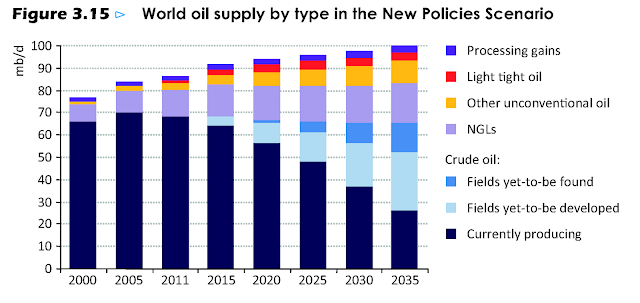
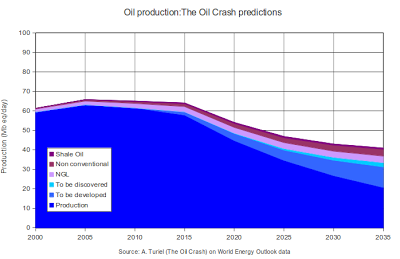
http://cassandralegacy.blogspot.co.uk/2013/01/what-future-for-petroleum.html
Edit history
Recommendations
0 members have recommended this reply (displayed in chronological order): = new reply since forum marked as read
Highlight:
NoneDon't highlight anything
5 newestHighlight 5 most recent replies
RecommendedHighlight replies with 5 or more recommendations
= new reply since forum marked as read
Highlight:
NoneDon't highlight anything
5 newestHighlight 5 most recent replies
RecommendedHighlight replies with 5 or more recommendations