|
Ask Auntie Pinko
February 16, 2006
By Auntie Pinko
 Dear
Auntie Pinko, Dear
Auntie Pinko,
I am a new member to this web site. I have just read two of
your responses to questions with considerable relief. Thank you
for your well written and well considered, accurate responses.
My question is: What is "gerrymandering"? I know
that somehow Tom DeLay was instrumental in changing the Congressional
districts in Texas to obtain a greater number of Republican electoral
votes, or a greater number of Republican congressional seats. But
how does this work?
Thank you for your response,
James,
Earlville, NY
Dear James,
Auntie is going to have to get out my drawing tools to help answer
this one!
Let's start with a small fictional state called "Roundham." Because
Roundham's state population is 2,300,000, it has three of America's
435 Congressional seats apportioned to it, based on the most recent
census (which determined the average Congressional district population
at about 647,000.) That's not a change for Roundham, which has sent
two Democrats and one Republican to the House of Representatives
since the early 20th Century. Here's a "map" of Roundham, showing
its nine counties, and its pre-Census Congressional District boundaries:

District 1 includes the northern, industrialized suburbs of Roundham's
capital city, Roundberg, and the heavily Latino communities in H
County. It's always been Democratic, but the state's Republican
Party is trying to woo those Latino voters in H County.
District 2 includes the heavily-Democratic city of Roundberg itself,
with its large minority population of African-Americans, as well
as the northeast inner-ring suburbs which are mixed Democratic and
Republican, and the very Republican I County.
District 3 includes some of the liberal small cities in eastern
C County, but is mostly rural and heavily conservative. It has been
reliably Republican for decades.
Altogether, Roundham has about 400,000 registered Democrats, about
300,000 registered Republicans, and the rest of its million or so
registered voters selected "no Party affiliation" on their registration
forms.
A particularly lackluster Democratic candidate and some nasty
scandals resulted in a Republican victory in Roundham's last Gubernatorial
election before the census, and a narrow Republican majority in
the state Legislature. The governor appointed Republican political
strategists to the commission designated to reapportion the state's
Congressional Districts, and they came up with a map that looks
like this:
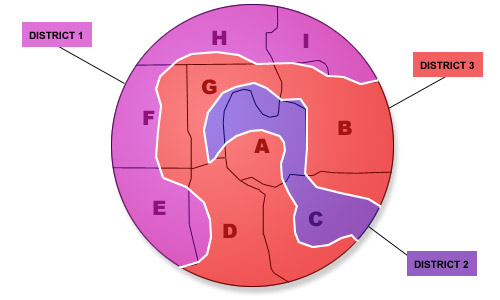
And now suddenly, although the actual balance of registered Democrats
and Republicans hasn't changed, Roundham is sending two Republicans
and one Democrat to Congress. To accomplish this, the reapportionment
task force had to split up virtually every county except B and I
(traditionally reliable Republican voting blocks) each of which
serves as the anchor for strangely-shaped districts that split up
some townships and even precincts to maximize the impact of Republican
voters. Democrats have either been herded into the newly-contorted
District 2 ("packing") or carefully split up between Districts 1
and 3 without disturbing the Republican dominance of those two Districts
("diluting").
That's gerrymandering. The term comes from Massachusetts Governor
Elbridge Gerry, who in 1812 created a district boundary that looked
like the outline of a salamander.
Gerrymandering is a perennial phenomenon in American politics,
and to some extent it is tolerated and even expected - a hangover
of the old "spoils system" of electoral politics. Reformers have
been trying to find ways to minimize it for centuries, and clever
politicians and their lawyers have been finding ways to subvert
the reform efforts for just as long.
What made Mr. Delay's venture into gerrymandering so outrageous,
in many peoples' opinion, was how he went about it. Normally the
electorate of a state will tolerate a certain amount of gerrymandering
as part of the normal reapportionment process, conducted under moderate
public scrutiny during the election cycle after a decennial census.
And as long as it isn't too obviously motivated by racial or ethnic
prejudice or other clearly discriminatory criteria, or too blatantly
manipulative, a certain amount of tweaking by the party in power
is expected, if still reprehensible.
Mr. Delay, however, went outside of this standard procedure. After
his state had already completed its normal post-census reapportionment,
squeezing in as much gerrymandering as its Republican state leadership
thought judicious, Mr. Delay still wasn't satisfied. After the process
was over and the results were already accepted by the Legislature,
he worked with Republicans in the legislature to create a whole
new apportionment map that was both blatantly manipulative, and
created outside the normal reapportionment process. It couldn't
have been a more obvious attempt to grab and cement party advantage
if he'd installed a huge neon sign spelling out "GERRYMANDER!"
You can find more information about gerrymandering on the Internet.
There's some fascinating history there, and some sleazy maneuvering
by both parties that will make your hair stand on end. And unless
we pass a Constitutional amendment specifying uniform and fair apportionment
criteria and procedures across all States, it will continue to be
an issue in many states.
Enjoy your research, James, and thanks for asking Auntie Pinko!
View Auntie's Archive
Do you have a question for Auntie Pinko?
Do political discusions discombobulate you? Are you a liberal at
a loss for words when those darned dittoheads babble their talking
points at you? Or a conservative, who just can't understand those
pesky liberals and their silliness? Auntie Pinko has an answer for
everything.
Just send e-mail to: mail@democraticunderground.com,
and make sure it says "A question for Auntie Pinko" in
the subject line. Please include your name and hometown.
|