|
From the Sahara to Germany: What Does
"Progress" Mean?
April 19, 2005
By Bernard Weiner, The
Crisis Papers
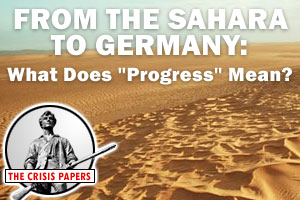
Going from wealthy, solidly infrastructured Germany to poor, developing
Morocco stimulates culture shock in major proportions. I was in
Deutschland to address a meeting of Democrats Abroad - Germany,
and to join the celebration for my mother-in-law's 90th birthday.
Though the German economy - along with most of the rest of the world
these days - is sluggish, still the country exudes enormous financial
strength and stability, with a huge middle class doing relatively
well.
The kingdom of Morocco, on the other hand, while much better off
than a good many Arab states, is still struggling to find its way
to economic growth and modernity while remaining true to its ethnic,
tribal and Islamic character. The middle-class, so important in
economic and cultural/political development, is slowly growing,
but probably not fast enough to really help the situation in a major
way.
Neither nomadic shepherding of camels, goats and sheep, nor tourism
can be expected to do it all, though Morocco is attracting more
and more international tourist attention, with low prices, friendly
people, exotic locales, beautiful landscapes and oases, and little
worry about Islamist extremists. We rode camels into the Sahara
and slept either on the dunes or in Berber tents - which, I can
verify, leak like sieves during sandstorms. In the southern part
of the country where I was, there was no animosity toward Westerners,
indeed many locals (most of whom speak French, based on the many
decades of French-protectorate influence) voiced great sympathy
for Americans living under George Bush.
THE RIPTIDE OF ALIEN CULTURE
This disparity between rich and poor countries reflects a social/political
phenomenon with which I've become all too familiar in my trips abroad
in the past several years. In the rural areas of mainland Greece
and Crete, in the Southeast Asia countries of Thailand, Laos and
Cambodia, in North Africa's Morocco, and probably equally true in
many ways for Asia's emerging industrial/technological giants China
and India, the same dilemma confronts these nations.
That dilemma: how can one reach "first-world" status without being
sucked totally into the undertow that is the prevailing international
culture sweeping across the globe - largely Western/America-based,
aided greatly by the ubiquity of cell-phones and satellite dishes
- and without having to go through the worst excesses of the industrialization
cycle?
This desire for modernity and status - symbolized by the desire
for big-ticket technological items such as cars, for example - brings
with it the toxic pollution that seems to certify for them a developing
culture on its way to someday playing in the same league with the
advanced nations of the world.
Is there a way to leapfrog over the worst of industrial/technological
development - the pollution, the corruption, the social cruelty
- without having to repeat the mistakes and unfolding history of
the developed world? So far, I see little evidence of such a pattern,
as each region and developing nation rushes headlong into its own
industrial revolution in order to get to the 21st-century dream
of riches and world status as quickly as possible. In doing so,
it pays a heavy social, political and environmental price.
RAMIFICATIONS OF "PROGRESS"
Many of these developing countries and regions repeat the pattern
of chokingly-polluted urban/rural areas: filthy, particulate-filled
air that can't be breathed healthfully, water that often is undrinkable
without boiling (if even available), the dumping of garbage and
sewage everywhere and anywhere, streets that are constantly clogged
with vehicles, many of them emitting noxious and toxic diesel fumes.
But all this tends to be regarded by officials as a perhaps-regrettable
but necessary stage in the development process that leads to modern
"progress" and world-class status.
Friends who visited China recently reported that even in the countryside,
far from the big cities, they rarely were able to see the sun, so
choked was the sky with smog and particulate matter; but the Chinese
citizens they met, even the most "enlightened liberals," couldn't
wait to get a car of their own. It is often the same syndrome at
work in Bangkok and Chiang Mai and Hanoi and on and on.
The geopolitical implications of such attitudes are many and scary:
where will the oil come from to fuel those millions of new vehicles?
And who will control those energy sources, and at what war-cost?
Is the U.S., assuming it can secure the oil/gas fields of the Greater
Middle East and Caucuses, prepared to take on China in a military
showdown over energy?
I don't know the answers to these questions about the developmental
dilemmas facing struggling countries and the policy/military ramifications
of energy control. But those major problem areas need to be dealt
with rationally, and rationality is not much in evidence in the
Bush Administration, which aims to straddle the globe like an arrogant
Colossus, grabbing what it can get. And woe be unto those who get
in their way: they might well sic mad-dog John Bolton on you, a
fate worse than death.
DEMOCRATS ABROAD
Millions of Americans are living and working in foreign countries
- and desirous of voting absentee in their home states in the general
elections. The Bush Administration, with bureaucratic overkill,
made it very difficult to register and vote abroad in 2004, as it
did with targeted populations inside the U.S. as well.
But thousands in Germany, and perhaps hundreds of thousands worldwide,
waded through the required paperwork and managed to cast their ballots
for Bush or Kerry. To date, there still has not been a breakdown
of those votes. Nearly six months after the election (!) we still
have no idea if those votes were counted, how many ballots were
cast, and the actual totals for each candidate. This is intolerable
inefficiency, or worse.
I was here to talk to the Munich chapter of Democrats Abroad.
The group, comprised of about 300 activists during the runup to
the November election, is significantly smaller now in the post-election
depression that set in after Bush was declared the victor. But the
meeting room was packed with savvy Dem activists, still determined
to fight the Bush Administration's reckless foreign and domestic
agenda and anxious to reform the Party from within to make sure
that the next time out, the Democratic candidate would emerge victorious.
Actually, they agreed with my supposition that the Democratic
candidate probably was victorious in 2004 but that election fraud,
made oh-so-easy by the lack of verifiable ballots in so many computer-voting
precincts, may well have led to Kerry's supposed defeat. Indeed,
statisticians have determined that Bush had only a one-in-a-million
chance to defeat Kerry in a honest vote, given the numbers and exit
pollls in Ohio, Florida and Pennsylvania. (See Ernest Partridge's
"Means,
Motive, Opportunity", "Shut
Up, They Explain", and other essays on this question listed
here).
The point I was making to the DA group, who readily agreed, is
that it doesn't matter how much the Party is reformed and how many
new voters they can register this year or how many Dem issues resonate
with the citizenry - none of that matters if the voting and vote-counting
systems continue on in their present state of corruptibility, controlled
by far-right Republican corporations with a lock on the secret software
that tallies the ballots.
I told them about having sat the previous week in the Sahara dunes
with two professional New Zealanders, well-versed in international
politics but appalled and almost unbelieving when I described the
current voting system in the States. "How can you Americans
let that happen?" they asked, as I described how, under the
so-called Help Americans Vote Act, Congress had approved the easily-tamperable
voting procedures.
The DA group seemed eager to take up my suggestion that the first
priority right now is to get out from under that our currently-mandated
voting and vote-counting system by calling for paper ballots counted
by hand, as is done in so many other first-world countries, most
notably Canada and France, with few if any problems.
Movements are afoot along these lines in America, but you barely
hear about them in the corporate-controlled mass media, and there
appears to be lethargy on this issue among leading Democrats and
ordinary citizens. Certainly, the Republicans are quite happy to
do nothing in the way of electoral reform, since they benefit by
the current cooked system.
LIGHTING THE ELECTORAL-INTEGRITY KINDLING
The key is to build up the fire of indignation in the citizenry
through constant repetition of how backward and corrupted our voting
system is, more worthy of Mugabe's Zimbabwe than of the supposed
leader of the free world, and get this issue on the front pages
and into the TV news cycle. We desperately need to get the situation
corrected at least by the time of the 2006 midterm election when
Democrats, given a free and honest vote-counting, easily could take
back the House. (When I left the States several weeks ago, Bush's
rating were down in the low-40s.)
The Democrats Abroad, led in Munich by such stalwarts as Jeffrey
Ely, Susan Diezduszycka-Suinat, and Kimberly Kistler-Grobholz, were
also eager to take the long view about what it would take to counteract
the decades of infrastructure-building by far-right Republicans.
It's important, they agreed, that Democrats spend their time and
money and energy on setting up opposing media outlets, think-tanks,
and so on to counter those funded by rightwing billionaires over
the past several decades.
We simply must have our infrastructure in place, both to help
swing the population away from the so-called "conservative" (read:
extremist) point of view that tends to dominate our political discourse
these days, and to help build the cadres of savvy politicos from
the grassroots up ready to take over when critical mass is achieved
and the far-right Republican machine crumbles.
It's a massive project, one that will take great dedication and
resources, but we have no other choice but to begin that heavy lifting
now, if we have any hope of extricating our party and the country
from the grip of avarice and corruption and power-hunger that currently
dominates the Republican Party.
HITLER BOOK AND MOVIE
I recommended to the Democrats Abroad that they get ahold of Sebastian
Haffner's illuminating book Defying Hitler, written in Germany
in the '30s, about how the Nazis came to achieve full power. Here's
my review of it, "Germany
in 1933: The Easy Slide Into Fascism."
Obviously, America 2005 is not Germany 1933, and Bush is not Hitler,
but the history of how the Nazis slowly sliced away the freedoms
and rights of the German population, to the point of total dictatorial
rule, has lessons to teach us as the U.S. extremists of the far-right
take us further down the road to an American brand of effective
one-party, authoritarian domination.
I wish I had seen Downfall, the movie about Hitler's final
days in the bunker, before I gave my DA talk. There are even more
scary parallels in that film which I saw upon my return to San Francisco.
What we are shown in the film, which is based on documented fact,
is a megalomaniacal leader (played brilliantly by Bruno Ganz) who
is incapable of accepting any blame or responsibility for failed
policy and who is delusionally bereft of any sense of reality, preferring
his grandiose fantasies of changing the world by force of will and
exercise of military might.
He pretends to represent and care for Germany's people, but he's
willing to take the whole country down with him when he goes - even
blaming the citizens at the end ("they elected me") for buying into
the whole militarist/patriotic belief-system that led to such ruin.
Sound like the behavior of anyone you know?
Bernard Weiner, Ph.D., has taught politics and international
relations at various universities, worked as a writer/editor with
the San Francisco Chronicle, and currently co-edits The
Crisis Papers. Send comments to crisispapers@comcast.net.
Crisis Papers Archive
|