|
U.S. Leaving Iraq? It's Still the Politics,
Stupid
August 2, 2005
By Bernard Weiner, The
Crisis Papers
 As
we've learned over the past four-plus years, no matter what the
spin justifications employed by Bush & Co. spokesmen - terrorism,
national security, freedom on the march - it's usually the politics,
stupid. As
we've learned over the past four-plus years, no matter what the
spin justifications employed by Bush & Co. spokesmen - terrorism,
national security, freedom on the march - it's usually the politics,
stupid.
We were told this from the inside by John DiIulio early in Bush's
first term. When the ex-administrator of Bush's faith-based programs
resigned, he let slip some powerful truths during an interview
with Esquire's Ron Suskind:
There is no precedent in any modern White House for what is going
on in this one: a complete lack of a policy apparatus. What you've
got is everything - and I mean everything - being run by the political
arm. It's the reign of the Mayberry Machiavellis. ... When policy
analysis is just backfill, to back up a political maneuver, you'll
get a lot of ooops.
An unnamed "current senior White House official" said
pretty much the same thing:
Many of us feel it's our duty - our obligation as Americans -
to get the word out that, certainly in domestic policy, there
has been almost no meaningful consideration of any real issues.
It's just kids on Big Wheels, who talk politics and know nothing.
It's depressing. DPC [Domestic Policy Council] meetings are a
farce.
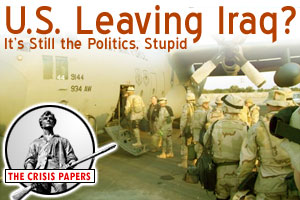
So here we have military spokesmen saying the U.S. plans to start
withdrawing a large number of troops by mid-2006. Does this mean
the Iraq War will be coming to an end? As if. Remember: it's the
politics, stupid.
Just the year should be the tipoff. Yes, that's right: there are
midterm elections coming up in November of 2006, and Bush & Co.
absolutely, positively must keep control of the House of Representatives
- especially if impeachment hearings and possible prison sentences
are to be avoided.
So, since national polls increasingly reveal Americans feel the
war is not worth it, a significant number of troops in Iraq will
be redeployed elsewhere. Mercenaries - i.e., Iraqi security forces
trained and paid for by American monies - will be expected to help
protect U.S. interests and bases.
GENUINE WITHDRAWAL OR POLITICAL FEINT?
It is not clear whether Bush's plan to withdraw troops from Iraq
is a military ruse - to return them "in-country," if necessary,
after the 2006 election - or is part of a sincere, long-term plan
to bring virtually all of them home and thus extricate the U.S.
from the quagmire the incompetent Bush Administration got them into
in the first place.
Conservative commentator Pat Buchanan makes the case for the latter
explanation in "Is
America's War Winding Up?":
It is difficult to draw any other conclusion from the just-completed
Rumsfeld mission. Standing beside our defense secretary in Baghdad,
Prime Minister Ibrahim al Jaafari called for the speedy withdrawal
of U.S. forces. The top U.S. commander, Gen. George Casey, also
standing beside Rumsfeld, said 'fairly substantial' withdrawals
of the 135,000 U.S. troops in Iraq could begin by spring...
Casey's comment lends credence to a secret British defense memo
that described U.S. officials as favoring a 'relatively bold reduction
in force numbers.' The memo pointed to a drawdown of Allied forces
from 170,000 today to 66,000 by next summer, a cut of over 60
percent.
Previously, the administration had denounced war critics who
spoke of timetables, arguing that they signal the enemy to go
to earth, build its strength, and strike weakened U.S. forces
during the pullout. Now, America's top general is talking timetables."
DEMOCRACY AT THE POINT OF A BAYONET
As my earlier comments suggest, I think the U.S.-leaving-Iraq
theory is wishful thinking. Given the track record of Bush/Cheney/Rumsfeld,
my suspicion is that not much has changed with regard to their goals
in Iraq and in the Greater Middle East; their desire to "stay the
course" in fulfilling those objectives remains the same - though
they may have to make a tactical withdrawal of some forces in the
service of that long-term strategy.
Bush & Co. came into power with the cockamamie ivory-tower idea
of introducing "democracy" at the point of a bayonet throughout
the entire Middle East, maybe even the world, and they still want
to do just that. Indeed, there's a bill making its way through Congress
-- see "All
Democracy, All the Time" - that would make the "spreading of
democracy" abroad the law of the land, not just an administration
venture.
Bush & Co.'s ulterior motives have to do with empire, oil, profit,
and, especially, using their adventures and wars as a way of garnering,
maintaining and expanding their domestic political control.
If they were truly and seriously to remove the U.S. from Iraq
- at least the most visible troops; no doubt the hardened military
bases would stay at the "invitation" of the host Iraq government
- it would look as if they were jettisoning their hegemonic goals
in that shaky, explosive region. In effect, U.S. withdrawal would
signify that the neo-cons' crusade against militant Islam was being
abandoned, or at least greatly scaled back, in the face of overwhelming
hostility of the locals (and world, and American public opinion)
against it.
Worse still for the Bush administration, they would tacitly be
admitting that, by invading and occupying Iraq, they made a terrible
mistake. And this regime, as we all know, does not make mistakes
- Bush says God talks to him, and he is doing the Lord's work, and
that's the end of that discussion.
THE OPTION OF DECLARING VICTORY
Of course, there is a face-saving way out for the Administration.
Bush could declare victory and pull the U.S. troops back home, to
ticker-tape parades down main street. You can almost hear him now:
"My fellow Americans: We were determined to end the tyrannical rule
of a brutal dictator, and we have done that. We were determined
to aid the Iraqis in establishing a functioning democracy in their
own country, and we have done that. We were determined to train
Iraqi security forces to defend and police their own country, and
we have done that. Therefore, truly, we can say 'Mission Accomplished'
and withdraw our military forces with heads held high. What happens
in Iraq after we leave is now up to the Iraqis themselves."
But even if Bush & Co. were to go that intelligent route - a highly
unlikely scenario - no doubt they would have ignored the larger
lesson to be learned: you don't win guerrilla wars. All the guerrillas
have to do is keep you tied down, forever; they don't have to win,
just grind you down, death by a thousand cuts. If you don't also
win the "hearts ands minds" of the locals, you lose.
In addition, once it's clear to the locals that the invaders can't
win (and this may already have happened in Iraq), ordinary citizens
start making deals with the guerrillas; the result is that the native
security forces and government institutions are even more infiltrated
with informers and agents. This certainly was the case in Vietnam.
Five sets of advisors told five different Presidents that military
stalemate was the best that could be hoped for in Vietnam, but each
of those five presidents believed they would be the one to snatch
victory from the jaws of defeat; Daniel Ellsberg, an insider par
excellence, wrote about this history in his invaluable
memoir Secrets. Nearly 60,000 American troops died as
a result of that hubris, along with several million Vietnamese.
Apparently, the only one who came to understand the lesson was Defense
Secretary Robert McNamara - which is one of the reasons he opposes
Bush's war in Iraq today.
Civil wars or nationalist wars to throw out invaders generally
end in political settlements, not military ones. Vietnam today is
still run by the Communist Party but its economy is largely semi-capitalist,
and it has trade pacts beloved by American corporations doing business
there; the Irish Republican Army just the other day said it is willing
to lay down its arms and seek victories through democratic elections
and political negotiations.
If the U.S. were to leave Iraq, thus removing the main reason
for the nationalist insurgency, it is likely that the various ethnic
and religious forces in that country would work out inclusive political
arrangements that could stabilize the situation. Their solutions
might not be those the U.S. prefers - it's possible that the new
Iraq would be much like Islamist Iran next door, and would be a
constant thorn in the side of America's foreign policy - but U.S.
troops no longer would be targets on the ground in that country,
nor would Iraq be a magnet for foreign terrorists.
BUSH'S OBSESSION: BOLTON AT THE U.N.
The fact that Bush is determined to force square-peg John Bolton
into the round United Nations hole is further confirmation that
the neo-cons are still in charge of U.S. foreign/military policy.
Bush is having to use a recess appointment since the Senate will
not approve this perjurer and habitual bully to be America's ambassador
to the U.N.
Bush/Cheney want Bolton there and there he will go. Why is it
so important that Bolton be at the U.N? The neo-con strategic philosophy
requires a weakening of all international institutions that potentially
could get in the way of America's hegemonic adventures in various
hotspots around the globe. (See "How
We Got Into This Imperial Pickle: A PNAC Primer.")
Recall that Cheney/Rumsfeld didn't want the U.S. to go to the
United Nations prior to "Shock & Awe"; they agreed reluctantly (at
the behest of Tony Blair and Colin Powell) in order to get a fig-leaf
approval from the Security Council to cover their embarrassingly
illegal military invasion of Iraq. Bush & Co. don't want to risk
a similar diplomatic morass as they move toward potential military
action against Iran and Syria.
Mad Dog Bolton will be the guy who is expected to coerce and threaten
U.N. diplomats to approve those military campaigns, and to head
up the "reform" (read: terminal weakening) of that international
body. Ergo, Bolton will go to the United Nations, Senate be damned.
Bush should be made to pay a heavy political price for this slap
in the face to the Senate, but what can be done at this stage is
not clear. It's possible that Patrick Fitzgerald will include Bolton
in his upcoming CIA-leak indictments.
JUDGE ROBERTS AS A STEALTH NEO-CON
That same in-your-face approach can be seen in Bush's nomination
of John G. Roberts to the Supreme Court. Those hoping that Bush
would appoint a more moderate-conservative candidate, in the mold
of retiring Justice Sandra Day O'Connor, were dreaming.
The operating procedure of the Bush administration is "take
it while it can be took." If anybody tries to stop you, run
over them. If, on rare occasion, determined bipartisan opposition
blocks your way, find another way around the obstacle. If that won't
work, back off a bit, bide your time and try again later.
Roberts is a clever choice. He's affable, bright, young, with
little in the way of an overt judicial record on which he can be
bashed; when his name was announced, his confirmation was regarded
as a sure thing.
But, as his political history indicates - from his machinations
in Florida in getting the 2000 recount stopped, to his views on
civil rights and civil liberties - he's a stealth far-right conservative,
who, if and when approved, will significantly alter the law for
decades, and not in the direction that will bring credit to the
court or the country. Just look at his recent ruling that confirms
Bush's near-dictatorial powers during "wartime."
And, of course, the situation only will get worse when Rehnquist
resigns or dies, giving Bush the opportunity for another far-right
appointment to the Supreme Court.
Senate Democrats should persist in trying to get the required
documents from Roberts' tenure at the Solicitor-General's office,
and should grill him hard on key issues he would face if he were
to gain a seat on the Supreme Court: the right to privacy, a woman's
right to choose, civil liberties, affirmative action, the concept
of checks-and-balances between the branches of government (especially
during "wartime"), etc. And, depending on his answers, determine
whether a filibuster is in order.
To let Roberts walk basically unexamined into the Supreme Court
would be a disgraceful abdication of senatorial responsibilities.
(Bad precedent: the Dems did just that the other day, when not one
of their senators showed up to question Karen Hughes on her nomination
to be an assistant secretary of state for propaganda.)
JANE FONDA AND GREEN GHOSTS
I have read two books this summer that relate, in their own ways,
to subjects under discussion here: Jane Fonda's memoir, My Life
So Far, and Pascal Khoo Thwe's From the Land of Green Ghosts:
A Burmese Odyssey.
Fonda's autobiography - fairly well-written, by the way - doesn't
go easy on herself, or her husbands (Vadim, Hayden, Turner), though
all are shown positively as highly complex personalities. She went
from naive movie star to naive businesswoman to naive political
activist, making all sorts of mistakes along the way. But her heart
was in the right place, and she grew more savvy and philosophical
as the years went on.
The focus of the book is not so much on her political maturation
during and after the 1960s as it is a moving journey to selfhood.
It took her many decades to stop being someone for everybody else
- sexy movie star, timid wife, uncertain feminist, social activist
- and to start opening herself to her Self, in the deepest meaning
of that term.
At 68, she recently announced that she'll be criss-crossing the
country in an eco-friendly bus, rallying peace sentiment in opposition
to Bush's Iraq War. See Jane go!
Pascal Khoo Thwe's From the Land of Green Ghosts - a fascinating,
well-written memoir - documents how this one-time Catholic seminarian
evolved into a revolutionist as a result of the brutality and destructive
incompetency of the "socialist" military regime in Burma. This Stalinist
military dictatorship still rules to this day, despite the heroic
opposition of Aung San Suu Kyi (winner of the 1991 Nobel Peace Prize)
and her many followers.
One Green Ghosts quote caught my eye as somewhat analagous
to what's happening in academia and elsewhere to so many in the
Bush era in the U.S. Thwe tells the story of a student who deigned
to ask a genuine history question of his professor, and was singled
out for punishment by the government; he was denounced as a "pro-colonialist,"
i.e., infected by liberal Western attitudes.
Not only was the student neither mad nor pro-colonial -- he
was not even anti-socialist. He was simply arguing an historical
fact, and wanted to generate a discussion. But perhaps, in the
circumstances in which we studied, that was a mad thing to do.
Troubled, I went to an English teacher, whom I had come to trust,
in order to learn about the argument in private. He said: "Remember
what your grandfather said about the earth's being flat at school
and round at home. He was a wise man, and taught you what you
need to know in Burma. It is the same in politics. Learn the arguments
for socialism in the textbooks, parrot them, pass your exams.
Never, never argue. But keep within your own head and heart what
you and everyone really knows - that in the real world, it is
a system of incompetence and corruption, and a project for ruining
the country. They may be as ignorant as peasants - but they have
the guns. Never, never argue with them."
In our own current situation, out of our love of country, we will
always, always, "argue with them," despite Bush & Co.'s heavy-handed
attempts to punish and silence their critics. Our souls, the soul
of America, and our dedication to learning and speaking truth to
power, require it.
Bernard Weiner, Ph.D. in government & international relations,
has taught at various universities, worked as a writer/editor with
the San Francisco Chronicle, and currently co-edits The
Crisis Papers. For comments, write crisispapers@comcast.net.
Crisis Papers Archive
|