|
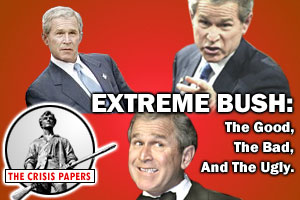
Extreme Bush: The Good, The Bad, And The
Ugly
November 22, 2005
By Bernard Weiner, The
Crisis Papers
 I
watched the newscast footage of Bush addressing an election-eve
rally in Virginia a few weeks ago, and the guy looked and sounded
somewhat inebriated; slurring his words, a goofy grin on his face,
oversized mannerisms. I had read recent articles about Bush's inability
to handle the enormous stress he's under these days and the likelihood
of his being on anti-depressants and/or hitting the bottle again,
but just assumed those were sensationalist bloggers spreading some
dirty fictions. I
watched the newscast footage of Bush addressing an election-eve
rally in Virginia a few weeks ago, and the guy looked and sounded
somewhat inebriated; slurring his words, a goofy grin on his face,
oversized mannerisms. I had read recent articles about Bush's inability
to handle the enormous stress he's under these days and the likelihood
of his being on anti-depressants and/or hitting the bottle again,
but just assumed those were sensationalist bloggers spreading some
dirty fictions.
But, oh my, when I watched the
video clips of his sad performance at that Virginia rally, I
began to wonder. It can't be easy being Bush these days, when all
is collapsing around him. Consider:
- The Iraq war going so badly that even that old dependable
warhawk John Murtha is urging Bush to close it down and redeploy
the troops
- Libby, DeLay under indictment and the Abramoff scandal getting
closer to the White House, with Frist on a legal hot seat as
well
- Patrick Fitzgerald heating up the Plamegate probe after hearing
from Bob Woodward, which could put Cheney, Rove, Hadley and
Rice once again under the Grand Jury microscope
- Centrist Republicans causing grief for Bush's agenda
- McCain's treatment-of-prisoners amendment making headway,
forcing Cheney and Bush to lobby for torture
- GOP stalwart Sen. John Warner sticking it to Bush on the
lack of success in Iraq
- Establishment conservative Republicans like Brent Scowcroft
and Lawrence Wilkerson and Bill Buckley and others firing off
the equivalent of mortar rounds into the White House over Bush's
Iraq war;
- The Downing Street Memos from inside Tony Blair's headquarters
verified that the Iraq war had been on the boards for at least
a year before the invasion, with the job being to "fix the intelligence"
around that policy decision
- Doug Feith and his Office of Special Plans being probed by
the Pentagon's Inspector-General for allegedly "stovepiping"
raw intel directly to Cheney/Libby in the White House
- The Taliban majorly regrouping in Afghanistan
- ANWR drilling taken off the table yet again
- Harry Reid implying the Dems might filibuster on Alito's
nomination to the Supreme Court
- Bush's poll numbers plunging into the mid- and even low-30s
- the residue of the "incompetence" and "lack of trust" issues
from Katrina and the Iraq disasters; the CIA leaking more and
more damaging info about Bush policy
The Good News: the Bush agenda is in jeopardy and the once-tight
GOP organization is in tatters, with corruption and incompetence
and wrongheadedness everywhere. Imperial ambitions are running headlong
into reality. All these provide room to maneuver for the GOP moderates,
and openings to attack for the Democrats, who finally are beginning
to wake up after years of numbness and atrophy.
The Bad News: On the other hand, Bush, Cheney, Rove and the GOP
remain in power - can you imagine three more years of that cornered,
weakened, flailing crew, with all the deliberate and unintended
damage they can do?
What would happen, for example, if a desperate or half-deranged
Bush decides on an extreme wag-the-dog action - say, if he were
to order a "pre-emptive" nuclear strike on Iran or Syria or North
Korea or Venezuela, or all of them together? Would there be anybody
to stop him inside the Administration? Would the Joint Chiefs have
the courage to - and be able to - rein him in?
Who knows? We've never been in this dark place before.
CONSTITUTIONAL CRISES, THEN AND NOW
Well, maybe we almost were once, when a heavy-drinking Nixon seemed
ready to take the country and the Constitution down with him as
he was heading over the political cliff known as Watergate and into
the Senate's impeachment dock. But, perhaps because cooler heads
prevailed, Nixon resigned instead - the first such asterisk next
to a president's name in America's history.
But the damage Nixon could do was almost more personal than political
or international. The carnage Bush could do to the country, and
the world, is of an entirely different order of magnitude.
Domestically, Bush could, for example, force the country into
a Constitutional crisis - by, say, declaring martial law as commander-in-chief
during "wartime."
Yes, that's right; according to this cockamamie legal doctrine
worked out by his then-White House counsel Alberto Gonzalez and
his neo-con legal team, Bush claims to be legally home-free to ignore
and violate laws whenever he acts as commander-in-chief during "wartime."
This makes him pretty much a dictator, indefinitely, since Bush
& Co. continually tell us that we're in the midst of a war that
will last forever. So far as I know, neither Gonzales (now Attorney
General) nor Bush has ever disavowed the memos that supplied that
interpretation of what a President legally can do.
You may recall that Nixon tried something similar during the Watergate
scandal, claiming that any time a President took an action, it was,
by virtue of him being President, ipso facto legal. The U.S.
Supreme Court shot that one down quickly. But it would appear that
Bush & Co. are willing to act as if that decision never had been
rendered by the court, because they've come up with a different
legal gimmick - the "commander-in-chief-during-wartime" ploy.
Sure, a presumptive Bush case would wend its way up to the Supreme
Court, but that could take a year or more and, in the interim, all
kinds of deadly mischief could be implemented and the Constitution
wrecked even more. Plus, with Roberts and Alito on the court, and
their affinity for strong executive preeminence in "wartime," there's
no guarantee of a decision similar to the Nixon case.
THE PLAME/MURTHA CONNECTION
Watching how the Republicans are attacking John Murtha for criticizing
Bush's failed policy in Iraq makes the genesis of the Plamegate
scandal more understandable.
Consider: Ambassador Joseph Wilson wrote his famous op-ed piece
for the New York Times some months after Bush gave the Iraqis
a healthy dose of "shock & awe." But things weren't going well for
the Occupation or for the way the U.S. war on Iraq was viewed around
the world. Old allies were openly in opposition, no WMD had been
found, millions of folks around the globe earlier had gone into
the streets in opposition to Bush's invasion.
And then here comes insider Joe Wilson, with an administration
pedigree and solid credentials, telling the world that, in effect,
the Bush-Cheney-Rumsfeld-Rice-Rove cabal in the White House had
lied about Iraq's nuclear capabilities, and by extension, the whole
WMD issue in general, along with the supposed Saddam/al-Qaida connection.
In short, the war had been launched, and an Occupation had been
established, based on lies and deceptions. The political fallout
could be devastating.
Rove and the rest of the high-ranking White House Iraq Group -
established to market the war - simply had to stop further attacks
on its credibility and quickly, before anti-war sentiment gained
any further momentum. Thus the slime attack on Wilson, and the outing
of his CIA operative wife, Valerie Plame - hitting him where it
hurts. Hitting Wilson/Plame hard, the Bush Administration believed,
would get the message to other insider whisteleblowers to keep their
mouths shut.
And their plan worked, at least for a good while. True, anti-Bush
elements inside the CIA, reacting to what had been done to their
colleague Plame, leaked a lot of damaging revelations about how
the case for war had been concocted out of unreliable raw intel,
unvetted by the professional intelligence agencies. But, on the
whole, the Bushies were able to keep a lid on their hidden policies
and crimes, at least through the all-important 2004 election.
But simmering below the surface was Special Counsel Patrick Fitzgerald's
criminal probe of the Plamegate scandal, with Cheney's surrogate,
Chief of Staff I. Lewis Libby, indicted on five counts of lying,
perjury and obstruction of justice. (Update: Fitzgerald a few days
ago acknowledged that he's once again bringing witnesses before
a sitting grand jury, which suggests that other Administration heavies
could be indicted soon. Possible targets: Rove, Cheney, Hadley,
Rice and others.)
IRAQ RETURNS TO THE FRONT BURNER
Suddenly the false reasons for going to war in 2003 are thrust
back into the headlines. This development dovetails with a major
increase in deaths of American military personnel and Iraqi civilians
and police forces at the hands of Iraqi insurgents - and growing
evidence of increasing tension between Sunni and Shi'ite elements.
Very quickly, in poll after poll, Americans of all stripes - including,
most ominously for the Bush Administration, conservative Republicans
- indicate that they increasingly believe the Administration hasn't
got a clue what it's doing in Iraq and that the time has come for
considering whether to cut our losses and get the hell out of that
incipient civil war situation. Bush's ratings are down in the mid-30s,
as low as they've ever been in five years.
And then horror of horrors for the neo-cons who took the country
into war: the one influential Democrat warhawk they always could
count on, Representative John Murtha, launches a frontal assault
on the justifications for staying in what is a losing war effort
in Iraq. The time to get out is now, he says - actually he said
re-deploying U.S. troops out of Iraq sometime within the next six
months - before tens of thousands of U.S. military personnel and
Iraqi civilians are killed or wounded and we have to get out anyway
at that time. In other words, the Vietnam-quagmire scenario.
Which brings us to The Ugly: we're back to Karl Rove's revolting
attack scenario, similar to what he devised in the Joe Wilson/Plamegate
scenario. Got to slime and brutalize Murtha, their loyal ideological
war-hawk buddy (even threatening him with an ethics probe), to make
an example of him so that nobody else gets the idea that it's wise
to criticize either the rationale for war or the conduct of the
war. Murtha and his ilk, especially among the suddenly feisty Democrats,
have to be defeated now, lest the anti-war and impeachment
momentum build even more.
It's their political future that Bush & Co. have put into the
political poker pot. No margin for error. This is for the big ones:
continued exercise of power, and avoiding jail terms down the line
for their crimes. That's why the gloves are off, and the emotional
intensity is so heightened - that plus the fact that this is the
first real debate on the war so lots of pent-up passions are being
loosed. The Busheviks are fighting to remain in control - and out
of prison - and the Democrats are battling not only to end an immoral
and illegal war but to try to retake at least one house of Congress
in next year's midterm election, thus insuring serious Congressional
movement to impeach Bush and Cheney forthwith.
WHAT'S TO BE DONE?
So what should we progressives, moderates and traditional conservative
Republicans do in response to what's happening in D.C.? Just stand
by with grins on our faces, watching the GOP run around confused
as their carefully-constructed house of cards comes tumbling down?
Say a pox on both your houses and work to establish a third party
alternative to the corrupt, power-hungry Republican zealots and
the programless, timid Democrats? Give aid and comfort to those
Dems now asserting themselves and try to reform the party from within?
Make our first priority the integrity of the vote in next year's
mid-term elections, focusing on hand-counted paper ballots, given
the history of how easy it is to manipulate the tally-numbers in
an e-voting system?
From where I sit, the answer is: all of the above. This is no
time to choose just one and sit back and watch. All of our energies
and time and money have to be devoted not only to the short-term
project of getting this reckless, corrupt crew out of the White
House but also to the longer-term necessity of getting our political
and electoral houses in order.
Here are some essential areas for action:
- Keep pouring it on, don't give the Bushies a moment of peace
to regroup their forces: Alito's nomination, the catastrophe
that is the Iraq War, the specific lies and deceptions that
took us into that war, the endemic corruption, torture as state
policy, the lack of true homeland security, the Patriot Act
crimes against the Constitution, the huge tax breaks for the
already-wealthy while popular social programs are cut for the
middle-class and poor, the stagnant economy, the humongous deficits,
etc. etc.
- Focus on taking back the House and/or Senate in 2006.
- Keep the options open and do the necessary exploratory work
to develop a wide and deep third party movement should the Democrats
return to their milquetoast ways, especially on the Iraq War
issue. And, where appropriate, DINO Democrats - Democrats In
Name Only - should be challenged in the primaries.
- Heap all praise on those elected Dem leaders willing to stand
up openly to the White House - the Murthas, the Reids, the Pelosis,
the Kennedys, et al. - and even such Republicans as Specter,
Snowe, Hagel and the like. And keep that momentum building in
the Congress, to provide a brake on overweening executive power.
Doing so will encourage more Congressional willingness to consider
impeachment, especially if Fitzgerald lowers the indictment
boom on more Bush Administration officials.
TRUE ELECTION REFORM
Finally, and most importantly, do not permit the voting system
in this country to remain corruptible and corrupted, as it is and
has been for years with the current e-voting system in so many states,
where the votes are tabulated by Republican-supporting companies
using secret software only they control. It has been demonstrated
that numbers easily can be changed by knowledgeable insiders, or
hackers from outside, leaving no evidence of such manipulation.
Even if all the other reforms were implemented, they wouldn't
mean a thing if the vote were to be stolen (again) on Election Day
2006.
Paper ballots, hand-counted, observed by representatives of both
parties - this balloting system works in much of the rest of the
world and it's time for America once again to have elections in
which we can trust.
So, that's the news from this correspondent - the good, the bad,
and the ugly. As Scoop Nisker says, if you don't like the news,
go out and make some of your own.
Bernard Weiner, Ph.D., has taught government & international
relations at various universities; has worked as a writer/editor
with the San Francisco Chronicle for 19 years, and currently
co-edits The
Crisis Papers. To comment, contact crisispapers@comcast.net.
Crisis Papers Archive
|