|
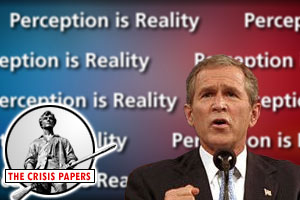
Perception is Reality
February 21, 2006
By Ernest Partridge, The
Crisis Papers
 "Today
the many disparate crises of the past have combined into one general
systemic crisis, placing the basic structure of the Republic at
mortal risk. At the forefront of concern must be the question: will
the Constitution of the United States survive? Is the American state
now in the midst of a transmutation in which the 217-year-old provisions
for a balance of powers and popular freedoms are being overridden
and canceled? Or will defenders of the Constitution step forward,
as has happened in constitutional crises of the past, to save the
system and restore its integrity?" - Jonathan Schell "Today
the many disparate crises of the past have combined into one general
systemic crisis, placing the basic structure of the Republic at
mortal risk. At the forefront of concern must be the question: will
the Constitution of the United States survive? Is the American state
now in the midst of a transmutation in which the 217-year-old provisions
for a balance of powers and popular freedoms are being overridden
and canceled? Or will defenders of the Constitution step forward,
as has happened in constitutional crises of the past, to save the
system and restore its integrity?" - Jonathan Schell
Yogi Berra said it best: "It is difficult to make predictions,
especially about the future."
Predictions in politics rest upon two presuppositions: (a) that
present trends will continue into the future, and (b) that there
will be no totally unexpected "surprises."
Both assumptions are rarely true and are refuted both by common
sense and by the lessons of history.
Case in point: last week's "Texas shootout." Until last week,
the White House routine was in motion and functioning smoothly:
Bush was the public face of the Administration, and Cheney the hand
in the sock-puppet, self-selected in 2000 to give stability, maturity
and "gravitas" to the Bush regime. Last week Cheney was exposed
to the public at large as the reckless, self-absorbed, super-annuated
adolescent that his perceptive critics knew him to be. Today the
right-wing propaganda mills are up to full speed, telling us "move
along, folks, nothing to see here." But try as they might, the public
perception of Dick Cheney will not revert to status-quo-ante. The
"present trend" of the Bush/Cheney team has been turned in an altered
direction.
But Dick Cheney's bad aim was a minor disruption, of interest
to us only because of its immediacy. Other "surprises" are well
known to all of us.
- In the fall of 1958, Fidel Castro seemed to be insignificant
irritant to the regime of Fulgencio Batista in Cuba. On New Years
Day in 1959, Batista fled Cuba, and two days later Castro and
his "brigands," marched into Havana.
- In the summer of 1963, John Kennedy's election to a second
term appeared to be a near-certainty.
- So too, his brother Robert's nomination at the Chicago Democratic
convention in August, 1968.
- On election day in 1964, Lyndon Johnson seemed assured of a
second term four years hence. And on election day, 1972, there
was no reason whatever to doubt that Richard Nixon would serve
out a full term.
- In the early eighties, Reagan's UN Ambassador, Jeanne Kirkpatrick,
warned us all that where communism had established its rule, it
had never retreated one square inch. And Mikhail Gorbachev, the
Right told us, was just another Communist apparatchik, like all
the others - "Khruschev with a tailored suit and a thin wife,"
as George Will put it.
- In 1990 Nelson Mandela was a prisoner of the South African
apartheid regime. In 1994 he was elected President of the Republic
of South Africa.
Political upheavals are like earthquakes. Beneath a placid landscape,
stresses quietly build up until the fault ruptures, suddenly and
without warning, forever transforming the landscape.
So, is an upheaval looming ahead for the United States? Not necessarily.
For history also teaches us that democracies can descend slowly,
by small increments, into despotism. As William O. Douglas put it:
"As nightfall does not come at once, neither does oppression. In
both instances, there's a twilight where everything remains seemingly
unchanged."
Which is our future? A bang, or a whimper? Or perhaps a renaissance?
We don't know. But the answer, to no small degree, is in the hands
of us, of "we the people."
This much seems likely: given the increasing unrest among the
American people, the accumulating evidence of GOP corruption and
Administration crimes, and the likelihood of a devastating economic
setback, come September and October this year, the political landscape
will be radically different than it is today. It could be far worse,
with an intervening catastrophic terrorist attack followed immediately
by martial law and full-fledged fascism. On the other hand, we the
people just might achieve our deliverance from this reign of error,
lies, greed, and cruelty.
The latter, hopeful, outcome may appear impossible today. But
we must never forget that every successful peoples' liberation movement
begins as an impossible dream. (And, be sure, many such movements
remain so). They then proceed to possibility, then probability,
and finally to inevitability and success.
The resistance to Bushism is now at the "impossible" stage; today,
the Busheviks control the ballot box and the mainstream media. Their
continuing control of the Congress and soon the Courts seems assured,
and the alleged "opposition party" is enfeebled, disorganized and
compliant. To be sure, if conditions and trends remain as they are
today, and there are no "surprises," continued control by the GOP
of all branches of government is a certainty.
However, it is very unlikely that conditions and trends will remain
as they are, or that there will be no disrupting "surprises." Below
this controlled and placid political and economic landscape, the
stresses are accumulating.
Among them:
- More and more moderate republicans and authentic conservatives
are finally coming to realize that they share little more with
the Bush Administration and the GOP Congress than a name, "Republican,"
and an adjective, "conservative." With the rightward shift in
US politics, traditional Republican values and policies - fiscal
responsibility, small government, local control, individual self-reliance
- are approaching congruence with those of the Democratic party.
And genuine conservatives share with the Democrats, and in opposition
to the Bush regime, a respect for our Constitution, the balance
of governmental powers, and the rule of law.
- Similarly, many libertarians are becoming disenchanted with
the Bushevik assault on civil liberties and its flirtation with
theocracy. In fact, a recent analysis of congressional voting
records has determined that with the exception of the estimable
libertarian-republican, Ron Paul, virtually all the top voting
scores in the libertarian
index belong to House Democrats.
- Bush has lost the confidence and support of a majority of Americans.
His approval ratings have once again dropped below 40%. A November
AP-Ipsos poll found that 57% of those polled do not believe that
the Bush Administration has "high ethical standards," and the
same number say
that Bush is not honest. Last month, a Gallup poll found that
58% consider Bush's second term a failure, and 53% believe that
Bush's administration deliberately misled
the public about Saddam's alleged WMD programs. Finally, an
October Ipsos poll found that exactly
half of the population would want Congress to consider impeachment
if Bush lied about his reasons for going to war with Iraq
- The Religious Right is fracturing, and the moderate Christians
are becoming politically active, reminding us that Jesus blessed
the peacemakers and condemned
the wealthy and the hypocrites. Some evangelical Christian
ministers are openly criticizing Bush's environmental policies
and expressing concern
about global warming.
- The patience of the international community with the neo-con's
imperial ambitions is wearing thin. And as knowledgeable observers
of international politics and economics are fully aware, the community
of nations is quite capable of exerting
considerable economic pressure on the US government.
- Bushism is based upon and sustained by a scaffolding of lies
and deception. At long last, the public is beginning to "wise
up," and as the Busheviks respond to public skepticism with still
more lies, their credibility crumbles, and with it their legitimacy
and political clout.
- Doubts about the validity of the election process will not
go away, despite the disparagement of the issue by the mainstream
media and the persistent indifference of the Democratic Party.
More and more jurisdictions are decertifying electronic voting
devices as legal challenges proliferate.
- The US economy is approaching
a breaking point, as the housing bubble is about to burst
followed by the bankruptcy of millions of double-mortgaged speculating
home owners. With ever-more Americans "maxing-out" their credit
cards and credit qualifications, and with the continuing decline
in median middle-class income, consumer spending is certain to
stall. Nothing provokes the American public to political action
more than economic distress.
- It is finally beginning to dawn on a few "movers and shakers"
of finance and industry that where Bush, Inc. is leading, they
should not want to follow. There are few winners in an economic
depression, least of all investors. And a country that fails to
invest in infrastructure, in scientific research, in technological
development, and in education, and which "outsources" its technical
jobs, is committing economic suicide. Savvy investors and corporate
financial officers recall that they flourished during the Clinton
administration, not to mention most
Democratic administrations.
- After five years of slavishly spewing out Bushite/GOP propaganda,
the mainstream media is losing its credibility and its audience.
The public is beginning to look to alternative sources for its
news: the foreign media, the independent press, and of course,
the Internet.
- The would-be despots, Bush, Cheney and the rest, are not very
good at despotism. There is a widening charisma-gap, as these
leaders appear ever-less "commanding" and ever-more puerile, incompetent,
and even pathetic. In addition, Bush and his minions are not "deep
thinkers." They prefer faith to science, and gut-feeling to expertise.
The public is beginning to appreciate that this administration
can not bend reality to its will, and that eventually "reality
bites."
All these factors are working to the disadvantage of the Bush
regime, thus, the sub-surface stresses are accumulating. Given the
manifest skills of the Bush propaganda machine, and the blackmail
and intimidation issuing from Karl Rove's office, the political
fault beneath could hold fast throughout the next decade, into the
Jeb Bush Administration. Or it could rupture next month. My guess
is sooner, rather than later.
Meanwhile, the resistance is gaining in strength.
The catalytic moment for liberation movements arrives when (a)
the movement achieves self-awareness - when the dissenters look
about and find that they are not alone, and recognize that they
are participants in a concerted political force, (b) when the movement
acquires effective leadership that focuses goals and coordinates
action, and (c) when leaders and followers of the movement achieve
results, albeit minor, and thus perceive that success is achievable.
This perception that success is possible is, in itself, a formidable
political force. "Perception is reality." Si, se puede!
I opened with a warning about the unreliability of political predictions.
So I will not now hazard predictions about the State of the Union
in the fall, as the mid-term election approaches. However, I can
point out some factors that might emerge in the meantime to re-shuffle
the political deck.
Election fraud
As Bush's approval ratings continue to fall, the economy sours,
the Iraq casualty toll increases with no end in sight, the Abramov
and Plame scandals yield indictments, the defensive lies from the
White House become more transparent and desperate, opinion polls
point to a Democratic blowout in the November elections. As more
and more voices are heard to ask, "why on earth did we elect these
guys?," the public becomes ever more receptive to the reply, "we
didn't! Those damned machines elected them!" Then the Busheviks
face a daunting dilemma: can they allow a Democratic takeover of
the Congress, and with it the power of congressional investigation
including the levers of subpoena and the threats of perjury and
contempt of Congress? Or dare they once again "jigger" the computer
programs, in the secret and unauditable ballot and compilation codes,
to assure a GOP "victory," thus inviting a Ukrainian-style public
rebellion?
The Mainstream Media
As the MSM continues to lose its audience, it faces another dilemma:
propaganda vs. profits. When the Soviet media, state-owned and thus
in no need of profits, persisted in spewing out state propaganda,
it gave rise to an underground media, samizdat,
and an enthusiastic public audience for foreign broadcasts and publications.
In the United States today, profits are a factor, as here and there
elements of the MSM, facing competition from foreign and independent
sources and the Internet, are exhibiting increasing critical independence
from the GOP party line. The opponents to Bush, Inc., need no counter-propaganda.
A healthy dose of the truth will suffice as an invaluable resource
in the struggle to bring an end to the reigning oligarchy.
Leadership
The resistance to Bushism is essentially leaderless, and thus unfocused
and disorganized. When the leaders emerge, reflecting the values
and aspirations of the resistance movement, that movement may become
a formidable force.
I am not proposing another despot to replace the ones we have.
If prospective leaders step forward with agendas alien to the followers,
they will be discarded. Successful leaders must embody the values
and aspirations of the movement. For if the movement is to be effective,
its goals must be defined and focused, and its activism coordinated.
In an authentic popular movement, communication and coordination
between leaders and followers flows in both directions. Let's be
realistic: where would the sixties civil rights movement be without
Martin Luther King, Jr. – or, if not King himself, a King-like leader?
Where India, without a Gandhi, South Africa without a Mandela, Russia
without a Sakharov? For that matter, where would the United States
be without a Washington, Jefferson, Franklin and the rest? All of
these succeeded as leaders because those in their movements chose
to follow. Other individuals, lost to history, claimed leadership
and were rejected.
Message Discipline is behind much of the success of the GOP. Memos
with "talking points" issue forth from the offices of Karl Rove
and Dick Cheney, with clear and simple messages that are heard,
incessantly, in the echo chambers of right-wing talk radio and right-wing
punditry. In contrast, the left speaks with a thousand tongues,
with worthy causes spread all over the political landscape, and
with factions, that should be allies, fighting amongst themselves
for a place at the podium. Witness the Washington Mall peace rallies,
where we hear messages of gay pride, reproductive freedom, animal
liberation, save the rain forests, abolish the death penalty, and,
oh yes, end the war. All these are commendable causes, and all these
are also wedge issues that fracture the coalition, to the delight
of the right, which therein gains an opportunity to divide and conquer.
To the public at large, a thousand messages equate with no message,
and a validation of the tiresome right-wing criticism that "the
left has no new ideas."
The essential message of the resistance movement must be simple,
clear, with few elements, and comprehensive enough to encompass
a broad coalition of citizens, who may differ on particular issues:
liberals, progressives, the religious, the secular, moderate Republicans,
conservatives, libertarians. To the religious, ask "What would Jesus
Do?" (ie., promote peace and charity, and condemn wealth and hypocrisy).
To "establishment" Republicans and their followers, "What is the
supreme object of your loyalty? A party? A man who happens to be
President or your country and its laws and Constitution?" And
to citizens in general: "What have they done to our country?"
If these few and simple messages are repeated, over and over,
the public might at last pay attention, and the resistance movement
might achieve self-identity and grow into an irresistible force
for reform and renewal.
In conclusion, we must pay no attention to the pundits' proclamations
that Democratic control of Congress is "out of reach," that impeachment
is impossible, or that claims of election fraud are groundless paranoia.
There are live
bombs in the basement of The House of Bush – scandals, crimes,
betrayals, treachery, even treason. Any one of these potentially
explosive issues might, at any time, go off and bring down the entire
wretched structure. Or they might all be defused, as a long night
of despotism falls upon our republic. We can be confident only of
this much: the present trends will not continue, and we must expect
and be prepared to deal intelligently with the unexpected.
We Americans are not an evil people. Woefully ignorant at times,
and short on political sales-resistance. But when we sense that
we've been swindled and lied to, watch out! Our country was born
in rebellion against tyranny. We have a Constitution and we have
a tradition of liberty and the rule of law. We have vivid memories
of a short time ago when we lived in a country that was both prosperous
and free.
But neither were the Germans or the Russians fundamentally evil
people. Yet they succumbed to evil regimes. The Germans had to be
liberated at horrendous cost. After seventy long years, the various
nationalities of the Soviet Union threw out their oppressors. We
may suffer the fate of the Germans – there are no guarantees. Or
perhaps "the Old World" will come to the rescue of the "New,"
just as we came to their rescue in the century just past.
Far better that we accomplish our own liberation and renewal.
For only the American people can restore the honor of the United
States of America.
Dr. Ernest Partridge is a consultant, writer and lecturer in
the field of Environmental Ethics and Public Policy. He publishes
the website, The
Online Gadfly and co-edits the progressive website, The
Crisis Papers. He is at work on a book, Conscience of a
Progressive, which can be seen in-progress here.
Send comments to: crisispapers@hotmail.com.
Crisis Papers Archive
|