|
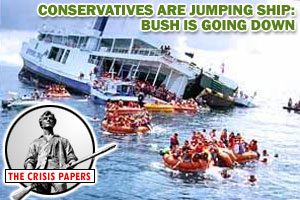
Conservatives are Jumping Ship: Bush is
Going Down
March 7, 2006
By Bernard Weiner, The
Crisis Papers
 I'm
more and more convinced that it will be Republicans, many of them
of the true conservative and realist kind, who effectively will
do in the Bush Administration. I'm
more and more convinced that it will be Republicans, many of them
of the true conservative and realist kind, who effectively will
do in the Bush Administration.
In this, I am reminded of the behavior of Richard Nixon. Realizing
that he was fast losing his middle-class, bourgeois base, he knew
when to call it quits on the Vietnam War and on his presidency after
his crimes were exposed.
Unlike Nixon's crew, Bush & Co. seem willing to take the country
down with them, so desperate are they to hold onto power, deplete
the treasury, pay off their corporate friends, carry out their ideological
revolution - and keep themselves out of the federal slammer.
The crimes of the Bush Administration are so many and varied that
none of us should be surprised by anything that might happen in
the coming weeks and months: Bin Laden captured or reported killed,
a U.S.-Israeli air assault on Iran's nuclear facilities, a major
terrorist attack inside the U.S. to be followed by martial law,
the announcement of a bird-flu outbreak with the military placed
in charge. I'm pretty level-headed and don't usually think in these
dire terms, but these guys have backed themselves into a political
corner and are desperate - and dangerous.
THE IMPLODING SCANDALS
Bush is at 34% approval rating (Cheney is at 18%!), and their
scandals are blowing up in their faces: Katrina lies and incompetence;
Iraq lies and incompetence; the Dubai Ports deal; GOP bribery and
corruption; Libby under indictment and Rove apparently about to
be; Bush claiming authority to authorize torture, spy on millions
of American citizens and violate the law whenever he says "national
security" is involved; Congress rebelling at being frozen out of
decision-making, etc. etc. But in the face of all that, the Rovian
M.O. is always to attack their foes and to hype the fright quotient.
The Administration didn't have to consider the most extreme options
until recently, when a lot of wheels started falling off the Bush
bus. The attacks were no longer mostly coming from liberals and
Democrats; more and more, they were coming from loyal conservative
Republicans, who, being apprised of the sinking poll numbers, saw
the handwriting on the wall: they realized they could well lose
their majorities in the House and Senate - in other words, lose
their jobs and access to the spoils of power - and they started
distancing themselves from the Administration.
So, rather than beating my usual drum here denouncing the high
crimes and misdemeanors of the Bush Administration, I thought I'd
just lay out the comments of those conservatives and let them speak
for themselves. (My late friend Emile de Antonio, the documentary
filmmaker, taught me a good lesson; it's always better, he pointed
out, to quote what the Wall Street Journal is saying rather than
quoting a hippie leftist making the same point. When their own supporters
smell the moral rot up top, the end is near.)
I'll concentrate here on Iraq and the neo-con ideologues who took
this country to war, though currently the flak is also coming hot
and heavy from the Right on both the domestic spying and Dubai ports
scandals. (Even conservative Republican Senator Richard Shelby says
Bush broke the law in the way he handled the Dubai
ports contract.)
THE NEO-CONS BEHIND THE WAR
Let's begin with a reminder that the conservative establishment
didn't agree from the very beginning with Bush's obsession to invade
Iraq. President George H.W. Bush, who successfully organized a massive
coalition to push Iraq's army out of Kuwait in the first Gulf War,
warned his son privately and through his spokesmen of the dangerous
consequences both of invading and occupying Iraq and of doing so
without wide international support. As he said of Iraq in A World
Transformed (written with Gen. Brent Scowcroft): "Had we gone
the invasion route, the United States could conceivably still be
an occupying power in a bitterly hostile land. It would have been
a dramatically different - and perhaps barren - outcome."
Fast forward to the present, when so many Republican stalwarts
are saying, in effect, that they backed the wrong horse. Their party
was taken over by rightwing extremists, incompetent at that, whose
reckless policies are doing great danger to the country and to the
future of the once-great GOP. Here's Melinda
Pillsbury-Foster, chair of the Arthur C. Pillsbury Foundation,
going even beyond the war into the deeper crimes being committed
against Americans' freedoms:
Most Americans do not yet realize that a war is being waged
- not against Iraq but against each of us. It is not the Republican
Party that is charge in this administration but a small cadre
who seized executive branch power and converted it to their
own uses. Most Republicans are experiencing a deer-in-the-headlights
moment right now. Their Party has been hijacked, their president
has been hijacked, and they do not know what to do. I remain
a registered Republican working for an effective coalition.
The attack on us and on our rights has hardly begun. You don't
go to the trouble of setting up this degree of control without
having made plans to use it.
NEO-CON FUKUYAMA HAS SECOND THOUGHTS
Or try this out. Francis Fukuyama, who wrote the 1992 neocon best-seller
The End of History, is exhibiting some serious
recantation these days in interviews and in his new book, America
at the Crossroads.
He now says that neo-conservatism has "evolved into something
I can no longer support," and should be tossed onto history's pile
of discredited ideologies. The doctrine, which has demonstrated
"the danger of good intentions carried to extremes ... is now in
shambles," and needs to be replaced by a more realistic foreign
policy.
For example, though he once supported regime change in Iraq, he
now believes the war there is the wrong sort of war, in the wrong
place at the wrong time.
The most basic misjudgment was an overestimation of the threat
facing the United States from radical Islamism. Although the
new and ominous possibility of undeterrable terrorists armed
with weapons of mass destruction did indeed present itself,
advocates of the war wrongly conflated this with the threat
presented by Iraq and with the rogue state/proliferation problem
more generally.
By definition, outsiders can't 'impose' democracy on a country
that doesn't want it; demand for democracy and reform must be
domestic. Democracy promotion is therefore a long-term and opportunistic
process that has to await the gradual ripening of political
and economic conditions to be effective.
THE CHENEY-RUMSFELD CABAL
Then we go to a long-time Administration stalwart who couldn't
take it any more: Lawrence
Wilkerson, a retired U.S. Army colonel who was chief of staff
for Secretary of State Colin Powell.
"What I saw was a cabal between the vice president of the United
States, Richard Cheney, and the secretary of defense, Donald Rumsfeld,
on critical issues that made decisions that the bureaucracy did
not know were being made," Wilkerson said in a well-publicized speech
at the New America Foundation last October. "And you've got a president
who is not versed in international relations and not too much interested
in them either."
Wilkerson has also focused attacks on the Bush administration
for condoning torture, setting lax and ambiguous policies on treatment
of detainees that inevitably led to the scandal of the abuses at
Abu Ghraib prison in Iraq and elsewhere.
BUCKLEY BUCKLES TO REALITY
Onward to the intellectual godfather of the modern conservative
movement, National Review founding editor William
F. Buckley Jr., who concludes that what may have started as
a decent move has evolved into disaster:
One can't doubt that the American objective in Iraq has failed.
... Our mission has failed because Iraqi animosities have proved
uncontainable by an invading army of 130,000 Americans. The
great human reserves that call for civil life haven't proved
strong enough. No doubt they are latently there, but they have
not been able to contend against the ice men who move about
in the shadows with bombs and grenades and pistols. ... Mr.
Bush has a very difficult internal problem here because to make
the kind of concession that is strategically appropriate requires
a mitigation of policies he has several times affirmed in high-flown
pronouncements. His challenge is to persuade himself that he
can submit to a historical reality without forswearing basic
commitments in foreign policy. ... The kernel here is the acknowledgment
of defeat.
THE TROOPS WANT OUT, SOON
Speaking of the troops in Iraq, recent
polling reveals that nearly 3 out of 4 of U.S troops in Iraq
think the U.S. should exit the country this year, and more than
one in four say the troops should leave immediately. The Chairman
of the Joint Chiefs of Staff admits also that the Iraqis want us
to leave "as
soon as possible."
Here are some pertinent comments
by a U.S. soldier in Iraq, writing as "djtyg," about why the
desire to leave that country:
We need to get out because our military cannot take much more
of this. We are stretched too thin and it's about to get worse.
... Soldiers are frustrated. Every soldier I have talked to
says that they are getting out of the military when they get
home. Every. One. Of. Them. Regardless of rank, experience,
or time in, they all want out. There has not been a single Soldier
I've talked to that says they want to stay in. This include
officers, NCOs, and rookies who are on their first tour of duty.
We need to get out of Iraq because Iraq is the reason why the
military is shrinking. We, like Cindy Sheehan, are curious as
to what "noble cause" we are fighting for. We can't seem to
find one. This is weakening America. At the rate we are going,
we are going to have a military that can't fight because it
has old and broken down equipment, and no troops to fight a
war with.
SEN. HAGEL LOWERS THE BOOM
Then there are key Republican senators who are willing to stick
out their necks by talking truth to power about Iraq - for example,
Nebraska Senator Chuck
Hagel, who says the U.S. is losing in Iraq and raised a parallel
to an earlier conflict.
"[The Vietnam War] was a national tragedy partly because members
of Congress failed their country, remained silent and lacked the
courage to challenge the administrations in power until it was too
late. To question your government is not unpatriotic - to not question
your government is unpatriotic," he said, arguing that 58,000 troops
died in Vietnam because of silence by political leaders. "America
owes its men and women in uniform a policy worthy of their sacrifices."
O'REILLY QUESTIONS STAYING IN IRAQ
So, let's see: Bush is losing old-money Republican conservatives,
GOP senators, neo-con theorists outside the Cheney-Rumsfeld insider
nexus, military insiders, troops under fire in Iraq - who else can
he lose? Would you believe the lunatic fringe, as symbolized by
that raving Limbaugh wannabee Bill
O'Reilly?
The Fox News pundit, who usually is in lockstep with the Bush program
and calls anybody who criticizes those policies idiots and worse,
had this to say the other day about the need to get out of Iraq
ASAP: "[We need to] hand over everything to the Iraqis as fast as
humanly possible [because] there are so many nuts in the country
- so many crazies - that we can't control them."
GOP DISCONTENT ON NATIONAL SECURITY
Well, one could go on and on with the criticism coming from the
Right - conservative former presidential candidate Pat Buchanan,
former Reagan Administration official Paul Craig Roberts, Congressional
warhawk John Murtha, et al. The point is that the Republicans, formerly
associated with a winning national-security message, are now regarded
much differently by many GOP rank-and-file and politicos.
Many Representatives and Senators also deeply resent the way the
Congress has been frozen
out of the power loop by the Bush Administration. "We simply
want to participate and aren't going to be PR flacks when they need
us," Florida's conservative GOP Congressman Mark Foley said. "We
all have roles. We have oversight. When you can't answer your constituents
when they have legitimate questions - we can't simply do it on trust."
Scott Reed, who managed Robert Dole's 1996 presidential campaign,
called the current low poll ratings for Bush and the GOP "pretty
shattering," noting especially that Bush's support among Republicans
fell from 83 percent to 72 percent. "The repetition of the news
coming out of Iraq is wearing folks down," Reed said. "It started
with women and it's spreading. It's just bad news after bad news
after bad news, without any light at the end of the tunnel."
THE PRESIDENT AS DICTATOR
"Even if you're a Republican member of Congress, you don't buy
the exaggerated view of the unified executive theory, in which the
only part of the Constitution that matters is Article II," on presidential
power, said James B. Steinberg, a dean at the University of Texas
at Austin. "If you want them to be in on the landing, you have to
have people there for the takeoff."
For example, two
staunch conservative Southern Senators won't accept Bush's Unified
Executive theory of governance. "I think the administration has
looked at the legitimate power of the executive during a time of
war and taken it to extremes," said Republican Sen. Lindsey Graham
of South Carolina. "[It's] to the point that we'd lose constitutional
balance. Under their theory, there would be almost no role for the
Congress or the courts." Mississippi's Sen. Trent Lott was even
more blunt: "Don't put your fist in my face."
EVEN WALL ST. IS TALKING IMPEACHMENT
Now all those defections from the Bush orbit are doing great damage
to the once-unified Bush & Co. juggernaut, but I've left out one
key one: Wall Street. The titans of finance are agitated, even to
the point of urging serious consideration of Bush's impeachment.
Here's some of what Barron's Editorial Page Editor Thomas
G. Donlan wrote in that establishment
financial journal:
...The administration is saying the president has unlimited
authority to order wiretaps in the pursuit of foreign terrorists,
and that the Congress has no power to overrule him ... Perhaps
they were researched in a Star Chamber? Putting the president
above the Congress is an invitation to tyranny. The president
has no powers except those specified in the Constitution and
those enacted by law. President Bush is stretching the power
of commander-in-chief of the Army and Navy by indicating that
he can order the military and its agencies, such as the National
Security Agency, to do whatever furthers the defense of the
country from terrorists, regardless of whether actual force
is involved.
Willful disregard of a law is potentially an impeachable offense.
It is at least as impeachable as having a sexual escapade under
the Oval Office desk and lying about it later. The members of
the House Judiciary Committee who staged the impeachment of
President Clinton ought to be as outraged at this situation
...
It is important to be clear that an impeachment case, if it
comes to that, would not be about wiretapping, or about a possible
Constitutional right not to be wiretapped. It would be about
the power of Congress to set wiretapping rules by law, and it
is about the obligation of the president to follow the rules
in the Acts that he and his predecessors signed into law ...
THREE MORE YEARS?
So, friends, when we're down in the dumps, depressed by the fact
that Bush & Co. are still in power even in the face of all their
lies and bumblings and policies that result in thousands of people
getting killed and maimed and tortured, let us consider that even
their once-loyal rats are deserting the sinking ship of state.
The thought of nearly three more years of Bush & Co. misrule is
too horrible to contemplate. So let's ratchet up the pressure, incorporate
distressed GOP moderates and conservatives into the impeachment
momentum, and let's send the Bush Bunker crew packing and return
the country to reasonable people dedicated to a restoration of Constitutional
rule of law and a realistic foreign policy. It's the least we can
do for our country.
Bernard Weiner has taught at various universities, worked as
a writer/editor with the San Francisco Chronicle, and currently
co-edits The
Crisis Papers. To comment, write: crisispapers@comcast.net.
Crisis Papers Archive
|