By News Staff | April 19th 2009 09:06 PM
Using NASA’s Spitzer Space Telescope, an international team of astronomers have found that at least 1 in 100 white dwarf stars show evidence of orbiting asteroids and rocky planets, suggesting these objects once hosted Solar Systems similar to our own. Team member Dr Jay Farihi of the University of Leicester will present this discovery on Monday 20th April at the European Week of Astronomy and Space Science conference at the University of Hertfordshire.
White dwarf stars are the compact, hot remnants left behind when stars like our Sun reach the end of their lives. Their atmospheres should consist entirely of hydrogen and helium but are sometimes found to be contaminated with heavier elements like calcium and magnesium. The new observations suggest that these Earth-sized stars are often polluted by a gradual rain of closely orbiting dust that emits infrared radiation picked up by Spitzer.
The data suggest that at least 1% to 3% of white dwarf stars are contaminated in this way and that the dust originates from rocky bodies like asteroids (also known as minor planets). In our Solar System, minor planets are the left over building blocks of the rocky terrestrial planets like the Earth. The Spitzer results imply that asteroids are found in orbit around a large number of white dwarfs, perhaps as many as 5 million in our own Milky Way Galaxy.
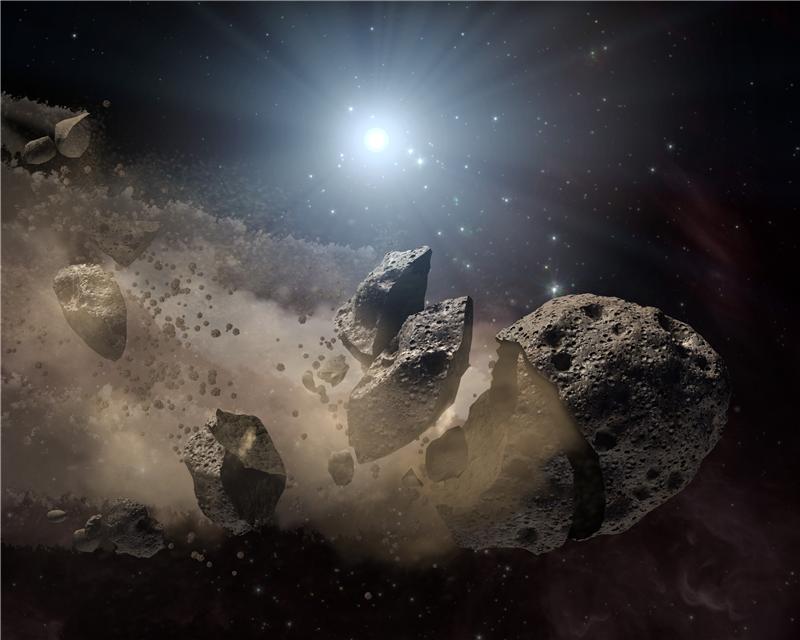
NASA's Spitzer Space Telescope set its infrared eyes upon the dusty remains of shredded asteroids around several dead stars. This artist's concept illustrates one such dead star, or "white dwarf," surrounded by the bits and pieces of a disintegrating asteroid. These observations help astronomers better understand what rocky planets are made of around other stars. Image: NASA / JPL - Caltech
more:
http://www.scientificblogging.com/news_articles/spitzer_spies_spent_solar_systems_around_dead_suns
 Printer-friendly format
 Email this thread to a friend
 Bookmark this thread
 (1000+ posts)
Send PM |
Profile |
Ignore
(1000+ posts)
Send PM |
Profile |
Ignore