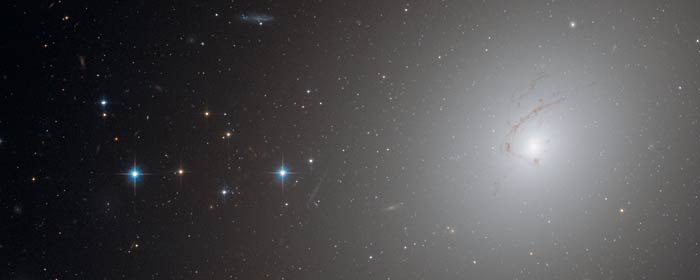
12-Aug 2010 Curling around itself like a question mark, the unusual looking galaxy NGC 4696 itself begs many questions. Why is it such a strange shape? What are the odd, capillary-like filaments that stretch out of it? And what is the role of a large black hole in explaining its decidedly odd appearance?
This picture, taken by Hubble’s Advanced Camera for Surveys, is not just a beautiful snapshot of NGC 4696, the largest galaxy in the Centaurus Cluster (galaxy cluster Abell 3526). It is also an illustration of the rich variety of objects that astronomers can see with the NASA/ESA Hubble Space Telescope.
NGC 4696 is an elliptical galaxy with a difference. Lacking the complex structure and active star formation of their spiral brethren, elliptical galaxies are usually little more than shapeless collections of ageing stars.
Most likely formed by collisions between spiral galaxies, elliptical galaxies experience a brief burst of star formation triggered as the interstellar dust and gas crash into each other, but which quickly leaves the young elliptical galaxies exhausted. With no more gas to form new stars from, the galaxies gradually grow older and fainter.
But NGC 4696 is more interesting than most elliptical galaxies.
more with bigger versions
http://www.spacetelescope.org/news/heic1013/
 Printer-friendly format
 Email this thread to a friend
 Bookmark this thread
 (1000+ posts)
Send PM |
Profile |
Ignore
(1000+ posts)
Send PM |
Profile |
Ignore