 |
Latest | Greatest | Lobby | Journals | Search | Options | Help | Login |
|
 Printer-friendly format
 Email this thread to a friend
 Bookmark this thread
 |
This topic is archived. |
| Home » Discuss » Topic Forums » Science |

|
RandomThoughts
 (1000+ posts)
Send PM |
Profile |
Ignore
(1000+ posts)
Send PM |
Profile |
Ignore
|
Mon Dec-20-10 10:44 PM Original message |
| Watching show on Einstein. |
| Printer Friendly | Permalink | | Top |
| Vinnie From Indy
(1000+ posts)
Send PM |
Profile |
Ignore
|
Mon Dec-20-10 10:54 PM Response to Original message |
| 1. Meh! It's all relative. |
| Printer Friendly | Permalink | | Top |
| laconicsax
(1000+ posts)
Send PM |
Profile |
Ignore
|
Mon Dec-20-10 11:26 PM Response to Original message |
| 2. The simplest explanation is that you don't understand time dilation. |
| Printer Friendly | Permalink | | Top |
| RandomThoughts
(1000+ posts)
Send PM |
Profile |
Ignore
|
Mon Dec-20-10 11:55 PM Response to Reply #2 |
| 4. You miss the point I was making. |
| Printer Friendly | Permalink | | Top |
| laconicsax
(1000+ posts)
Send PM |
Profile |
Ignore
|
Tue Dec-21-10 02:06 AM Response to Reply #4 |
| 7. The point you're making is based on a misunderstanding of relativity. |
| Printer Friendly | Permalink | | Top |
| RandomThoughts
(1000+ posts)
Send PM |
Profile |
Ignore
|
Tue Dec-21-10 03:46 AM Response to Reply #7 |
| 10. When this dawns on you yuor going to get it I think. |
| Printer Friendly | Permalink | | Top |
| laconicsax
(1000+ posts)
Send PM |
Profile |
Ignore
|
Tue Dec-21-10 02:32 PM Response to Reply #10 |
| 12. There's nothing for me to get. Your questions are based on a misunderstanding. |
| Printer Friendly | Permalink | | Top |
| RandomThoughts
(1000+ posts)
Send PM |
Profile |
Ignore
|
Tue Dec-21-10 03:09 PM Response to Reply #12 |
| 13. LOL, you still don't get it. |
| Printer Friendly | Permalink | | Top |
| laconicsax
(1000+ posts)
Send PM |
Profile |
Ignore
|
Tue Dec-21-10 09:35 PM Response to Reply #13 |
| 15. Seriously. Go to the library, find a book that covers relativity, read it. |
| Printer Friendly | Permalink | | Top |
| RandomThoughts
(1000+ posts)
Send PM |
Profile |
Ignore
|
Thu Dec-23-10 05:53 AM Response to Reply #15 |
| 16. LOL. |
| Printer Friendly | Permalink | | Top |
| Jim__
(1000+ posts)
Send PM |
Profile |
Ignore
|
Thu Dec-23-10 11:21 AM Response to Reply #16 |
| 17. "... why would one move slower in time when observed by the other, and one move faster in time." |
| Printer Friendly | Permalink | | Top |
| RandomThoughts
(1000+ posts)
Send PM |
Profile |
Ignore
|
Thu Dec-23-10 02:21 PM Response to Reply #17 |
| 18. So if each person sees the other clock slow down. |
| Printer Friendly | Permalink | | Top |
| Jim__
(1000+ posts)
Send PM |
Profile |
Ignore
|
Thu Dec-23-10 04:16 PM Response to Reply #18 |
| 19. No, they're not in the same time reference. |
| Printer Friendly | Permalink | | Top |
| RandomThoughts
(1000+ posts)
Send PM |
Profile |
Ignore
|
Thu Dec-23-10 08:10 PM Response to Reply #19 |
| 21. There is a statement. |
| Printer Friendly | Permalink | | Top |
| Jim__
(1000+ posts)
Send PM |
Profile |
Ignore
|
Fri Dec-24-10 07:08 AM Response to Reply #21 |
| 22. Read the problem statement: "Suppose that in Jack’s frame we have two synchronized clocks ... |
| Printer Friendly | Permalink | | Top |
| RandomThoughts
(1000+ posts)
Send PM |
Profile |
Ignore
|
Sat Dec-25-10 03:45 AM Response to Reply #22 |
| 24. You are saying the clocks are stationary. |
| Printer Friendly | Permalink | | Top |
| Jim__
(1000+ posts)
Send PM |
Profile |
Ignore
|
Sat Dec-25-10 06:56 AM Response to Reply #24 |
| 25. Yes, they're stationary within a reference frame. |
| Printer Friendly | Permalink | | Top |
| RandomThoughts
(1000+ posts)
Send PM |
Profile |
Ignore
|
Sat Dec-25-10 11:00 PM Response to Reply #25 |
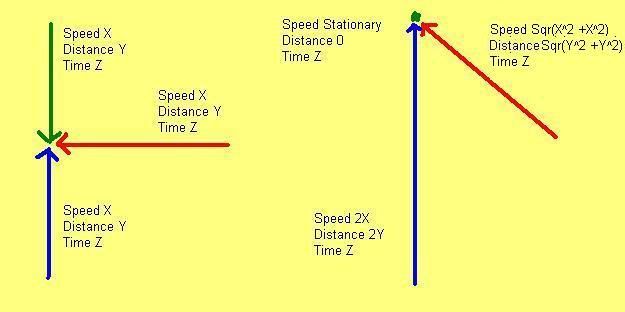
| 27. Here is the basic thing. |
| Printer Friendly | Permalink | | Top |
| Jim__
(1000+ posts)
Send PM |
Profile |
Ignore
|
Sun Dec-26-10 12:34 PM Response to Reply #27 |
| 28. I'm not sure how to interpret your diagrams. |
| Printer Friendly | Permalink | | Top |
| RandomThoughts
(1000+ posts)
Send PM |
Profile |
Ignore
|
Sun Dec-26-10 02:08 PM Response to Reply #28 |
| 29. The direction would not matter, if it did it creates inconsistencies. |
| Printer Friendly | Permalink | | Top |
| Jim__
(1000+ posts)
Send PM |
Profile |
Ignore
|
Mon Dec-27-10 03:56 PM Response to Reply #29 |
| 32. Let's look at your diagram from post #27 then. |
| Printer Friendly | Permalink | | Top |
| qazplm
(1000+ posts)
Send PM |
Profile |
Ignore
|
Mon Dec-27-10 02:34 PM Response to Reply #24 |
| 30. there is almost nothing in the universe that |
| Printer Friendly | Permalink | | Top |
| laconicsax
(1000+ posts)
Send PM |
Profile |
Ignore
|
Thu Dec-23-10 08:01 PM Response to Reply #16 |
| 20. Reading books is one way to learn about a subject. I suggest you try it. |
| Printer Friendly | Permalink | | Top |
| TheMadMonk
(1000+ posts)
Send PM |
Profile |
Ignore
|
Tue Dec-21-10 03:10 AM Response to Reply #4 |
| 9. Vectors cancel over time. |
| Printer Friendly | Permalink | | Top |
| MrsBrady
(1000+ posts)
Send PM |
Profile |
Ignore
|
Mon Dec-20-10 11:38 PM Response to Original message |
| 3. i took 2 college astronomy classes last year... |
| Printer Friendly | Permalink | | Top |
| RandomThoughts
(1000+ posts)
Send PM |
Profile |
Ignore
|
Tue Dec-21-10 12:01 AM Response to Reply #3 |
| 5. My arguement is not that the earth is the center. |
| Printer Friendly | Permalink | | Top |
| qazplm
(1000+ posts)
Send PM |
Profile |
Ignore
|
Fri Dec-24-10 12:03 PM Response to Reply #5 |
| 23. man you've taken one of the simplest |
| Printer Friendly | Permalink | | Top |
| mindwalker_i
(836 posts)
Send PM |
Profile |
Ignore
|
Tue Dec-21-10 12:42 AM Response to Original message |
| 6. There are actually two effects here |
| Printer Friendly | Permalink | | Top |
| bananas
(1000+ posts)
Send PM |
Profile |
Ignore
|
Tue Dec-21-10 02:37 AM Response to Original message |
| 8. The Twin Paradox |
| Printer Friendly | Permalink | | Top |
| leahcim
(56 posts)
Send PM |
Profile |
Ignore
|
Tue Dec-21-10 12:57 PM Response to Original message |
| 11. I think you've missed that: |
| Printer Friendly | Permalink | | Top |
| Jim__
(1000+ posts)
Send PM |
Profile |
Ignore
|
Tue Dec-21-10 04:46 PM Response to Original message |
| 14. "... why did time dilation happen on the trip to the moon, and then it was not canceled out ... |
| Printer Friendly | Permalink | | Top |
| Confusious
(1000+ posts)
Send PM |
Profile |
Ignore
|
Sat Dec-25-10 11:17 AM Response to Reply #14 |
| 26. You just could have said |
| Printer Friendly | Permalink | | Top |
| qazplm
(1000+ posts)
Send PM |
Profile |
Ignore
|
Mon Dec-27-10 02:36 PM Response to Original message |
| 31. there is no location on the Earth |
| Printer Friendly | Permalink | | Top |
DU
AdBot (1000+ posts)     |
Thu Feb 12th 2026, 02:03 PM Response to Original message |
| Advertisements [?] |
| Top |
| Home » Discuss » Topic Forums » Science |
|
Powered by DCForum+ Version 1.1 Copyright 1997-2002 DCScripts.com
Software has been extensively modified by the DU administrators
Important Notices: By participating on this discussion board, visitors agree to abide by the rules outlined on our Rules page. Messages posted on the Democratic Underground Discussion Forums are the opinions of the individuals who post them, and do not necessarily represent the opinions of Democratic Underground, LLC.
Home | Discussion Forums | Journals | Store | Donate
About DU | Contact Us | Privacy Policy
Got a message for Democratic Underground? Click here to send us a message.
© 2001 - 2011 Democratic Underground, LLC