 |
Latest | Greatest | Lobby | Journals | Search | Options | Help | Login |
|
 Printer-friendly format
 Email this thread to a friend
 Bookmark this thread
 |
This topic is archived. |
| Home » Discuss » General Discussion |

|
Dennis Donovan
 (1000+ posts)
Send PM |
Profile |
Ignore
(1000+ posts)
Send PM |
Profile |
Ignore
|
Fri Jul-29-11 06:08 PM Original message |
| 44 years ago today - USS Forrestal Fire kills 134 sailors |
| Printer Friendly | Permalink | | Top |
| TheDebbieDee
(1000+ posts)
Send PM |
Profile |
Ignore
|
Fri Jul-29-11 06:13 PM Response to Original message |
| 1. Didn't "Five-planes" McCain start that fire? |
| Printer Friendly | Permalink | | Top |
| Dennis Donovan
(1000+ posts)
Send PM |
Profile |
Ignore
|
Fri Jul-29-11 06:15 PM Response to Reply #1 |
| 2. Shit! Thank you!! |
| Printer Friendly | Permalink | | Top |
| cherokeeprogressive
(1000+ posts)
Send PM |
Profile |
Ignore
|
Fri Jul-29-11 11:01 PM Response to Reply #2 |
| 16. Take this from a former flight deck sailor. |
| Printer Friendly | Permalink | | Top |
| Dennis Donovan
(1000+ posts)
Send PM |
Profile |
Ignore
|
Sat Jul-30-11 12:26 PM Response to Reply #16 |
| 34. You're absolutely correct: |
| Printer Friendly | Permalink | | Top |
| SwampG8r
(1000+ posts)
Send PM |
Profile |
Ignore
|
Fri Jul-29-11 11:14 PM Response to Reply #2 |
| 18. nm |
| Printer Friendly | Permalink | | Top |
| cherokeeprogressive
(1000+ posts)
Send PM |
Profile |
Ignore
|
Fri Jul-29-11 11:25 PM Response to Reply #18 |
| 20. This is so far off of the mark it would be funny if you weren't serious. |
| Printer Friendly | Permalink | | Top |
| Obamanaut
(1000+ posts)
Send PM |
Profile |
Ignore
|
Sat Jul-30-11 01:58 AM Response to Reply #2 |
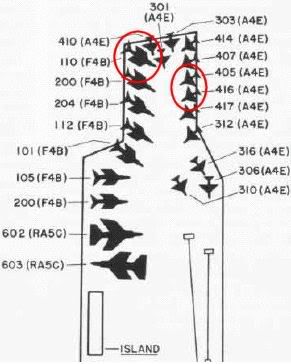
| 31. No, there was no plane behind the A-4 McCain was in. There are no planes |
| Printer Friendly | Permalink | | Top |
| csziggy
(1000+ posts)
Send PM |
Profile |
Ignore
|
Fri Jul-29-11 06:17 PM Response to Reply #1 |
| 3. No, he was cleared of any wrong doing |
| Printer Friendly | Permalink | | Top |
| indepat
(1000+ posts)
Send PM |
Profile |
Ignore
|
Fri Jul-29-11 06:45 PM Response to Reply #3 |
| 8. Who was CINCPAC at the time? |
| Printer Friendly | Permalink | | Top |
| csziggy
(1000+ posts)
Send PM |
Profile |
Ignore
|
Fri Jul-29-11 10:03 PM Response to Reply #8 |
| 11. I don't even know what the acronym means |
| Printer Friendly | Permalink | | Top |
| jmowreader
(1000+ posts)
Send PM |
Profile |
Ignore
|
Fri Jul-29-11 10:51 PM Response to Reply #11 |
| 14. CINCPAC = Commander in Chief, Pacific Fleet |
| Printer Friendly | Permalink | | Top |
| csziggy
(1000+ posts)
Send PM |
Profile |
Ignore
|
Fri Jul-29-11 10:55 PM Response to Reply #14 |
| 15. Ah, OK, Thanks for the explanation. n/t |
| Printer Friendly | Permalink | | Top |
| SwampG8r
(1000+ posts)
Send PM |
Profile |
Ignore
|
Fri Jul-29-11 11:15 PM Response to Reply #8 |
| 19. sad day |
| Printer Friendly | Permalink | | Top |
| Kaleva
(1000+ posts)
Send PM |
Profile |
Ignore
|
Fri Jul-29-11 06:19 PM Response to Reply #1 |
| 5. The rocket came from an F4 and not from McCain's SkyHawk |
| Printer Friendly | Permalink | | Top |
| roguevalley
(1000+ posts)
Send PM |
Profile |
Ignore
|
Fri Jul-29-11 10:43 PM Response to Reply #1 |
| 13. people have said he did a forbidden thing and threw his engine |
| Printer Friendly | Permalink | | Top |
| cherokeeprogressive
(1000+ posts)
Send PM |
Profile |
Ignore
|
Fri Jul-29-11 11:08 PM Response to Reply #13 |
| 17. "people have said" |
| Printer Friendly | Permalink | | Top |
| RamboLiberal
(1000+ posts)
Send PM |
Profile |
Ignore
|
Sat Jul-30-11 12:04 AM Response to Reply #17 |
| 21. +1 on your response |
| Printer Friendly | Permalink | | Top |
| cherokeeprogressive
(1000+ posts)
Send PM |
Profile |
Ignore
|
Sat Jul-30-11 12:18 AM Response to Reply #21 |
| 24. Can't tell you how much I hate being in the position of wanting to defend McCain |
| Printer Friendly | Permalink | | Top |
| krispos42
(1000+ posts)
Send PM |
Profile |
Ignore
|
Sat Jul-30-11 12:32 AM Response to Reply #17 |
| 25. Why didn't the A-4 pilots eject to safety? |
| Printer Friendly | Permalink | | Top |
| cherokeeprogressive
(1000+ posts)
Send PM |
Profile |
Ignore
|
Sat Jul-30-11 12:46 AM Response to Reply #25 |
| 26. I don't think 0/0 ejection seats were in Naval aircraft at the time. |
| Printer Friendly | Permalink | | Top |
| krispos42
(1000+ posts)
Send PM |
Profile |
Ignore
|
Sat Jul-30-11 01:05 AM Response to Reply #26 |
| 27. No Martin-Bakers yet? |
| Printer Friendly | Permalink | | Top |
| cherokeeprogressive
(1000+ posts)
Send PM |
Profile |
Ignore
|
Sat Jul-30-11 01:19 AM Response to Reply #27 |
| 28. Here's the seat used in the A-4. |
| Printer Friendly | Permalink | | Top |
| krispos42
(1000+ posts)
Send PM |
Profile |
Ignore
|
Sat Jul-30-11 01:39 AM Response to Reply #28 |
| 29. Hmmm... doesn't give ejection parameters there |
| Printer Friendly | Permalink | | Top |
| cherokeeprogressive
(1000+ posts)
Send PM |
Profile |
Ignore
|
Sat Jul-30-11 01:35 PM Response to Reply #29 |
| 40. I was in from '80-89. AMS1 at the time of my medical discharge. Blew the ACL in my left knee. |
| Printer Friendly | Permalink | | Top |
| Obamanaut
(1000+ posts)
Send PM |
Profile |
Ignore
|
Sat Jul-30-11 02:35 PM Response to Reply #40 |
| 44. I was on the John F Kennedy when it collided with the Belknap. There |
| Printer Friendly | Permalink | | Top |
| krispos42
(1000+ posts)
Send PM |
Profile |
Ignore
|
Sun Jul-31-11 01:10 AM Response to Reply #40 |
| 45. A whole decade? Very nice. |
| Printer Friendly | Permalink | | Top |
| Obamanaut
(1000+ posts)
Send PM |
Profile |
Ignore
|
Sat Jul-30-11 02:06 AM Response to Reply #17 |
| 32. Having served in airwing squadrons aboard several different aircraft |
| Printer Friendly | Permalink | | Top |
| cherokeeprogressive
(1000+ posts)
Send PM |
Profile |
Ignore
|
Sat Jul-30-11 12:26 PM Response to Reply #32 |
| 33. When were you on the America? Me: VS-32 '81-85 |
| Printer Friendly | Permalink | | Top |
| Obamanaut
(1000+ posts)
Send PM |
Profile |
Ignore
|
Sat Jul-30-11 01:06 PM Response to Reply #33 |
| 37. I'm not real sure. I think it was in 1986, with VA 46. I joined the squadron in Spain after |
| Printer Friendly | Permalink | | Top |
| cherokeeprogressive
(1000+ posts)
Send PM |
Profile |
Ignore
|
Sat Jul-30-11 01:20 PM Response to Reply #37 |
| 38. Wow that's awesome. |
| Printer Friendly | Permalink | | Top |
| Obamanaut
(1000+ posts)
Send PM |
Profile |
Ignore
|
Sat Jul-30-11 01:28 PM Response to Reply #38 |
| 39. People from the bowels of the ship used to stop by our maint control |
| Printer Friendly | Permalink | | Top |
| cherokeeprogressive
(1000+ posts)
Send PM |
Profile |
Ignore
|
Sat Jul-30-11 02:14 PM Response to Reply #39 |
| 42. Do you ever hear the sound of the radar when watching footage of flight deck ops? |
| Printer Friendly | Permalink | | Top |
| Kaleva
(1000+ posts)
Send PM |
Profile |
Ignore
|
Sat Jul-30-11 12:06 AM Response to Reply #13 |
| 23. That's been debunked years ago but some keep promoting it. |
| Printer Friendly | Permalink | | Top |
| Obamanaut
(1000+ posts)
Send PM |
Profile |
Ignore
|
Sat Jul-30-11 01:54 AM Response to Reply #1 |
| 30. Actually, no. nt |
| Printer Friendly | Permalink | | Top |
| trof
(1000+ posts)
Send PM |
Profile |
Ignore
|
Fri Jul-29-11 06:18 PM Response to Original message |
| 4. I have a friend who was there. |
| Printer Friendly | Permalink | | Top |
| Dennis Donovan
(1000+ posts)
Send PM |
Profile |
Ignore
|
Fri Jul-29-11 06:20 PM Response to Reply #4 |
| 6. By all accounts, it was as bad as it gets without the ship actually being completely destroyed |
| Printer Friendly | Permalink | | Top |
| RamboLiberal
(1000+ posts)
Send PM |
Profile |
Ignore
|
Fri Jul-29-11 06:43 PM Response to Original message |
| 7. Thanks for posting - I remember seeing a very good film doc on this |
| Printer Friendly | Permalink | | Top |
| csziggy
(1000+ posts)
Send PM |
Profile |
Ignore
|
Fri Jul-29-11 10:09 PM Response to Reply #7 |
| 12. National Geographics Seconds to Disaster series did an episode |
| Printer Friendly | Permalink | | Top |
| RamboLiberal
(1000+ posts)
Send PM |
Profile |
Ignore
|
Sat Jul-30-11 12:06 AM Response to Reply #12 |
| 22. I saw that episode |
| Printer Friendly | Permalink | | Top |
| hedgehog
(1000+ posts)
Send PM |
Profile |
Ignore
|
Sat Jul-30-11 12:30 PM Response to Reply #7 |
| 35. +1 Blame McCain for Palin, but not this. |
| Printer Friendly | Permalink | | Top |
| Permanut
(477 posts)
Send PM |
Profile |
Ignore
|
Fri Jul-29-11 07:15 PM Response to Original message |
| 9. Thanks for posting, Dennis |
| Printer Friendly | Permalink | | Top |
| lpbk2713
(1000+ posts)
Send PM |
Profile |
Ignore
|
Fri Jul-29-11 07:15 PM Response to Original message |
| 10. The names of the dead ... |
| Printer Friendly | Permalink | | Top |
| BlueCheese
(897 posts)
Send PM |
Profile |
Ignore
|
Sat Jul-30-11 12:33 PM Response to Original message |
| 36. We're not going to do to John McCain... |
| Printer Friendly | Permalink | | Top |
| Dennis Donovan
(1000+ posts)
Send PM |
Profile |
Ignore
|
Sat Jul-30-11 02:06 PM Response to Reply #36 |
| 41. The OP doesn't say anything at all that swiftboats McCain |
| Printer Friendly | Permalink | | Top |
| cherokeeprogressive
(1000+ posts)
Send PM |
Profile |
Ignore
|
Sat Jul-30-11 02:18 PM Response to Reply #41 |
| 43. It doesn't. You are correct. However, just the mention of the Forrestal or McCain |
| Printer Friendly | Permalink | | Top |
| Dennis Donovan
(1000+ posts)
Send PM |
Profile |
Ignore
|
Sun Jul-31-11 07:52 AM Response to Reply #43 |
| 46. I'm in complete agreement. I see a similar situation regarding another naval incident.... |
| Printer Friendly | Permalink | | Top |
| BlueCheese
(897 posts)
Send PM |
Profile |
Ignore
|
Sun Jul-31-11 11:57 AM Response to Reply #41 |
| 47. Sorry. |
| Printer Friendly | Permalink | | Top |
DU
AdBot (1000+ posts)     |
Thu Feb 19th 2026, 07:38 AM Response to Original message |
| Advertisements [?] |
| Top |
| Home » Discuss » General Discussion |
|
Powered by DCForum+ Version 1.1 Copyright 1997-2002 DCScripts.com
Software has been extensively modified by the DU administrators
Important Notices: By participating on this discussion board, visitors agree to abide by the rules outlined on our Rules page. Messages posted on the Democratic Underground Discussion Forums are the opinions of the individuals who post them, and do not necessarily represent the opinions of Democratic Underground, LLC.
Home | Discussion Forums | Journals | Store | Donate
About DU | Contact Us | Privacy Policy
Got a message for Democratic Underground? Click here to send us a message.
© 2001 - 2011 Democratic Underground, LLC