General Discussion
Related: Editorials & Other Articles, Issue Forums, Alliance Forums, Region ForumsThe potential upside to printed meat
Consider the amount of antibiotics that will need to be added to the culture in a sanitary environment.
Consider the amount of steroids that will be needed to make it grow in culture.
Consider the potential for herd born diseases, hoof and mouth, prions, mad cow, etc.
Consider the amount of water needed to culture the cells.
Consider the amount of corn needed to feed the culture.
In my opinion this will be no different from making beer, tofu or cheese and the energy expenditure and environmental impact will be a fraction of what is used to "grow it on the hoof".
 = new reply since forum marked as read
Highlight:
NoneDon't highlight anything
5 newestHighlight 5 most recent replies
= new reply since forum marked as read
Highlight:
NoneDon't highlight anything
5 newestHighlight 5 most recent replies

russspeakeasy
(6,539 posts)

lunatica
(53,410 posts)Printed meat could literally be what stops the advance of global warming. And my guess it that printed meat could be used for every kind of meat, including fish.
There would be changes so profound that we can't even imagine them now.
2on2u
(1,843 posts)
lunatica
(53,410 posts)

MyshkinCommaPrince
(611 posts)This is a fascinating and unanticipated development. Waiting to see how the details work out, if and when this actually enters our culture.
RebelOne
(30,947 posts)I am a vegetarian and would love to have a good steak or pork chop as long as I know that no animal was killed.
2on2u
(1,843 posts)And no animals treated inhumanely like they are at many factory farms. I am very much a carnivore, and might have quibbles because I know what delicious meat tastes like, but I have an open mind. Taking the burden off of our environment is a good thing.

PD Turk
(1,289 posts)"Replicated Meat" 
2on2u
(1,843 posts)and smile.
http://www.guardian.co.uk/environment/2012/may/18/3d-printers-food-sustainable
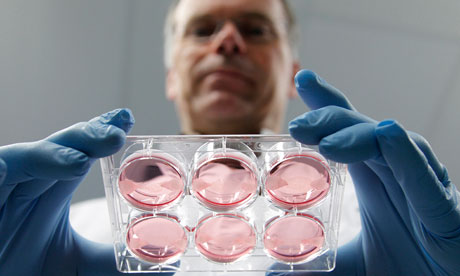
Dutch scientist Mark Post holds samples of in-vitro meat, grown in a laboratory. Photograph: Francois Lenoir /Reuters
Before the end of the year, if Professor Mark Post of Maastricht University gets his way, the world's first test-tube burger will be flame-grilled by Heston Blumenthal at The Fat Duck in Bray and served to a celebrity guest. Meals at this restaurant don't come cheap, but this one will be the climax of a €250,000 research project – and a milestone in Post's quest to find new ways of feeding the world, without destroying the planet.
His petri-dish patty will be made from a mixture of fat and cow muscle grown from stem cells in a culture of foetal calf serum (that's blood plasma without the clotting agents) – a technology trialled in February. It may sound less appetising than a Big Mac – but it could bring huge environmental benefits. Producing beef this way results in a 96% reduction in greenhouse gas emissions compared to rearing animals, and uses 45% of the energy, 1% of the land and 4% of the water associated with conventional beef production.
Meanwhile, at Cornell University in New York, PhD candidate Jeffrey Lipton has developed a 3D food printer that lays down liquid versions of foods, dot by dot and layer by layer, to build up edible meals. "So far we have printed everything from chocolate, cheese and hummus to scallops, turkey and celery", he says. At present, the technology uses liquid or melted versions of conventionally produced ingredients, but the aim is to create a range of 'food inks' made from hydrocolloids – substances that form gels with water. Homaru Cantu, a chef who has used the printer to make sushi, thinks this could have big implications for sustainability, not least because there would be no prepping of fresh ingredients, and therefore no food waste. "Imagine", he says, "being able to grow, cook or prepare foods without the negative industrial impact – from fertilisers to packaging. The production chain for food would nearly be eliminated."

Viva_La_Revolution
(28,791 posts)but the aim is to create a range of 'food inks' made from hydrocolloids – substances that form gels with water."
You've heard of "glued meat" right? well, this will be meat made from glue. sounds like they're not even close anyway.
2on2u
(1,843 posts)Viva_La_Revolution
(28,791 posts)Aerows
(39,961 posts)If it has the same nutritional content and is safer, I don't see a problem. I love rare steak, lamb and I love sushi. If it is the same, but safer, why wouldn't I want to try it? Do you mill your own wheat to make flour and then make bread? If you don't, you are still far away from your food. In my view, this is similar.
Opinions vary, I know, I'm just curious why lab grown meat is so much more horrible than factory farm meat. I would think that there is a benefit to it. I can see the issue with control, because if you control the food supply, you control the populace, but still, it is undeniable that lab grown meat could take a tremendous burden off of our environment.
Viva_La_Revolution
(28,791 posts)so far I haven't seen a thing except glowing articles about how it's going to be great. not a word about nutrition or safety for that matter, you all seem to just be assuming it will be safe.  and for the record, factory farm meat sucks compared to grass fed, we're all just conditioned to think it tastes normal.
Aerows
(39,961 posts)This is a developing industry, and I remember as early as 1987 reading about a lab created piece of ham from potato bacteria protein. This actually seems like it is closer to nature than that experiment.
It has a ways to go, and I don't think anyone is much more than optimistic that it *can* happen. I think most agree that it hasn't happened, yet, but that's no reason to stop trying  .
.
2on2u
(1,843 posts)of heart or the mildly empathetic.
Viva_La_Revolution
(28,791 posts)you ever have your arm shoulder deep in a cow who can't get her calf out? I have.
We raised and butchered and lived off cattle and chickens. they were treated well and killed clean. never stressed let alone tortured like in the factory farms. one of my first memories is of our neighbor with tears in his eyes as he put down his favorite hog so his family would eat that winter. As the men were processing the hog, the rest of us, kids included were dealing with a flock of 100 chickens. by the end of the day they were cleaned and bagged. We understood how much work went into raising those animals, and we understood it was necessary.
2on2u
(1,843 posts)humankind, you can leave the kind part out when it comes to factory farms, what you experienced was a little different... a lot more sane.
Viva_La_Revolution
(28,791 posts)we all decided factory farms were disgusting 20,000,000 threads ago
Aerows
(39,961 posts)Like those "glued steaks" are those incredibly cheap, completely round "Filet mignons". They don't taste anywhere near like a real filet mignon, but I would prefer one of those (especially if ground up) in a heartbeat over a tofu burger. One is meat, and one ... isn't. I don't care how it got to the table and what you did to it. Tofu is not and never will be meat.
If this approaches the taste of meat, and it sounds very much like it will, it seems a superior solution to tofu and other "fake" meats. Those "fake meats" require a lot of processing, too. This is no different.
Aerows
(39,961 posts)smells like a burger, looks like a burger and has a texture like a burger... I don't particularly care how it came to the table, as long as I can get it medium rare just the way I like it  .
.
I would think that meat grown this way would probably be safer than "on the hoof" meat at rare or medium rare - not that it has ever stopped me before or ever will.
2on2u
(1,843 posts)If they are even remotely closer than tofu, I'm all for it.
HiPointDem
(20,729 posts)even cheaper.
indeed, why bother to feed half the population anyway. they just take up space. less of them, more room for the 1%.
Aerows
(39,961 posts)Realistically speaking, however, people starving to death would probably prefer amino acid and glucose shakes to starvation. I know I would, though it certainly wouldn't be my first choice
HiPointDem
(20,729 posts)to whom would it be helpful?

MineralMan
(151,269 posts)50 points to the house of the first person to identify the source of that one.
2on2u
(1,843 posts)MineralMan
(151,269 posts)Frederick Pohl mentioned it in The Space Merchants in 1952. It was vat-grown food. They called it Chicken Little.

Fumesucker
(45,851 posts)By the time Pohl wrote the sequel he had a lot more experience as a writer, I think it was a better book although The Space Merchants was a good read..
MineralMan
(151,269 posts)I went through a period of about a year when I read pretty much only science fiction, and then I moved on. Back then, I was a book a day reader.
And now, it's time for my second cup of coffiest.
tritsofme
(19,900 posts)2on2u
(1,843 posts)be on the menu as soon as the ships start landing it would appear.

alphafemale
(18,497 posts)Meat hasn't passed through your guts in 30 years.
I'm not eating printed meat.
Aerows
(39,961 posts)is passing through mine at this moment (and wow, is it delicious) and I'd try it. Can't be worse than a tofu burger.
Hell, the "barbecue ribs" that vegans eat that are made of peanut butter are far worse than tofu burgers. Anything that is an improvement... is an improvement.

undeterred
(34,658 posts)and tissue culture does carry the possibility of other kinds of contamination, including viruses.
2on2u
(1,843 posts)A non-chemical disinfection method which is gaining increasing acceptance is ultraviolet (UV) disinfection. UV kills all known spoilage microorganisms, including bacteria, viruses, yeasts and moulds (and their spores). It is a low maintenance, environmentally friendly technology which eliminates the need for chemical treatment while ensuring high levels of disinfection.
How UV disinfection works
UV is the part of the electromagnetic spectrum between visible light and X-rays. The specific portion of the UV spectrum between 185-400nm (known as UV-C) has a strong germicidal effect, with peak effectiveness at 265nm. At these wavelengths UV kills microorganisms by penetrating their cell membranes and damaging the DNA, making them unable to reproduce and effectively killing them.
A typical UV disinfection system consists of a UV lamp housed in a protective quartz sleeve and mounted within a cylindrical stainless steel chamber. The liquid to be treated enters at one end and passes along the entire length of the chamber before exiting at the other end. Virtually any liquid can be effectively treated with UV, including raw municipal water, filtered wash water, process water, brines, marinades, pickles and process effluent.
undeterred
(34,658 posts)lunatica
(53,410 posts)in the distant future who carefully cooked something so new and so revolutionary that everyone was incredibly curious to taste it. As you've probably guessed by now he was cooking real food with real ingredients grown in real soil. When his guests found out what the delicious stuff was, they all gagged and threw up.
HopeHoops
(47,675 posts)
pinboy3niner
(53,339 posts)...but no matter what we do, it remains stuck in the printer queue."
Fumesucker
(45,851 posts)It's only a matter of time until someone "prints" synthetic Long Pig..
I suspect there might be a substantial market for it, along with some fava beans and a nice chianti.