General Discussion
Related: Editorials & Other Articles, Issue Forums, Alliance Forums, Region Forums
74 Years Ago Today; The Demon Core irradiates Harry Daghlian - Daghlian dies 25 days later
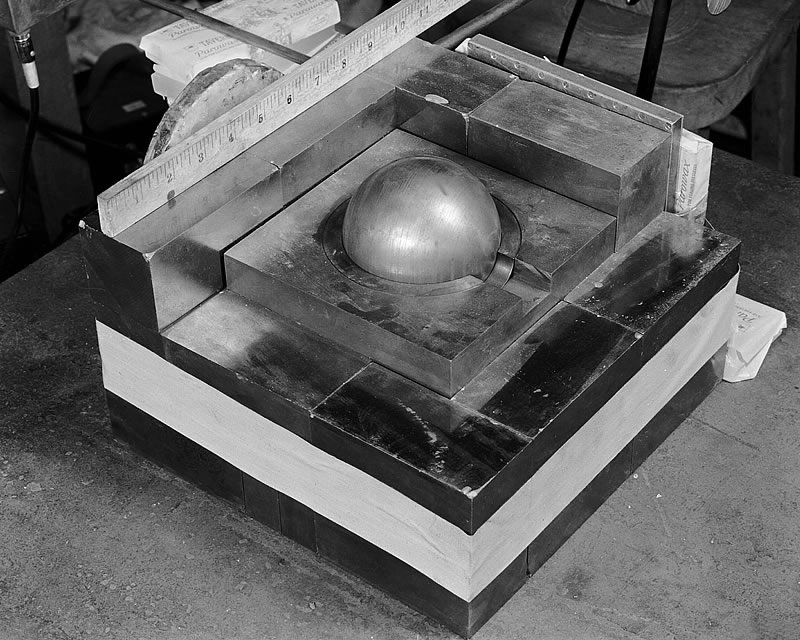
A re-creation of the experiment involved in the 1945 incident. The sphere of plutonium is surrounded by neutron-reflecting tungsten carbide blocks.
The demon core was a spherical 6.2-kilogram (14 lb) subcritical mass of plutonium 89 millimetres (3.5 in) in diameter, that was involved in two criticality accidents, on August 21, 1945 and May 21, 1946. The core was intended for use in a third nuclear weapon, but remained in use for testing after Japan's surrender. It was designed with a small safety margin to ensure a successful explosion of the bomb. The device briefly went supercritical when it was accidentally placed in supercritical configurations during two separate experiments intended to guarantee the core was indeed close to the critical point. The incidents happened at the Los Alamos laboratory in 1945 and 1946, both of which resulted in the acute radiation poisoning and subsequent deaths of scientists Harry Daghlian and Louis Slotin. After these incidents the spherical plutonium core was referred to as the "demon core".
Manufacturing and early history
The demon core (like the second core used in the bombing of Nagasaki) was a solid 6.2-kilogram (14 lb) sphere measuring 89 millimetres (3.5 in) in diameter. It consisted of three parts: two plutonium-gallium hemispheres and a ring, designed to keep neutron flux from "jetting" out of the joined surface between the hemispheres during implosion. The core of the device used in the Trinity nuclear test at the Alamogordo Bombing and Gunnery Range in July did not have such a ring.

The two physicists Harry Daghlian (center left) and Louis Slotin (center right) during the Trinity Test
The refined plutonium was shipped from the Hanford Site in Washington state to the Los Alamos Laboratory; an inventory document dated August 30 shows Los Alamos had expended "HS-1, 2, 3, 4; R-1" (the components of the Trinity and Nagasaki bombs) and had in its possession "HS-5, 6; R-2", finished and in the hands of quality control. Material for "HS-7, R-3" was in the Los Alamos metallurgy section, and would also be ready by September 5 (it is not certain whether this date allowed for the unmentioned "HS-8"'s fabrication to complete the fourth core). The metallurgists used a plutonium-gallium alloy, which stabilized the δ phase allotrope of plutonium so it could be hot pressed into the desired spherical shape. As plutonium was found to corrode readily, the sphere was then coated with nickel.
On August 10, Major General Leslie R. Groves, Jr., wrote to General of the Army George C. Marshall, the Chief of Staff of the United States Army, to inform him that:
The next bomb of the implosion type had been scheduled to be ready for delivery on the target on the first good weather after August 24th, 1945. We have gained 4 days in manufacture and expect to ship the final components from New Mexico on August 12th or 13th. Providing there are no unforeseen difficulties in manufacture, in transportation to the theatre or after arrival in the theatre, the bomb should be ready for delivery on the first suitable weather after August 17th or 18th.
Marshall added an annotation, "It is not to be released on Japan without express authority from the President", as President Harry S. Truman was waiting to see the effects of the first two attacks. On August 13, the third bomb was scheduled. It was anticipated that it would be ready by August 16 to be dropped on August 19. This was pre-empted by Japan's surrender on August 15, 1945, while preparations were still being made for it to be couriered to Kirtland Field. The third core remained at Los Alamos.
First incident
The core, assembled, was designed to be at "−5 cents". In this state there is only a small safety margin against extraneous factors that might increase reactivity, causing the core to become supercritical, and then prompt critical, a brief state of rapid energy increase.[7] These factors are not common in the environment; they are circumstances like the compression of the solid metallic core (which would eventually be the method used to explode the bomb), the addition of more nuclear material, or provision of an external reflector which would reflect outbound neutrons back into the core. The experiments conducted at Los Alamos leading to the two fatal accidents were designed to guarantee that the core was indeed close to the critical point by arranging such reflectors and seeing how much neutron reflection was required to approach supercriticality.
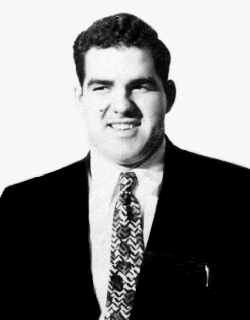
Harry K Daghlian
On August 21, 1945, the plutonium core produced a burst of neutron radiation that led to physicist Harry Daghlian's death. Daghlian made a mistake while performing neutron reflector experiments on the core. He was working alone; a security guard, Private Robert J. Hemmerly, was seated at a desk 10 to 12 feet (3 to 4 m) away. The core was placed within a stack of neutron-reflective tungsten carbide bricks and the addition of each brick moved the assembly closer to criticality. While attempting to stack another brick around the assembly, Daghlian accidentally dropped it onto the core and thereby caused the core to go well into supercriticality, a self-sustaining critical chain reaction. He quickly moved the brick off the assembly, but received a fatal dose of radiation. He died 25 days later from acute radiation poisoning.
</snip>

 = new reply since forum marked as read
Highlight:
NoneDon't highlight anything
5 newestHighlight 5 most recent replies
= new reply since forum marked as read
Highlight:
NoneDon't highlight anything
5 newestHighlight 5 most recent replies

rampartc
(5,835 posts)barely subcritical hemispheres of plutonium being somewhere near the top of the list.

DarthDem
(5,465 posts)I never knew any of this. Thanks for posting.

TrollBuster9090
(6,135 posts)the incident that killed Louis Slotin?
(Fictionalized because, in the movie they have it happen to a fictional character, and have it happen before the bombs are dropped, rather than after.)
It was a pretty good movie. Paul Newman did a good job playing General Groves.

panader0
(25,816 posts)Rec'd.

calimary
(90,817 posts)
hunter
(40,859 posts)It's done remotely, behind shielding, in this device:
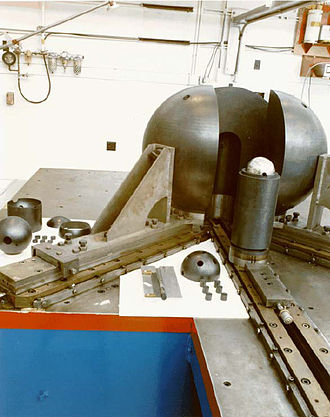
https://en.wikipedia.org/wiki/Flattop_%28critical_assembly%29
The core of the KRUSTY space power system was tested in this machine before full power testing of the prototype.
https://www.nasa.gov/press-release/demonstration-proves-nuclear-fission-system-can-provide-space-exploration-power
smirkymonkey
(63,221 posts)I really appreciate your historical posts. I find them fascinating. Some of them I am familiar with and some of them I have never come across, like this one.
Thanks again for posting! 


Kick in to the DU tip jar?
This week we're running a special pop-up mini fund drive. From Monday through Friday we're going ad-free for all registered members, and we're asking you to kick in to the DU tip jar to support the site and keep us financially healthy.
As a bonus, making a contribution will allow you to leave kudos for another DU member, and at the end of the week we'll recognize the DUers who you think make this community great.