General Discussion
Related: Editorials & Other Articles, Issue Forums, Alliance Forums, Region ForumsVoting machine vendors: corruption, opacity, and lies (17 min. video)
Important 17 min. video to watch and share with others -- some coverage of Ballot Marking Devices included
Voting machine vendors: corruption, opacity, and lies by Jennifer Cohn
 = new reply since forum marked as read
Highlight:
NoneDon't highlight anything
5 newestHighlight 5 most recent replies
= new reply since forum marked as read
Highlight:
NoneDon't highlight anything
5 newestHighlight 5 most recent replies

alwaysinasnit
(5,669 posts)
diva77
(7,880 posts)public oversight is the gold-standard for election integrity.


Ms. Toad
(38,890 posts)The error rate for hand-counted ballots is between .5% and 2% (depending on the method of counting),
The error rate for machine-read ballots is 1-2%.
The key is to change the law (if necessary) so that, in the event of a recount, the paper ballots themselves are the legally operative record of voter intent.
alwaysinasnit
(5,669 posts)and the people who operate them.
http://blackboxvoting.org/
Ms. Toad
(38,890 posts)final word on the expression of the voter's intent, the integrity of the voting machine is irrelevant.
Hermit-The-Prog
(36,631 posts)Here's a start:
https://www.verifiedvoting.org/voting-system-principles/
Ms. Toad
(38,890 posts)At least until the process by which voting machine software can be changed is updated to permit near-instantaneous changes.
Open source software is - generally - the most secure software around because the best minds have access to it, errors get discovered - and fixed - before they can be exploited.
Unfortunately, that same full visibility works against election security in a way that is not obvious to well-intended people who are unfamiiar with the reality of updating voting machines software.
In order to ensure that changes to the software do not adversely impact an election, it is a painstaking process to alter the software. It requires multi-level testing and government consent before implementation to prove it will not alter the integrity of the system. This is a process that takes (last time I was directly aware of it) at least two election cycles.
In the mean time - the open source software is being tested by anyone who chooses to test it, bugs are discovered and, as fast as they are discovered, people with nefarious intent devise ways to exploit the bugs.
Even with the fastest good guys writing code at the same pace as the bad guys, the bad guys have around a year head start on implementation BECAUSE of the appropriate barriers to allowing on-the-fly changes to voting machine software. So while we are waiting for the fix to be approved, the bad guys are exploiting the bug. And there's nothing we can do about it.
So - if there is a way to speed up the process of approving changes, even #7 would be fine. But that requires caution because it opens up the voting sofware to the introduction of un(or poorly) tested changes.
Hermit-The-Prog
(36,631 posts)No election can be verified if it depends on software or electronics.
The only role for electronics is to assist in creating paper ballots, for example, in Braille or other language for the voter.
Ms. Toad
(38,890 posts)Count, yes. Hand counting is just as inaccurate as electronic counting (see an earlier post) - so you are no farther ahead - and arguably farther behind because of the time it would take to hand count.
As long as the appropriate laws are changed to designate the ballot completed by the voter as the final record of their intent, there is no reason not to use the counting technology that is available, accurate (and verifiable becuase there is a paper it counted) and makes the task quicker and simpler.
I'm sure you use a computer - you're posting here. You probably have a cell phone so you don't rely on a land line. You probably have a furnace in your home, rather than a wood burning stove. I'm equally certain you would not recommend rejecting these technological advances in favor of earllier technology that was more costly (in time or money). There is no reason to make an exception here.
Hermit-The-Prog
(36,631 posts)Precincts should be small enough to facilitate quick, public counts.
My usage of computing devices has nothing to do with the purely logical reasons for eliminating them from elections.
It's fine to use a computing device to do 3d CAD, play some games, take an online poll. It's not fine to insinuate such devices between voter and ballot, and public and election. All of these devices are state machines -- see, e.g., https://www.freecodecamp.org/news/state-machines-basics-of-computer-science-d42855debc66/ -- and no voter, general public observer, or election official can attest to or verify all of the possible states of that machine. Beyond that, it is a completely unnecessary, opaque, obscuring collection of abstractions inserted into the conversation that is an election.
An election needs to use a physical token that (a) the voter can verify as a properly marked ballot reflecting his or her choice(s), (b) the public can observe to confirm that it is a single ballot, without being able to see the voter's choices, and (c) the public can tally. Introducing electronics at any of those stages breaks the verifiability of the election and thus invalidates it.
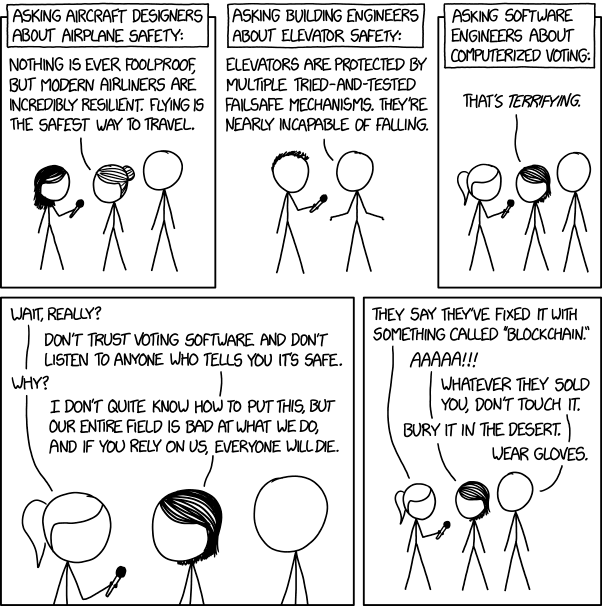
Naturally, there's an xkcd that addresses one part of the problem with computing devices in elections, that of how really atrocious programming actually is:
Ms. Toad
(38,890 posts)If the laws are revised, if necessary, to designate the ballot completed by the voter as the formal record of the voter's intent who or what counts it is completely irrelevant because the ballot is always there to audit.
(In some jurisdicitions the voter-marked ballot is already designated as the formal record - others it is not.)
To rearrange our entire system of voting (as would be necessary for your hand-counting scheme), is to allow the tail to wag the dog. Scanning are relied on for making all sorts of high stakes determinations. It is straightforward, reliable technology. It speeds up the vote count and is as reliable, if not more than hand counting. As long as the ballot itself is the final record of the voter's intent, it does not "break the verifiabiity of the election." The direct record, made by the voter is always there for verification.
If you want to observe vote counting - volunteer to be a precinct or county observer. Contact your local democratic member of the board of elections. They are always looking for more people to observe the process - you will have to be tied to a particular candidate, but a democratic board of elections member should be able to point you in the right direction. You'll be a lot less prone to hyperbole if you actually engage in the process you want to trash.
Hermit-The-Prog
(36,631 posts)The only "nonsense" is the belief that black boxes do not eliminate the ability to verify elections.
Having paper ballots as the formal record does not help so long as people rely on the number spit out by the invisible workings of the electronic device.
The reliability of the scanner is not relevant. It simply obscures the tally process from the people whose lives depend upon that tally.
Volunteering to be an observer of that which is humanly impossible to observe is futile.
Ms. Toad
(38,890 posts)and that's the problem.
Electronic voting systems were designed by the same folks who were providing mechanical systems. They designed them not as secure electronic devices, but as tools that depended on the same physical mechanisms as election protection has always depended on: locked doors, no access to the election materials without the presence of both parties (including during transport with members from each party being in the transport vehicle), voting in plain sight of both pollworkers who belong to each party, but your friends and neighbors, etc.
Being an observer would help you understand the physical security, the care taken by members of both parties to protect the integity of the election, the impossibility of actually carrying out all of the hacks people are suggesting are happening (none could have been carried out in any of the many precincts where I've been an observer, or in the county board of elections where I've also been an observer - for the entire process of the election from start to finish. (I have performed this service in both heavily democratic and heavily republican counties).
As I've explained repeatedly, what goes on inside the black box irrelevant when you have the actual physical ballots which are designated by law as the formal indicator of the voter's intent. Scanner technology is very straightforward - and has been used since at least the 70s on high stakes testing. I've spent a considerable amount of time testing at least two versions of the scanners currently in eletion service, and I've read the code for one of them. In the event there is a suspicion something is going on that shouldn't be, it is pretty trivial to test and confirm or dispel the suspicions because you have the physical ballots that produced the count.
Hermit-The-Prog
(36,631 posts)You advocate using something to hide a part of the election process. This is wrong.
I advocate making the entire process transparent to the electorate except for the association between voter and selections.
Hiding a part of the process behind some electronic device means the voters become complacent about the hidden part and it then becomes an accepted substitute for the hidden part. Nobody checks the "formal record".
Ms. Toad
(38,890 posts)In my life I've voted on at least 5 different kinds of voting machines. Some involving software and some not.
I'm not advocating hiding anything - what I am telling you is that the vote counting process has been automated for decades and - an automated process is (in your estimation ) hidden. But that "hiding" is not new..
In every single election in which I've voted in the more than 4 decades I've been voting, the counting process was mechanized. In lever machines the counting was were mechanized, the butterfly/punch card ballots were read by an electronic eye of sorts, the scantron-type ballots were read by an electronic reader. Not a single one of the 80+ ballots I've cast in my lifetime has been read by a human being. So what I'm suggesting is that you are fooling yourself if byo ubelieve that automated counting is somehow new since the 2000 election. The use of some form of automated device to count has been used since at least the 70s. I can't attest to anything before that, since I cast my first vote in 1974. Similarly, the reliance on physical, rather than electronic, security, has been a part of voting for at least that long. The latter is where the voting machine companies severely miscalculated - as, primarily, long-time mechanical voting companies who had to change with the time when voting became sexy and there was suddenly money available to buy new voting machines, they did not anticipate thaat anyone would expect the new-to-them software to be impermeable. In their minds, they were swapping one kind of voting device for another. And - in terms of how electronic voting was actually implemented, they were not wrong.
Hermit-The-Prog
(36,631 posts)A. Paper ballots: human readable, human markable, countable by humans
B. Electronic voting machines: no ballot exists except as an abstraction that lasts momentarily, machine actions not viewable by humans, numbers produced may or may not reflect human selections, not verifiable
C. Paper ballots counted electronically: ballots are human readable, but counted via a hidden process and tucked away while everyone points to grocery store checkouts as somehow evidence that the tally has not been hidden
Elections are more important than checking out at the grocery store.

Hekate
(100,133 posts)