General Discussion
Related: Editorials & Other Articles, Issue Forums, Alliance Forums, Region ForumsFinance sector as percent of US GDP, 1860-present: the growth of the rentier economy

Financialization is a term sometimes used in discussions of financial capitalism which developed over recent decades, in which financial leverage tended to override capital (equity) and financial markets tended to dominate over the traditional industrial economy and agricultural economics.
Financialization is a term that describes an economic system or process that attempts to reduce all value that is exchanged (whether tangible, intangible, future or present promises, etc.) either into a financial instrument or a derivative of a financial instrument. The original intent of financialization is to be able to reduce any work-product or service to an exchangeable financial instrument... Financialization also makes economic rents possible...financial leverage tended to override capital (equity) and financial markets tended to dominate over the traditional industrial economy and agricultural economics...
Companies are not able to invest in new physical capital equipment or buildings because they are obliged to use their operating revenue to pay their bankers and bondholders, as well as junk-bond holders. This is what I mean when I say that the economy is becoming financialized. Its aim is not to provide tangible capital formation or rising living standards, but to generate interest, financial fees for underwriting mergers and acquisitions, and capital gains that accrue mainly to insiders, headed by upper management and large financial institutions. The upshot is that the traditional business cycle has been overshadowed by a secular increase in debt.
Instead of labor earning more, hourly earnings have declined in real terms. There has been a drop in net disposable income after paying taxes and withholding "forced saving" for social Security and medical insurance, pension-fund contributions and–most serious of all–debt service on credit cards, bank loans, mortgage loans, student loans, auto loans, home insurance premiums, life insurance, private medical insurance and other FIRE-sector charges. ... This diverts spending away from goods and services.
In the United States, probably more money has been made through the appreciation of real estate than in any other way. What are the long-term consequences if an increasing percentage of savings and wealth, as it now seems, is used to inflate the prices of already existing assets - real estate and stocks - instead of to create new production and innovation?
http://en.wikipedia.org/wiki/Financialization
 = new reply since forum marked as read
Highlight:
NoneDon't highlight anything
5 newestHighlight 5 most recent replies
= new reply since forum marked as read
Highlight:
NoneDon't highlight anything
5 newestHighlight 5 most recent replies
dkf
(37,305 posts)There are big changes since then.
HiPointDem
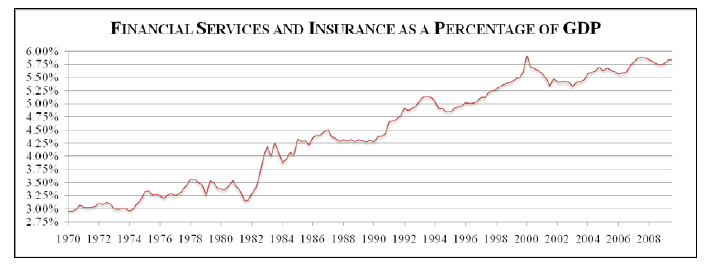
(20,729 posts)According to the latest data from the Commerce Department, the financial sector now accounts for 8.4 percent of the United States’ Gross Domestic Product, “eclipsing the peak it hit in 2006.”
In the 1950s, the financial sector accounted for less than 3 percent of GDP.
Meanwhile, financial firms are once again making more than 30 percent of all corporate profits in the U.S.
http://thinkprogress.org/economy/2011/12/14/389487/financial-sector-gdp-recession/?mobile=nc



JNelson6563
(28,151 posts)It doesn't matter when the article is from...we're doomed! DOOMED!!1!
Julie
HiPointDem
(20,729 posts)The Financial Sector Now Makes Up A Bigger Share Of The Economy Than Before The Recession
According to the latest data from the Commerce Department, the financial sector now accounts for 8.4 percent of the United States’ Gross Domestic Product, “eclipsing the peak it hit in 2006.” In the 1950s, the financial sector accounted for less than 3 percent of GDP. Meanwhile, financial firms are once again making more than 30 percent of all corporate profits in the U.S.
http://thinkprogress.org/economy/2011/12/14/389487/financial-sector-gdp-recession/?mobile=nc

leveymg
(36,418 posts)channeling the money back into reinvestment in jobs creation, since the rentiers won't do it voluntarily.

Kick in to the DU tip jar?
This week we're running a special pop-up mini fund drive. From Monday through Friday we're going ad-free for all registered members, and we're asking you to kick in to the DU tip jar to support the site and keep us financially healthy.
As a bonus, making a contribution will allow you to leave kudos for another DU member, and at the end of the week we'll recognize the DUers who you think make this community great.