General Discussion
Related: Editorials & Other Articles, Issue Forums, Alliance Forums, Region ForumsSo, what kinds of cars do people with low incomes buy?
Do they buy new cars? No, they don't, because they can't afford them, can't get car loans, and just generally don't even think about such a thing.
Nope. They buy older cars. If you go on Craig's List anywhere and visit the Cars for Sale area, setting the system to display vehicles with the lowest price first, you'll see the cars they buy.
Now, at one time, a guy could buy a cheap old car and make his own repairs to it, using junkyard parts and learning a little about wrenching on cars. I used to buy cars that way. I'd spend a couple hundred dollars on an undesirable older car that seemed to run OK. I'd fix little things on that car, as needed, and kept an eye on it at all times. If it started making expensive noises or acted funny, I'd sell it to someone else for the same couple of hundred dollars and buy a different one. I did that for about 30 years. Sometimes, I even made a few bucks on my cars, and got to drive some pretty cool older cars, but that's another story.
Today, that method of owning a car is dead. Just about every car on Craig's list in the $1000-2500 range is from the late 1990s or early 2000s. Every one of them has a computer, tons of emissions control systems and other complicated gismos in it. It has become very difficult to impossible to do your own problem trouble-shooting and repairs on any of those cars. Today's cheap cars are very, very close to the end of their lives. You can't have a mechanic fix them, either. At $100/hour labor costs and with modular designs, you can't just replace wheel bearings in your driveway any longer, for example. You have to buy a complete hub, instead, which will cost you at least a couple hundred dollars. Repairing what breaks on older cars often costs more than the car is worth, so the next stop is the junkyard, really.
It's still possible to drive older cars successfully and get rid of them before some problem develops that costs more than the car is worth. But, you have to know cars really well to do that. I finally quit buying older cars and bought a brand new one with a warranty and just make payments on it every month. Turns out that's cheaper and it's less likely to break down at a time when I can't afford to fix it. When the warranty expires, I trade it in and buy another new one. That's what most people do these days, really.
Except if you have a low income and can't get a new car. Then, you're stuck in a place that is very, very difficult to get out of. You're going to end up driving an older, but very complicated, vehicle that will certainly break down at the very worst possible time. When it does, you're going to be in a very bad position, indeed. A broken car and not enough money to fix or replace it is a disaster that is faced by many, many people every month. It's a dilemma without a good solution. When your car breaks, you're on the bus again.
It's hard to be living around the poverty line today. It's much harder than it used to be, and cars are one of the things that make it so difficult. I have no solution for this problem to offer, I'm sad to say. It's another good argument for a minimum living wage requirement in this country.
 = new reply since forum marked as read
Highlight:
NoneDon't highlight anything
5 newestHighlight 5 most recent replies
= new reply since forum marked as read
Highlight:
NoneDon't highlight anything
5 newestHighlight 5 most recent replies

Arne
(3,609 posts)Just lifted my hood and found a rats nest.
Turds everywhere.
Around here, squirrels hide acorns and stuff under the hood. You have to keep watch on that.
Arne
(3,609 posts)
MineralMan
(151,460 posts)They like to chew wiring and hoses. That can get really expensive really quickly.

Withywindle
(9,989 posts)This was in Chicago. Not only did all the wiring get chewed up but we found evidence of serious rat partying in there. Chicken bones and ketchup packets.

Bear Creek
(883 posts)Is made out of peanut oil. You would think they would choose a oil that wasn't edible.

ancianita
(43,314 posts)Just a thought.
Arne
(3,609 posts)

rzemanfl
(31,421 posts)Black squirrels had taken over the neighborhood. One subzero morning I unplugged the engine heater on my wife's car, turned the key and all sorts of black stuff came out from under the hood. We called that squirrel "Stumpy" whenever we saw it. It paid a price for a warm place to sleep.
Archae
(47,245 posts)I saw one incident myself, my Dad delivered fuel oil to a farmhouse, and when he started the oil truck we heard a screech from under the hood, a cat had got caught in the fan belt and killed.
Was I ever sad.

LeftInTX
(34,696 posts)Although it was during the summer. New Jersey.....
The cat survived. It was touch and go. After a few weeks cat came home with a cast, bandages and a bunch of yellow powder on his wounds.
I was really pissed at my mom because she didn't look for the cat before she started the car. I was also mad that we didn't have an "indoor cat"...(Cat could sleep in the bathroom, but couldn't wander around the house. Afterward, she changed her mind and cat's favorite show was Flintstones.

yellowdogintexas
(23,738 posts)Probably via the fender well. Those engine areas have plenty of little spaces that are somewhat safer than an auto.
Anyway, my brother in law went to the Co Op, got a haircut, then drove over to our cousin's house. Called my sister and asked her if she had seen the black cat - she said no I don't see him.
"Well, he just got out at Mark's" Cat rode around in the engine compartment for 30 miles with 3 opportunities to escape.
He rode home in the cab

sinkingfeeling
(57,911 posts)miles on it. No body damage. I sold it to a 16 year-old for $1000 although I had an offer for $1500.

Arkansas Granny
(32,265 posts)The cars have often times been in wrecks which are repaired and been made to look presentable enough to sell. Many have been repossessed when someone couldn't keep up with payments.

quaker bill
(8,265 posts)how do I know this? I would buy my beaters occasionally from these lots. I told them i had cash, and the price would drop 40 to 50% every time. But then like MM I had tools and trouble shooting skills, so I would drive beaters into the ground, and then junk them and buy another. These days I am careful and buy a pricier breed of beater.

DFW
(60,347 posts)The first car I bought on my own was a 1961 Corvair. That was in 1974, and it cost me about $125.
Looking back, it's a wonder I'm still alive.
MineralMan
(151,460 posts)I drove it for about six months and sold it for $200. It looked a lot better when I sold it than when I bought it.
I liked that little 2-door Corvair. Cool little car, really.
fwvinson
(488 posts)Beautiful car. Still love it today.
essme
(1,207 posts)One of the teachers I worked with has restored a 1960 Corvair-- I thought you might enjoy his website: https://www.viewsfromthevair.com/penny-lane
MineralMan
(151,460 posts)Thanks!
essme
(1,207 posts)I have enjoyed your posts over the years- I need to write to Earl and get my old name back (my husband did), but I have been reading you for a long time!
Stephanie
MineralMan
(151,460 posts)
erronis
(24,195 posts)the ground. I know, since I was a kid who "borrowed" the family "soap bar" car and drove a bit too fast.
Ralph Nader: https://en.wikipedia.org/wiki/Unsafe_at_Any_Speed#%22The_Sporty_Corvair%22
Arne
(3,609 posts)Look ma, No steering.
flotsam
(3,268 posts)The main complaint was camber tuck as experienced by all VW drivers and combatted by dune buggy owners (like me). Ralph Nader was a publicity seeking quack who used fear-mongering to kill off an American Design that could have competed with the VW, which, let us not forget sold as many (around 10 million) bugs as Ford sold model T's and in a much more crowded market. And from your source:
"A 1972 safety commission report conducted by Texas A&M University concluded that the 1960-1963 Corvair possessed no greater potential for loss of control than its contemporary competitors in extreme situations.[5]"
MineralMan
(151,460 posts)They were not designed for race-car maneuvers. The 1960 Corvair I owned was a nice little car with some very interesting mechanical innovations for an American car. I liked it a lot. Mine was a 2-door base trim coupe, with just the standard engine and a manual transmission. It performed well, was fun to drive, and I never experienced any handling issues. Of course, I drove it in a normal, sane way, just like I drove all cars. By the time Nader's book came out, GM had corrected the camber tuck issue, anyhow, but the book killed the car anyway.
I can't say it was my favorite car of all time. It was just a small, economical car to drive for six months in 1969. I replaced it with a 1959 Austin Healey Bugeye Sprite I found stored in a garage and paid $200 for. It was lots more fun to drive. That got replaced by a 1959 Austin Mini, which was even more fun to drive. I drove those cars for 6 months, too, and sold them for a profit.
But, the Corvair was cute, for sure. It ran well, and I only paid $100 for it, because of Ralph Nader's book. Never gave me a lick of trouble, although the gasoline-fired heater wasn't much to write home about. That didn't matter, though, because I was in California at the time.
Ralph Nader is a troublemaker. He also cost Al Gore the election in 2000. I will never forgive him for that.
flotsam
(3,268 posts)My Mother actually cried and stopped me. That was ok because it's replacement was a Triumph TR3.
MineralMan
(151,460 posts)My only Triumph was a 59 Triumph (Standard) 10. Cutest car ever made! It was an absolute girl magnet. Why, I'm not exactly sure, but it was.

LiberalArkie
(19,891 posts)bracket..

ismnotwasm
(42,674 posts)My husband and I used to buy $500.00 cars, spend a grand or so usually in things like new brakes, tires, other upkeep stuff. No car payment. Did this as long as kids were in the house. We still buy used, but gently used, like a year old.

lastlib
(28,453 posts)
jcgoldie
(12,046 posts)Like you I've bought used cars all my life. Some with less mileage when I had more money to spend and some real clunkers when I didn't. Of course they are not as reliable as newer cars under warranty, but your ability to work on them and fix them up is still pretty much in direct relation to your knowledge of automobile repairs and general mechanics. Computer systems on modern vehicles may seem daunting to you because you know nothing about them, but in the end replacing an O2 sensor or an alternator on a newer vehicle is not tremendously more complicated than rebuilding a carburetor or replacing the same alternator 30 years ago. People with no mechanical knowledge would still have to get help from a mechanic... unless they are your buddy their time was expensive then and it is now. I buy and sell used vehicles on craigslist as you mentioned, just sold a 10 year old impala police car with 200 k miles for $1000. It had a bad O2 sensor and air duct motors in the dash that were shot and continuously clicking trying to switch between inside and outside air. I didn't want to mess with tearing the dash apart so I sold it. The guy who bought it was no professional mechanic but he bought all the parts he needed for couple hundred bucks and he fixed it himself. When I talked to him 2 weeks later because I had signed the wrong part of the title, he was delighted like he'd gotten the deal of the century and I was just glad it was gone... same as it ever was... 
Locrian
(4,523 posts)pros and cons but generally speaking it all depends on your knowledge. "back in the day" it was dad, or your friends, or just about anyone on the block that had a mechanical background, worked in a factory, mfg, etc. We did lose a lot of that type of resource - true.
Now it's youtube videos etc. Diagnostics are better - buy a $99 BlueDriver or OBD2 scanner and you can trouble shoot a lot of common problems and save hundreds. Yeah, you're probably not going to pull an engine but "back in the day" that wasn't too common either....
Not to mention cars are just more reliable than back then and last longer, safer etc.
Now for "affordable" - (and what poor get conned into) that's topic for a different thread. It seems to be anyone with a pulse can get a car loan for 30K. To me that type of predatory sales and lending etc is a recipe for another financial bubble.

Ohiogal
(40,839 posts)My husband and you have a lot in common. He always, always, has worked on his own cars doing basic and not so basic repairs. I guess in his teen years he and his buddies were real gear heads. That’s what his generation did back then. He owned some interesting cars throughout his younger years. Some he kept longer than others, and almost every one he has a story to tell about.
Now, our present cars are kinda old by today’s standards. They run fine and there’s nothing wrong with them, so he (we) keep them because most new cars today are unaffordable when you live on a teacher’s pension. But that day will come, and I don’t know what we’re gonna end up with. My adult sons are pretty savvy about cars and they all tell me, “Dad is gonna hate when it’s time to buy a new car with all the new technology they put in them nowadays.”
A car is practically a necessity nowadays to be able to hold down a job. Yet car ownership is very costly ... the car itself, gas, repairs, insurance, and maintenance. I doubt this even crosses the radar of many wealthier individuals or many politicians, for that matter. What kind of car can you afford to own when making minimum wage? Who cares, it’s not my problem, they will probably think. Or, “get a job” which is their answer to everything, such as finding affordable housing, affordable healthcare, even starting a family. “Get a job”. As if toiling away at minimum wage cures everything.
It’s indeed a problem and yet another reason why being fully employed doesn’t always cure every one of society’s problems.

Rorey
(8,514 posts)I've been poor. Very poor. Poor to the point where there were consecutive days that I didn't eat.
Now I'm doing ok.
The thing is, when you're poor you have to live more in the moment than when you're not poor. These days, I can watch sales and stock up. If I see a good buy on something, I can get it, even if I won't need it for quite some time.
When you're poor, you really can't do that. You have to get what you need when you need it if you're able. If you're not able, you do without, even if it's essential. The concept of something being "essential" has a whole different meaning when you're poor.
When you're poor you can't stock up on those good buys because you might need that money that those good buys will cost for something else, like a pair of shoes for your child.
It doesn't make any sense, but being poor really is more expensive than not being poor.
MineralMan
(151,460 posts)Rorey
(8,514 posts)And how far I made it stretch. I'm still a pretty "cheap date" to this day. I just hate the idea of wasting anything. I don't think the stress of being extremely poor is ever forgotten.
MineralMan
(151,460 posts)were a test of what I called "voluntary poverty." I made it work, somehow. However, I had other skills I could have used to get a decent-paying job at any time, so there was that. I stuck with the writing stuff, though, and eventually made it work well enough to live a typical middle-class lifestyle.
Because I always had those skills, though, I had a safety valve I could use if necessary. I just never used that safety valve, and got through those times OK.
Rorey
(8,514 posts)For a few years I was the sole supporter of my family. I had four kids and a sick husband. After he died a whole lot of people seemed to pity me and wanted to help. The thing is, when he died my financial situation wasn't as dire. Don't get me wrong, my heart was shattered to lose my husband, and I still miss him to this day. But at the time I had one less mouth to feed, and no longer had to figure out how I was going to pay for medicine for him and other health care costs. Also, after he died, my kids got Social Security benefits. My husband, who wasn't able to work and provide for his kids, was a better provider after he died through those benefits.
It just burns me so much when anyone talks about getting rid of SS benefits!
A few years before my husband died we bought a '69 Chevy Nova for $200 from an extended family member. We drove that car for six years. I could tell a lot of stories about that car.
MineralMan
(151,460 posts)
MerryBlooms
(12,359 posts)I think there are a lot of people who are living in the 70's. It's not like that anymore. You can't pick up good paying jobs as a teen. Rural is horrid and dead end. If you're in a town with little public transport, it's difficult. People assume everyone can get a car, not true, and if they do, there's unaffordable maintenance.
I drive a 2000 Honda Accord EX 5 spd manual. She has 90,000 on her. I've never had a major issue and she's easy to maintain. Regular maintenance is all she's ever needed. I can pop my hood and change my own filters, add fluids, etc... I have no doubt, with a new Honda it would be more difficult.
I was blessed with a dad who taught me how to drive in all weather conditions, car maintenance, jump a car, how to change tires with any kind of jack, change windshield wipers, etc... Not everyone has that experience. Before I was allowed to drive on the road, my dad made me learn how to parallel park. lol, Good times. I was 14 when he started teaching me.
My dad was a heavy equipment operator. I used to love going with him on the weekends. He would set me on his lap, and after showing me how, let me control the front end loader, grader, etc... omg, so much fun. He wasn't the perfect dad, but, some things he did perfect.
Rorey
(8,514 posts)It sounds like your dad was pretty cool.
I remember my mom making me change a tire on our car before she'd let me start driving. Of course she didn't know that my brother and I had been driving vehicles all over the place whenever they'd leave us home for a few hours. We lived on a farm, so all over the place wasn't far from there, and it was mostly tractors. It was a lot of fun.
MerryBlooms
(12,359 posts)I also remember when my husband died, that feeling of aloneness. It meant I had no one to call, just in case. I am pretty self-sufficient, but there are times I wish I still had someone to call. Sometimes just for someone heavier to jump on the shovel when I'm digging in a bed! Heh.
Rorey
(8,514 posts)I'm sorry for your loss. 
I was *lost* about a lot of things after my second husband died. I remember standing in the auto parts store with tears streaming dwn my face while I was buying a battery. He always did all of the car stuff.
When I eventually met someone else and it started to get serious, I was determined not to allow myself to depend on someone like that again. We eventually got married and I eventually did rely on him for some things. Then he voted for trump, and then he cheated, and I was alone again. But this time, I'm fine. I knew I could survive because I had done it before.
Of course it helps a lot that I've got two sons who live here in Colorado, and they're my heroes on a regular basis.

Flaleftist
(3,473 posts)"Take boots, for example. He earned thirty-eight dollars a month plus allowances. A really good pair of leather boots cost fifty dollars. But an affordable pair of boots, which were sort of OK for a season or two and then leaked like hell when the cardboard gave out, cost about ten dollars. Those were the kind of boots Vimes always bought, and wore until the soles were so thin that he could tell where he was in Ankh-Morpork on a foggy night by the feel of the cobbles.
But the thing was that good boots lasted for years and years. A man who could afford fifty dollars had a pair of boots that'd still be keeping his feet dry in ten years' time, while the poor man who could only afford cheap boots would have spent a hundred dollars on boots in the same time and would still have wet feet."
This was the Captain Samuel Vimes 'Boots' theory of socioeconomic unfairness.
The Boots theory seems intuitive, but many people fall victim to the trap laid out by the theory.
Wealthy people with access to capital and disposable income can make decisions with their money that leave them richer and better off.
One of my favourite examples is the simple task of doing laundry. Wealthy people can afford high-efficiency modern machines and bulk-purchased, good-quality laundry detergent. They own their own machines, and the cost per load is minimal over the lifetime of any good washer and dryer.
The poor? They spend hours lugging their laundry to a Laundromat and even more time waiting for the machines to finish. Those with less can't afford to buy in bulk, so they often end up buying small packets of detergent at huge markups. They pay a lot per load, and they can't do it at home.
https://moneywise.com/a/boots-theory-of-socioeconomic-unfairness

GreenEyedLefty
(2,116 posts)My ex and I were quite poor when we were in our early 20s. I remember even now how expensive it was. High rent, older cars, washing clothes at laundromats, usury level interest rates if a short term (payday) loan was needed.
sir pball
(5,347 posts)The reason that the rich were so rich, Vimes reasoned, was because they managed to spend less money.
Take boots, for example. He earned thirty-eight dollars a month plus allowances. A really good pair of leather boots cost fifty dollars. But an affordable pair of boots, which were sort of OK for a season or two and then leaked like hell when the cardboard gave out, cost about ten dollars. Those were the kind of boots Vimes always bought, and wore until the soles were so thin that he could tell where he was in Ankh-Morpork on a foggy night by the feel of the cobbles.
But the thing was that good boots lasted for years and years. A man who could afford fifty dollars had a pair of boots that'd still be keeping his feet dry in ten years' time, while the poor man who could only afford cheap boots would have spent a hundred dollars on boots in the same time and would still have wet feet.
This was the Captain Samuel Vimes 'Boots' theory of socioeconomic unfairness.
-Men At Arms

That has been my experience as well. Years ago, not only could I never buy more than I needed (if I could even buy that), but I ended up paying late fees on utility bills as well. I can remember being perpetually late on almost everything, rarely able to get a few bucks ahead.
Being I couldn't afford a decent reliable car, I ended up paying for many repairs until the car died on me. Several times I ended up with no car at all, which limited my ability to find gainful employment, keeping me in poverty. I needed a dependable car to get a better job, but I couldn't get a better job without a dependable car. I learned first hand that poverty is a vicious cycle that is very hard to break. The memories of that time haunt me still.

JCMach1
(29,233 posts)Uses less than $20 electricity each month and I have changed oil 2x and front tires once in 4 years.
Much cheaper than a beater
Rorey
(8,514 posts)I saw an electric one for a super good price, but the ad said the battery wasn't holding a charge. I looked up the price of a new battery and it was THOUSANDS of dollars!!! That kind of freaked me out.
JCMach1
(29,233 posts)It only air cools ...
Chevy battery engineering (especially on Volts) is very, very good.
Rorey
(8,514 posts)I'm just not knowledgeable enough on these things, and I was in sort of a spot when I bought my car. I had planned to drive my 2010 Chrysler Town and Country into the ground, and then the transmission in my daughter's vehicle went out. For two months I was giving her and my grandson rides. Then he got a job, and playing taxi driver started to get to be a bit too much. I decided to give her my van and get something else for myself.
caraher
(6,364 posts)You're right, batteries are super-expensive. But as noted, GM engineered a lot of protection for the Volt battery and my 2013 model's battery performance is still up to specifications.
The early Leafs were notorious for rapid battery degradation.
I had a similar experience to your when I bought the Volt. I test drove a used Prius at a dealership and it seemed OK, but I noticed the gas engine seemed to be running more than I'd experienced as a passenger in a friend's Prius. I noticed there was a service code - turns out it meant the battery needed to be replaced. Not much point to driving a Prius whose electric motor never runs!

bluedigger
(17,442 posts)Hard to find a vehicle under $3G and 200k around here. 

doc03
(39,134 posts)December every year he loads up his lot with older cars.
He sells them to people that get their earned income credit tax refunds. It is hard to get a fairly good car for less than $5000. I bought my niece one a few years ago for $2500 then a couple months later the head gasket went out. Turned out the head was warped and it was cheaper to get a used engine than fix the old one. She had it a couple years then the computer went $1400. She had a good credit rating so instead she was able to lease a new car. I think that is the way to go.
Rorey
(8,514 posts)To me, it doesn't make sense. Maybe I'm just not understanding something about it.
doc03
(39,134 posts)a good credit rating you can have a dependable car. After all if you buy a new car it isn't worth much when you get it paid off anyway.
Rorey
(8,514 posts)And if that new car still runs, then at least you've got a car at some point. At the end of the leasing period, you've got nothing.
I bought a 2016 with only 4,000 miles on it a few months ago. I think I was super lucky to find this particular car. It seems to be in perfect condition and is just right for me.
MineralMan
(151,460 posts)The big issue is keeping the driving mileage under the limit every month and keeping the car in top appearance condition. It's cheaper than buying a new car, on a monthly basis, but there's always a risk at the end of the lease. Additional turn-in costs at that time can cause a lot of problems for some people.
I don't do it. My strategy is to buy a car with a 5-year bumper-to-bumper warranty and finance it for 5-years. Then, when the five years are up, I trade it in on a new one. That, so far, has resulted in lower payments for the next new car. Residual value is important at that point. If your car is a popular model, the trade-in value will be high when you swap it out for a new one.
Rorey
(8,514 posts)It's affordable, and I don't have to worry about that whole mileage thing, though I don't drive all that much these days anyway.
I came pretty close to buying a new car, but fortunately my sons talked me out of it.

Victor_c3
(3,557 posts)I other than donating to local charities that address this issue, I’m not sure what can easily be done to provide reliable transportation to those in need.
MineralMan
(151,460 posts)A good transit system helps, but isn't adequate. I don't know of a good solution.
doc03
(39,134 posts)public transit. You don't have a car you are stuck.
GreenEyedLefty
(2,116 posts)I worked for a nonprofit in Flint, MI during the "contract (on) America" years. The Republican version of "welfare reform" was devastating. I remember getting phone calls from people in tears who said they wanted to work but couldn't afford a car, or more importantly, child care, which is criminally expensive.

obamanut2012
(29,470 posts)And even lower-end electric bikes. Way cheaper, less and cheaper maintenance, usually no insurance needed or special license stickers.
Downside is if you live sometimes cold (I don't) or someplace that came be very rainy (I do). I have to drive 15 miles to work so use a car now, but when I was just out of college and poor, I rode a bike -- and later a moped -- in snow, sleet, etc.
People in rural areas are really screwed.
Wellstone ruled
(34,661 posts)light up a fire. Let me add this to the thread. Cost of Insurance is totally nuts. Most people do not realize this,your Zip Code as well as your Bank Account ant Credit Score determine just how much your Insurance will cost you as well as how much deductible will be.
BTW,KIA's are Lease-able here for 99 Bucks,but we get killed with the License Fees. And as we know,people here like new. And the Curb-Stoner's are doing boom time Business. As well as the Buy Here Pay Here people.
greenjar_01
(6,477 posts)
MineralMan
(151,460 posts)
Initech
(109,021 posts)And the bottom line is that the people who own these places suck, and their products suck. And they repeatedly screw over the poor and low income people of this country.
Rorey
(8,514 posts)Huge rip-offs against poor people.
Another situation where this same concept applies is some mobile home parks. Desperate people can get into "their own home" for not too much money and a not great credit rating. They often don't realize that they're getting into a situation where they not only have to make the payment on their mobile home, they also have to pay lot rent, plus utilities and all repairs.
I didn't have any idea about this until I sat in eviction court and watched case after case of a mobile home park against tenants. It's a real con game against poor people, for sure.
obamanut2012
(29,470 posts)Away from home who don't know better.
exboyfil
(18,366 posts)When it would have taken about $2000 on each to keep them on the road. If I could work on cars like my coworker (he is able to bend brake lines etc), then it would have made economic sense to do that. Paying even an independent mechanic to do it did not make any sense. I ended up replacing both with a single vehicle - a 2020 Subaru and I bought the extended warranty. Even before I started working from home because of Covid, we had essentially gone down to one car. The 2002 was driven by my daughter to work and back. She bought herself a 2018 Subaru when the 2002 died.
I hated giving up my older cars, but it is definitely a greener solution. I feel bad for poorer people, and I have also thought how car ownership is just another barrier to anything but survival. I have no mass transit to get to my job, but I am fortunate that I live close enough to allow my wife to drive me to work. I can't imagine what it is like for people who have two or three part time jobs and part of the challenge is getting from one to the other after only 3-4 hours of work.
haele
(15,504 posts)I can really kick myself for selling my only "new car" - a 1989 Ford long bed 4 banger Ranger (5 on the floor) - to my neighbor back in 2002 when the clutch went out the same time as the manefold and I couldn't afford a short -block repair and the clutch even if I did most of it myself at the base auto hobby shop using a couple cases of beer to get other guys to help. I still occasionally see it around town - there's a particular odd couple of dents in the bed on the driver's side that looks like a T-Rex tried to take a bite out of it.
Now, we have a '11 Santa Fe that needs work that used to cost ~ $200, but now half the work requires specialty tools and factory training, so we are looking at going on 3 months sitting garaged while we save up $700 for a reputable mechanic to fix it.
Our other car is a dinky affordable economy car lease I had to get when I started a job commuting early and Laz needed the Santa Fe to shuttle kids to school, shop, etc... during the day. I got a lease because it was more reliable and actually cheaper than buying outright a reliable used car that might last five years with regular maintenance before it would need to be scrapped.
A good used car in San Diego starts around $5k, and generally requires at leas $300 a year maintenance to keep going.
A clunker sold on the side of the street with a 70% of dying on you after a year starts around $1200, with another $1000 or so of repairs that need to be made before it might be able to pass smog.
My current lease is $205 a month with gap coverage and they cover the maintenance on what would be a $16k new car. I'm lucky, working class just above median wage with reasonable credit and a military ID, which took $2k off the terms and we can afford that since my work doesn't require a large professional wardrobe. But ten years ago...I would have been scouring the auction sites with a mechanic buddy.
And those lower on the economic ladder than me - they're stuck with disposable cars. On average $1k or so every 2/3 years in car costs no matter how well they care for it.
It's worse now on the economy than it ever was.
Haele

LakeArenal
(29,949 posts)Runs great. 4x4. AC works. Kinda dirty.
Here in Costa Rica that is a great car and a great deal.
onethatcares
(17,003 posts)2WD that seems to work pretty well. 65K miles on it, body looks like it hasn't been twerked, in fact no dents. Interior is cloth and looks pretty damn good for the age. Oil looks good on the dipstick, doesn't make any funny noises, tires look like brand new without rot.
Was told that it was bought at auction after being donated by some charity (cars for the blind or whatever).
Maybe I got lucky, crossing my fingers that I did. From the seller it was 6800.00
My last truck was a 98 chev 2500 with one ton springs. 5.7 ltr automatic 2WD. I bought it at 69K miles and it went funky at 225K
I'll drive this one till one of us dies. but I do agree, after working on the older points/condenser/cap, carbed motors, there is hardly anything an owner can do with the newer models.

talkinghand
(1,309 posts)If you keep looking with persistence, you can find a lot that carries paper. These require proof of income and half down. I find a $3000 car and scrape together the half down. That’s been a whole paycheck at times. Let bills slide and cut back expenses. I make $300 payments and pay it off quickly.
When it falls apart within a couple years I go back to the same lot. I find a $6000-$7000 car or truck and since they don’t usually want that $3k car for trade they’ll offer like $600 for it. Sell it on CL for $1200 (ask $1500) and the lot will call all the high risk lenders. Take the $1200 plus another $800 - $1800 and put down $2k - $3k. Make $400 payments.
Call for deferred payments they let you defer up to three. If you get 60 days behind the tow truck will come one morning while it’s still dark. Lol. If it’s a nice driver he’ll knock on the door and let you get your stuff out : )
I don’t buy off Craigslist because car lots have to do safety checks including 1/2 the tread and no cracked windshields. Not that it won’t be a problem car that’s hit or miss. But it’s smogged and tagged so that’s worth the extra cost. Plus establishing a relationship with a local business. It’s fun to go down to the corner lot and test drive dream cars. After you’ve been a customer a couple years they just let you take the vehicles out. Too bad there’s never any gas in them lol
ToxMarz
(3,017 posts)I wonder if they will be more reliable and less costly to maintain.

BamaRefugee
(3,893 posts)is really hard, tools get stolen when you're not looking, you get an expensive ticket if you can't fix it before dark and have to leave one wheel up on a jack....ask me how I know!

davsand
(13,446 posts)A car not only can provide transport but also shelter. The income division in this nation is horrifying to all of us that are paying attention, and homelessness will most likely become an even bigger issue as we get further into the economic fallout from COVID and Pendejo45's mishandling of it. I've seen several examples of how fast the slide into homelessness is once transportation becomes an issue, and I'm worried it will speed up now. It is a horrific thing.
Sorry. Not to be any sort of preachy here because I know you all understand it. This has been weighing heavy on my mind lately.
Laura

George II
(67,782 posts)bucolic_frolic
(55,533 posts)I do mid-level things - brakes, starters, light electronics, light suspensions, alternators. Won't ever be able to do engine work, but for anything else there is info on YouTube and lots of instructions online. I diagnose cars just like illnesses - Google the symptoms. Almost always someone else has had your problem and posted it online.
Early computers were ok, but once you needed a scan tool to diagnose the codes, that became a problem.
Most things - shoes, socks, power equipment - they strip out the costs and make them cheaper so you have to buy them more frequently. Often this is because they were bought out in the Great Recession due to poor sales, and the new owners just want to make money. I've heard more than one qualified mechanic say cars today are 100,000 mile throwaways. Some good quality 80's and 90's cars you could go 300,000 if you fixed them.
With all the mergers, acquisitions, buyouts, spinoffs, division sales, nobody seems to make complicated things from the ground up. They buy components. If they won't put their name on them, they're no good. Only 2 or 3 car manufacturers make their own transmissions. That means engineering, design, testing, production. Very expensive. Most - even high end luxury cars - buy them from third parties.
Recenty a well-known food label started offering cheese. You know they don't make it. They contract for it. The goal is profit - a new line of goods. And the manufacturer just wants to off-load substandard product and make money too. It was the worst cheese I ever had.
Know your suppliers.

judesedit
(4,600 posts)Pepsidog
(6,365 posts)Evolve Dammit
(21,805 posts)A similar post could be about low-income housing, but that's another tale of woe for those making "minimum wage: It's a fucking greased rope, and the grease is getting thicker and applied much more frequently. Our first house was 45K and I thought we overpaid by 7K (1984). I really feel for the 20-30 year old guys and gals when it comes to expenses. Student loans are another major factor as well. As Liz Warren said, "the game is rigged." And it is.
Ollie Garkie
(356 posts)for 2600, runs great, only 110k miles, luckily when i bough it a year ago today i was already working at home,
who knows what would happen if i was putting "normal" miles on it

WheelWalker
(9,410 posts)Bought my last vehicle in 2000. A Jeep Cherokee. Currently have 289,000 miles and still doesn't use oil between changes. Bought it on a 48 month contract. A good value I reckon. At 72, I expect to expire before it does. I'm what you call a "person of low income". $1216/month Soc. Sec. What kind of vehicle does a "person of low income" buy? Answer: they don't.
erronis
(24,195 posts)That was the first year for both of those cars.
The 4Runner's crankshaft broke with ensuing damage and there was quite a bit of body rust. Eventually bought another 4Runner much later but wasn't as good.
The Rabbit I ran to the ground. Got up to 120MPH on a flat road in Kansas. The fuel pump kept giving out and clutches (wonder why).
Too many VW bugs and buses. Piss poor engines for what they were supposed to do. Drove across most of the US in the drafts of semis.
LeftInTX
(34,696 posts)In 2012, the AC kept dying on our 1998 Mercury Villager Minivan. The prognosis for repair of the AC was not good. There may have been engine issues that were causing the AC to go downhill. The AC worked, but did not cool...
We sold it for $1,700 Craigslist. (Brother in law sells cars, so it was his idea) I'm pretty sure the family was low income. They were OK with the van "as is"..they knew that it would not have AC...This is Texas and a Minivan does not have good air circulation via open windows... I don't know how long the VAN lasted for them.
Response to MineralMan (Original post)
infullview This message was self-deleted by its author.
MineralMan
(151,460 posts)Feh!
Response to MineralMan (Reply #67)
infullview This message was self-deleted by its author.

herding cats
(20,054 posts)I deeply hope you can consolidate your irrational anger with real statistics some day. Unless you have something impactful and relevant. We're not going to give a shit about some random, non-verified anomaly you're ticked off about.
As they say: link it or I never happened. Show us relevant statistics. Antidotal "first person" stories mean less than zero in this context. There's actual data out there about such. Not some random bitter relative, real traceable data.
Peace to you.

mbusby
(825 posts)...a cam shaft in an AMC engine back in the day. Had the help of someone I knew at work who tore down and rebuilt Corvette engines as a hobby. After doing it, I would not recommend doing your own.

appleannie1
(5,474 posts)I know someone that lives in the next small town. She is now walking almost a mile to work in the dark at 6AM no matter the weather just to keep food on the table. The transmission went out on the old beater she owns. You are so right in your assessment.
Hiawatha Pete
(2,082 posts)A few years back I invested in an OBDII scan tool from Princess Auto (a Canadian chain) - best $29 dollars I ever spent.
It comes with the code book listing all the trouble codes and almost anyone can learn to use it.
I used it to troubleshoot the check engine light on my car a few times, one time it was the downstream O2 sensor. Bought a new one across the border at Advance Auto Parts in Niagara Falls, NY for $53 (after the dealership quoted me $125 for the same sensor plus $125 labor) and I installed it myself.
That said, the new cars are really hard to work on-everything's crammed in there so tight and there's lots of things I would not venture doing myself.
And yes the time is long past due for a living wage. And better investment in public transport so people who cannot afford to drive or are not capable or too infirm to drive are not denied the same mobility benefits as those who are.
raccoon
(32,431 posts)MineralMan
(151,460 posts)Hiawatha Pete
(2,082 posts)
pnwmom
(110,307 posts)MineralMan
(151,460 posts)Many places have no such amenities
Manifestor_of_Light
(21,046 posts)The automakers in Detroit. They bought up the streetcar lines in many cities after WW II and ripped up the tracks.
They did this to force people to buy cars and pay all the associated expenses like gas, maintenance, parking and insurance.
I read that people in Houston have to pay more money every year in car expenses than anywhere else in the country.
I believe it because I grew up in Houston. So it's a case of big corporations colluding to screw us over as usual.
MineralMan
(151,460 posts)Sorry.
Manifestor_of_Light
(21,046 posts)Eisenhower built the interstate highway system in the fifties as a defense project.
Large suburbs were built in the 50s, requiring commuting to city centers and lots of street improvements. They were called Levittowns. People in rural areas have to have cars too. Big cities push against light rail, but the citizens love it. They tried to stop light rail in Dallas, and it was extended all the way to Denton, I believe.
MineralMan
(151,460 posts)The never had public transit and still don't. Cars are even more essential there, and incomes are even lower in many cases. There is not just one America.
Manifestor_of_Light
(21,046 posts)My statements about how nearly everyone in the whole country has to have a car was not ignoring small town and rural America. I was talking about cities and small towns too. You're assuming something I did not intend. I've lived in Texas my entire life. I am well aware that you have to have a car in small towns too.
I've lived in large cities, I've lived in small towns. You had to have a car to get around in the city, because the bus service was quite unreliable and joke. It was only used by poor people who had no other alternative.
If you live in New York, San Francisco, Chicago or Boston, you can live without a car. Those are all very old cities that are densely packed. They've had mass transit for a very long time. The big cities in the South were basically made inhabitable by the widespread use of air conditioning. They have somewhat old downtowns, but also have sprawl into multiple counties.

Ron Green
(9,873 posts)has been based on fear and cheap oil.
The automobile, while providing historic mobility and “freedom” (that’s a double-edged sword to be sure) to a growing consumer economy, encouraged and enabled “white flight” to suburbs built not incrementally as in past centuries, but instead to a finished state. At the same time, freeways through cites destroyed established communities, mostly of color, to serve private transportation. The entire suburban experiment, financed on debt and the promise of unlimited growth, has now come due - and almost every city in the U.S. is broke.
The private vehicle has so formed our assumptions that most Americans can’t imagine life without a car, despite the fact that - as witnessed in this thread - it’s become nearly impossible for people of modest means to participate.
AllaN01Bear
(29,742 posts)have a number of disqualifiers.. somone takes me shopping , drs. appointments .etc..
erronis
(24,195 posts)Several miles from any stores. We rely on social services and friends/neighbors to help us.
I hope that a new social awareness in this country will allow more of us to live good lives.
KPN
(17,461 posts)the one really good solution. Universal basic income, stronger protections for the rights to form unions and collective bargaining, and a more progressive tax code are others.
MineralMan
(151,460 posts)KPN
(17,461 posts)
Johnny2X2X
(24,352 posts)It’s a constant source of anxiety. Is my car going to make it to work everyday? What happens if this repair is $2000?
People would be surprised at the loan they can qualify for at a reputable major dealer. Go to the nice places that are affiliated with the automaker. The sub prime Car City type places are a scam and people get stuck in horrible deals with cars that break down anyway.
Bear Creek
(883 posts)The reason that the rich were so rich, Vimes reasoned, was because they managed to spend less money.
Take boots, for example. He earned thirty-eight dollars a month plus allowances. A really good pair of leather boots cost fifty dollars. But an affordable pair of boots, which were sort of OK for a season or two and then leaked like hell when the cardboard gave out, cost about ten dollars. Those were the kind of boots Vimes always bought, and wore until the soles were so thin that he could tell where he was in Ankh-Morpork on a foggy night by the feel of the cobbles.
But the thing was that good boots lasted for years and years. A man who could afford fifty dollars had a pair of boots that'd still be keeping his feet dry in ten years' time, while the poor man who could only afford cheap boots would have spent a hundred dollars on boots in the same time and would still have wet feet.
This was the Captain Samuel Vimes 'Boots' theory of socioeconomic unfairness.
Terry Pratchett, Men at Arms: The Play
MineralMan
(151,460 posts)orangecrush
(30,741 posts)The Crown Victoria Police Interceptor.
There is a reason the police and taxi companys used the Vic for so many years.
The most reliable passenger sedan ever built
Repairs are mostly inexpensive, as a fleet vehicle, it was designed to be easy to work on.
17 mpg, but all the power you will ever need.
5 star crash rating from all directions.
Kevlar panels in the front drivers doors and steel plates in the backs of the front seats, just the thing for less than safe neighborhoods.
Superior suspension to civilian cars, high performance brakes, driveshaft, external oil and transmission cooler, all stock.
Having people drive slow in front of me sucks
Got mine in 2015 for $4,000 dollars in black.
Inspection last month cost me the price of the sticker.
Friends made fun of me for driving this, they stopped laughing when I showed them the inspection fee.
Do your homework before buying one, know what common problems to look for, especially electrical as the cop hardware gets ripped out before auction and causes problems.
Also, it's amazing how polite other drivers have become since I started driving this. No tailgaters, no one cuts me off in traffic, people always wave me ahead of them (don't want me behind them), and I haven't received a single single digit salute. How great and much safer the highway would be if people were that nice all the time.

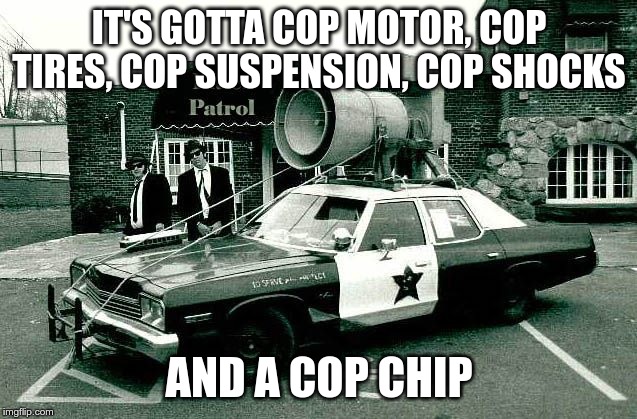

keithbvadu2
(40,915 posts)Used cop car in a nearby neighborhood.
No insignia but has the spotlight.
License plate:::::: SCARED U
happybird
(5,402 posts)The tags were NOT OJ 

BainsBane
(57,773 posts)Cars are expensive. I took a bus for many years. If you live in a city, buses are a good alternative.
MineralMan
(151,460 posts)I'm writing about a more general problem. I live in an urban city. It is a mile to the nearest bus stop and three transfers to any place where low income work is available or healthcare.
BainsBane
(57,773 posts)You live near a bus line.
Bear Creek
(883 posts)The buses were gotten rid of in the 80s.
BainsBane
(57,773 posts)and many other cities, I expect.
progree
(13,052 posts)BainsBane
(57,773 posts)that must be awful. I did bus it for many years, however. I now have a car. It's 13 years old but still runs fine.

cayugafalls
(5,975 posts)2800 for a 1996 Dodge Ram.
Easy to work on and nothing to complex. It had kind of low miles at 160k and has been a great truck. Of course gas is a concern, but I do not drive much at all and it is really reliable.
Cars and transportation should be a right for people in any 1st world country. The government should work to make all citizens have a fair shot at getting to work and getting around. it is why public transportation is so important.
I feel public transportation should be free or at least subsidized for people who need it.
ZERTErYNOthe
(262 posts)I am the kind of person you are talking about:
Now, at one time, a guy could buy a cheap old car and make his own repairs to it, using junkyard parts and learning a little about wrenching on cars.
I have been doing my own "wrenching" since the 70s, and briefly did it as a job. I can honestly say, it is far easier today than it was back then. Exhaust systems (mufflers, etc.) last a LOT longer. Materials are better, such as Stainless Steel. It used to be common to replace your exhaust every few years (remember the commercials "I'm not gonna pay a lot for this muffler"?).
Same with ball joints, tie rods, and other suspension parts. They last so much longer. What used to be replaced every 30K miles is now going strong at over 100K.
As far as computers, I think that is a blessing. I remember the days of tuning carburetors. and trying to figure out what is going wrong, pulling spark plugs and looking at the deposits, changing jets, that sort of thing. Now days the car tells you exactly what is wrong. It will tell you which cylinder is misfiring, most likely why, and from there it is a simple fix.
All of the typical stuff from the old days, brakes, exhaust, suspension, haven't really changed, and the new stuff is actually a bit easier to diagnose and fix.
I've flipped a few cars because of stuff like this, and made an easy return on on investment, and in one case got a nice single mom a minivan at well under market value, and still covered my costs.
I believe it is a credit to recent engineering that we believe we "can't" wrench on our cars, but the real issue is that we just don't need to as often, so it isn't that common.
I would LOVE to hear other viewpoints.
keithbvadu2
(40,915 posts)My new car is 10 years old. I keep it up cuz it's value to me is more than I would get as a trade in.
As I got older I was less able to repair them so a new vehicle was more economical and reliable.
The cheapest thing you can do for the most value is regular oil changes.
A friend of mine told me his son called him up and needed help. His engine was blown. He could not afford oil so he quit checking it. Funny how he could not afford oil but he found that he had to afford another car.
Mosby
(19,491 posts)Even though it will cost far more for the user, but that's the idea. Its a post-ownership society.
MineralMan
(151,460 posts)I'm not seeing that happening any time soon.
Mosby
(19,491 posts)If they make this work they don't need to sell cars, just send them out 24/7 to transport people who can't afford one.
progree
(13,052 posts)The manufacture of gasoline-engine cars causes as much greenhouse gas emissions (including the mining of the minerals all the way to final assembly) as driving them an average 15,000 miles per year for the average lifetime of a car.
Electric vehicles are even more greenhouse-gas intensive to manufacture, per Consumer Reports, though they didn't say by how much. So even if we manage to have a nominally completely carbon-free grid (as if that was possible), and switched to 100% electric vehicles, we'd cut the ground transportation carbon emissions by less than half.
Maybe today's 1.0 degrees C over pre-industrial times is not enough to force the necessary changes. But 1.5 degrees, 2.0, 3.0? Inarguably we're headed there unless things change drastically.
What's we're doing is way way way unsustainable. And its all happening faster than predicted so far and accelerating, as a read of the Environment & Energy group makes clear.

BlueIdaho
(13,582 posts)Even in rural areas it can work. As a kid, I lived in a town with a population of 5,000. We had a full blown metro bus service that cost a nickel a ride. Of course that was long ago, but still...
progree
(13,052 posts)There's a 10 person limit on the regular-sized 40 foot busses (15 on the articulated busses). The drivers are instructed that when they have reached the 10 person limit, they are to put on the chyron "Next Bus, Please". So you can't depend on the bus you were aiming to catch as not being "full". And if that's full, chances are good the next one will be too, it seems to me.
Where I live, just 4 miles west of the IDS tower (but as far as the bus service even back in pre-pandemic times, it's like being way out in the sticks), it's at least an hour apart other than the regular M-F commute hours. So "next bus, please" means wait an hour (or more).
I visit the MetroTransit Facebook page daily to see what's going on. (Also I ride the bus maybe 2 or 3 round trips a month).
As a consequence, and of the transit lockdown we had earlier in the year, and similarly in other cities, more people are buying cars that managed to do without until the pandemic.
Just another burden on poor people -- now unreliable public transit even in places, like the Twin Cities, where it used to be very reliable.
Bettie
(19,800 posts)I had to stop the car and reach through the door to get the window down without it falling through the door, but that vehicle lasted us six or seven years!
MineralMan
(151,460 posts)Bettie
(19,800 posts)I learned to drive it when my boyfriend (now husband of 31 years) had an infection in his knee and I had to drive him to the hospital. I accidentally downshifted on the highway and he screamed "CLUTCH!!!" and took over the shifting. I never did that again!
We made sure our kids learned to drive a stick...well, the two who drive. The little one is only 12!
Had one in the 80's.
Definitely a one calorie car.

Delphinus
(12,534 posts)stated that very well.
I lived hand-to-mouth for many of my years and was under major stress when my older car went on the fritz. I didn't have a backup car, family lived elsewhere, and friends were only able to help so much.
MineralMan
(151,460 posts)I've been there, too.
progree
(13,052 posts)on the regular-sized 40 foot busses (15 on the articulated busses). The drivers are instructed that when they have reached the 10 or 15 person limit, they are to put on the chyron "Next Bus, Please". So you can't depend on the bus you were aiming to catch as not being "full". And if that's full, chances are good the next one will be too, it seems to me.
Where I live, just 4 miles west of the IDS tower (but as far as the bus service even back in pre-pandemic times, it's like being way out in the sticks), busses are at least an hour apart other than the regular M-F commute hours. So "next bus, please" means wait an hour (or more).
I visit the MetroTransit Facebook page daily to see what's going on. (Also I ride the bus maybe 2 or 3 round trips a month).
As a consequence, and of the transit lockdown we had earlier in the year, and similarly in other cities, more people are buying cars that managed to do without until the pandemic.
Just another burden on poor people -- now unreliable public transit even in places, like the Twin Cities, where it used to be very reliable.
Kaleva
(40,401 posts)Arne
(3,609 posts)they're gone now, but on every corner is an Advanced Auto across from Oriylies across from Pep Boys.
Thankfully I can still do the light repairs.
MineralMan
(151,460 posts)So, I had the skills to repair the old cars I used to own. In my late 60s, I decided that working on cars was too hard on my back and other moving parts. Now, I'm 75, and I have no plans to work on vehicles any longer, unless absolutely necessary. That's why I got rid of my old 1991 Volvo 74 wagon a few years ago and switched to buying new cars that had warranties.
That said, I have a 1996 Ford Ranger in my driveway that needs an alternator and a rear brake job. I got an estimate for those, but it was more than the truck is worth. So, this spring, I will either replace the alternator and reline the drum brakes myself or donate the truck to a charity. I'm not sure which, actually. Neither job is very difficult, and I can certainly do both things. The new rear drums and other parts for the brakes will run about $100. The alternator is about the same price. The question is whether I am willing to do the work. I have all the tools I need on hand, but do I want to get down to do the brakes and bend over the fender to do the alternator? I'm not sure, actually.
Arne
(3,609 posts)I'll add even ball joints at one point could not be removed.
I got the rat and cleaned up the mess.
MineralMan
(151,460 posts)Oh, the ball joints can be replaced, but often not in your driveway.
I once bought a GMC Jimmy with 90,000 miles on it. Paid $6000 for it at a dealership. Worst vehicle I have ever owned. From what I can tell, it was designed to function for just 100,000 miles and then be taken to a junkyard. At the 100K mark, everything started failing. Front hub bearings. Then ball joints. Then the 4WD control module. Then one thing and next another thing. Every one of those failures cost at least $500 in the shop to fix. Others cost much more. That SUV was a POS, and no mistake about it.
In the end, I put it on Craig's List and sold it to some guy for $500, after the intake manifold developed a water leak. Good luck to him.
That's when I was down to just that 1991 Volvo 740 Wagon. Then, it started having small failures in its primitive computer control system and fuel injection system. Other problems also occurred. I repaired all of those things myself, and then sold it to some young guy for $1000.
Then, my wife and I bought a brand new 2013 KIA Soul ($18K out the door) and cut back to just one car. We drove that for seven years and replaced it with a 2020 KIA Soul $20K out the door, which we will keep for five years, until its warranty expires and the loan is paid off. Then, we'll trade it in, too, while its resale value is still high (typically about $10K at five years. When we trade it, it will only have about 30K miles on it.
From now on, the cars I drive will have bumper-to-bumper warranties.
Arne
(3,609 posts)I love the Santa Fe, good looking, roomy and powerful enough.
It is an early generation that had no recalls, but front bearings sound like a helicopter.

crickets
(26,168 posts)