General Discussion
Related: Editorials & Other Articles, Issue Forums, Alliance Forums, Region ForumsThis message was self-deleted by its author
This message was self-deleted by its author (left-of-center2012) on Mon Sep 13, 2021, 12:50 PM. When the original post in a discussion thread is self-deleted, the entire discussion thread is automatically locked so new replies cannot be posted.
 = new reply since forum marked as read
Highlight:
NoneDon't highlight anything
5 newestHighlight 5 most recent replies
= new reply since forum marked as read
Highlight:
NoneDon't highlight anything
5 newestHighlight 5 most recent replies

Champp
(2,409 posts)I'm shocked, shocked I tell you. 

Brother Buzz
(40,404 posts)Luis Elizondo is a career intelligence officer whose experience includes working with the U.S. Army, the Department of Defense, the National Counterintelligence Executive, and the Director of National Intelligence. As a former Special Agent In-Charge, Luis conducted and supervised highly sensitive espionage and terrorism investigations around the world. As an intelligence Case Officer, he ran clandestine source operations throughout Latin America and the Middle East.
Most recently, Luis managed the security for certain sensitive portfolios for the US government as the Director for the National Programs Special Management staff. For nearly the last decade, Luis also ran a sensitive aerospace threat identification program focusing on unidentified aerial technologies. Luis’ academic background includes microbiology, immunology and parasitology, with research experience in tropical diseases. Luis is also an inventor who holds several patents.

lagomorph777
(30,613 posts)
DoD has confirmed what he says. Lots of detail still missing (e.g. the recent DoD report briefly mentions hundreds of sightings/detections, but fails to give details on any of them).
We need Avi Loeb's Galileo Project to bring this stuff out into the open so we can all understand it better.
Response to left-of-center2012 (Original post)
Gaugamela This message was self-deleted by its author.

montanacowboy
(6,730 posts)it will destroy the Christian religion and we can't allow that to happen.
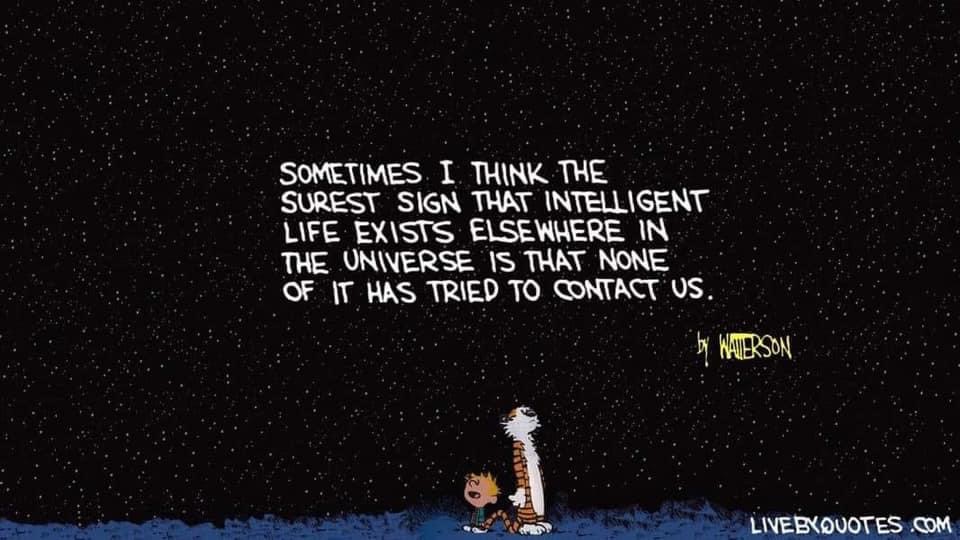
I hope I live long enough to see the little green men or whatever they are arrive on earth and give us a what for

machoneman
(4,128 posts)...what I'd call the religious right in space and on Earth after world wars, strife, etc. allowed religious fanatics to take over. Fascinating stuff.

jpak
(41,780 posts)The Invaders

Shanti Shanti Shanti
(12,047 posts)Pew pew pew!

USALiberal
(10,877 posts)

Tommymac
(7,334 posts)President Obama is right - take the unknown seriously and hope serious people are trying to use Science to figure things out.
Here is an example of one of those unknowns. Is it real or is it memorex?


lagomorph777
(30,613 posts)left-of-center2012
(34,195 posts)I bet if I posted a recipe to the food forum,
someone would come along and slap something political on it,
and yuck it up.
sad

stillcool
(34,407 posts)up there, must be all kinds of things that have been going on thousands and billions of light-years away. We humans have been looking up for forever, never running out of new discoveries, and it is still undefinable How could anyone say what is, or is not possible?
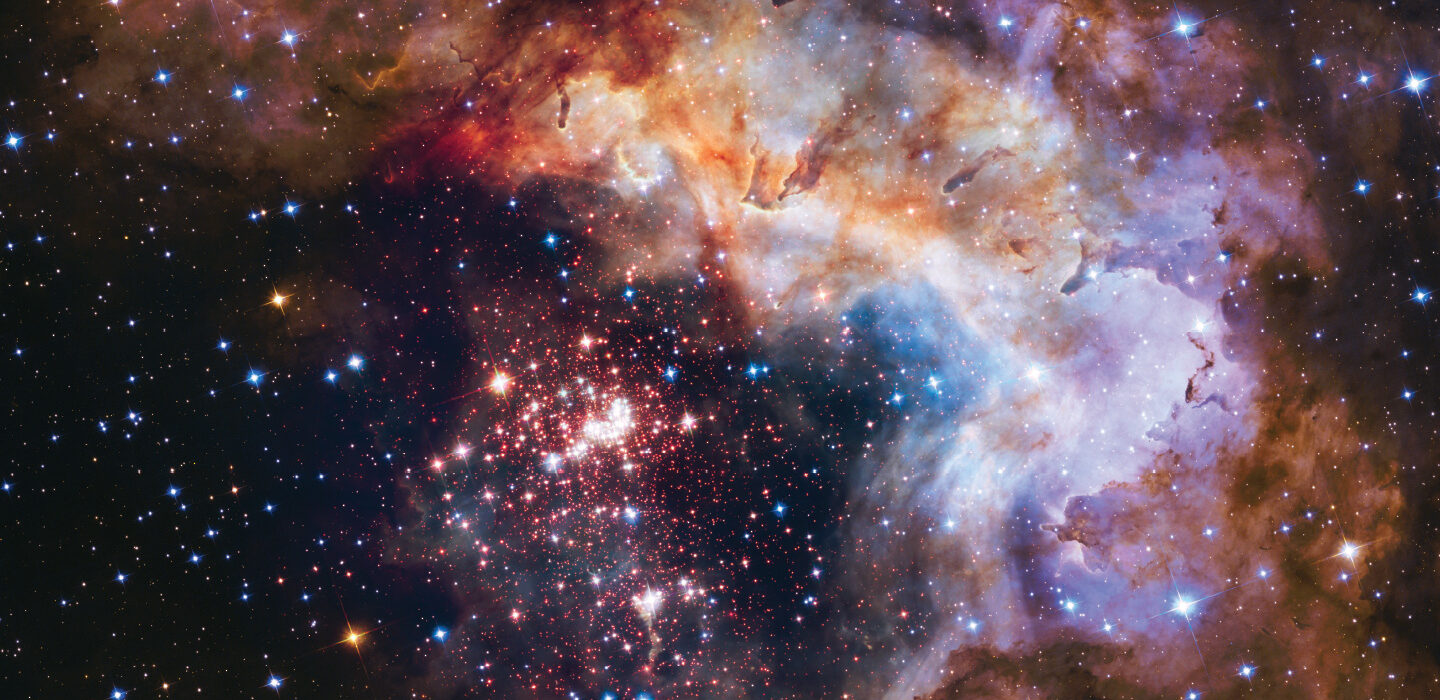
Clusters of stars like this one helped show that the Milky Way is enormous and just one of many galaxies. The glittering young stars in this Hubble Space Telescope image are about 20,000 light-years away in the constellation Carina.
NASA, ESA, THE HUBBLE HERITAGE TEAM/STSCI AND AURA, A. NOTA/ESA AND STSCI, AND THE WESTERLUND 2 SCIENCE TEAM
PLANETARY SCIENCE
A century of astronomy revealed Earth’s place in the universe
A series of revolutions in astronomy have bumped us from the center of thingsBy Lisa Grossman
JULY 21, 2021 AT 9:00 AM
https://www.sciencenews.org/article/space-exoplanet-century-astronomy-earth-universe
A century ago, the Milky Way galaxy was the entirety of the known universe. We had no idea what made the stars shine, and only one star — our own sun — was known to harbor any planets. Of those planets, humans had explored only one: Earth.
“The stellar universe, as we know it … is a flattened, watch-shaped organization of stars and nebulae,” astronomer Harlow Shapley wrote in Science News Bulletin, the earliest version of Science News, in August 1921 (SN: 8/8/1921, p. 3). That sparkling pocket watch was the Milky Way, and at the time Shapley wrote this, astronomers were just beginning to conceive that anything at all might lie beyond it.
Today, spacecraft have flown by every one of the solar system’s planets, taking close-ups of their wildly alien faces. The solar system, it turns out, contains a cornucopia of small rocky and icy bodies that have challenged the very definition of a planet. Thousands of planets have been spotted orbiting other stars, some of which may have the right conditions for life to thrive. And the Milky Way, we now know, is just one of billions of galaxies.
The last 100 years have brought a series of revolutions in astronomy, each one kicking Earth a bit farther from the center of things. Along the way, people have not exactly been receptive to these blows to our home planet’s centrality. In 1920, the question of whether there could be other “island universes” — galaxies — was the subject of the Great Debate between two astronomers. In the 1970s, when Mars was shown to have a pink sky, not blue, reporters booed. Their reaction “reflects our wish for Mars to be just like the Earth,” said astronomer Carl Sagan afterward. And in the 1990s, astronomers almost missed extrasolar planets hiding in their data because they had tailored their search techniques to find planets more like those in our own solar system.

Kick in to the DU tip jar?
This week we're running a special pop-up mini fund drive. From Monday through Friday we're going ad-free for all registered members, and we're asking you to kick in to the DU tip jar to support the site and keep us financially healthy.
As a bonus, making a contribution will allow you to leave kudos for another DU member, and at the end of the week we'll recognize the DUers who you think make this community great.