General Discussion
Related: Editorials & Other Articles, Issue Forums, Alliance Forums, Region ForumsWhere the Heck Are We Going to Charge All of the Electric Cars?
https://slate.com/business/2021/10/electric-vehicle-tesla-charger-curb.htmlOne in three U.S. housing units does not have a garage, according to the 2019 American Housing Survey, and many of those households do not have their own parking spots. As gas stations slowly yield to electric chargers, the ratio of fueling nozzles to vehicles is plummeting, with some studies suggesting we’ll need as many as one charger for every two electric vehicles. The bipartisan infrastructure bill contains $7.5 billion to charge EVs, which President Joe Biden hopes will make up half of U.S. auto sales by 2030, up from around 2 percent today.
Where to charge them? Many cities are experimenting with EV charging at the curb, and extension cords have been spotted hanging from the windows of East Village tenements and Boston triple-deckers. Street parking has long been a lawless affair, and so far, electric vehicle charging at the curb is working much the same way: every driver for him or herself. By and large, experts fear that EV adoption will lag in places where curbside parking is dominant, such as New York City, which despite its liberal voters and enormous wealth counts just 15,000 electrics among its 2 million cars.
 = new reply since forum marked as read
Highlight:
NoneDon't highlight anything
5 newestHighlight 5 most recent replies
= new reply since forum marked as read
Highlight:
NoneDon't highlight anything
5 newestHighlight 5 most recent replies

randr
(12,653 posts)from the friction of tires

NickB79
(20,404 posts)You can recapture some lost energy, but you still need to charge eventually

ForgoTheConsequence
(5,214 posts)

MineralMan
(151,540 posts)The reality, however, is that most (not all, of course) people who must park on the street cannot afford electric cars in the first place.

Hortensis
(58,785 posts)And the inevitable subsidies will help some.
 My income crashed just around the time I was going to lease or purchase a new hybrid, had literally just taken one for a test drive. Now we'll wait for used, which is going to be a wait. Not entirely sure either of us will still be driving or the closest gas stations will still be there. But transitions are transitions.
MineralMan
(151,540 posts)With used car prices where they are now and with new car supply being very low, that will increase the pressure on lower-income people even more. They're already forced to buy older and older cars to afford one at all. That means that even used EVs, of which there aren't that many to begin with, will increase further in price.
I've been below the poverty line a number of times in my life. When I was, I bought crappy cars, but I had auto mechanic skills. That was long ago, when individuals could still repair most problems on their own. That time has passed. Used cars over 10-12 years old are no longer reliable, and repairs often cost more than the car is worth, frankly.
So people with lower incomes are stuck in a very difficult situation. There are some very inexpensive EVs out there in other parts of the world, but they don't meet US safety standards and won't be imported here.
Slow and painful. That's what the transition will look like.
Hortensis
(58,785 posts)and big societal transitions are practically guaranteed to load up that load. For those of adequate means, the switch will be neither slow nor painful.
Through most of my childhood I carried laundry to laundry mats, waited instead of playing, fended off creeps when necessary, and carried it home. Lots of people still do.
Since we never had a car, I walked and rode my bicycle distances only most kids today could never imagine themselves doing. But people, including kids, still do. And, like you, my husband fixed all our cars; our oldest was a 40-year-old Chevy 310 pickup when he gave it to an admiring friend; life spans could be as long as handy owners chose to fix them. Now...!
The Democratic Party has worked to make everyone middle class and shrivel poverty for more than a century -- and had enormous successes before the electorate decided they needed a change. But, a lot of low-income people have always joined others to vote to keep themselves that way, and as long as we have the vote that will never change.
Now, if we lose the vote, poverty and walking, instead of EVs, will become normal for far more people. For the foreseeable future, electric cars will be for people in democracies and for elites in trumpistans, where slow and painful is their "middle" class.
MineralMan
(151,540 posts)among people who could afford one if they wanted to. Living in an urban metro and always being interested in cars, I've seen the cars owned by people who park on the street. Typically, they live in apartment buildings that have no parking facilities at all. During the winter, ever snowstorm leads to people frantically trying to find a place to park so their car won't be towed away by the city. Often, they can't afford to bail the car out of the impound lot and they lose it.
Mass transit could help some, but often people work in places that take a couple of hours to get to on the bus. So, they have to have some sort of car. And the cars they can buy are mostly crapped out old cars nobody else would buy. If you look at street-parked cars for very long, you'll soon notice that many of them are running with a donut spare on one wheel. No money for a replacement tire. Blown out mufflers, noisy brakes, engines with misses that would require an overhaul to fix.
EVs won't fix that situation in any way, unfortunately. It will mean that there will be more clapped out cars with engines available, but the problem will be the same.
Those apartment buildings with no parking won't have charging stations anyhow. Many barely have reliable heat.
I'm not convinced, frankly, that the problem has a reasonable solution. Too much money would be required to create solutions. The low-income segment of society will just end up with even more problems to deal with.
Hortensis
(58,785 posts)to the list: what about rural dwellers late to benefit from this great change who ITM will find gas prices increasingly prohibitive, gas pumps increasingly far away, old car maintenance and parts increasingly expensive, moving to town also more/often prohibitively expensive, and whatever government sticks used to encourage switching more painful than government incentives are helpful? Of course the same for disadvantaged elderly.
Whatever. People will handle it as they always have, even if it means more time and money taken by the struggle and less available for preferred pursuits of happiness.
And who knows, maybe those swept up in the extremism of this era will fail to drag us over a nihilistic cliffe, we'll finally enter another era of enlightened government empowered by an enlightened majority, and this will all go much smoother and faster.
And you'll write a very popular book for young readers, but with unexpectedly good sales among adults also, explaining some of what they canNOT believe happened in this era. That's in the future, of course.
MineralMan
(151,540 posts)They're designed for urban environments and have none of the costly safety and comfort things we insist on. They're limited in speed to about 35 mph, have a relatively short range, charge quickly, and seat only a couple of people. None are available in the USA. None are scheduled to become available, either. If you're in China, you can buy one, or in a number of other places, but not here.
Think golf cart technology, really. Such vehicles are even legal in some places, like The Villages in Florida.
We may have to make them legal in this country for strictly urban transportation. That will take some time to soak in for us. It may never happen here. I don't know.
There are many alternatives to the cheapest EV available in the US. That costs around $30K. Not an option for many people who can't even finance a $5000 used car. Some of the global urban EVs sell for under $5K. But they're not of interest in this country. They sure are in other places on this planet, though.
Maybe we need to rethink. I can see them becoming an option here at some point.
Hortensis
(58,785 posts)So practical and needed that perhaps it'll turn out to be inevitable. Even in an impoverished, run-down RW state, inadequate transportion would cause shortages of those workers that can't be done without. And on a more positive side, I'd already choose for a car with a dashboard I didn't have to take a class to start using.
MineralMan
(151,540 posts)are not really something most people would buy right now, even if they were available, which they are, with many, many limitations.
Hortensis
(58,785 posts)have to change for us to buy a vehicle we'd be tempted to get out and push. (I once drove a rental Ford "Aspire" in No. GA mountains and speak from experience.)
However, a few sharp government sticks to make it necessary, and maybe a carrot to help chivvy us out the door sooner rather than later, could do that.

MichMan
(17,390 posts)None of those inexpensive EV meet safety standards that are required in this country.

Xoan
(25,570 posts)MineralMan
(151,540 posts)Not even close. In fact, it will take years before you'll see the quantity of used EVs at reasonable prices become available.
Blues Heron
(9,026 posts)every other utility runs along the street, why cant they put some outlets in? there are electric lines everywhere. If we can have zillions of parking meters we can have chargers. How is this a big mystery.
NickB79
(20,404 posts)Basically, it's a massive infrastructure investment with few standards in place right now and little planning so far. It has to be done, but it's gonna be harder than a lot of people realize.
MineralMan
(151,540 posts)EV chargers require power. More power requires larger wiring. Larger wiring requires a redesign of the underground utility system. Plug too many things into your wall outlet and the circuit breaker trips. Think of it that way.
So, no, you can't just "put in outlets along the street." Outdoor outlets require a different standard than indoor ones. Electricity isn't free, either. Who pays for the electrical power. The wiring doesn't exist now to install a charging station at every parking space. Everything would have to be redesigned, and all of that new infrastructure will cost a remarkable amount of money.
It's far more complicated than you think. On the other hand, people can now drive to a nearby gas station and fill up their car. That infrastructure is already in place. The infrastructure for universal use of EVs does not. It will have to be built from scratch.
Blues Heron
(9,026 posts)
walkingman
(11,153 posts)Last edited Sat Oct 30, 2021, 10:04 AM - Edit history (1)
on the interstate, do you walk to a charging station to get a bucket of electricity? Or maybe a F-150 will come along and give you a boost!!
Mosby
(19,491 posts)
Liberal In Texas
(16,420 posts)
I would imagine in the future you might see AAA trucks with portable chargers for people stupid enough to run out of power on an interstate.
walkingman
(11,153 posts)
drray23
(8,821 posts)
phylny
(8,819 posts)who run out of power aren’t stupid, just unlucky 😊

Backseat Driver
(4,671 posts)at next charging station with the partnered Orbiting-Assist Apple app or Android Alex-Assist, both with Driver-less Tesla technology tool to then summon your vehicle once you arrive at the charging station for first-in-line emergency charge! No VIP status or "taking cuts" discount available for F-150 booster rocket charge for at the curb minimum charging. 

Diamond_Dog
(41,040 posts)Perhaps in cities, it would be feasible to increase public transportation and make it clean, safe, and reliable. But yes what to do about your car is a problem.
jimfields33
(19,382 posts)to be very popular. Lol. I’d hate to see that electric bill.

Luciferous
(6,601 posts)
spanone
(142,053 posts)jimfields33
(19,382 posts)My extension cord hanging out my window. I wonder if some will attach their own extension cord to it, to go down the street with it.
CentralMass
(16,994 posts)That seems to cover the home charging scenario. (Charging with 110V using an extension cord - "Level 1 Charging" ). The cost go down with level 2 & 3 charging due to the greater efficiency. from the article as cheap as $3.10 per 100 miles of charge.
https://electrek.co/2021/10/27/how-much-does-it-cost-to-charge-a-tesla/
The executive summary for their example is that for an EV with a 75kwh battery and 305 mile range it would cost $19.41 to charge so $19.41/ 305 = $0.064 per mile (rounded). Cost per 100 miles: 0.064 x 100 = $6.36 for 100 miles of range
The full text of that example is below.
"Here’s a semi-simple way to figure it out
Find your EV’s battery size (kWh).
Note the EPA estimated range of your EV, or the average range your specific EV is currently getting you.
Visit the EIA website
Look up the average cost of residential electricity in your state, or in the US as a whole.
Remember, these numbers are cents per kWh, so you’ll want to move that decimal place over to get to dollars.
(ex: 22.10 = $0.22)
Multiply your cost per kWh x the size of your battery.
(ex: 0.22 x 75 kWh = $16.50 to fully charge)
REMEMBER: We also need to account for charging efficiency (~85% for home and ~95% DCFC).
Ex: $16.50 / 85 = 0.0194 x 15 = $2.91 (additional cost from energy lost during charging)
Lastly, add for your total:
$16.50 + $2.91 = $19.41 to fully charge your 75 kWh battery from 0-100%
Now that we have that, we can calculate costs in terms of miles:
Take your total cost to charge, and divide it by your EV’s range, for an example we will say 305 miles:
$19.41 / 305 = $0.064 per mile (rounded)
Now multiply that by 100 to get your cost per 100 miles:
0.064 x 100 = $6.36 for 100 miles of range
FTC: We use income earning auto affiliate links. More.
Blues Heron
(9,026 posts)with no seeming understanding that its the current that is the limiting factor. Any voltage can be stepped up or reduced, but the delivery of high current is what requires the heavy duty wires etc.
dalton99a
(95,248 posts)
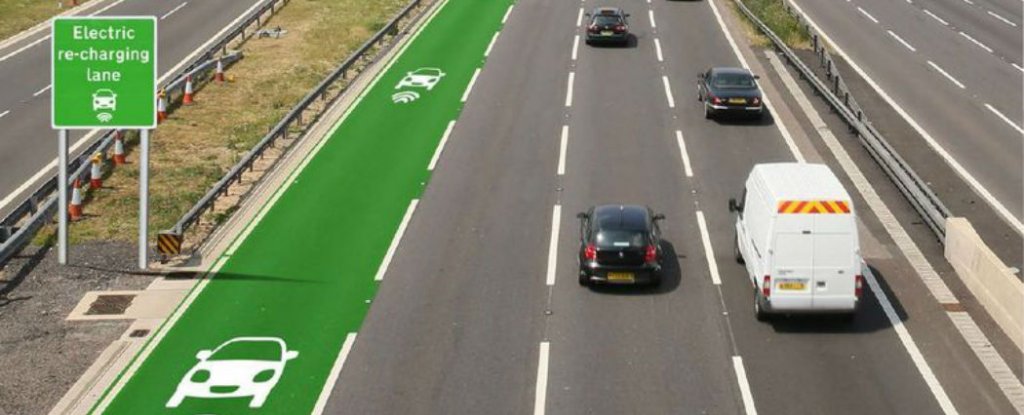
(Highways England)
NickB79
(20,404 posts)And how many miles of road do we need to tear up? We've currently got 4 million miles of road in the US.
Ripping up a half million miles of road isn't exactly a cheaper or faster alternative to installing millions of sidewalk chargers.
Hortensis
(58,785 posts)Charge times can be very short with high-capacity commerial chargers, so it's easy to imagine many routinely charging at work. Employers that didn't provide for all could set time limits at charging locations.
Regular home current apparently can take more much longer than a day for a full charge of an empty battery, so something will have to be done about that -- by those who can.
drray23
(8,821 posts)At my workplace we have four EV chargers free for use. If the number of EVs drastically increased that too would ramp up.
It will just become another incentive employers throw in to attract prospective hires . At least at a place like mine with scientists and high tech people.
Hortensis
(58,785 posts)just sooner at places like yours.
Some home workers who go in each week or so may choose to charge at work, and presumably many home workers will need to recharge less often and can have the car plugged in to a standard house outlet for long hours, almost never running it low.
Of course restaurants. Supermarkets and shopping centers would have to monitor use, but yes.
MichMan
(17,390 posts)
3Hotdogs
(15,544 posts)Cost 10K more than Sonata without hybrid. I drive 50K per year on average (sales).
How long before I recover the 10K? I didn't do good in math in high school. .... Not too good in English either.
Demsrule86
(71,555 posts)
Shermann
(9,072 posts)So they may have to visit a GigaCharger once a week or so. It's workable.
Demsrule86
(71,555 posts)Response to NickB79 (Original post)
leftyladyfrommo This message was self-deleted by its author.
drray23
(8,821 posts)Just use Google maps and search EV charging Spokane.
Hortensis
(58,785 posts)the charging stations that'll be needed. I love this stuff even if I don't use the tiniest fraction and our kids more often than not decide to teach us what they think we should be doing.
CentralMass
(16,994 posts)drray23
(8,821 posts)Unless I am reading it wrong it's way more than 54

frazzled
(18,402 posts)but no electrical service directly in our parking spot. Installing a, say, 240-volt Level 2 charging system probably would be a pretty expensive undertaking (not to mention going through the red tape of getting condo-board approval). Add that to the cost of the vehicle, and it's beyond our means. Our 14-year old Prius met its maker (well, needed a repair that was more than the car was worth), so while we would like to have gone electric, we opted for a new Prius instead, which is more or less half the cost of an electric vehicle and charges itself. We've been getting an average 59 mpg on combined city and highway driving, so we're okay with that for now. If it lasts another 14 years, we'll probably be too old to drive anyway.

ananda
(35,504 posts)It will run on EV after the battery charges,
but will switch back to gas.

Sapient Donkey
(1,568 posts)That actually charge 100% and do not cause extra strain on the battery. Basically make the process to refueling similar to what we have now, even if it takes 5 or 10 minutes longer.
That’s not really my wheelhouse, nor is battery tech something I follow too closely. So, I have no idea how realistic that is today.
scrabblequeen40
(335 posts)that's what I do.

Conjuay
(3,108 posts)i just noticed this week that our local mall is setting up a charging station for (I guess)12-15 cars. I expect there will be a "charge" (sorry...) for being able to wander the mall while your car is juicing up.
What is the price /rate for an electric charge?

Rhiannon12866
(258,780 posts)We've long had one at the local mall, and whenever I passed by before the pandemic, it was always occupied. There's now another one at the county municipal center in the "park & ride" lot and I've heard there's a third one downtown. I don't know what the rate is, but I noticed they were in use during the summer "tourist season." 

Beakybird
(3,402 posts)can't be stolen. You can charge the batteries in your home. Of course, 40-60 lbs per battery is a conundrum!!
PoliticAverse
(26,366 posts)
Fiendish Thingy
(24,055 posts)But I think King Coal Joe demanded it be stripped from the bill.
scrabblequeen40
(335 posts)
gulliver
(14,075 posts)Good article and thanks for posting. It answers its own question with " Some analysts suggest commercial destinations, where parking stays are shorter. Customers can charge as they shop, just as they would in the parking lot of a Target or a Whole Foods."
You would never have to stop at a gas/charging station again—bad news for the current "quick shop" model of refueling. Electricity is a whole lot easier to distribute to multiple locations (grocery stores, workplaces, restaurants... as mentioned in comments above) than gasoline. Honestly, our parents and grandparents put in vast numbers of utility lines and pipes, right up to every building and into every room that needed them. They'd be looking at this "where do we charge the cars?" problem and asking "what's the problem?"
On edit: I believe the real problem is getting to the needed level of electric power generation and distribution capacity.

hunter
(40,852 posts)Now we just sit around and whine.
The Republicans are the worst. All good things are impossible in their idiocracy. It's amazing they can wipe their own arses.

Best post on this thread by far. The naysayers think of everything in terms of "it'll be too expensive and take a long time to adapt". Alexander Graham Bell and Thomas Edison are rolling over in their graves.
Whatever happened to the so-called "can-do" American spirit?
I remember when hybrids were first discussed and the naysayers were out in force. No one blinks an eye at a hybrid any longer. Our trash haulers and school buses and public buses are mostly hybrids now and I know plenty of people who own them. EV's are coming one way or another, so why not just look for solutions instead of starting out from the stance of "it'll be too expensive and inconvenient and take too long."
ColinC
(11,098 posts)But when I stopped, it turned out I was in an electric car and couldn't find a charging station

csziggy
(34,189 posts)Maybe businesses could provide them for their employees or apartment complexes for their residents. Rather than having acres of asphalt surrounding malls, that area could generate electricity to power electric vehicles - and contribute to the grid or at the very least reduce the demand on the grid.

Kick in to the DU tip jar?
This week we're running a special pop-up mini fund drive. From Monday through Friday we're going ad-free for all registered members, and we're asking you to kick in to the DU tip jar to support the site and keep us financially healthy.
As a bonus, making a contribution will allow you to leave kudos for another DU member, and at the end of the week we'll recognize the DUers who you think make this community great.