General Discussion
Related: Editorials & Other Articles, Issue Forums, Alliance Forums, Region ForumsFlorida rejects math books with 'references' to critical race theory
This is crazy. I have never seen CRT discussed in other than law school classes.
Link to tweet
https://www.washingtonpost.com/education/2022/04/16/florida-rejects-math-textbooks-prohibited-topics/?utm_campaign=wp_main&utm_medium=social&utm_source=twitter
The Florida Department of Education announced on Friday that Richard Corcoran, the outgoing commissioner of education, approved an initial adoption list of instructional materials for math, but 41 percent of the submitted textbooks were rejected — most of them in elementary school.
Some were said not to be aligned with Florida’s content standards, called the Benchmarks for Excellent Student Thinking, or BEST. But others, the department said, were rejected for the subject matter. “Reasons for rejecting textbooks included references to Critical Race Theory (CRT), inclusions of Common Core, and the unsolicited addition of Social Emotional Learning (SEL) in mathematics,” it said in an announcement on the department’s website.
In ‘social-emotional learning,’ right sees more critical race theory
Although the department described the textbook review process as “transparent,” it did not mention which textbooks had been rejected or cite examples from the offending passages.
 = new reply since forum marked as read
Highlight:
NoneDon't highlight anything
5 newestHighlight 5 most recent replies
= new reply since forum marked as read
Highlight:
NoneDon't highlight anything
5 newestHighlight 5 most recent replies

LetMyPeopleVote
(183,586 posts)

Nevilledog
(55,179 posts)Link to tweet
Lindsey Simmons
@LynzforCongress
Y’all.
They burnin’ math books as a last ditch effort to make folks think 74,216,154 > 81,268,924.
3:34 PM · Apr 17, 2022
LetMyPeopleVote
(183,586 posts)
speak easy
(12,599 posts)"Freedom is the freedom to say that two plus two make four."
― George Orwell, Nineteen Eighty Four.

SergeStorms
(21,009 posts)that so offended them, but of course those are kept secret so no one is accidentally exposed to them and scarred for life. 
DeSatan has to go, but of course there's the GQP controlled legislature to pick right up where he left off. Oops, can I say "left" here on DU? 
speak easy
(12,599 posts)SergeStorms
(21,009 posts)Not legal in the People's Republic of DeSatan. 
old as dirt
(1,972 posts)I mean, assuming that Physicists can be trusted.
I don't always make that assumption, due to cultural differences.
Work From Home (Physics Version) | A Capella Science
"...but of course you'd think that, spending all of your time in your body"
Of course, spending all of my time in my body, I do wonder anything can generate heat without accelerating molecules by applying a force thru a distance somewhere along the line.
old as dirt
(1,972 posts)Mathematics has always been controversial.
Back before we started settling our differences by writing Fairy Tales, we tossed the heretics overboard and drowned them.
Or, something like that, anyway. Who really knows? It was some 2500 years ago.
What was up with Pythagoras?
Pythagoras had a problem with beans and irrationality. What really happened? I don't know! The square root of two is irrational, and beans are delicious.
We Don't Talk About Bruno (From Encanto)
Jim__
(15,308 posts)
underpants
(197,678 posts)Standards of Learning yep the S. O. L. s

FSogol
(47,685 posts)old as dirt
(1,972 posts)I'm pretty sure that I predicted this a couple of decades ago.
Defining Gravity (Wicked Parody feat. Dianna Cowern & Malinda Kathleen Reese) | A Capella Science
"No Physicist that is or was is ever gonna to bring me down!"
A Capella Science - Bohemian Gravity!
"A Tachyon, a Dilaton and Gravity!"
old as dirt
(1,972 posts)https://www.historyireland.com/william-rowan-hamilton-irelands-liberator-of-algebra/
William Rowan Hamilton— Ireland’s liberator of algebra
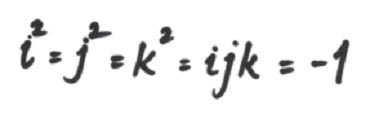
The formula for quaternions scratched by William Rowan Hamilton on Broombridge, Cabra, 16 October 1843.
‘ONE SMALL SCRATCH FOR A MAN, ONE GIANT LEAP FOR MATHEMATICS’
On a bright Monday morning, on 16 October 1843, the world of mathematics was changed forever. William Rowan Hamilton was walking along the banks of the Royal Canal in Dublin with his wife, Helen. As he passed Broombridge in Cabra, he had a flash of inspiration. Hamilton described the ‘eureka’ moment in a letter to his son some years later:
‘Although your mother talked with me now and then, yet an undercurrent of thought was going on in my mind, which gave at last a result, whereof it is not too much to say that I felt at once an importance. An electric current seemed to close; and a spark flashed forth, the herald (as I foresaw, immediately) of many long years to come of definitely directed thought and work . . . Nor could I resist the impulse—unphilosophical as it may have been—to cut with a knife on a stone of Brougham Bridge as we passed it, the fundamental formula . . .’
Thus Hamilton’s mind gave birth to a strange new system of four-dimensional numbers called ‘quaternions’. In a nineteenth-century act of minor vandalism, Hamilton scratched his mathematical creation on the bridge.
Liberator of algebra
The quaternions are Hamilton’s most celebrated contribution to mathematics. Two-dimensional numbers had played a significant role in two-dimensional geometry and in solving practical problems in two dimensions. Hamilton had been trying to extend his theory of two-dimensional numbers to a theory of three-dimensional numbers (also called triplets). He hoped that these triplets would provide a natural mathematical structure for describing our three-dimensional world. He had difficulty finding a suitable theory of triplets (we now know why—it’s impossible!). Then, on 16 October 1843, his mind gave birth to quaternions as he walked along the banks of the Royal Canal. In this moment of revelation he realised that if he worked with number quadruples and an unusual multiplication operation he would get everything he wanted. He named his new system of numbers ‘quaternions’ because each number quad-ruple had four components.
Hamilton had created a completely new structure in mathematics. The mathematical world was stunned by his audacity in creating a system of numbers that did not satisfy the usual commutative rule for multiplication. (This is the rule in arithmetic which says that it does not matter in which order you multiply two ordinary numbers, e.g. two times three equals three times two. The quaternions did not satisfy this rule.) This did not bother Hamilton because this is what usually happens in nature. For example, consider an empty swimming pool and the two operations of diving into the pool head first and turning the water on. The order in which the operations take place is important!
Hamilton has been called the ‘liberator of algebra’ because his quaternions smashed the previously accepted notion that any useful algebraic number system should satisfy the rules of ordinary numbers in arithmetic. His quaternions opened up a new landscape where mathematicians could feel free to conceive new number systems that were not shackled by the rules of ordinary numbers in arithmetic. One could say that modern algebra was born on the banks of the Royal Canal in Dublin. I suppose one could also say that it was ‘one small scratch for a man, one giant leap for mathematics’! Hamilton’s creation of quaternions is commemorated by a plaque which was unveiled in 1958 by the taoiseach, Éamon de Valera, who was a mathematician himself and a fan of Hamilton. De Valera paid homage to Hamilton by scratching the quaternion formulas on his cell wall when he was in Kilmainham Jail in 1924.
Use of the word ‘liberator’ illustrates the fact that freedom plays a significant role in mathematics. The notion of freedom in mathematics can surprise some people, but the mathematician Cantor once said that freedom is the essence of mathematics. In fact, one is free to conceive of any new ideas one wants in mathematics (just as Hamilton was free to conceive of the quaternions, even though they broke with convention at the time). These new ideas may or may not lead to something interesting or useful. Historically (and probably also in the future) the major breakthroughs in mathematics have typically happened because the great mathematicians were free to conceive of any new ideas they wanted, even if their wild thoughts broke with conventions and seemed bizarre to other mathematicians and the general public.
snip---------
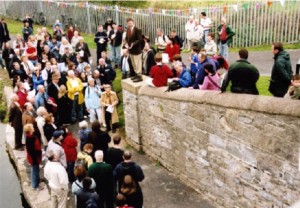
The annual Hamilton walk
The annual Hamilton walk, initiated by Professor Anthony G. O’Farrell in 1990, takes place on 16 October to commemorate Hamilton’s famous creation. It retraces his steps from Dunsink Observatory to Broombridge and takes about 45 minutes. I organise the walk, which typically attracts over 200 people from diverse backgrounds, including staff and students from third level, staff and students from second level, and many from the general public. The large number of participants from the general public indicates that there is substantial interest in Hamilton and the walk. I also receive many calls from the media and other bodies every year expressing an interest in doing a piece on Hamilton and the walk. Consequently, Hamilton’s story and the walk have appeared many times on a variety of television and radio programmes and in lots of news-paper articles. Cabra Community Council make the event into a very festive affair, with a large banner draped across the bridge and stalls along the canal. Fields Medallists Timothy Gowers and Efim Zelmanov, and Nobel Prize-winners in physics Murray Gell-Mann, Steven Weinberg and Frank Wilczek have participated in the walk. Broombridge has become a world-famous site in the history of mathematics and science because of Hamilton’s creation of quaternions. The word ‘Broomsday’ is now sometimes used in mathematical and scientific circles to indicate 16 October, and plays the same role as Bloomsday does for literary groups.
old as dirt
(1,972 posts)20 Things You Didn't Know About... Math
2. The great 19th-century mathematician Carl Friedrich Gauss called his field “the queen of sciences.”
3. If math is a queen, she’s the White Queen from Alice in Wonderland, who bragged that she believed “as many as six impossible things before breakfast.” (No surprise that Lewis Carroll also wrote about plane algebraic geometry.)
They've been complaining about Disney as well, lately. What's up with that? I wonder if there's a connection.
First Look! Disney's Alice Through The Looking Glass!
Bettie
(19,972 posts)this so called "CRT in math"...
But they won't give one because it doesn't fucking exist.
jcgoldie
(12,046 posts)6 white socks and 5 black socks are in a drawer. What are the odds of choosing a black sock at random?
A) 5/6
B) 5/11
C) 0 (because the black socks are all at the bottom due to systematic oppression) 
brooklynite
(96,882 posts)old as dirt
(1,972 posts)Algebra in Wonderland
By Melanie Bayley
March 6, 2010
Oxford, England
SINCE “Alice’s Adventures in Wonderland” was published, in 1865, scholars have noted how its characters are based on real people in the life of its author, Charles Dodgson, who wrote under the name Lewis Carroll. Alice is Alice Pleasance Liddell, the daughter of an Oxford dean; the Lory and Eaglet are Alice’s sisters Lorina and Edith; Dodgson himself, a stutterer, is the Dodo (“Do-Do-Dodgson”).
But Alice’s adventures with the Caterpillar, the Mad Hatter, the Cheshire Cat and so on have often been assumed to be based purely on wild imagination. Just fantastical tales for children — and, as such, ideal material for the fanciful movie director Tim Burton, whose “Alice in Wonderland” opened on Friday.
Yet Dodgson most likely had real models for the strange happenings in Wonderland, too. He was a tutor in mathematics at Christ Church, Oxford, and Alice’s search for a beautiful garden can be neatly interpreted as a mishmash of satire directed at the advances taking place in Dodgson’s field.
In the mid-19th century, mathematics was rapidly blossoming into what it is today: a finely honed language for describing the conceptual relations between things. Dodgson found the radical new math illogical and lacking in intellectual rigor. In “Alice,” he attacked some of the new ideas as nonsense — using a technique familiar from Euclid’s proofs, reductio ad absurdum, where the validity of an idea is tested by taking its premises to their logical extreme.
Early in the story, for instance, Alice’s exchange with the Caterpillar parodies the first purely symbolic system of algebra, proposed in the mid-19th century by Augustus De Morgan, a London math professor. De Morgan had proposed a more modern approach to algebra, which held that any procedure was valid as long as it followed an internal logic. This allowed for results like the square root of a negative number, which even De Morgan himself called “unintelligible” and “absurd” (because all numbers when squared give positive results).
The word “algebra,” De Morgan said in one of his footnotes, comes from an Arabic phrase he transliterated as “al jebr e al mokabala,” meaning restoration and reduction. He explained that even though algebra had been reduced to a seemingly absurd but logical set of operations, eventually some sort of meaning would be restored.
Such loose mathematical reasoning would have riled a punctilious logician like Dodgson. And so, the Caterpillar is sitting on a mushroom and smoking a hookah — suggesting that something has mushroomed up from nowhere, and is dulling the thoughts of its followers — and Alice is subjected to a monstrous form of “al jebr e al mokabala.” She first tries to “restore” herself to her original (larger) size, but ends up “reducing” so rapidly that her chin hits her foot.
Alice has slid down from a world governed by the logic of universal arithmetic to one where her size can vary from nine feet to three inches. She thinks this is the root of her problem: “Being so many different sizes in a day is very confusing.” No, it isn’t, replies the Caterpillar, who comes from the mad world of symbolic algebra. He advises Alice to “Keep your temper.”
In Dodgson’s day, intellectuals still understood “temper” to mean the proportions in which qualities were mixed — as in “tempered steel” — so the Caterpillar is telling Alice not to avoid getting angry but to stay in proportion, even if she can’t “keep the same size for 10 minutes together!” Proportion, rather than absolute length, was what mattered in Alice’s above-ground world of Euclidean geometry.
In an algebraic world, of course, this isn’t easy. Alice eats a bit of mushroom and her neck elongates like a serpent, annoying a nesting pigeon. Eventually, though, she finds a way to nibble herself down to nine inches, and enters a little house where she finds the Duchess, her baby, the Cook and the Cheshire Cat.
Chapter 6, “Pig and Pepper,” parodies the principle of continuity, a bizarre concept from projective geometry, which was introduced in the mid-19th century from France. This principle (now an important aspect of modern topology) involves the idea that one shape can bend and stretch into another, provided it retains the same basic properties — a circle is the same as an ellipse or a parabola (the curve of the Cheshire cat’s grin).
Taking the notion to its extreme, what works for a circle should also work for a baby. So, when Alice takes the Duchess’s baby outside, it turns into a pig. The Cheshire Cat says, “I thought it would.”
The Cheshire Cat provides the voice of traditional geometric logic — say where you want to go if you want to find out how to get there, he tells Alice after she’s let the pig run off into the wood. He points Alice toward the Mad Hatter and the March Hare. “Visit either you like,” he says, “they’re both mad.”
The Mad Hatter and the March Hare champion the mathematics of William Rowan Hamilton, one of the great innovators in Victorian algebra. Hamilton decided that manipulations of numbers like adding and subtracting should be thought of as steps in what he called “pure time.” This was a Kantian notion that had more to do with sequence than with real time, and it seems to have captivated Dodgson. In the title of Chapter 7, “A Mad Tea-Party,” we should read tea-party as t-party, with t being the mathematical symbol for time.
Dodgson has the Hatter, the Hare and the Dormouse stuck going round and round the tea table to reflect the way in which Hamilton used what he called quaternions — a number system based on four terms. In the 1860s, quaternions were hailed as the last great step in calculating motion. Even Dodgson may have considered them an ingenious tool for advanced mathematicians, though he would have thought them maddeningly confusing for the likes of Alice (and perhaps for many of his math students).
At the mad tea party, time is the absent fourth presence at the table. The Hatter tells Alice that he quarreled with Time last March, and now “he won’t do a thing I ask.” So the Hatter, the Hare and the Dormouse (the third “term”) are forced to rotate forever in a plane around the tea table.
When Alice leaves the tea partiers, they are trying to stuff the Dormouse into the teapot so they can exist as an independent pair of numbers — complex, still mad, but at least free to leave the party.
Alice will go on to meet the Queen of Hearts, a “blind and aimless Fury,” who probably represents an irrational number. (Her keenness to execute everyone comes from a ghastly pun on axes — the plural of axis on a graph.)
How do we know for sure that “Alice” was making fun of the new math? The author never explained the symbolism in his story. But Dodgson rarely wrote amusing nonsense for children: his best humor was directed at adults. In addition to the “Alice” stories, he produced two hilarious pamphlets for colleagues, both in the style of mathematical papers, ridiculing life at Oxford.
Without math, “Alice” might have been more like Dodgson’s later book, “Sylvie and Bruno” — a dull and sentimental fairy tale. Math gave “Alice” a darker side, and made it the kind of puzzle that could entertain people of every age, for centuries.
SergeStorms
(21,009 posts)the same way again. I had absolutely no knowledge of this explanation before. 
Now I'll never be able to get this out of my mind anytime Alice in Wonderland is mentioned (not that it comes up very often).
Thanks for that wonderful tidbit, old as dirt! 
old as dirt
(1,972 posts)
The latest edition of The Annotated Alice (by Martin Gardner, the Scientific American Mathematical Recreations guy) came out in 2015. It's bigger and better than the previous editions, and definitely not massless. They don't fly at the speed of light, for as they fly, they proceed thru time, and they change.
https://www.amazon.com/Annotated-Alice-150th-Anniversary-Deluxe/dp/0393245438
A richly illustrated and expanded collector’s edition of Martin Gardner’s The Annotated Alice, including Through the Looking-Glass, to celebrate the 150th anniversary of Alice’s Adventures in Wonderland
One summer afternoon in 1862, the Rev. Charles Lutwidge Dodgson took a rowboat out on the Thames. With him were three young friends from the Liddell family―the sisters Lorina, Edith, and Alice. Dodgson often spun fairy tales on these boating trips to pass the time, and on this particular afternoon the story was particularly well received by Alice, who afterwards entreated him to write it down for her. Dodgson recalled the pivotal moment thusly: "In a desperate attempt to strike out some new line of fairy-lore, I had sent my heroine straight down a rabbit-hole, to begin with, without the least idea what was to happen afterwards."
The tale, initially titled Alice's Adventures Under Ground, became Alice's Adventures in Wonderland, which Dodgson published in 1865 as Lewis Carroll. So began the journey, now in its 150th year, of one of the most beloved stories of all time.
The Annotated Alice: 150th Anniversary Deluxe Edition compiles over half a century of scholarship by leading Carrollian experts to reveal the history and full depth of the Alice books and their enigmatic creator. This volume brings together Martin Gardner’s legendary original 1960 publication, The Annotated Alice; his follow-ups, More Annotated Alice and the Definitive Edition; his continuing explication through the Knight Letter magazine; and masterly additions and updates edited by Mark Burstein, president emeritus of the Lewis Carroll Society of North America. In these pages Lewis Carroll's mathematical riddles and curious wordplay, ingeniously embedded throughout the Alice works, are delightfully decoded and presented in the margins, along with original correspondence, amusing anecdotal detours, and fanciful illustrations by Salvador Dalí, Beatrix Potter, Ralph Steadman, and a host of other famous artists.
Put simply, this anniversary edition of The Annotated Alice is the most comprehensive collection of Alice materials ever published in a single volume. May it serve as a beautiful and enduring tribute to the charming, utterly original "new line of fairy-lore" that Lewis Carroll first spun 150 years ago.
The deluxe anniversary edition of The Annotated Alice includes:
* A rare, never-before-published portrait of Francis Jane Lutwidge, Lewis Carroll's mother
* Over 100 new or updated annotations, collected since the publication of Martin Gardner's Definitive Edition of The Annotated Alice in 1999
* More than 100 new illustrations, in vibrant color, by Salvador Dalí, Beatrix Potter, Ralph Steadman, and 42 other artists and illustrators, in addition to the original artwork by Sir John Tenniel
* A preface by Mark Burstein, president emeritus of the Lewis Carroll Society of North America, and all of Gardner's introductions to other editions
* A filmography of every Alice-related film by Carroll scholar David Schaefer
* 225 color and black-and-white illustrations
"Massless" - 2015 NOBEL PRIZE NEUTRINO DISCOVERY (A Capella Science)
old as dirt
(1,972 posts)https://en.wikipedia.org/wiki/Neutrino_oscillation#Seesaw_mechanism
https://en.wikipedia.org/wiki/Seesaw_mechanism
Transforming the Border Wall into a Teeter-Totter | Rael San Fratello | ARTIST STORIES
old as dirt
(1,972 posts)In my experience, Fundamentalists don't believe in many of the entities that I believe in, which is fine until they try to Cancel my Culture with their intolerance.
Then their religion becomes too small for me.
Scott Aaronson
University of Waterloo
Abstract
Theoretical computer scientists have been debating the role of oracles since the 1970’s. This paper illustrates both that oracles can give us nontrivial insights about the barrier problems in circuit complexity, and that they need not prevent us from trying to solve those problems.
snip-------
https://www.scottaaronson.com/papers/subtle.pdf
Of course, it could be the Physicists, but they are generally more willing to accept that we come from different cultures with different beliefs, even if we do sometimes give them a hard time for not believing in the same things that we believe in, and vis-versa.
The odds that P=NP is 3% | Scott Aaronson and Lex Fridman
"...but because we are mathematicians, or descended from mathematicians..."
Kenny Rogers - The Gambler

jmowreader
(53,508 posts)…every problem looks like a nail. In this case, if the only tool you have is race-baiting every problem looks like CRT.
What might be interesting is if we had a list of these math books that supposedly contain CRT so that actual CRT teachers could look at them and decide if they really do contain CRT.
Response to jmowreader (Reply #23)
old as dirt This message was self-deleted by its author.
LetMyPeopleVote
(183,586 posts)LetMyPeopleVote
(183,586 posts)LetMyPeopleVote
(183,586 posts)This lady was rated as "not qualified" by the ABA and was confirmed after the election. The Federalist Society had ran out of qualified candidates and so TFG and MoscowMitch confirmed this idiot before Joe was sworn in
Link to tweet
https://www.wonkette.com/33-year-old-federal-judge
Yesterday, a 33-year-old woman who has never tried a case was given a lifetime appointment to the federal bench. She has only been out of law school for eight years.
Kathryn Kimball Mizelle, wife of Trump stooge Chad Mizelle, graduated college in 2009 and law school in 2012. She has practiced law for a total of four (4) years.
Now, she is a United States District Court judge for the Middle District of Florida.
The lame duck Senate confirmed Mizelle on Wednesday, by a party-line vote of 49 - 41.
With this confirmation, Mitch McConnell upended a 123-year-old Senate tradition of declining to confirm appointments by a president who lost reelection.