General Discussion
Related: Editorials & Other Articles, Issue Forums, Alliance Forums, Region ForumsDid Bernie Sanders block President Obama's appoints to the USPS Board?
https://www.dailykos.com/stories/2020/8/15/1969636/-Bernie-Sanders-did-indeed-block-Obama-Democratic-nominees-to-USPS-board
https://www.washingtonpost.com/politics/postal-service-trump-dejoy/2020/08/18/a9b4dd18-e14c-11ea-8181-606e603bb1c4_story.html
 = new reply since forum marked as read
Highlight:
NoneDon't highlight anything
5 newestHighlight 5 most recent replies
= new reply since forum marked as read
Highlight:
NoneDon't highlight anything
5 newestHighlight 5 most recent replies

Hekate
(100,133 posts)Things that make you go hmmmm
AntivaxHunters
(3,234 posts)Link to tweet
?s=20&t=B2x77BnJmhZDadDaUiGqlA

Demsrule86
(71,555 posts)Demsrule86
(71,555 posts)"McConnell basically said, 'if you don't give me James Miller III, I'm not giving you anybody,'" Sauber said. "And that's what he did."
McConnell's office did not respond to a request for comment.
The slate of nominees included former Sen. Ted Kennedy's widow, Vicki Kennedy, and Stephen Crawford, an economic sociologist who served on Obama's postal service transition team in 2009. Crawford said the group of five often met over lunch to discuss their mutual frustration at the ..."
https://abcnews.go.com/US/years-turmoil-postal-service-governing-board-fueled-political/story?id=72482926
He held his ground and got no one...a deal should have been made.

Celerity
(54,912 posts)Link to tweet
https://threadreaderapp.com/thread/1294314766572425219.html
Meet the postal nominees Bernie blocked:
James Miller: Ronald Reagan's OMB director who wanted to privatize the Postal Service
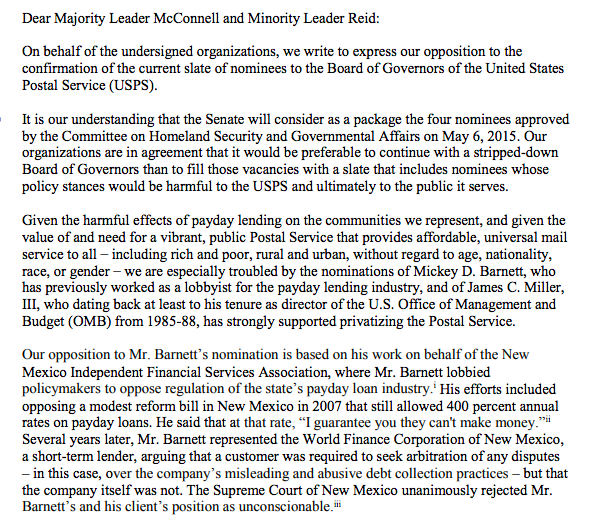
Mickey Barnett: A GOP payday lending lobbyist
Stephen Crawford: Who wanted to end Saturday mail and slash jobs, pensions and healthcare benefits
These postal nominees were opposed by:
Leadership Conference on Civil and Human Rights
American Postal Workers’ Union
AFL-CIO
AFSCME
NAACP
National Council of La Raza
SEIU
National Urban League
Read what they had to say about these nominees⬇️
What Jason may not understand is that the attacks on the Postal Service did not begin with Trump. For years, there's been a concerted attempt to dismantle and privatize the Postal Service for years - and Bernie has led the effort against those attacks again and again.
In 2012, Bernie formed a coalition of 27 Senators to stop the Postal Service from closing up to 15,000 post offices, eliminating more than 100 mail processing facilities, ending Saturday mail and slashing over 100,000 postal service jobs.
Now more than ever, let us unite to strengthen, protect and expand the Postal Service - and fight against every attempt to dismantle, sabotage, destroy and privatize it.
James Miller, 1 nominee Bernie blocked, said at his confirmation hearing: "I think it would be best for the world, for the economy & for the American people if the Postal Service was demonopolized and privatized, which is a position I held when I worked for President Reagan."
Mickey Barnett, another nominee Bernie blocked, was a lobbyist who fought against a bill in the New Mexico state legislature that would have prevented payday lenders from charging customers an interest rate above 400%. Read more from civil rights leaders⬇️
Stephen Crawford, the last nominee Bernie blocked, supported reducing the delivery of mail from 6 days down to as little as 3 days, slash jobs, undermine collective bargaining rights and provide fewer health care and pension benefits to its workers.
Who is Stephen Crawford and How Will He Affect the Post Office?
On 6/6/12, President Barack Obama nominated Stephen Crawford to be a member of the Board of Governors for the United States Postal Service for the remainder of the term ending in December 2015. The position was formerly held by Alan C. Kessler, who resigned amid controversy regarding the use of his influence on the Board to assist his business friends. The Senate must confirm the appointment of Crawford, although President Obama has the option of placing his nominee into position when the Senate is in recess. However, those expecting an appointment of a governor who will support the Post Office as a democratic institution, which will honor its mandate of providing affordable service to all its citizens, and good jobs for the country, may well be disappointed.
In late 2008, President-Elect Barack Obama named Stephen Crawford to his transition team for the United States Postal Service and Postal Regulatory Commission. Crawford’s job was to review and make recommendations on policy regarding the two postal agencies. Most notably, Crawford, as a, “Special Supplemental Employee” for the USPS, wrote a report for the Postal Service entitled, “Towards a New Business Model for the United Postal Service,” dated 10/5/09. Crawford’s report provides insight in to how Crawford could potentially affect the Post Office if appointed to the Board of Governors.
Manipulating Postal Workers
In his report, Crawford reveals his business strategy for undermining postal workers as follows,
“As for employees, engage them in discussions of ways to improve operations. Once the level of trust is improved, ask them about work rules and the trade-offs among the values they place on various aspects of their jobs and the compensation for it. If collective bargaining agreements restrict such direct communications with employees, seek changes in them, offering in the process to share the findings with the unions. (I realize that it’s easy for me to say that, much harder for management to do.)
Crawford further explains the challenge for management in obtaining concessions from postal workers while appearing to act in their interests. Crawford states,
“The challenge for management is to continue to work well with its unions on further downsizing its workforce while obtaining reasonable concessions on wages, benefits, and work rules. In the past pressing for concessions has lead to breakdown in negotiations and thus binding arbitration as called for by the relevant laws. USPS management believes that binding arbitration tends to ratify the status quo, as arbitrators seek to balance the demands of the two parties”
Crawford also advises management on how to best respond to arguments for keeping living wage jobs at the Post Office. Crawford uses the large mailer argument in stating,
“Defenders of the status quo may point to the fact that the Postal Service is one of the last places where minority group members and those without a college degree can achieve a middle-class standard of living. The answer to such arguments is that if the public wants to subsidize a traditional postal service and its employees, it’s free to do so through tax-financed appropriations. If not, it needs to free management to press for adjustments the way the Big Three auto firms did with their unions. The argument here should emphasize the tension between providing universal service without subsidies AND paying premium compensation to a large workforce, noting that it’s hard enough for USPS to do either without raising prices faster than inflation, much less both, and that in a time of declining volume per delivery, something has to give.”
Although it goes against the expressed policy of the Post Office, the claim that the Postal Service should not consider the public interest is a common argument of the large mailers. In testimony to the President’s Commission on the Postal Service, magazine publisher Conde Nast (Glamour, Vogue, Golf Digest, more) argued that mailers should not have to pay for, “matters of public interest.” In written testimony, David Orlin, the Senior Vice President, Strategic Sourcing, for Conde Nast in a letter dated 2/10/03, stated,
“The USPS was meant to be self-sustaining with all costs born by its customer base. Its mandate was to break even over time. However, mailers should not be burdened with the cost for social purposes and/or matters of public interest. The Congress should pay for these types of costs if they deem it necessary for America.”
Time Warner (CNN, People magazine, etc.,) in their comments to the President’s Commission also recommended eliminating the public interest in terms of postage rates. In their comments, submitted in early 2003, then AOL/Time Warner stated,
“Rates should be deaveraged and unbundled to reflect actual USPS costs of providing service.”
By, “deaveraging” the costs, Time Warner and other corporations want to further bring “market principles” into the Postal Service. Currently, “the greater good,” although greatly diminished, still prevail somewhat. For example, the cost of sending a letter across town helps cover the cost of sending a letter across the country. The costs are averaged out so that the system is affordable for everyone, everywhere. The averaging of the costs, making it affordable for the rural or poor citizen, in effect works to bind the nation together as originally intended when the Post Office was created.
Manipulating the Public
In addition, Crawford recommends that the Post Office offer free PO boxes to citizens as a substitute for delivery to their homes. Crawford suggests that frequency of delivery could be reduced to 3 to 5 times a week. More importantly, similar in nature to attempting to convincing workers to cut their own wages and benefits, Crawford implies that the Postal Service should manipulate the public to give up their accustomed service. Crawford states,
“The point here is to note the possibilities for encouraging public willingness to accept less frequent delivery, whether voluntary or not. That is more likely if they have attractive options.”
Reducing service to the public, as in reducing delivery frequency or consolidation, is another way of putting “market principles” or “business values” into what should be a public service. This strategy of reducing service to the general public is familiar for members of the community who have witnessed the seemingly deliberate short staffing of counter help at the Post Office and the signs directing customers to contract stations.
Corporate mailers want to see the USPS increase service and decrease postage rates to the high volume corporate mailers and decrease service and increase postage rates for the individual and small mailers. This makes it harder for individuals, small businesses, and non-profit organizations to conduct their business and express their views or mail products at affordable rates. Corporations and their allies purchase “experts” like Crawford to provide allegedly independent intellectual rationalizations for their actions.
Starving the Post Office
On the plus side, Crawford does recommend removing postage price caps as the Post Office has little control over costs given the obligation to deliver mail to everyone and rising fuel costs. The passage of the 2006 Postal Accountability and Enhancement Act (PAEA), was a big move that set up the “starvation” of funds we see today. There has been much talk of the PAEA requirement that mandated prefunding of retiree health benefits for employees who have not even been born. However, there has been relatively little discussion of the harmful price caps of PAEA. The PAEA prevents the USPS from raising postage rates faster than inflation. Any other business or organization would raise the cost of their service if costs such as fuel rose too high and the Postal Service did this prior to the passage of the 2006 PAEA.
The obvious and historical solution to the increased costs at the Post Office is to increase the revenue from postage. Of course the large mailers, which are led by the major banks, such as Bank of America, and media giants like Time Warner (CNN, etc.), have communicated to Congress, in advance, that increasing revenue through postage should be off the table.
In addition to the excessive prefunding requirement and the unrealistic price caps, the third main contribution to the financial “starvation” of the Post Office is the massive discounts to the large mailers. Although Crawford does not mention it directly, advertising mail is not paying their fair share due to heavy discounts. According to an article appearing on 10/11/2011 in the Wall Street Journal (a conservative business newspaper),
“First-class mail accounted for 50%, or $34 billion, of the postal service’s total revenue in the 2010 fiscal year. Advertising mail had higher volumes but brought in $17.3 billion, or only 26% of total revenue, due to hefty discounts and lower rates.”
Raising the rates on advertising mail, which already receives generous discounts, would be the legal, logical and equitable way of addressing the current lack of revenue. Absent revenue, Crawford explains the only place to cut is labor, which Crawford, not surprisingly, recommends as part of “sharing the pain.”
An “Alternative Interpretation” of Pricing
Although Crawford’s gives plenty of issues to comment on, here is one last issue that also shows a willingness to undermine democratic principles of current postal policy. Crawford recommends,
Redefine “Uniform Prices”: A related issue is ‘uniform prices”. The current interpretation seems to that uniform means that postal rates must be the same for all letters, regardless of the distance they travel. That is bad business policy because efficient prices reflect real costs…This paper recommends an alternative interpretation, one that defines “uniform” as charging the same rate for the same distance travelled.”
As stated earlier, currently many costs are averaged so that every citizen can engage in communication and transactions with others in a secure and affordable manner. In contrast, Crawford recommends replacing democratic principles with business principles. Clearly, such changes would benefit the large corporations at the expense of small businesses, non-profit organizations, and individuals.
Existing law regarding Postal Policy is below and the reader can see the original democratic values underlying the Post Office, which Crawford and others are attempting to change. As it stands, existing postal policy is currently being ignored specifically in the case of postage rates, the closings of Post Offices, and the treatment of postal workers. The recommendations and actions of any nominee or member of the Board of Governors, Postal Regulatory Commission, officer of the Postal Service, member of Congress, or President of the United States can be compared with current postal policy.
Given Crawford’s time as part of President Obama’s transition team and his explicit Postal Service report, the president knew what he was getting when he nominated Crawford to be a member of the Board of Governors. Crawford’s employment history, experience running for elected office, federal contributions, and a short list of his publications are included below.
In addition to his recent nomination of Crawford, President Obama has also nominated former governors James C. Miller III and Katherine Tobin to return to the Board. Both were shown to be very corporate friendly. President Obama’s nomination of Miller is of obvious concern. Miller has openly called for the privatization of the Postal Service and has played a key role in the dismantling that has occurred so far. All three candidates must still pass the Senate confirmation process.
It should be noted that President Obama is on record as supporting a reduction to 5 day mail delivery, the end of the social security supplement for FERS retirees, and the reduction of compensation to federal workers injured on the job.
Given the current nature of the debate over the Post Office, it is likely that President Obama will be the one to oversee the dismantling of the Post Office, one of the country’s greatest democratic institutions, which has historically provided excellent service to customers, living wage jobs for the American people, and fostered democracy and open and secure exchange of information.
What Can be Done?
Rather than dismantle an important democratic infrastructure, reduce service, and eliminate living wage jobs, Congress and President Obama should address the root causes of the financial problems at the Post Office, which is a lack of revenue to cover reasonable costs. The revenue taken in by the Post Office could easily cover costs if one or more of the following actions were taken:
1. A realistic retiree healthcare prefunding requirement to correct the overly aggressive prefunding imposed by Congress in the 2006 PAEA. The current prefunding requirement requires prefunding for 75 years in advance and payable within a 10 year period. The cost to the Post Office is approximately 5.5 billion per year, which is about the yearly postal deficit.
2. The return of retirement fund overpayments. The Post Office has overpaid an estimated $56 to $85 billion to Civil Service Retirement Service (CSRS) and $6.9 billion to Federal Employee Retirement System (FERS).
3. The elimination of postage price caps imposed by Congress in the 2006 PAEA. Postage was capped at the rate of inflation, but there are no caps on the costs such as fuel, which has risen much higher than the cost of inflation.
4. A reduction or elimination of excessive discounts benefiting large mailers. Large mailers pay as little as 8 cents per letter while citizens pay 45 cents to mail a letter. In addition to correcting the revenue problems, raising rates for large corporations would increase democracy. Time Warner and other large corporations have successfully convinced the Postal Regulatory Commission (PRC) to raise rates for postage on smaller periodicals, which has made it more expensive for regular people to express their views. Raising the rates on advertising mailings and lowering the rates for non-profits would increase the voice of the citizen in relation to the owners of corporations.
5. Proper pricing under existing rules. The Board of Governors and Postmaster General have not utilized their pricing powers under the law to secure available revenue. For example, the Postal Regulatory Commission (PRC) recently reported that, “Standard Mail Flats generated revenues $643 million less than its attributable costs, yet the Postal Service has repeatedly failed to utilize existing pricing options to address this growing Standard Mail intra-class subsidy.” In this case, the “Standard Mail” referred to, is advertising mail. A total of $1.6 billion was lost in 2011 due to similar failure by the Postal Service to price according to existing law.
At the request of large corporations who use the Post Office, Congress and then President George Bush manufactured the financial “crisis” by passing the PAEA in 2006 that starved the Post Office of revenue with the prefunding requirements and the postage caps. Congress and President Barack Obama could easily undo these damaging policies and restore the revenue. However, the problem is that the large corporations, who provide financial support for government representatives re-election campaigns, are in opposition to raising advertising mailing rates and are actively pushing for consolidations, closures, and service cuts to further increase profits and increase corporate control over the Post Office. As in other issues, Congress tends to side with the large corporations who make generous campaign contributions.
Postage rates should be set to encourage affordable communication and commerce for all Americans. The U.S. Constitution established post offices to serve all of the American public, not just corporate interests. Requiring large corporations to pay their share of postage rates will provide the revenue necessary for the Post Office to meet its costs and will restore the Post Office’s historic role as a vital democratic institution for a democratic society.

W_HAMILTON
(10,439 posts)By blocking Obama's appointments -- EVEN AFTER WE KNEW THAT TRUMP HAD BEEN ELECTED PRESIDENT -- meant that Sanders was giving all the power to Trump.
Sanders did a lot of questionable shit in 2016.
AntivaxHunters
(3,234 posts)who was Mitch's fav?
I don't know, it seems to be a case of a "net zero" where you're damned if you do & damned if you don't.

Scrivener7
(60,080 posts)How is that "net zero?"
AntivaxHunters
(3,234 posts)But read again what Warren Gunnel's said.
He said ALL of the nominees Bernie blocked were white Republican men.
So what am I missing here exactly?
And why are we even talking about this in the first place? It seems so out of place given everything that's happening right now.
Link to tweet
W_HAMILTON
(10,439 posts)And you know who disputes him? Warren Gunnels:
“It is a total lie and a distortion of reality to assert that Bernie Sanders, one of the strongest defenders of the U.S. Postal Service in Congress, enabled Trump’s efforts to destroy the Postal Service. Along with the American Postal Workers Union, the AFL-CIO and the NAACP, Senator Sanders did everything he could to stop two extreme right-wing Republicans from being appointed to the Postal Service’s Board of Governors,” Gunnels said in a statement. “These two Republicans wanted to privatize the Postal Service, slash jobs and slow down mail delivery.”
Taken from: https://time.com/5882006/usps-board-governors-trump/
AntivaxHunters
(3,234 posts)W_HAMILTON
(10,439 posts)...that he knew that the two nominees that Sanders blocked were part of the deal to move forward with all of Obama's nominees; when Sanders blocked those two, Republicans blocked all the Democratic nominees, and Trump ended up coming into office able to fill all of those positions by himself.
It was a dumb move by Sanders and you can draw a direct line from his actions then to the problems we are having with USPS leadership today.
AntivaxHunters
(3,234 posts)and Warren's tweet says exactly what you posted said.
IDK, maybe I'm missing it. I was up all night and need rest so I'm a bit out there right now.

Cha
(320,703 posts)Are!

msongs
(74,214 posts)
comradebillyboy
(10,963 posts)totally unsurprising.

greatauntoftriplets
(179,361 posts)

lapucelle
(21,130 posts)Sen. Bernie Sanders, I-Vt., and Senate Majority Leader Mitch McConnell, R-Ky., squared off over Obama's nominees to the U.S. Postal Service's Board of Governors -- the powerful panel that oversees post office operations. When the two politicians failed to reach an agreement, all nine seats were left unfilled, laying the foundation for a controversy that now engulfs one of America's most beloved institutions and, some are alleging, could threaten the 2020 election.
Sanders' decision in 2015 and 2016 to block two of the Obama administration's nominees -- made at the behest of powerful union leaders -- and McConnell's decision to block the rest in retaliation created a unique opportunity for President Donald Trump to appoint a full slate of picks to a panel that is meant to be comprised of bipartisan members serving staggered, seven-year terms.
That standoff over the appointees has emerged as a poignant example of the law of unintended consequences in Washington -- and Postal Service insiders now place it at the root of the current threat facing both the Postal Service and the upcoming presidential election.
snip=========================================================
At issue, those people said, were two Republican nominees: James Miller III, a former governor who had been renominated to the board in 2013, and Mickey Barnett, another former governor who had lobbied for payday lenders in his home state of New Mexico.
Miller had served as the director of the Office of Management and Budget under President Ronald Reagan, and had at one point suggested privatizing the Postal Service -- a position that made him anathema to the powerful postal unions.
To quell Miller's nomination, Mark Dimondstein, president of the American Postal Workers Union, encouraged Sanders to block a vote on his nomination.
snip================================================================
snip==================================================================
For the first time since President Richard Nixon established the Board of Governors, it was empty. Industry experts said this absence of leadership led to a period of paralysis at the agency, where the status quo -- which almost everyone agreed was not sustainable -- prevailed indefinitely.
snip=============================================================
snip===========================================================
https://abcnews.go.com/US/years-turmoil-postal-service-governing-board-fueled-political/story?id=72482926
JohnSJ
(98,883 posts)
betsuni
(29,306 posts)
SYFROYH
(34,214 posts)
yardwork
(69,660 posts)Trump's appointees have tried to destroy the USPS.

Hassin Bin Sober
(27,499 posts)
W_HAMILTON
(10,439 posts)...when he blocked Obama from nominating them and instead let Trump do so?
Scrivener7
(60,080 posts)to get his three Democrats onto the Board?
48656c6c6f20
(7,638 posts)Occasionally cuts off his nose to spite his face which leads to dubious outcomes, but lots of publicity. So yeah!

Sympthsical
(11,124 posts)Oh dear, looks like they just did.
Well . . . that's a look. Not a progressive look. Or a liberal look. Or even really a moderate look. But a look nonetheless.
Election's in three months, and people apparently still feel like we have room to play these Blue vs Blue games (and it's like the entire bench is here, boy howdy).
Disappointing.
Sewa
(1,636 posts)They hate it when a progressive stands up Mitch. 💀🤙
W_HAMILTON
(10,439 posts)...isn't standing up to McConnell-- it's doing his bidding.
Sewa
(1,636 posts)With the information he had at the time. To bad, like very one, he couldn’t predict the future 💀🤙
betsuni
(29,306 posts)Last edited Sat Aug 6, 2022, 08:05 AM - Edit history (1)
Double standard. They're never given the benefit of the doubt, bad intentions always assumed. Sanders not a Democrat.
yardwork
(69,660 posts)Trump had been elected and was taking office within weeks.
Scrivener7
(60,080 posts)Because the makeup of the Board HAS TO be 4 from one party and 5 from the other?
If he did not have that information, why didn't he?
Scrivener7
(60,080 posts)
Cha
(320,703 posts)Thank You
Response to Sympthsical (Reply #14)
Post removed
Scrivener7
(60,080 posts)There are specific parameters required by law for the nine who are nominated to the board: Only five may be from the same political party;
Whether or not you are disappointed, that's how it works.
We would have had the majority.
867-5309.
(1,189 posts)I mean, all five seemed hostile to the USPS and workers.
Response to 867-5309. (Reply #36)
Scrivener7 This message was self-deleted by its author.
lapucelle
(21,130 posts)The 59-year-old lawyer, who endorsed Obama in 2008 and 2012, serves on the board of trustees for the Kennedy Center, co-founded the Edward M. Kennedy Institute for the United States Senate and the advocacy group Common Sense about Kids and Guns.
She has also declined repeated invitations to run for her late husband's Senate seat in Massachusetts.
Members of the USPS Board of Governors are appointed by the president and confirmed by the Senate. The board selects the postmaster general and reviews the policies and spending practices of the postal service, which said Friday that it had wrapped up 2013 with a $354 million loss.
https://www.upi.com/blog/2014/02/12/Obama-nominates-Vicki-Kennedy-Ted-Kennedys-widow-for-USPS-board/7021392258679/
Cha
(320,703 posts)lapucelle! 

Cha
(320,703 posts)on this.
JI7
(93,908 posts) 

Tarheel_Dem
(31,454 posts)Cha
(320,703 posts)

Tarheel_Dem
(31,454 posts) Cha
(320,703 posts) 

Tarheel_Dem
(31,454 posts)
Cha
(320,703 posts) Hortensis
(58,785 posts)Without McConnell's and Sanders' blocking of Obama's appointments, he would have put a stable, competent board in place that could have held off tRump and the RW powers' ongoing attempts to destroy/privatize the USPS. All informed observers knew that at the time, and the links are an indication of the discussion.
Speculation over exactly why they would do that is open. McConnell's motives are obvious -- he needed to block formation of a board that could protect and run the USPS properly. There were a very limited number of ways Sanders would have benefited, which were also speculated about at that time.

bigtree
(94,683 posts)Scrivener7
(60,080 posts)
Kick in to the DU tip jar?
This week we're running a special pop-up mini fund drive. From Monday through Friday we're going ad-free for all registered members, and we're asking you to kick in to the DU tip jar to support the site and keep us financially healthy.
As a bonus, making a contribution will allow you to leave kudos for another DU member, and at the end of the week we'll recognize the DUers who you think make this community great.