General Discussion
Related: Editorials & Other Articles, Issue Forums, Alliance Forums, Region ForumsIn 1963, JFK ordered a complete withdrawal from Vietnam.
President Kennedy visited Vietnam as a US Representative in 1951.

Later, as a US Senator, Kennedy publicly opposed the Eisenhower Administration’s continuing efforts to support the French in an unwinnable colonial war of liberation.
Hear JFK express his position on Vietnam in 1954:
Around that time, CIA Director Allen Dulles evidently offered the French US nuclear weapons.
When he was President, JFK did all he could to preserve the peace. While he sent “volunteer advisors” to Indochina, he kept regular US armed forces (draftees) out of Vietnam.
JFK Had Ordered Full Withdrawal from Vietnam: Solid Evidence
JAMES K. GALBRAITH
WhoWhatWhy.org, 09/26/17
EXCERPT…
Evidence of JFK’s Decision to Withdraw from Vietnam
The evidence is massive and categorical. It includes:
* Robert McNamara’s instructions to the May 1963 SecDef Conference in Honolulu to develop the withdrawal plan.
* A detailed account of the McNamara-Taylor mission to Vietnam that returned with the withdrawal plan, drafted in their absence in the Pentagon by a team under Kennedy’s direct control.
* An audiotape of the discussion at the White House that led to the approval of NSAM 263 (National Security Action Memorandum), which implemented the plan; this audio was released by the Assassination Records Review Board at my request.
* The precise instructions for withdrawal delivered by Maxwell Taylor, Chairman of the Joint Chiefs of Staff, to his fellow Chiefs on October 4, 1963, in a memorandum that remained classified until 1997.
Taylor wrote:
“On 2 October the President approved recommendations on military matters contained in the report of the Secretary of Defense and the Chairman of the Joint Chiefs of Staff. The following actions derived from these recommendations are directed: … all planning will be directed toward preparing RVN forces for the withdrawal of all US special assistance units and personnel by the end of calendar year 1965. The US Comprehensive Plan, Vietnam, will be revised to bring it into consonance with these objectives, and to reduce planned residual (post-1965) MAAG strengths to approximately pre-insurgency levels… Execute the plan to withdraw 1,000 US military personnel by the end of 1963…”
False Narratives
Why do so few Americans know that President Kennedy, a few weeks before his assassination, had decided to get the US military out, and avert what would later become the “quagmire” of a full-scale American war in Vietnam?
Because for three decades following these events, many historians adopted a false narrative which assumed an absolute continuity in policy between Kennedy and Johnson. By no coincidence, this was the line of the government at the time.
But a small minority of historians — beginning with Peter Dale Scott in 1972, followed by John Newman in his 1992 book JFK and Vietnam — were able to tease out the truth from the record. Their work was supported by a key witness, Robert McNamara, in his 1995 memoir In Retrospect.
The historian Fredrik Logevall has provided a chapter to the companion volume for The Vietnam War. [The Vietnam War: An Intimate History by Geoffrey C. Ward, Burn’s collaborator.] Logevall does not acknowledge the withdrawal plan, although he gives the following personal view:
“…the better argument is that JFK most likely would not have Americanized the war, but instead would have opted for some form of disengagement, presumably by way of a face-saving negotiated settlement.”
This is an improvement over the long-standing official story, but still misleading. Logevall states that “withdrawal theorists” have made their judgments “hastily,” with “evident reluctance,” based on “scant hints” in the documentary record.
In fact the record is rich and decisive. The issue has been debated many times. I would refer readers seeking a full account to the second edition of Newman’s JFK and Vietnam, which appeared in 2017 after a hiatus of 25 years following suppression by the publisher of the original book.
CONTINUES…
https://whowhatwhy.org/politics/government-integrity/jfk-ordered-full-withdrawal-vietnam-solid-evidence/
Galbraith’s father was the great economist, John Kenneth Galbraith, who also served as Ambassador to India.
Papers reveal JFK efforts on Vietnam

John F. Kennedy, John Kenneth Galbraith, and Jawaharlal Nehru
By Bryan Bender, Globe Staff | June 6, 2005
WASHINGTON -- Newly uncovered documents from both American and Polish archives show that President John F. Kennedy and the Soviet Union secretly sought ways to find a diplomatic settlement to the war in Vietnam, starting three years before the United States sent combat troops.
Kennedy, relying on his ambassador to India, John Kenneth Galbraith, planned to reach out to the North Vietnamese in April 1962 through a senior Indian diplomat, according to a secret State Department cable that was never dispatched.
Back-channel discussions also were attempted in January 1963, this time through the Polish government, which relayed the overture to Soviet leaders. New Polish records indicate Moscow was much more open than previously thought to using its influence with North Vietnam to cool a Cold War flash point.
The attempts to use India and Poland as go-betweens ultimately fizzled, partly because of North Vietnamese resistance and partly because Kennedy faced pressure from advisers to expand American military involvement, according to the documents and interviews with scholars. Both India and Poland were members of the International Control Commission that monitored the 1954 agreement that divided North and South Vietnam.
The documents are seen by former Kennedy aides as new evidence of his true intentions in Vietnam. The question of whether Kennedy would have escalated the war or sought some diplomatic exit has been heatedly debated by historians and officials who served under both Kennedy and his successor, Lyndon B. Johnson.
CONTINUES…
http://www.boston.com/news/nation/washington/articles/2005/06/06/papers_reveal_jfk_efforts_on_vietnam/?page=1
Ours would be a very different world today had President Kennedy completed his term in office. That thought was anathema to those who gain power and make money off war.
 = new reply since forum marked as read
Highlight:
NoneDon't highlight anything
5 newestHighlight 5 most recent replies
= new reply since forum marked as read
Highlight:
NoneDon't highlight anything
5 newestHighlight 5 most recent replies

The Unmitigated Gall
(4,710 posts)But it’s always struck me as the moment our national derailment began.
reymega life
(675 posts)and LBJ got us into that war in which 58 thousand Americans were killed?

SCantiGOP
(14,719 posts)Less than one month here and two hidden posts already?
LBJ didn't 'get us into that war' he continued it. And I don't see anything in the post you replied to that related to your answer.

Hekate
(100,133 posts)Just sayin’
The Unmitigated Gall
(4,710 posts)A man of peace who wanted no war. There WAS the Bay Of Pigs fiasco for instance.
But he didn’t want the war in Vietnam. War in Vietnam divided the country horribly and provided an opening for Nixon. Nixon gave us Watergate, for which he was pardoned, setting the country up for Raygun and Iran-Contra.
Which set a stage for Dubya and his lying the country into war. Dubya’s predilection for stovepiping lies while slow-walking the truth made Drumf’s outright lying the next logical step.

LeftInTX
(34,286 posts)The country wasn't divided when he was president.
The conflict in Vietnam at that time consisted of "military advisors", which was code word for "officers doing stuff over there"....(My dad was a pilot and was sent there twice under Kennedy) It wasn't not considered particularly dangerous when my dad went and he was pretty good at shopping while he was there.
Johnson ramped it up in 1964

roamer65
(37,953 posts)IMO, I think Kennedy would have been out of Vietnam by 1965 and LBJ would not have been VP in a second term.
LeftInTX
(34,286 posts)The war became extremely unpopular when Johnson ramped things up. In 1963, it was an "overseas mission" like many others "overseas missions" that the US is engaged in. However, young unlisted men were not being sent into active combat, hence there wasn't much noise made about it.
May 1961: President John F. Kennedy sends helicopters and 400 Green Berets to South Vietnam and authorizes secret operations against the Viet Cong.
• January 1962: In Operation Ranch Hand, U.S. aircraft start spraying Agent Orange and other herbicides over rural areas of South Vietnam to kill vegetation that would offer cover and food for guerrilla forces.
• February 1962: Ngo Dinh Diem survives a bombing of the presidential palace in South Vietnam as Diem’s extreme favoritism toward South Vietnam’s Catholic minority alienates him from most of the South Vietnamese population, including Vietnamese Buddhists.
• January 1963: At Ap Bac, a village in the Mekong Delta southwest of Saigon, South Vietnamese troops are defeated by a much smaller unit of Viet Cong fighters. The South Vietnamese are overcome despite their four-to-one advantage and the technical and planning assistance of U.S. advisers.
• May 1963: In a major incident of what becomes known as the “Buddhist Crisis,” the government of Ngo Dinh Diem opens fire on a crowd of Buddhist protestors in the central Vietnam city of Hue. Eight people, including children, are killed.
• June 1963: A 73-year-old monk immolates himself while sitting at a major city intersection in protest, leading other Buddhists to follow suit in coming weeks. The United States’ already declining confidence in Diem’s leadership continues to slide.
• November 1963: The United States backs a South Vietnam military coup against the unpopular Diem, which ends in the brutal killing of Diem and his brother, Ngo Dinh Nhu. Between 1963 and 1965, 12 different governments take the lead in South Vietnam as military coups replace one government after another
https://www.history.com/topics/vietnam-war/vietnam-war-timeline
My dad likely was flying planes that sprayed Agent Orange. We lived in Japan from Aug 1960-Aug 1963. My dad was sent to Vietnam at least twice.
I doubt if there would have been Gulf of Tonkin BS, but there is no proof that Kennedy would have pulled out by 1965
roamer65
(37,953 posts)But as you say, he was more measured and definitely was more analytical than Johnson.
I think he would have done the analysis and gotten out.

wnylib
(26,009 posts)US military fighting other people's wars for them. That's why the Bay of Pigs was such a fiasco. The CIA and Joint Chiefs had planned an invasion of Cuba to overthrow Castro during the Eisenhower administration. They expected to carry it out under Nixon if he had won in 1960.
They sold Kennedy, against his skepticism, that there was a large group of Cuban activists who would rise up and have the majority of the Cuban people with them if the US infiltrated Cuba with weapons in a special operation.
Kennedy agreed to it ONLY on the condition that the Cuban people would back such an operation. He warned that he would not send additional troops to rescue them if the mission failed because he would not let the US get drawn into a war that was not widely supported by the people in Cuba.
The mission failed. What they told Kennedy was all puffed up BS as an excuse to get our military into Cuba to wage a regime change war. They called Kennedy's bluff and found out that it was not a bluff. The mission was discovered by Cuban officials and attacked. Kennedy held his ground and did not send in the additional troops that the CIA and Joint Chiefs called for.
Kennedy took responsibility publicly for the fiasco. Privately, he never trusted the CIA and Joint Chiefs again.
Before his assassination, Kennedy spoke about the futility of fighting in Vietnam when the South Vietnamese people were not backing us and resented the dictators that we propped up there. Kennedy had sent additional military to Vietnam, but Eisenhower was the first to send US advisors there. Kennedy did not want to commit to a long, futile war which was actually an internal civil war in Vietnam between the North and the South.
Johnson was more willing to cooperate with the military's demands for more troops and weapons. He greatly escalated our troop numbers there.
Johnson accomplished a lot of good things domestically, in civil rights and in economics with his "guns and butter" policy. But I strongly disagreed with the guns part of it.
Hekate
(100,133 posts)I was alive and sentient at that time, and the war in Vietnam was already well underway when JFK was assassinated.
LBJ was lied to by the generals and MacNamara as surely as the rest of us were lied to.

MarineCombatEngineer
(18,060 posts)That's the meaning of the post going right the hell over your head.
Chill out and really read what was posted.
Kid Berwyn
(24,393 posts)The fact RFK's kids can't talk on TV about what their father told them shows the cover-up continues.
Bush "41": "We have more will than wallet."
Bush "43": "Money trumps peace."
And the people who shout, "Move on!" never wonder why the rich get richer and the warmongers and banksters never go to jail.
https://www.democraticunderground.com/?com=view_post&forum=1002&pid=5851116

slightlv
(7,790 posts)puzzle pieces start falling into place.
sad, isn't it...
I was only 7 years old when he was shot. Even at that age, I realized the enormity of what had happened. We were sent home from school. I remember the tears of my mom and grandmother, and even the heavy remorse from my father (who was a registered Republican, but not like the R's of today!). I most remember sitting in front of the TV the day of the funeral, and watching it all. The memories are fuzzy, like most 7 yr old's... but some things are just indelibly inked into your soul forever.
More etched are his brother's and MLK's. That was the summer I thought we'd never see the end of killing. I've often wondered why, with all going on today, the evil we're surrounded by don't get struck down like the good did during that year. Seems like it would be karma in action... but what do I know. (shrug)
LeftInTX
(34,286 posts)He also sent my dad there in 1962.
He would be sent for a month each time. We were stationed in Japan. My dad was a pilot.
mahina
(20,645 posts)Everything in our lives would be different and he may still have been here. Like so many others, ours, theirs and the Montagnards.
LeftInTX
(34,286 posts)Kid Berwyn
(24,393 posts)Author Russ Baker, a good friend of democracy, has covered one political dynasty’s impact on US history:
https://whowhatwhy.org/politics/government-integrity/part-1-mr-george-bush-of-the-central-intelligence-agency/
The assassinations of 1968 angered me at the time. Foolishly, I thought the police and government authorities would protect liberals.
PS: Really appreciate your tag line.

thucythucy
(9,103 posts)at least in public:
The question on Vietnam is asked at 12:35. His espousal of the domino theory comes at 14:30.
When he talks about "the government" and "the president" he's talking about Diem.
I wonder how he would have explained complete withdrawal to the American public, given he was on record saying the fall of Vietnam would be a monumental disaster to American interests and would threaten even India.
Sadly, we'll never know.
LeftInTX
(34,286 posts)Kennedy was kind of a hawk...
(They all were back then)
thucythucy
(9,103 posts)the whole "who lost China" nonsense of the 1950s, which cost the Democrats the Presidency twice.
McCarthyism was very much still a threat, even if McCarthy had succumbed to his alcoholism. So to "lose" Vietnam--as if it or China was somehow ours to lose--would have been throwing red meat to the GOP.
Like I say, we'll never know what Kennedy's course of action would have been, and I remain skeptical of anyone who claims they do.

grantcart
(53,061 posts)a fair review of all his actions in Laos and Vietnam would show, I am guessing, that he was very much enthralled with special forces giving allies space to counter insurgencies, which worked in Malaysia and would have continued to opt for minimal elite forces and demand more from the Vietnamese.
The idea that he was disengaging from SV doesn't square with his green lighting the Diem assassination.
I doubt that he would have ever opted for a mass US presence that LBJ eventually fell for.
Kid Berwyn
(24,393 posts)He had tentatively approved a coup, but not murder. Here’s what JFK dictated Nov. 4, 1963:
(President Kennedy): Monday, November 4, 1963. Over the weekend the coup in Saigon took place. It culminated three months of conversation about a coup, conversation which divided the government here and in Saigon.
(President Kennedy): Opposed to a coup was General Taylor, the Attorney General, Secretary McNamara to a somewhat lesser degree, John McCone, partly because of an old hostility to Lodge which causes him to lack confidence in Lodge's judgment, partly as a result of a new hostility because Lodge shifted his station chief; in favor of the coup was State, led by Averell Harriman, George Ball, Roger Hilsman, supported by Mike Forrestal at the White House.
(President Kennedy): I feel that we must bear a good deal of responsibility for it, beginning with our cable of early August in which we suggested the coup. In my judgment that wire was badly drafted, it should never have been sent on a Saturday. I should not have given my consent to it without a roundtable conference at which McNamara and Taylor could have presented their views. While we did redress that balance in later wires, that first wire encouraged Lodge along a course to which he was in any case inclined.
(President Kennedy): Harkins continued to oppose the coup on the ground that the military effort was doing well. There was a sharp split between Saigon and the rest of the country. Politically the situation was deteriorating. Militarily it had not had its effect; there was a feeling, however, that it would. For this reason, Secretary McNamara and General Taylor supported applying additional pressures to Diem and Nhu in order to move them.
(John Kennedy, Jr): Unclear
(President Kennedy): You want to say something? Say something. Hello.
(John Kennedy, Jr): Hello.
(President Kennedy): I was shocked by the death of Diem and Nhu. I'd met Diem with Justice Douglas many years ago. He was an extraordinary character. While he became increasingly difficult in the last months, nevertheless over a ten-year period he'd held his country together, maintained its independence under very adverse conditions. The way he was killed made it particularly abhorrent.
(President Kennedy): The question now is whether the generals can stay together and build a stable government, or whether Saigon will begin... will turn on... public opinion in Saigon, the intellectuals, students, etcetera, will turn on this government as repressive and undemocratic in the not too distant future.
Source: https://millercenter.org/the-presidency/educational-resources/jfk-memoir-dictation-assassination-of-diem
For some reason, the nation’s press have consistently repeated the claim that JFK ordered the coup.
grantcart
(53,061 posts)I detail JFK involvement in the coup which was not a tentative approval but coordinated and paid for by the CIA and confirmed by the State Dept through Ambassador Lodge.
The assassination was not part of the plan and shocked Kennedy. Minh killed them when they escaped the previous night and was worried they might escape again, the plan was to let them leave the country.
I should have said "green lighted the coup" not the assassination.
As to the OP Diem had threatened to negotiate directly with the communists and eliminate the US if they continued criticize his anti-Buddhist campaign and the General's coup was a reaction to that. If the administration wanted to withdraw the had the perfect opportunity to do so.
The "plan to withdraw" that was floated in May was a bluff that was used to pressure Diem on the Buddhist campaign but didn't work.
Kid Berwyn
(24,393 posts)“We can help them, we can give them equipment, we can send our men out there as advisors, but they have to win it, the people of Vietnam, against the communists.” —President John Kennedy in a televised interview with Walter Cronkite on September 2, 1963.
thucythucy
(9,103 posts)are wholly wrong."
So which way would he have gone?
In the next few weeks he would approve of a plan to overthrow the Diem regime with the purpose of strengthening the war effort.
Why go through the trouble of overthrowing a foreign government and setting up a new regime if you intend to withdraw anyway?
Kid Berwyn
(24,393 posts)If we go by history, JFK did all he could to avoid war. To the chagrin of the Joint Chiefs of Staff, several of of whom were insubordinate as evinced on conversations JFK secretly taped in the White House during the 1962 Cuban Missile Crisis. Rather than risk World War 3, Kennedy and his team worked out a blockade and negotiated the MRBMs’ removal.
https://historynewsnetwork.org/article/160196
LBJ used the 1964 Gulf of Tonkin Incident as a rationale for deploying the US Marines in 1964. It was a ginned-up cassus belli, an alleged North Vietnamese torpedo boat attack on US destroyers that never happened. Classified for 40 years, it was our nation’s story for sending in the draftees, a half million at a time, into someone else’s civil war.
https://nsarchive2.gwu.edu/NSAEBB/NSAEBB132/press20051201.htm
thucythucy
(9,103 posts)about Vietnam had he lived.
He certainly had at least a somewhat more sophisticated and nuanced view of the region than most of his contemporaries in politics, so it's difficult for me to see him ordering the kind of massive escalation Johnson ordered, or the carpet bombing of the North that Nixon carried out.
But a unilateral withdrawal also seems unlikely.
My guess--and of course it's only a guess--is that as with the Cuban missile crisis he would have found a third way, something between total withdrawal and total war.
It's heartbreaking to think how we'll never know, thanks to yet another miscreant with easy access to a firearm.
LeftInTX
(34,286 posts)One of those times was in 1963.
My dad was one of the advisors. I call BS.
Kid Berwyn
(24,393 posts)JFK was on the record in approving plans to withdraw from the war in Vietnam. Unlike his successors, Kennedy was opposed to its escalation. Get details in
“JFK and Vietnam: Deception, Intrigue, and the Struggle for Power” by John M. Newman.
https://jfkjmn.com/
JFK put my dad, an ROTC guy, on active duty in the USN Medical Corps just before the Cuban Missile Crisis.

Crazyleftie
(458 posts)but......the Dulles brothers and the CIA............
Kid Berwyn
(24,393 posts)Here’s two important names from history who get little notice for their part in the investigation of JFK’s assassination.
Allen Dulles, as a top official of the OSS and CIA, incorporated NAZI war criminals into the CIA from its founding. John McCloy, as High Commissioner for Germany, allowed Klaus Barbie, Alfred Krupp, eight members of his board, and who-knows-who-else to escape justice. Of course, Dulles and McCloy also were barons of Wall Street and Beltway Insiders, at the heart of the military industrial complex. We all can see what that means for the United States today.

Two Warren Commissioners had extensive ties to NAZI Germany. Both men Played major roles in the rise of post-war fascism. Neither’s relationship with our nation’s enemy was brought to the attention of the American people by our “free press.”
Background:
The American who let the Nazis rebuild Germany
https://thecritic.co.uk/issues/november-2021/the-american-who-let-the-nazis-rebuild-germany/
CIA and NAZI War Criminals
https://nsarchive2.gwu.edu/NSAEBB/NSAEBB146/index.htm
Helped America prosper as a nation where…
"Money trumps peace." -- George W Bush, WH press conference, Feb. 14, 2007.
For some reason, I’ve never heard this on television nor met a neighbor or lawyer or politician who knew this information. DU has done its best to fight these fascist bastards. It’s a job made tougher by the wealthy and powerful, who support the dictator’s ideas and methods. The rich gotta keep getting richer, you know.

PatrickforB
(15,425 posts)the Military Industrial Complex, which was dying to play with its death-toys and generate PROFITS for shareholders and Wall Street greed-lizards?
I have always thought JFK was killed because he wasn't going to send troops into Nam, but the MIC knew they could get LBJ to.
Just an opinion, but an educated one.
Kid Berwyn
(24,393 posts)That very well could be the assassination’s origin. And they are not mutually exclusive theories. Either way, to manipulate the levers of government, such as investigating agencies and bodies, requires official actions. Which is where a spotlight on secret agencies comes in, CIA having hired the Mafia to kill Castro and never mentioned it to the Warren Commission investigating the assassination of the President.
Sen Gary Hart: 'American Journalism Never Followed Up On (JFK) Story"
Excerpt…
"You don't have to be a genius to believe that they knew something about the coincidence of events -- Cuba, Mafia, CIA and Kennedy -- that somebody didn't want that out in the public 12 years later," Hart said.
At a time when his Church committee was uncovering plots against the Cuban president and the CIA's use of the Mafia in those plots, Hart was privy to other peculiarities as well.
According to Hart, the Warren Commission -- the presidential commission charged with investigating Kennedy's assassination that concluded Lee Harvey Oswald acted alone -- remained unaware of the connections between Cuba, the CIA, the Mafia and Kennedy. Only then-CIA director Allen Dulles, who was on the commission, knew, according to Hart, but Dulles said nothing to the other members.
Hart also heard from William Robert Plumlee -- a former CIA contract pilot who gave classified testimony to the Senate Foreign Relations Committee, then chaired by John Kerry, in the '90s -- about how he believed Kennedy was really killed. Plumlee told Hart that he'd flown a plane to Texas days before the president's assassination and had later come to believe that several people on board were connected to the murder. A report by TV producer Robert Vernon claimed that Plumlee testified that the flight -- with Roselli on board -- was an attempt to thwart the Kennedy assassination.
Hart tried to uncover the truth about the Kennedy assassination and the "big unanswered questions." He said he worked with fellow Church committee member and former Sen. Richard Schweiker (R-Penn.), but ultimately ran out of resources and leads. During an ill-fated presidential bid in the 1980s, Hart vowed he'd reopen the Kennedy investigation if elected. In retrospect, he said it "was probably a stupid thing to do," citing death threats he received.
Continues…
http://www.huffingtonpost.com/2013/11/20/jfk-assassination-gary-hart_n_4302598.html
H2O Man
(79,048 posts)that JFK's election was the coup, and his death realignment.
Kid Berwyn
(24,393 posts)The bastards of the ownership class hated the New Deal. They thought they’d ended it for good when Ike begat Tricky Dick.
When JFK won in 1960, they heaped all manner of crapola from the agenda they were readying for a President Nixon on Kennedy — Bay of Pigs, Cuban Missiles, Mafia Banking. They thought they could get their way, no matter who was working in the Oval Office.
What a surprise when JFK stood up to them. Case in point, Operation NORTHWOODS, a plan concocted to provoke public support for war on Cuba. The lone copy of which was found in McNamara’s papers and is now preserved at the National Security Archives at George Washington University.
https://nsarchive2.gwu.edu/news/20010430/northwoods.pdf
Dulles and Lemnitzer told Kennedy the optimum time to strike was Fall 1963. Nixon woulda jumped on it.
H2O Man
(79,048 posts)of our friends on this discussion said that one can't say for sure that JFK would have gotten out of Vietnam. I guess in the sense that he was killed before that was possible, that could be true. I've noted before, my father was first generation Irish-American, one of 14 siblings. Several were in law enforcement, and a couple in intelligence. One covered SE Asia back then, and was strongly anti-Kennedy. JFK had out-smarted the intelligence in Vietnam. After the Bay of Pigs, he didn't trust them. By nature -- at that time -- intelligence reports "documented" great success in Vietnam. Things were going wonderful, they just needed a bit more military and time. They thought they had the young president fooled. But he was two steps ahead of them. He was using those very reports to document that it was going so well the US should withdraw.

Dyedinthewoolliberal
(16,211 posts)got on the steel companies shit list when he took them to task for not adhering to an agreement they made with the union. It's not hard to see how the 'powers that be' could consider him a problem.
PRESIDENT JOHN F. KENNEDY'S ATTACK ON THE STEEL COMPANIES [OCTOBER 22, 1962]
The President: I have several announcements to make.
[I. ] Simultaneous and identical actions of United States Steel and other leading steel corporations increasing steel prices by some $6 a ton constitute a wholly unjustifiable and irresponsible defiance of the public interest. In this serious hour in our Nation's history, when we are confronted with grave crises in Berlin and Southeast Asia, when we are devoting our energies to economic recovery and stability, when we are asking reservists to leave their homes and families for months on end and servicemen to risk their lives- and four were killed in the last 2 days in Vietnam-and asking union members to hold down their wage requests at a time when restraint and sacrifice are being asked of every citizen, the American people will find it hard, as I do, to accept a situation in which a tiny handful of steel executives whose pursuit of private power and profit exceeds their sense of public responsibility can show such utter contempt for the interests of 185 million Americans. If this rise in the cost of steel is imitated by the rest of the industry, instead of rescinded, it would increase the cost of homes, autos, appliances, and most other items for every American family. It would increase the cost of machinery and tools to every American businessman and farmer. It would seriously handicap our efforts to prevent an inflationary spiral from eating up the pensions of our older citizens, and our new gains in purchasing power.
It would add, Secretary McNamara informed me this morning, an estimated $1 billion to the cost of our defenses, at a time when every dollar is needed for national security and other purposes. It would make it more difficult for American goods to compete in foreign markets, more difficult to withstand competition from foreign imports, and thus more difficult to improve our balance of payments position, and stem the flow of gold. And it is necessary to stem it for our national security, if we're going to pay for our security commitments abroad. And it would surely handicap our efforts to induce other industries and unions to adopt responsible price and wage policies. The facts of the matter are that there is no justification for an increase in steel prices. The recent settlement between the industry and the union, which does not even take place until July 1st, was widely acknowledged to be non-inflationary, and the whole purpose and effect of this administration's role, which both parties understood, was to achieve an agreement which would make unnecessary any increase in prices. Steel output per man is rising so fast that labor costs per ton of steel can actually be expected to decline in the next 12 months. And in fact, the Acting Commissioner of the Bureau of Labor Statistics informed me this morning that, and I quote, "employment costs per unit of steel output in 1961 were essentially the same as they were in 1958."
The cost of the major raw materials, steel scrap and coal, has also been declining, and for an industry which has been generally operating at less than two-thirds of capacity, its profit rate has been normal and can be expected to rise sharply this year in view of the reduction in idle capacity. Their lot has been easier than that of one hundred thousand steel workers thrown out of work in the last 3 years. The industry's cash dividends have exceeded $600 million in each of the last 5 years, and earnings in the first quarter of this year were estimated in the February 28th Wall Street Journal to be among the highest in history. In short, at a time when they could be exploring how more efficiency and better prices could be obtained, reducing prices in this industry in recognition of lower costs, their unusually good labor contract, their foreign competition and their increase in production and profits which are coming this year, a few gigantic corporations have decided to increase prices in ruthless disregard of their public responsibilities. The Steelworkers Union can be proud that it abided by its responsibilities in this agreement, and this Government also has responsibilities which we intend to meet. The Department of Justice and the Federal Trade Commission are examining the significance of this action in a free, competitive economy. The Department of Defense and other agencies are reviewing its impact on their policies of procurement. And I am informed that steps are under way by those members of the Congress who plan appropriate inquiries into how these price decisions are so quickly made and reached and what legislative safeguards may be needed to protect the public interest.
Price and wage decisions in this country, except for a very limited restriction in the case of monopolies and national emergency strikes, are and ought to be freely and privately made. But the American people have a right to expect, in return for that freedom, a higher sense of business responsibility for the welfare of their country than has been shown in the last 2 days
Kid Berwyn
(24,393 posts)"If a free society cannot help the many who are poor, it cannot save the few who are rich"
-- Inaugural Address of John F. Kennedy, Friday, January 20, 1961
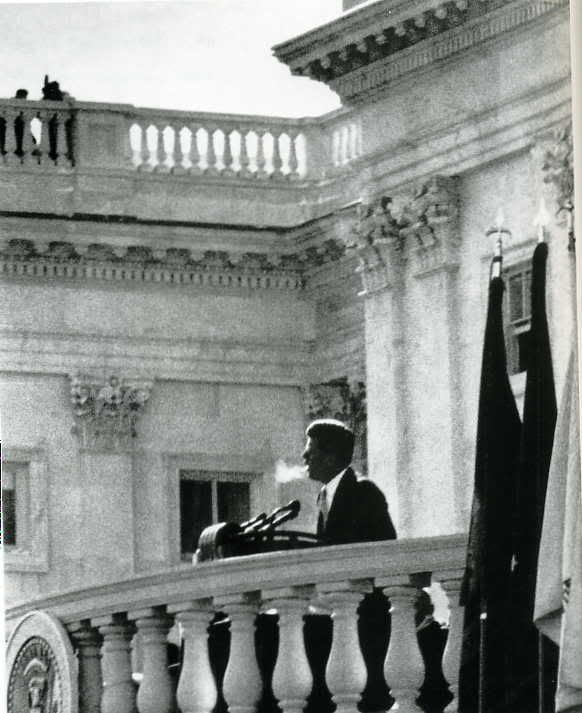
So, in the short time he had, President Kennedy did what he could to balance the interests of concentrated wealth with the interests of the average American -- necessary for the good of the country.
Professor Donald Gibson detailed the issues in his 1994 book, Battling Wall Street: The Kennedy Presidency.
From the book:
"What (J.F.K. tried) to do with everything from global investment patterns to tax breaks for individuals was to re-shape laws and policies so that the power of property and the search for profit would not end up destroying rather than creating economic prosperity for the country."
-- Donald Gibson, Battling Wall Street. The Kennedy Presidency
More on the book, by two great Americans:
"Gibson captures what I believe to be the most essential and enduring aspect of the Kennedy presidency. He not only sets the historical record straight, but his work speaks volumes against today's burgeoning cynicism and in support of the vision, ideal, and practical reality embodied in the presidency of John F. Kennedy - that every one of us can make a difference." -- Rep. Henry B. Gonzalez, Chair, House Committee on Banking, Finance, and Urban Affairs
"Professor Gibson has written a unique and important book. It is undoubtedly the most complete and profound analysis of the economic policies of President Kennedy. From here on in, anyone who states that Kennedy was timid or status quo or traditional in that field will immediately reveal himself ignorant of Battling Wall Street. It is that convincing." -- James DiEugenio, author, Destiny Betrayed. JFK, Cuba, and the Garrison Case --This text refers to an out of print or unavailable edition of this title.
Had he lived to serve a second term, I'd bet on JFK over Wall Street, Big Business and The Fed.
gopiscrap
(24,733 posts)he was in Vietnam in very early 61 at the tail end of the Eisenhower administration. Was shot January 18, 1961
He died of those wounds on December 18, 1964 when I was 7 years old
grantcart
(53,061 posts)gopiscrap
(24,733 posts)Last edited Wed Nov 23, 2022, 01:00 AM - Edit history (1)
and when this happened I still had a poor grasp on the English language
LeftInTX
(34,286 posts)Kid Berwyn
(24,393 posts)Your family’s loss is unimaginable. No words can convey the feelings and wishes in our hearts.
It sounds hollow, but is true: Your father’s service and sacrifice help keep our nation free.
gopiscrap
(24,733 posts)You are very kind! Happy Thanksgiving

Fiendish Thingy
(23,227 posts)She had obtained a bunch of stuff via FOIA, and was reading excerpts on the radio. She was reading the draft of 1964 budget proposals that projected expenditures for troops and equipment, and it showed the intention to withdraw troops from Viet Nam.
Kid Berwyn
(24,393 posts)The “Beverly Hills housewife” went where the US press failed to venture: the inner workings of the Warren Report. She, IMS, created an index of the 26 volumes of footnotes and references that the Warren Commission failed to do.
While I was unable to find that quote you remember hearing, here’s an example of her analysis which echoes in the news of this day:
“Mae Brussell began to study the pattern of Nazis coming to the United States after World War Two and patterns of murders identical to those in Nazi Germany. It was as if an early Lenny Bruce bit—on how a show-bit booking agency, MCA, chose Adolf Hitler as dictator—had actually been a satirical prophecy of the way Richard Nixon would rise to power. “How much violence was there in Nazi Germany,” Mae asks rhetorically, “before the old Germany, the center of theater, opera, philosophy, poetry, psychology and medicine, was destroyed? How many incidents took place that were not coincidental before it was called Fascism? What were the transitions? How many people? Was it when the first tailor disappeared? Or librarian? Or professor? Or when the first press was closed or the first song eliminated? Or when the first political science teacher was killed coming home on his bike? How many incidents happened there that were perfectly normal until people woke up and said, ‘Hey, we’re in a police state!”
― Mae Brussell, The Essential Mae Brussell: Investigations of Fascism in America
Source: https://www.goodreads.com/work/quotes/40321175-the-essential-mae-brussell-investigations-of-fascism-in-america
Here’s what Ms. Brussell had to say about fascist international’s connections to the assassination in Dallas:
The Nazi Connection to the John F. Kennedy Assassination
Evidence of link between Nazis still in operation after World War II to the still unsolved murder of John F. Kennedy
by Mae Brussell
EXCERPT…
Wild Bill Donovan of the OSS, Allen Dulles and the Vatican
Allen Dulles dubbed it Operation Sunrise. He mounted it from his walk-up office in Bern, Switzerland, where, since 1942, he had maintained contact with key nazis. Operation Sunrise was conceived when these nazis decided, in the face of defeat, that they preferred to surrender to the Americans and British. The agreement, which double-crossed the Russians, was signed April 29, 1945.
The principle negotiator on the German side was SS Commander Karl Wolff, head of the Gestapo in Italy. Wolff acted with full authority, for he was formerly chief of Heinrich Himmler's personal staff. Wolff’s relationship with Dulles spared him from the dock at Nuremberg, but when it was later discovered that he had dispatched "at least" 300,000 Jews to the Treblinka death camp he was handed a token sentence. In 1983 Wolff made the social pages when he and some of his old SS buddies sojourned on the late Hermann Goering's yacht Carin II of Hamburg. The skipper was Gert Heidemann, an avowed Hamburg nazi. The yacht belonged to the widow, Emmy Goering, whose estate attorney was the celebrated Melvin Belli. Belli has always had an eclectic clientele. He represented Jack Ruby after he shot Oswald. And he represented actor Errol Flynn's family interests. Flynn (once a close friend of Ronald Reagan) has been identified as having collaborated with the Gestapo.
When Wolff hammered out the secret surrender terms with Dulles, he had in the back of his mind a safe diaspora for his nazi compatriots. This is where the OSS, William Donovan and the sovereign state of the Vatican came in. "Wild Bill" Donovan was top dog in the OSS. Shortly before the Germans overran Europe, Father Felix Morlion, a papal functionary, had set up a Vatican intelligence organization called Pro Deo in Lisbon. When the U.S. entered the war Donovan moved Morlion lock, stock and barrel to New York and opened a sizeable bank account for him to draw on. The priest founded the American Council for International Promotion of Democracy Under God, on 60th Street. In the same building is the office of William Taub, whose name popped up during the Watergate affair. Taub is well-known as a wide-ranging middleman for such powerful figures as Nixon, Howard Hughes, Aristotle Onassis and Jimmy Hoffa, and his behind-the-scenes maneuvers were invaluable to Nixon in his 1960 run at the presidency. Taub was especially close to Cardinal Alfredo Ottaviania of the Holy See, who arranged Mussolini's 1929 "donation" of $89 million to the Vatican to ensure its neutrality with Mussolini and Hitler. The money went into a special fund in the Vatican Bank, and after the war part of it was entrusted to "God's Banker" Michele Sindona for investment. Sindona channeled a good chunk of it to the Nixon campaign.
When Rome was liberated in 1944 Morlion and Pro Deo relocated there. In recognition of Donovan's good works on behalf of Pro Deo, Pope Plus XII knighted him with the Grand Cross of the Order of St. Sylvester. And before he flew off to Washington to cut his deal with the CIA, Reinhard Gehlen received the Sovereign Military Order of Malta award from the Pontiff. So did James Jesus Angleton, a Donovan operative in Rome who became the CIA's chief of counterintelligence.
For Dulles, Operation Sunset was a personal triumph, one that set in motion his rise to the top of the intelligence heap. In 1963, by virtue of that position, he became the CIA's representative on the Warren Commission.
CONTINUES…
http://www.maebrussell.com/Mae%20Brussell%20Articles/Nazi%20Connection%20to%20JFK%20Assass.html
Ms. Brussell passed away in 1988 at age 66, two years after that was published. What a loss for our nation. FTR, her writings have been buttresses by what’s been revealed since then.
Genki Hikari
(1,766 posts)Strange, the troops Ike had sent to Vietnam by 1960 had been 900. Here are the numbers during the JFK admin:
1961: 3205
1962: 11300
1963: 16300
http://www.americanwarlibrary.com/vietnam/vwatl.htm
So through 1963, JFK had increased the military personnel in Vietnam by a whopping 1800%. Please don't be ridiculous and say that LBJ sent those last 5000 between November 23 and December 31. It wouldn't be true, and we all know it.
Lowering Vietnam personnel by 1000 personnel was barely a 6% reduction in force, and was undoubtedly under consideration because JFK knew he looked bad at home and abroad for supporting Diem--until the South Vietnamese themselves took that thug out only three weeks before JFK himself was assassinated. Politicians dabbling in another country's affairs always start looking for potential outs when that same country goes through a violent transition of power.
I know people don't want to hear this, but in every single year of his Presidency, JFK supported overt and covert actions in Vietnam. Multiple records attest to this. Read the featured reports of the 1961-1963 period listed in the timeline on this page:
https://www.archives.gov/research/vietnam-war
Documents like this one show exactly how much he was committed to inserting military forces into Vietnam:
https://catalog.archives.gov/id/193504?objectPage=3
Or how he made it clear he didn't want to pull out of Vietnam unless public sentiment back home forced him to do so? I mean this is what he apparently sent to Diem in a letter in September of 1963:
I have said publicly that we do not wish to cut off our aid program at this time, and I shall not change this position except as such change becomes necessary in response to the democratic processes of this country. But it would be wrong for me not to let you know that such change is inevitable unless the situation in Vietnam can somehow take a major turn for the better.
https://catalog.archives.gov/id/193383
And yet the deteriorating situation in Vietnam wasn't enough to stop JFK'ssupport for South Vietnam exhibited by a two-pronged assault at Da Nang on 11 Nov 1963.
https://catalog.archives.gov/id/26392238
So much for wanting to leave Vietnam.
Even if he had asked for RIF plans, plenty of leaders consider alternative courses of action, for a whole lot of reasons, but that doesn't mean they implement any of those alternatives. The chances of JFK changing course aren't very high. He was a hard-core anti-Communist--by his own admission, and by his every action as both a Senator and as POTUS. There's every reason to believe he would have foregone any withdrawal plans when South Vietnam didn't descend into utter chaos after Diem was ousted. Because he certainly didn't seem to be interested in deescalation at Da Nang less than two weeks after Diem got whacked.
In the end, speculation about what JFK wanted to do or would have done is ridiculous. We can only go by what he actually did. And, for most of his term of office, he was quite happy to send military personnel to Vietnam, and to have them engage in a full array of military actions there.
That is reality.

RobinA
(10,478 posts)up for reelection and had to deal with "soft on Communism" tauts from the Republicans.
Kid Berwyn
(24,393 posts)They do not, necessarily, represent the future.
You, and those who appreciate hard data, in addition to narrative and the historical record, might value the great DUer Jim DiEugenio’s critique of John Newman:
John Newman’s JFK and Vietnam, 2017 version
Written by James DiEugenio
June 19, 2021
While working on Oliver Stone’s upcoming documentary, Jim DiEugenio consulted the 2nd edition of John Newman’s ground-breaking book, JFK and Vietnam, and now takes the opportunity to review the development of Newman’s important thesis and the innovation and impact of this substantial research in dispelling the myth that LBJ did not alter Kennedy’s policy in Vietnam.
EXCERPT…
II
In 2017, Newman issued a new version of JFK and Vietnam. It turns out that the original publisher of the hardcover edition essentially sandbagged the book. Even though the thesis was red hot at the time of first publication—early 1992—John got no book tour to promote his work, in spite of the fact that Arthur Schlesinger had written a positive critique for the New York Times Book Review. (March 29, 1992) Further, Warner Books pulled the volume from bookstores and refused to take the author’s calls about it. (Newman, JFK and Vietnam, 2017 version, p. 479) After the intervention of the family of John Kenneth Galbraith, the author got the rights back to his work. (Ibid, pp. 489–90) He set about refashioning it.
I did not realize just how much this version of the book differed from the 1992 edition. But while working on Oliver Stone’s upcoming documentary, I had the opportunity to read certain sections. I concluded that it was a substantial rewrite. Because of that, plus the fact that I never critiqued the early version, I decided that this 2017 edition deserves to be, however belatedly, reviewed.
Right at the start, in his prologue, the author makes two additions to the book. The first deals with how he struck upon the idea of using such a hypothesis as the subject for his dissertation. It was due to a challenge from his former boss, Lt. General William Odom. (Newman, p. xiii) Then, by serendipity, Newman was stationed in Arizona with a man who was instrumental in working on what ended up being part of the main framework of his book: Col. Don Blascak. When John told him the subject of his dissertation—Kennedy and Vietnam—Blascak said, “Well, that’s when the big lie started.” (ibid, p. xiv) Blascak then gave him a list of people involved in MACV—Military Assistance Command, Vietnam—in 1962.
From these men, and a visit to the army’s Carlisle Barracks in Pennsylvania, Newman developed the evidence for one of the main tenets of his book, namely that General Paul Harkins and Colonel Joseph Winterbottom had devised an intelligence deception about how the war was going in 1961–62, because they knew that, in fact, it was not going well. (ibid, p. xvi)
When the dissertation was completed in late 1991, Newman sent a chapter dealing with that issue to former Secretary of Defense Robert McNamara. McNamara declined to see him, but he did write back that he did not think he was lied to. After the book was published, McNamara did agree to a visit. Over a series of meetings, the author provoked the former secretary to write his memoir about the war, entitled In Retrospect. Published in 1995, McNamara stated for the first time in public that President Kennedy would not have escalated the war as Johnson did. In fact, he wrote that JFK would have pulled out of the war. (McNamara, p. 96) Newman, as we shall see, was quite influential in McNamara denying the academic/MSM verdict on this subject: History would have been different had Kennedy lived.
The powerful impact of the publicity surrounding McNamara’s book caused McGeorge Bundy, Kennedy’s National Security Advisor, to write his own study of his part in the Indochina debacle. (See Lessons in Disaster, p. 22) Unfortunately, Bundy passed away before his book was completed. But a capable scholar, Gordon Goldstein—who Bundy had chosen as his writing partner—finished the volume after his death. Bundy had the same message: Kennedy would not have escalated in Vietnam.
CONTINUES…
https://www.kennedysandking.com/john-f-kennedy-reviews/john-newman-s-jfk-and-vietnam-2017-version
I have the honor of meeting Mr. DiEugenio in 2013 at the Passing the Torch conference, held at Duquesne University in Pittsburgh. The Honorable Dr. Cyril Wecht, MD, was our host.
Time since then has filed by. Almost as fast as that since November 22, 1963.
I remember then. And today is nothing like then.
grantcart
(53,061 posts)another purpose than actually withdrawing the troops is very superficial when other known facts are included.
May 1963 saw the start of a sharp change in domestic Vietnamese politics where the Diem regime moved from sustaining support to and from the Buddhist community to trying to establish a Catholic superiority. It erupted in a very bizarre issue of prohibiting Buddhists displaying their flags celebrating Buddha's birth using a a law banning presentation of flags other than the national flag even though Papal flags had been allowed the week before.
There were negotiations with Buddhists demanding religious equality but the situation continued to deteriorate with the self immolation of Thich Quang Duc which was a protest against religious discrimination.
So a more likely understanding of the threat of leaving South Vietnam is that it was part of an organized campaign to equip the Generals opposed to Diem with more negotiating power which the CIA was in fact doing at the time. The situation deteriorated quickly when Diem's sister in law (First Lady of S. Vietnam - Diem was a bachelor) announced that if the Buddhists want to have another barbecue I will be glad to supply the gasoline". This radicalized the students in Saigon and the regime lost public support.
If Kennedy wanted to actually withdraw troops that would have been the time to implement an actual plan. In September Diem leaked a counter threat, if the US didn't stop meddling in the Catholic/Buddhist Diem would come to an agreement with the Communists and kick the Americans out. Diem's brother Nhu leaked this proposal to Joseph Alsop who published it in the Washington Post.
If Kennedy was determined to leave South Vietnam all he had to do was call Diem's bluff and leave. That is not what happened. Rather the Kennedy administration reacted in anger, no withdrawal plan was formulated or implemented and instead the CIA was instructed to coordinate with high ranking Generals to remove Diem. A military revolutionary council was headed by General Minh and the Kennedy administration green lighted a coup through CIA officer Conein. The Generals also sought assurances from Ambassador Lodge that the administration was supporting and was told "the US will not interfere".
On Nov 1st Conein passed 3 million piastres to Minh to grease support with key officers and they moved against Diem and Nhu. The brothers escaped the initial attempt which presumably would have allowed them to leave the country peacefully. They were captured on Nov 2nd and Minh afraid that they might escape had them killed immediately, much to the shock of the Kennedy administration which had signed up for a coup but not an assassination.
The "plan" to withdraw from Vietnam was part of a back and forth confrontation using bluffs between Diem and Kennedy. Diem made a major miscalculation and doubled down on Kennedy's bluff. Facts are after May the Kennedy administration did not develop or implement a plan to leave South Vietnam but did develop and implement a plan to remove the leadership of the country and that is what they should be judged on.
Having said that I don't think that Kennedy would ever have allowed a large land army to prop up South Vietnam. He would have tried to use a more Jesuit approach of using key players and highly trained special forces to nudge history. If that had failed I am certain that he would have cut his losses in the same way he did in Cuba and avoided the massive tragedy that eventually became the American war in Vietnam.
Kid Berwyn
(24,393 posts)Last edited Mon Nov 28, 2022, 02:33 PM - Edit history (1)
The Church played a major role in French Indochina and around the world. The record shows it supported President Diem and his brothers, who were closer to tyranny than democracy.
The Jesuits I have had the honor to meet not only do the Good Lord’s work putting the Gospels into action by actually helping the sick, poor, weak, they tell the truth.
Here are the thoughts JFK recorded in the White House Nov. 4, 1963:
(President Kennedy): Monday, November 4, 1963. Over the weekend the coup in Saigon took place. It culminated three months of conversation about a coup, conversation which divided the government here and in Saigon.
(President Kennedy): Opposed to a coup was General Taylor, the Attorney General, Secretary McNamara to a somewhat lesser degree, John McCone, partly because of an old hostility to Lodge which causes him to lack confidence in Lodge's judgment, partly as a result of a new hostility because Lodge shifted his station chief; in favor of the coup was State, led by Averell Harriman, George Ball, Roger Hilsman, supported by Mike Forrestal at the White House.
(President Kennedy): I feel that we must bear a good deal of responsibility for it, beginning with our cable of early August in which we suggested the coup. In my judgment that wire was badly drafted, it should never have been sent on a Saturday. I should not have given my consent to it without a roundtable conference at which McNamara and Taylor could have presented their views. While we did redress that balance in later wires, that first wire encouraged Lodge along a course to which he was in any case inclined.
(President Kennedy): Harkins continued to oppose the coup on the ground that the military effort was doing well. There was a sharp split between Saigon and the rest of the country. Politically the situation was deteriorating. Militarily it had not had its effect; there was a feeling, however, that it would. For this reason, Secretary McNamara and General Taylor supported applying additional pressures to Diem and Nhu in order to move them.
(John Kennedy, Jr): Unclear
(President Kennedy): You want to say something? Say something. Hello.
(John Kennedy, Jr): Hello.
(President Kennedy): I was shocked by the death of Diem and Nhu. I'd met Diem with Justice Douglas many years ago. He was an extraordinary character. While he became increasingly difficult in the last months, nevertheless over a ten-year period he'd held his country together, maintained its independence under very adverse conditions. The way he was killed made it particularly abhorrent.
(President Kennedy): The question now is whether the generals can stay together and build a stable government, or whether Saigon will begin... will turn on... public opinion in Saigon, the intellectuals, students, etcetera, will turn on this government as repressive and undemocratic in the not too distant future.
Source: https://millercenter.org/the-presidency/educational-resources/jfk-memoir-dictation-assassination-of-diem
Contrast with the more pro-colonialist approach others in the US Government took in Vietnam, excerpts below courtesy of The Education Forum operated by the great DUer John Simkin:
Who changed the coup into the murder of Diem, Nhu and a Catholic priest?
From The Secret History of the CIA by Joseph Trento"
Who changed the coup into the murder of Diem, Nhu and a Catholic priest accompanying them? To this day, nothing has been found in government archives tying the killings to either John or Robert Kennedy. So how did the tools and talents developed by Bill Harvey for ZR/RIFLE and Operation MONGOOSE get exported to Vietnam? Kennedy immediately ordered (William R.) Corson to find out what had happened and who was responsible. The answer he came up with: “On instructions from Averell Harriman…. The orders that ended in the deaths of Diem and his brother originated with Harriman and were carried out by Henry Cabot Lodge’s own military assistant.”
Having served as ambassador to Moscow and governor of New York, W. Averell Harriman was in the middle of a long public career. In 1960, President-elect Kennedy appointed him ambassador-at-large, to operate “with the full confidence of the president and an intimate knowledge of all aspects of United States policy.” By 1963, according to Corson, Harriman was running “Vietnam without consulting the president or the attorney general.”
The president had begun to suspect that not everyone on his national security team was loyal. As Corson put it, “Kenny O’Donnell (JFK’s appointments secretary) was convinced that McGeorge Bundy, the national security advisor, was taking orders from Ambassador Averell Harriman and not the president. He was especially worried about Michael Forrestal, a young man on the White House staff who handled liaison on Vietnam with Harriman.”
At the heart of the murders was the sudden and strange recall of Sagon Station Chief Jocko Richardson and his replacement by a no-name team barely known to history. The key member was a Special Operations Army officer, John Michael Dunn, who took his orders, not from the normal CIA hierarchy but from Harriman and Forrestal.
According to Corson, “John Michael Dunn was known to be in touch with the coup plotters,” although Dunn’s role has never been made public. Corson believes that Richardson was removed so that Dunn, assigned to Ambassador Lodtge for “special operations,” could act without hindrance.
SOURCE:
“The Secret History of the CIA.” Joseph Trento. 2001, Prima Publishing. pp. 334-335.
And the situation on the ground, as reported a month prior to the murderous coup from a real reporter:
'SPOOKS' MAKE LIFE MISERABLE FOR AMBASSADOR LODGE
'Arrogant' CIA Disobeys Orders in Viet Nam
Richard Starnes
The Washington Daily News, Wednesday, October 2, 1963, p.3
SAIGON, Oct.2 - The story of the Central Intelligence Agency's role in South Viet Nam is a dismal chronicle of bureaucratic arrogance, obstinate disregard of orders, and unrestrained thirst for power.
Twice the CIA flatly refused to carry out instructions from Ambassador Henry Cabot Lodge, according to a high United States source here.
In one of these instances the CIA frustrated a plan of action Mr. Lodge brought with him from Washington because the agency disagreed with it.
This led to a dramatic confrontation between Mr. Lodge and John Richardson, chief of the huge CIA apparatus here. Mr. Lodge failed to move Mr. Richardson, and the dispute was bucked back to Washington. Secretary of State Dean Rusk and CIA Chief John A. McCone were unable to resolve the conflict, and the matter is now reported to be awaiting settlement by President Kennedy.
It is one of the developments expected to be covered in Defense Secretary Robert McNamara's report to Mr. Kennedy.
Others Critical, Too
Other American agencies here are incredibly bitter about the CIA.
"If the United States ever experiences a 'Seven Days in May' it will come from the CIA, and not from the Pentagon," one U.S. official commented caustically.
("Seven Days in May" is a fictional account of an attempted military coup to take over the U.S. Government.)
CIA "spooks" (a universal term for secret agents here) have penetrated every branch of the American community in Saigon, until non-spook Americans here almost seem to be suffering a CIA psychosis.
An American field officer with a distinguished combat career speaks angrily about "that man at headquarters in Saigon wearing a colonel's uniform." He means the man is a CIA agent, and he can't understand what he is doing at U.S. military headquarters here, unless it is spying on other Americans.
Another American officer, talking about the CIA, acidly commented: "You'd think they'd have learned something from Cuba but apparently they didn't."
Few Know CIA Strength
Few people other than Mr. Richardson and his close aides know the actual CIA strength here, but a widely used figure is 600. Many are clandestine agents known only to a few of their fellow spooks.
Even Mr. Richardson is a man about whom it is difficult to learn much in Saigon. He is said to be a former OSS officer, and to have served with distinction in the CIA in the Philippines.
A surprising number of the spooks are known to be involved in their ghostly trade and some make no secret of it.
"There are a number of spooks in the U.S. Information Service, in the U.S. Operations mission, in every aspect of American official and commercial life here, " one official - presumably a non-spook - said.
"They represent a tremendous power and total unaccountability to anyone," he added.
Coupled with the ubiquitous secret police of Ngo Dinh Nhu, a surfeit of spooks has given Saigon an oppressive police state atmosphere.
The Nhu-Richardson relationship is a subject of lively speculation. The CIA continues to pay the special forces which conducted brutal raids on Buddhist temples last Aug. 21, altho in fairness it should be pointed out that the CIA is paying these goons for the war against communist guerillas, not Buddhist bonzes (priests).
Hand Over Millions
Nevertheless, on the first of every month, the CIA dutifully hands over a quarter million American dollars to pay these special forces.
Whatever else it buys, it doesn't buy any solid information on what the special forces are up to. The Aug. 21 raids caught top U.S. officials here and in Washington flat-footed.
Nhu ordered the special forces to crush the Buddhist priests, but the CIA wasn't let in on the secret. (Some CIA button men now say they warned their superiors what was coming up, but in any event the warning of harsh repression was never passed to top officials here or in Washington.)
Consequently, Washington reacted unsurely to the crisis. Top officials here and at home were outraged at the news the CIA was paying the temple raiders, but the CIA continued the payments.
It may not be a direct subsidy for a religious war against the country's Buddhist majority, but it comes close to that.
And for every State Department aide here who will tell you, "Dammit, the CIA is supposed to gather information, not make policy, but policy-making is what they're doing here," there are military officers who scream over the way the spooks dabble in military operations.
A Typical Example
For example, highly trained trail watchers are an important part of the effort to end Viet Cong infiltration from across the Laos and Cambodia borders. But if the trailer watchers spot incoming Viet Congs, they report it to the CIA in Saigon, and in the fullness of time, the spooks may tell the military.
One very high American official here, a man who has spent much of his life in the service of democracy, likened the CIA's growth to a malignancy, and added he was not sure even the White House could control it any longer.
Unquestionably Mr. McNamara and Gen. Maxwell Taylor both got an earful from people who are beginning to fear the CIA is becoming a Third Force co-equal with President Diem's regime and the U.S. Government - and answerable to neither.
There is naturally the highest interest here as to whether Mr. McNamara will persuade Mr. Kennedy something ought to be done about it.
SOURCE:
http://educationforum.ipbhost.com/index.php?showtopic=7534&mode=threaded
The nation’s press — conservative then as now — are the ones who’ve consistently echoed the claim that JFK ordered the coup. Thank Goodness for the Jebbies and John Simkin.
ETA middle article that I just noticed was missing.

Ford_Prefect
(8,610 posts)regimes are today. The CIA in turn were committed to a Cold War ideology which allowed no alternatives to aggressively dominating a political sphere. The oil and weapons industries stirred this pot to their own advantage. The Ultra Cold Warriors saw Kennedy as a weak liberal who would negotiate away opportunities like an American Neville Chamberlin. When you see movies or TV which lampoon that point of view it is important to understand that they really were just as seriously black and white, Christian vs Communist, my way or the highway absolutist as the characters you see. No less so than the Neo-Cons we know from W & Cheney's regime or today's RW Christian Nationalists, they were every bit as driven and willing to bend any rule or law to get the world they wanted to see.
They saw Kennedy and many others like him as impediments to the spread of the Great American Capitalist Empire. JFK would have insisted on diplomacy as the ultimate arbitration. He was not invested in military adventurism and saw that view of American power as mistaken empire building. He spent a very great deal of his time working towards a political environment in which a shared future was worth more than owning any single point of real estate.
Kid Berwyn
(24,393 posts)Conservatives Worry and the Cover-up Begins
Late at night in the watering holes of American intelligence agents, the mention of Stanley K. Sheinbaum's name can still arouse a muttering of anger. Sheinbaum was the first person to go public with his experience of CIA activity in the United States--a story about the Agency's infiltration of a legitimate civilian institution. Sheinbaum so embarrassed senior officials of the CIA that they set in motion an elaborate internal operation intended to prevent anyone else from ever doing what he had done.
Sheinbaum's connection with the CIA began in the 1950s, a period when security officers at the rapidly expanding Agency were sometimes overworked. On occasion they neglected to ask someone to sign a secrecy contract, which was normally a prerequisite of employment. Once signed, it committed a CIA agent to complete secrecy, beginning with the first day on the job and continuing until death. But Sheinbaum's association with the CIA was indirect, through a university that turned out to be working under contract with the Agency. He was never a CIA employee and, as far as he can remember, was never asked to sign a secrecy agreement. During his days as a doctoral student at Stanford University and as a Fulbright fellow in Paris, Sheinbaum developed a strong interest in helping the economies of underdeveloped nations expand. When his Fulbright ran out in the summer of 1955, he landed a position at Michigan State University, working on a $25 million government project to advise South Vietnam President Ngo Dinh Diem. By 1957, Sheinbaum was coordinator of the project.
His new responsibilities included inspecting work in Vietnam. Before he went on a trip there in 1957, university officials told him about the general CIA connection; once there, Vietnamese officials informed him that his project staff included CIA officers. The revelation bothered him. He thought it inappropriate that he and other legitimate academic advisers were being used as cover for U.S. government manipulation. Sheinbaum left Vietnam feeling that his work and his program had been compromised. Upon his return to the United States, he was further entangled when he was called upon to meet with four top South Vietnamese officials in San Francisco. "Within an hour of their arrival," Sheinbaum later recalled, "the youngest, a nephew of Ngo Dinh Diem, conspiratorially drew me aside and informed me that one of the others was going to kill the eldest of the group." While taking steps to thwart the plot, Sheinbaum realized that his original goal, the economic improvement of impoverished nations, was getting lost in his administrative work as coordinator. His growing dismay--at what he later called the "unhealthy" CIA component and "the general U.S. policy ... in Vietnam"--led him to resign from the project in 1959.
By this stage, however, Sheinbaum had information that was confidential. Following the buildup of U.S. troops in Vietnam and the assassination of Diem, Sheinbaum decided it was his patriotic duty to publicize information that he hoped might put the brakes on U.S. involvement. Writing about the connections between Michigan State University, the CIA, and the Saigon police (with the help of Robert Scheer, a young investigative reporter), the Sheinbaum story was to appear in the June 1966 issue of Ramparts magazine. The article disclosed that Michigan State University had been secretly used by the CIA to train Saigon police and to keep an inventory of ammunition for grenade launchers, Browning automatic rifles, and .50 caliber machine guns, as well as to write the South Vietnamese constitution. The problem, in Sheinbaum's view, was that such secret funding of academics to execute government programs undercut scholarly integrity. When scholars are forced into a conflict of interest, he wrote, "where is the source of serious intellectual criticism that would help us avoid future Vietnams?"
Word of Sheinbaum's forthcoming article caused consternation on the seventh floor of CIA headquarters. On April 18, 1966, Director of Central Intelligence William F. Raborn Jr. notified his director of security that he wanted a "run down" on Ramparts magazine on a "high priority basis." This strongly worded order would prove to be a turning point for the Agency. To "run down" a domestic news publication because it had exposed questionable practices of the CIA was clearly in violation of the 1947 National Security Act's prohibition on domestic operations and meant the CIA eventually would have to engage in a cover-up. The CIA director of security, Howard J. Osborn, was also told: "The Director [Reborn] is particularly interested in the authors of the article, namely, Stanley Sheinbaum and Robert Scheer. He is also interested in any other individuals who worked for the magazine."
Osborn's deputies had just two days to prepare a special briefing on Ramparts for the director. By searching existing CIA files they were able to assemble dossiers on approximately twenty-two of the fifty-five Ramparts writers and editors, which itself indicates the Agency's penchant for collecting information on American critics of government policies. Osborn was able to tell Raborn that Ramparts had grown from a Catholic lay journal into a publication with a staff of more than fifty people in New York, Paris, and Munich, including two active members of the U.S. Communist Party. The most outspoken of the CIA critics at the magazine was not a Communist but a former Green Beret veteran, Donald Duncan. Duncan had written, according to then CIA Deputy Director Richard Helms, "We will continue to be in danger as long as the CIA is deciding policy and manipulating nations." Of immediate concern to Raborn, however, was Osborn's finding that Sheinbaum was in the process of exposing more CIA domestic organizations. The investigation of Ramparts was to be intensified, Raborn told Osborn.
CONTINUES…
https://www.thriftbooks.com/w/secrets-the-cias-war-at-home_angus-mackenzie/668061/#edition=2292399&idiq=634858
Capitalism’s Invisible Army wasn’t supposed to do any of that, yet Mr. Dulles found it A-OK. Today we live in the wealthiest times in human history. Per David Stockman, the time where 7/8 of all wealth ever. And yet there’s a catch. We are in Year 41 of Trickle Down Econ 666 where almost all the gold is in the pockets of the very few. And money still trumps peace or people or planet.

zipplewrath
(16,698 posts)In the spring of '63, the Pentagon was forever telling the White House how well things were going in Vietnam. As such, MacNamara was forever telling them to plan for a withdrawal in '65. It affected budgets that are planned at DoD a good two years or more in advance. The Pentagon always drug their feet on these plans because they knew that it was wishful thinking that we'd be able to withdraw that early.
What Kennedy knew, didn't know, or intended to do is always going to be nothing more than a guess.

ShazzieB
(22,582 posts)This. And no matter how "educated" a guess may be, on the end it's still a guess.

NNadir
(38,041 posts)Kid Berwyn
(24,393 posts)
Source: https://www.jfklibrary.org/asset-viewer/archives/JFKNSF/342/JFKNSF-342-007
A few weeks later, President Johnson ordered US to do whatever was needed to maintain government of South Vietnam.
National Security Action Memorandum 273

Source: https://www.discoverlbj.org/item/nsf-nsam273
The history:
https://www.maryferrell.org/pages/1963_Vietnam_Withdrawal_Plans.html
https://www.kennedysandking.com/john-f-kennedy-reviews/john-newman-s-jfk-and-vietnam-2017-version
NNadir
(38,041 posts)That Nixon was worse does not excuse Kennedy.
The cabinet he selected, including the corporate thinker Robert McNamara who was unqualified to be Secretary of Defense, was kept intact by LBJ and ruined LBJ's legacy by driving the Vietnam War to new heights.
I suggest that if one really wants to know something about the history of that time, one could do far worse than reading David Halberstam's "The Best and Brightest."
JFK's mentor, his father Joe Kennedy, who in 1940, as US Ambassador to Britain, did everything in his power to cut Britain off on aid in its (then) solo war against Hitler, ran around in 1960 assuring everyone he knew that his son was "no liberal." He was right. Kennedy was the only Democrat in the Senate to not vote to censure Joe McCarthy, a family friend, and Godfather to RFK's namesake son, the modern day loon Robert F. Kennedy Jr.
FDR sent Joseph Kennedy to Britain to get him out of the country, because he was sure Kennedy was going to support his opponent in his bid for a third term. (FDR's relations with Britain were managed behind Kennedy's back through Harry Hopkins.)
(cf. Michael R. Beschloss, Kennedy and Roosevelt: The Uneasy Alliance.)
Kennedy almost stumbled into a nuclear war because his poor performance at the Vienna Summit caused Khrushchev (who had survived Stalin) to take him, with some good evidence, to be a lightweight pushover. Kennedy was in over his head, in spite of being able to read a good speech composed by Theodore Sorensen well.
The alternate history that he was an advocate for peace in Vietnam is purely nonsense. He was terrified of repeating the charge made by the Republicans against Truman that Truman "lost China."
The view of Kennedy as a great avatar of liberalism does not stand up to serious inspection. For Chrissakes, he watched Martin Luther King's "I have a dream" speech on television, when he was just down the block, worrying all the time if it was going to cost him Southern Votes. (A few years later Nixon would make racist appeals to break the then "solid" Democratic South.)
I regard John Kennedy as the worst Democratic President of the last half of the 20th century. We are lucky we survived him. I personally will never forgive him for that day during the Cold War, when I woke up, as a child, expecting to be vaporized in the afternoon. In fact, in the entire 20th century, he gives Woodrow Wilson a run for the title of "Least Honorable Democratic President."
I have no use for alternative history, particularly internet alternative history.

David__77
(24,728 posts)…
Kid Berwyn
(24,393 posts)JFK weighed the advice of the experts — military, political, scientific, industrial — but made the decisions himself. He traveled to Vietnam in 1951 on a fact finding tour with the French.
Afterwards in the House and later as a Senator, Kennedy was critical of U.S. support of the French there, saying, "We have allied ourselves to the desperate effort of a French regime to hang on to the remnants of empire."
JFK understood the basic problem missed by the nation’s experts: We were throwing our support behind colonialists. It’d be like Washington, Jefferson, Adams, Madison, Franklin and the Founders siding with King George.
I heard James Douglas, author of “JFK and the Unspeakable: Why He Died and Why It Matters” speak in Royal Oak, Mich., late in 2013.
One of the important points covered in the Q&A afterward was on Kennedy and his policy toward Vietnam: a member of the audience asked Douglas how he could be so certain that JFK would have pulled U.S. military support from South Vietnam?
Douglass quoted Bobby Kennedy, who had been asked the same question by Arthur Schlessinger. RFK pounded the table and shouted:
"Because we were there!"
Background, submitted for those who like Kennedy Democrats: https://ratical.org/ratville/JFK/Unspeakable/
Dysfunctional
(452 posts)and saved over 58,000 members of the U.S. military and millions of Vietnamese civilians and soldiers.
Kid Berwyn
(24,393 posts)And disastrous.
On behalf of Eisenhower (and Nixon), Dulles wanted to give the French nukes.
“We might give them a few.” Did the US offer to drop atom bombs at Dien Bien Phu?
By Fredrik Logevall
Bulletin of the Atomic Scientists | February 21, 2016
EXCERPT…
Dulles was noncommittal. Before any US military strikes could occur, he said, Paris would need to commit to an internationalization of the struggle (under a plan known as United Action) and would have to give the French-supported government of Vietnam an “independent” role going forward, meaning it would be able to negotiate on its own to receive American aid. Bidault shook his head at the thought of effectively setting Vietnam on the first steps of the road to independence. France was fighting to hold on to the jewel of its empire, while the United States was fighting to stop communism—and the two goals were not necessarily in harmony. As on many previous occasions, a “dialogue of the deaf” (in the French expression) ensued, as Dulles argued for giving full independence to the noncommunist Vietnamese and Bidault answered that by doing so France would abandon the whole reason behind going to war in the first place. According to Dulles’s account, the Frenchman concluded the session with an ominous warning: If the fortress fell, France would want to pull out completely from Southeast Asia and assume no continuing commitments, “and the rest of us would have to get along without France in this area.”
It was an unpromising start to the proceedings. Bidault, according to several sources, left the meeting angered by the Americans’ stubborn fixation on United Action when he could think only of Dien Bien Phu, while Dulles for his part told British officials over lunch that the French were on the verge of quitting Vietnam altogether. When tripartite talks (involving also Britain) got under way that afternoon Bidault’s mood had not improved. He was garrulous, ironical, and obscure, and more than a few of the twenty-odd people the room, aware of his weakness for drink, suspected he was inebriated. A British observer suspected exhaustion more than alcohol, but the effect was the same: Nobody really understood what the Frenchman was saying. “[He] said he was casting himself to the wolves, into the waves, under the train, but we could not quite make out which wolves, waves, train.” Bidault also read out a “declaration of French intentions” which indicated a French commitment to defending the Associated States at all costs, but which later in the meeting he seemed to dismiss as merely “une tendance” which he did not plan to publish.
Turning to Dulles, the foreign minister noted the presence of American ships in the Gulf of Tonkin and Dulles’s repeated public statements that the United States would not tolerate the expansion of communism. If Washington so desired it could now reconcile those twin realities by assisting her ally at Dien Bien Phu. “He merely looked glum,” Bidault later remembered of the American’s reaction, “and did not even promise to repeat my request to Washington.”
But Dulles did offer a response, the nature of which has been shrouded in controversy for more than half a century. According to Bidault, the American took him aside during an intermission and asked him whether atomic bombs could be effective at Dien Bien Phu. If so, Dulles allegedly went on, his government could provide two such bombs to France. Bidault said he turned down the suggestion flat, on the grounds that the bombs would destroy the garrison as well as the Viet Minh, while dropping them farther away, on supply lines, would risk war with China. When informed a few months later of Bidault’s claim, Dulles said he could not recall making such an offer and insisted there must have been a misunderstanding.
Given Bidault’s visible exhaustion on the day in question, and his muddled speechmaking, and given the lack of any British or American confirmation of the claim, it is reasonable to suppose Dulles had it right: No offer was made. On the other hand, Bidault’s version is supported by senior French official Jean Chauvel in his memoirs, and by French general Paul Ely in his diary, which was kept on a daily basis. Ely, a key player on Indochina strategy in these months, wrote that he was of two minds about “the offer of two atom bombs. The psychological impact would be tremendous, but the [military] effectiveness would was uncertain, and it carries the risk of generalized warfare.”
Moreover, Bidault’s contention that Washington might offer atom bombs to his government had an inherent plausibility. In December 1953, when Western leaders held talks in Bermuda, Eisenhower alarmed the British and French delegations by referring casually to the atomic bomb as just another weapon in the West’s arsenal, one that might be used if the Chinese under Mao Zedong violated the terms of the recently-concluded truce in the Korean War. In February 1954, the president told Congressional leaders that in the event of war with China the United States would “go all the way,” with no limitations on targets hit or weapons used.
CONTINUES…
https://thebulletin.org/2016/02/we-might-give-them-a-few-did-the-us-offer-to-drop-atom-bombs-at-dien-bien-phu/
Prolly old hat to you, Dysfunctional. Difficult for many, if not most, to comprehend.

burrowowl
(18,494 posts)Kid Berwyn
(24,393 posts)The idea of extracting wealth from a place without compensating its owners is what brought about the American Revolution. JFK believed it hypocritical for a democratic country to say it wouldn’t apply to other nations and peoples.
Deconstructing JFK: A coup d’état over foreign policy?
by James DiEugenio
EXCERPT…
So, along with his brother Robert and sister Patricia, he decided to visit the Middle East, Asia, and particularly Indochina. As he said, his purpose was “to get some first-hand knowledge, some facts to bite on, to know how these people regard us.”[10]
When Kennedy arrived in Saigon, he first listened to the French commander General Jean de Lattre de Tassigny say that, with 250,000 troops, the French could not lose.[11] But there was another person in Saigon that Kennedy decided to meet.
He was Edmund Gullion. Kennedy had first met Gullion at the State Department back in 1947, while getting help for a speech. In Saigon, Gullion met the young JFK at the rooftop restaurant of the Hotel Majestic. There, Kennedy heard a very different message about French prospects:
In twenty years, there will be no more colonies. We’re going nowhere out here. The French have lost. If we come in here and do the same thing, we will lose too, for the same reason. There’s no will or support for this kind of war back in Paris. The home front is lost. The same thing would happen to us.[12]
The impact of what Kennedy saw and heard altered the prevailing, hackneyed picture of the “Free World versus The Communist Menace” in the Third World. His view now became more nuanced and subtle. As biographer Herbert Parmet wrote,
Jack Kennedy was evolving into a spokesman for a more sophisticated view. He was beginning to call attention to the soft spot of the Western cause, to the frustration of a region that had long contended with colonial domination.[13]
In other words, with Gullion’s help, Kennedy saw the French war in Indochina not as a contest between the communists and Western republicans.
He now saw it as the doomed struggle of French empire to hold on to a far-flung colony that wanted to be independent. In other words, it was really a battle between colonialism and nationalism, and America was backing the colonialists. As his brother later said, this meeting had “a very, very major” impact on his thinking.[14]
CONTINUES…
https://transnational.live/2021/02/10/deconstructing-jfk-a-coup-detat-over-foreign-policy/
This stuff still matters, Democracy.

Martin Eden
(15,625 posts)
Kid Berwyn
(24,393 posts)Take the late E. Howard Hunt, the former CIA agent and Watergate burglar, who planted phony diplomatic cables in a White House safe to make it appear JFK ordered the assassination of South Vietnamese President Diem.
Hunt Says He Fabricated Cables on Diem to Link Kennedy to Killing of a Catholic
By David E. Rosenbaum Special to The New York Times
Sept. 25, 1973
WASHINGTON, Sept. 24—E. Howard Hunt Jr. said today that he had fabricated State Depart ment cables to show a link be tween President Kennedy and the assassination of the Presi dent of South Vietnam, Ngo Dinh Diem, a Roman Coholic, to estrange Catholic voters tram the Democratic party.
Hunt told the Senate Water gate Committee that he had forged the cables on orders from Charles W. Colson, then a special counsel to President Nixon, after Mr. Colson had “suggested that I might be able to improve upon the record.”
It was Mr. Colson's desire, Hunt testified, “to demonstrate that a Catholic U. S. Adminis tration had, in fact, conspired in the assassination of a Catho lic chief of state of another country.”
The existence of the cables became known last spring, and Hunt's contention that Mr. Colson had ordered that they be written was disclosed in May during the Pentagon papers trial in Los Angeles. Among many documents released at that time was Hunt's testimony before the Watergate grand jury, in which he described how he fabricated the cables.
SNIP…
In the case of the bogus cables and the Ellsberg bur glary, Hunt testified, it was con templated that material that might be beneficial politically to the Nixon Administration would be leaked to the press. Hunt even went so far, he said, as to compile a list of news men who, he thought, might be receptive to the material.
The forged cables, he said, were shown to William Lam bert, then a reporter for Life magazine, who was close to Mr Colson. Hunt said that Mr. Col son had given him instructions to let Mr. Lambert copy the documents by hand but not tc let him make photo copies of them because they could not withstand professional scrutiny. Mr. Lambert never wrote about the documents.
The cables were removed by Nixon Administration offi cials from Hunt's safe in June 1972, after he was implicated in the Watergate burglary. They were among the material; turned over to L. Patrick Gray 3d, then acting director of the Federal Bureau of Investiga. tion. Mr. Gray has testified that he burned the documents last December.
SOURCE: https://www.nytimes.com/1973/09/25/archives/hunt-says-he-fabricated-cables-on-diem-to-link-kennedy-to-killing.html
Most people today have no clue about any of this. In a few decades, maybe nobody will know.

former9thward
(33,424 posts)By 1963 Kennedy had increased American troop levels to 16,300. The OP says he was going to remove 1000 by the end of 1963. That is a small fraction of what was there. It was not a complete withdrawal. The OP says a withdrawal by 1965. That is what LBJ always said. Winning was right around the corner and then we could withdraw.
https://www.americanwarlibrary.com/vietnam/vwatl.htm
Kid Berwyn
(24,393 posts)The thread title refers to the title of James Galbraith’s article, first mentioned in the OP.
While the numbers show how small 1,000 is compared to 16,000 present, the record also shows the Pentagon wasn’t following JFK’s orders. Instead of reducing units, the 1,000 were advisors scheduled for rotation home, Maj. John M. Newman found.
dembotoz
(16,922 posts)and lbj will get the blame...so now as it has always been
Kid Berwyn
(24,393 posts)LBJ offered key advice that helped defuse and resolve the Cuban Missile Crisis.
The Cuban Missile Crisis, October 18-29, 1962
EXCERPT...
JFK reopens the discussion of trading the missiles in Turkey. McNamara insists that the case should be made that this is not so much a trade as a way of preventing a Soviet military attack on a NATO member nation. (52:58)
McNamara says that if reconnaissance flights are fired upon tomorrow that means air strikes and "almost certainly an invasion." (59:03)
(Apparently JFK is no longer in the room at this point in the discussion.)
Vice President Lyndon Johnson responds: "If you're willing to give up your missiles in Turkey - why don't you...make the trade there and save all the invasion, lives and everything else?" (1:02:10)
George Ball also argues for making the trade openly with the USSR to avoid "enormous casualties and a great, great risk of escalation." (1:03:35)
McNamara: "Max is going back to work out the surveillance plan for tomorrow with the Chiefs as to how much cover we need and so on. We're just going to get shot up sure as hell. There's no question about it. We're going to have to go in and shoot." (1:07:15)
McCone responds: "I'd take these Turkish things out right now" but also tell Khrushchev firmly that if they fire at our planes again "in we come." (1:08:22)
McNamara denounces Khrushchev's Oct 26 letter: "Hell, that's no offer. There's not a damned thing in it that's an offer. You read that message carefully. He didn't propose to take the missiles out....It's twelve pages of fluff." (1:09:30)
LBJ questions the value of the surveillance flights: "I've been afraid of these damned flyers ever since they mentioned them...some crazy Russian captain...might just pull a trigger. Looks like we 're playing Fourth of July over there. I'm scared of that and I don't see what you get for that photograph. ... Psychologically you scare them. Well hell, its like the fellow always telling me in Congress, 'Go on and put the monkey on his back.' Every time I tried to put a monkey on somebody's else's back, I got one. If you're going to try to psychologically scare them...you're liable to get your bottom shot at." (1:33:00)
SOURCE: http://www.hpol.org/jfk/cuban/
Later, during the Gulf of Tonkin episode, however, Johnson DID go with the advice of McNamara, Bundy and Rusk.
The record also shows JFK wasn't going to.