General Discussion
Related: Editorials & Other Articles, Issue Forums, Alliance Forums, Region ForumsHarvesting the fresh water moisture above our oceans & Great Lakes
I would like to know more about the structure.
Maybe a pipeline from above the ocean surface to the shore with intake fans, where then condensed?
Tall or partially submerged columns anchored below? Drones? So much information missing about the "structure."
But plenty of fresh 💧 promise.
https://www.sciencealert.com/new-technology-could-tap-into-a-virtually-limitless-supply-of-fresh-water
New Technology Could Tap Into a Virtually Limitless Supply of Fresh Water
25 December 2022
By DAVID NIELD
(Chris Meredith/Getty Images)
There's not enough fresh water to go around on planet Earth, and it's a problem that's expected to only worsen in the coming years.
[Unless we harvest the moisture above waters surrounding US.]
 = new reply since forum marked as read
Highlight:
NoneDon't highlight anything
5 newestHighlight 5 most recent replies
= new reply since forum marked as read
Highlight:
NoneDon't highlight anything
5 newestHighlight 5 most recent replies

yellowdogintexas
(23,694 posts)could be in the Ohio / Tennessee river valley. There are many lakes & four major rivers (Ohio, Mississippi, Cumberland and Tennessee).
There are only a few areas more humid in the country; very often the air temp and the humidity are the same(we call it The Air You Wear) There is a LOT of fog especially in August and September.
I used to work on the 19th floor of a building in Nashville, and there were a couple of times it took until 10 am for the fog to lift up to our level.

CaliforniaHoustonian
(74 posts)So much untapped potential.
Now, if we can only get the media to care enough to pressure politicians to help provide for the minimal infrastructure needed, instead of just political bickering.

Kaleva
(40,365 posts)as the effects of climate change get more severe

mopinko
(73,723 posts)same infra required to distribute, but a lot less energy.
CaliforniaHoustonian
(74 posts)Yep!

bucolic_frolic
(55,129 posts)Could produce less rain, thereby impacting mountain lakes or streams. On the surface I think this a zero sum game.
CaliforniaHoustonian
(74 posts)No offense meant.
bucolic_frolic
(55,129 posts)I stand by my original post.
CaliforniaHoustonian
(74 posts)You can't be a hater when Democrats try to lead with new ideas, please.

Marthe48
(23,174 posts)Geologists say that the Sahara Desert was tropical at one time, then the Atlas Mountains arose, blocking moisture laden winds from the ocean from the land. In modern times, seems like the wind blows west to east, so the theory makes sense to me. Places like the American Southwest are historically dry, and Native Americans endured long droughts. Maybe some of the Pacific Mountains block enough moist air to cause that dryness. And of course, demand.
If humans start to harvest moisture in the air, I hope they do it in a way that doesn't end up robbing Peter to pay Paul.

cbabe
(6,642 posts)Privatizing our Liquid Continent | the interglobalist
In Bolivia's well known case under the Bechtel contract, it became illegal for city residents or peasants in surrounding communities to collect rainwater for drinking, irrigation, or anything else. Immediately, water prices in some areas rose by 200% when new water laws were enforced.
https://www.democracynow.org › 2006 › 10 › 5 › bolivian_activist_oscar_olivera_on_bechtels
Bolivian Activist Oscar Olivera on Bechtel's Privatization of Rainwater ...
Oscar emerged in 2000 as the leader of the nationwide protest movement against water privatization in Bolivia. He is in New York City for a conference at the Cornell Global Labor Institute where ...
https://www.pbs.org › frontlineworld › stories › bolivia › thestory.html
FRONTLINE/WORLD . Bolivia - Leasing the Rain . The Story | PBS
The army battled civilians in the streets on and off for three months, hundreds were arrested, a seventeen year-old boy was shot and killed, the government of Bolivia nearly collapsed. The issue...
SWBTATTReg
(26,257 posts)others in that region) to gather moisture. They look like giant tennis nets stretched out across the deserts and apparently gather moisture (perhaps from the morning dew, etc.?). A clever idea if it works which obviously it must since they're using these nets.

Wounded Bear
(64,323 posts)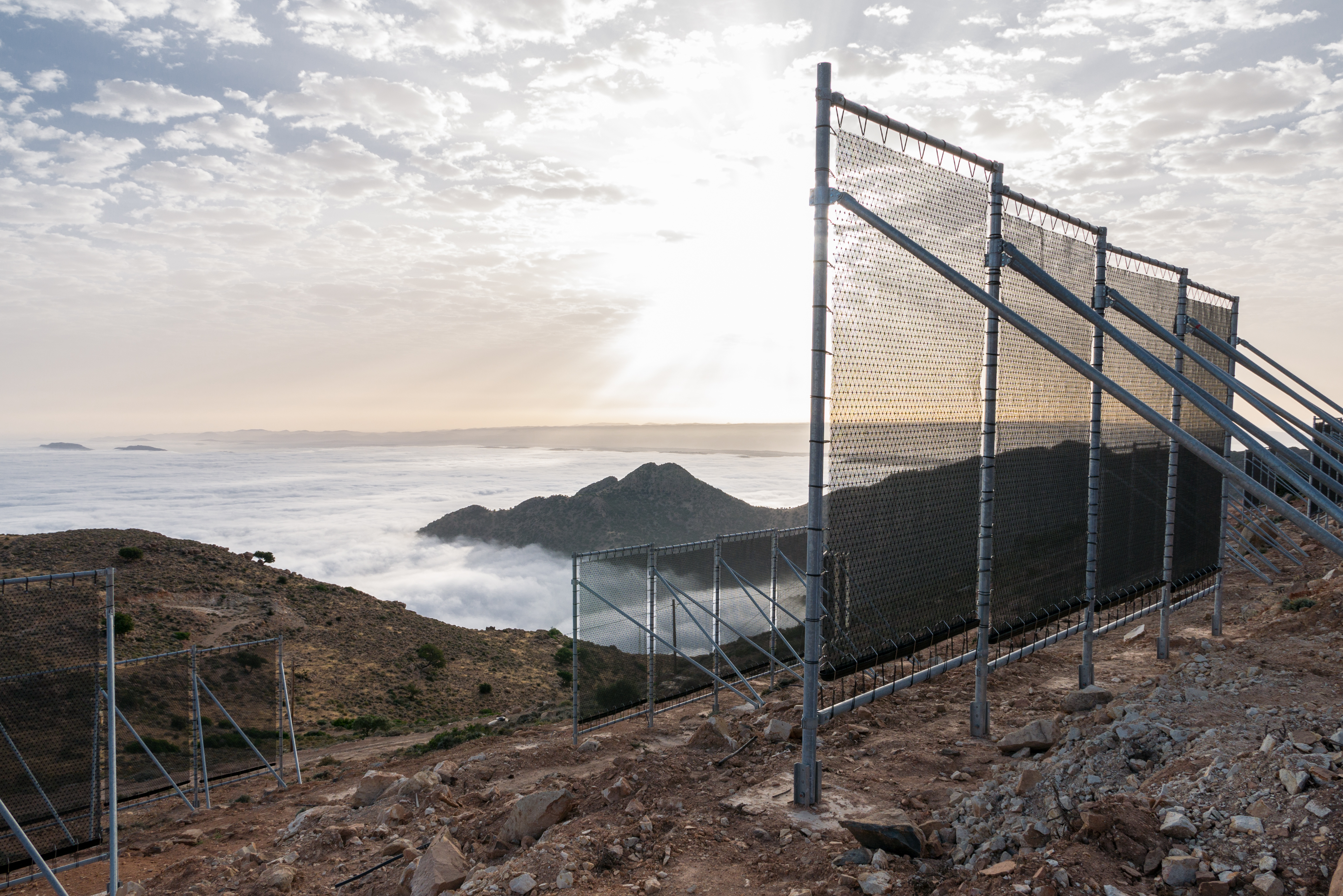
Not sure it works in the open desert. This in close to the coast, on hillsides and tops to collect the offshore breeze and trap moisture from that.
unc70
(6,501 posts)Works in many places
Trailrider1951
(3,581 posts)They put up woven nets that take the droplets from fog that moves inland from the Pacific Ocean, and use the water for drinking and growing crops.
Chile:
https://reliefweb.int/report/chile/fog-traps-save-chilean-farming-community-severe-drought
Peru:
http://sustainablefootprint.org/peruvians-harvesting-water-from-fog/
This idea could work in other places that are near the ocean and have frequent foggy conditions. 

Xolodno
(7,349 posts)But their are a lot of technologies in use or not in use enough for water. But if we can toss this as another way to get water, why not? But lets also look at some of the others we could do either in a mass or limited scale.
1. Water recycling. Granted almost no one will get on board with that, but in some places they pump it or place in fields to refill the ground water table.
2. Drip irrigation, still a lot of farmers opposed to this. And lets be honest, some farms might have to be "retired". Almond milk may bring in a quick cash crop, but its not sustainable. I remember when I was a kid when we visited family in the rural areas of outer Bakersfield, there was acres and acres of cotton fields. Now? It's acres and acres of almonds...or cows.
3. Drop subsidies on some water intensive crops.
4. Many canals have dirt or stone bottoms and open air tops. LA County has contracted with some water districts where they pay to have the canal concreted on the bottom and then covered on top to avoid evaporation (and collects the extra water)b. But this gets hard, I live less than a mile from the California Aqueduct, it has a concrete bottom, but covering it would be a bad idea. A lot of coyotes, hawks, owls, quail, mountain lions, bears, etc. depend on that water.
5. At my old company, waterless urinals were put it, we should put those in at every house hold/business where possible. Plus other water saving techniques.
6. Back in my Water Resource Econ course days, we had a guest speaker from Israel who pointed out we had an advantage. That we could create what he called "jelly-fish" (a huge spherical plastic membrane), fill them up with fresh water from Alaska or Canada at the outlet of a river and with minimum energy, float them down to California Coastal cities and supply them. Then ship the membranes back up and start over.
7. Get rid of lawns and make it illegal for an HOA to require it.
Granted some of this will cost jobs in landscaping and I didn't even touch pool taxes which would do the same. But if we want to get serious about water conservation, we need to hit it at both the macro and micro level. And I'll even add something that seems counter intuitive, restore some of the river tributaries that Floyd Dominy destroyed in his mad rush to build damns (most probably don't know who he is, but he wanted to damn a spot just outside the Grand Canyon which would cause a part of it to flood, and once met with criticism, he stated the flooding might actually improve the views of the canyon when on the water. Kudos to the Sierra Club, they responded "would you flood the Sistine Chapel just so you could get a closer view of the ceiling" .
.
Restoring those tributaries would probably bring in more moisture to the affected areas, not to mention replenish the natural sea life, salmon runs, etc. I bet if I really did a study, I would probably a correlation between the growth of damns, farms, etc. to the negative effects to the fisheries off the coast of California.
Hermit-The-Prog
(36,631 posts)Install solar panels over the canal to reduce evaporation. These won't block wildlife from getting to the water. The panels will also drip condensation back into the canal. It's already being done, just not widespread.