General Discussion
Related: Editorials & Other Articles, Issue Forums, Alliance Forums, Region ForumsSelf-employed? The less you make, the MORE they take in taxes.
My final client of the 2023 tax season was kind of a pain. A self-employed house cleaner, she complained and complained all the way through the interview. I did my best to sympathize with her - I had been self-employed myself for a number of years, and I remembered how onerous the self-employment taxes had seemed at the time. I had also had my taxes done professionally once - ONLY once - and I still remember the sticker shock there.
The next day, I had some free time and decided to do a little analysis with the tax software - putting in different figures for both scenarios, wage-earner vs. self-employed. I expected to see higher taxes for self-employed people, of course. But I expected that those extra taxes would be more or less the same percentage-wise among all income groups. Or, maybe they would even be lower for lower-income people when taking Earned Income Credit into account.
So, I was completely taken aback when I realized the reality of the situation.
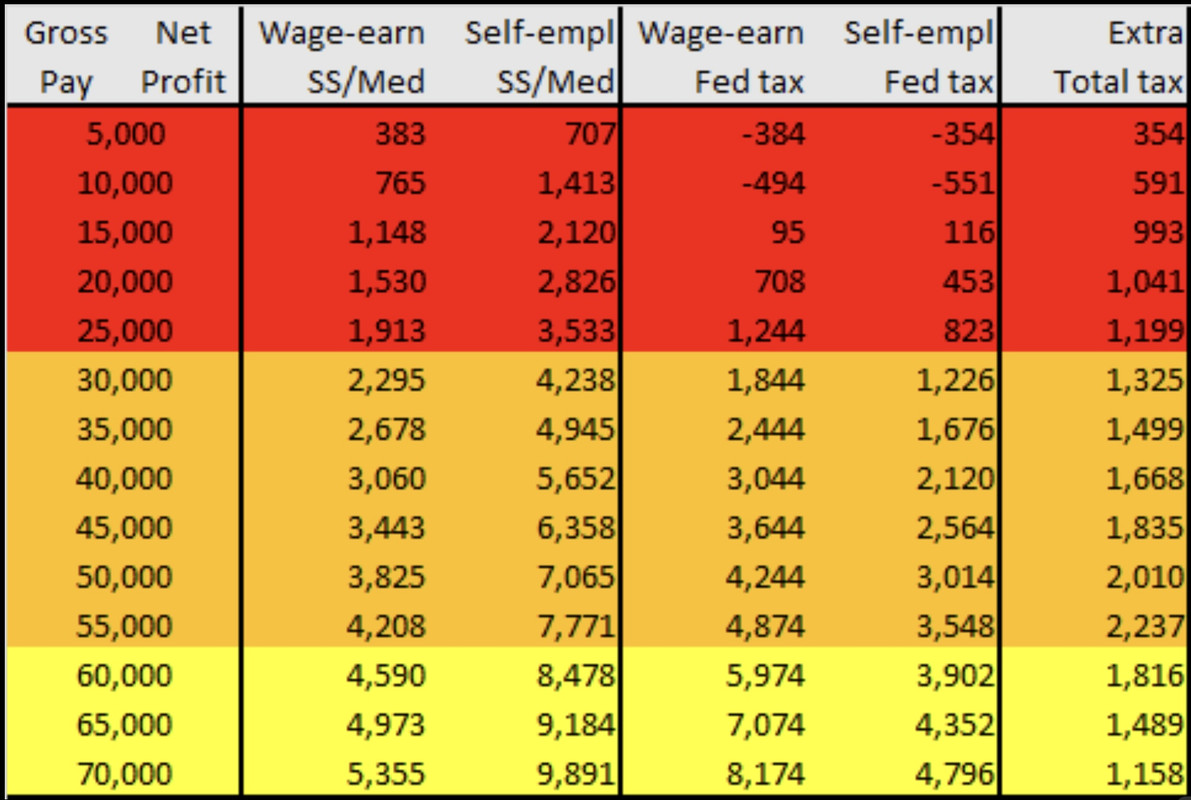
The first chart shows the difference in SS/Medicare taxes and Federal taxes between the two groups. Self-employed people pay more in SS/Medicare taxes, but less in Federal taxes. Overall, they pay more. The first clue that something was wrong came at the $60,000 mark - a self-employed person making 60K paid LESS in additional taxes than someone making $55K. Even worse - a self-employed person making $70,000 paid less in additional taxes than a self-employed person making $25,000 (!!!)
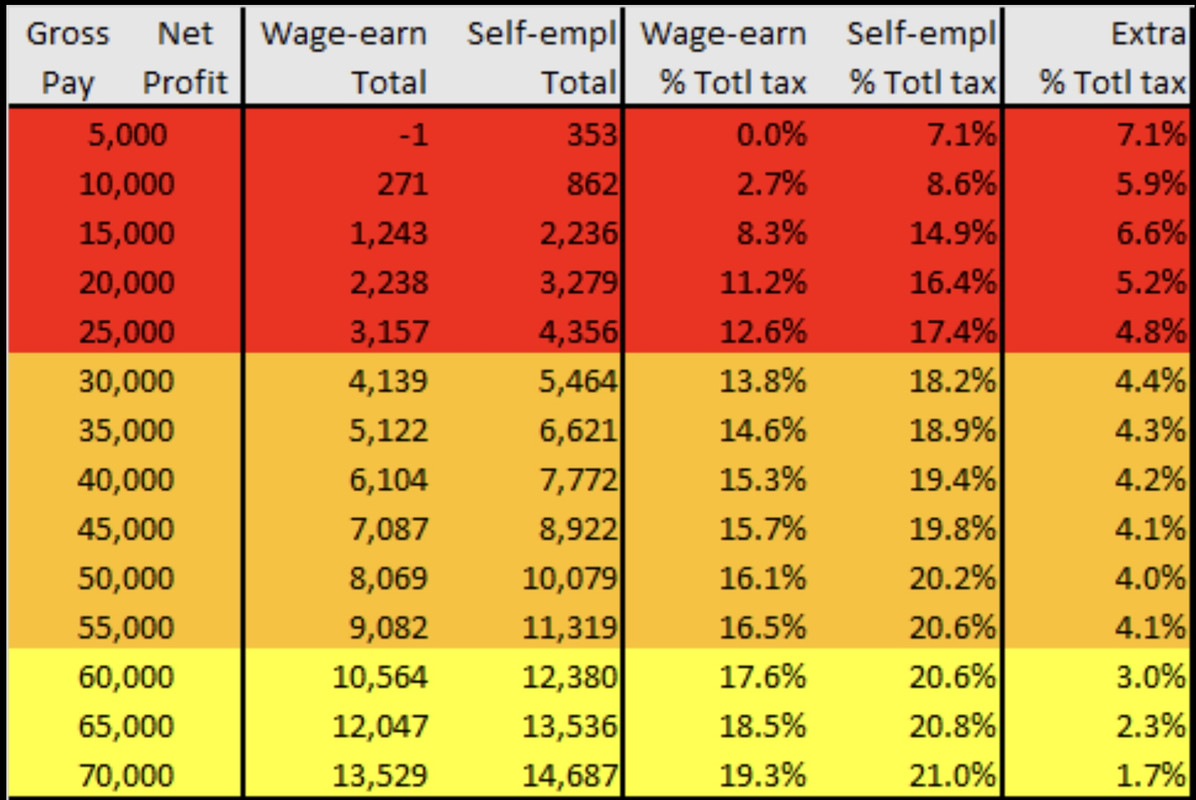
The second chart made it even clearer. It was eye-popping. A self-employed person making only $5,000, while paying "only" $353 in total taxes, paid a whopping 7.1% more taxes than a wage-earner making the same $5,000. Meantime, a self-employed person making $70,000 paid only 1.7% more than the comparable wage-earner.
If that seems backwards, it's because... it is.
So, "the more you make, the more they take"? Not if you're self-employed.
This regressive tax system desperately needs to be changed, especially with more and more people being forced into the "independent contractor" role by companies who don't want to pay the employer share of Social Security and Medicare taxes anymore.
 = new reply since forum marked as read
Highlight:
NoneDon't highlight anything
5 newestHighlight 5 most recent replies
= new reply since forum marked as read
Highlight:
NoneDon't highlight anything
5 newestHighlight 5 most recent replies

Ms. Toad
(38,824 posts)If you are going to compare apples to apples, you need to include the full SS and Medicare taxes for both self-employed and employed.
At $5,000, an employed individual would be paying 7.65% in taxes to the two combined, not the 0% you have them paying. A self-employed person would be paying roughly 15.3%.
Beyond that it's simple math. A flat tax that applies without deduction always hits the lowest income individuals hardest becaseu ever dollar is taxed. A graduated tax (like income tax) exempts a certain amount at the low end of the scale and increases as income gets higher (i.e. the marginal tax rate is higher). As the marginal tax rate of both individuals climb, the extra kick of the 7.65% extra (roughly) paid by the self-employed individual diminishes relative to the increased percentage coming from the income tax.
As long as you accept the structure of social security (flat tax paid by everyone to create a social net for retirement), with half paid by the employer and half paid by the employee, a self-employed individual will always pay double what an employed individual will into that system.
The theory is that people who are self-employed act as the employer and the cost of that added tax should be built into the cost for services provided by the self-employed individual (just as the cost is built into the employer's business).
The reality is more complicated. There are a lot of "self-employed" individuals who really aren't self-employed. They are employees, but the employer is trying to save a buck (or a lot of bucks) on taxes - social security, specifically. I did taxes for a number of years and just doing a quick run down of how many of my "self-employed" clients were actually self-employed - I can only recall one. Most were classified that way, paid on a 1099 by their employer, but were almost certainly misclassified. Essentially, when you control the minutiae of what a worker does (rather than handing them a job and letting them figure out how to get it done) the person is an employee - not self-employed.
They could challenge their employer - would likely win. It's a simple IRS form to report that a job for which your employer did not pay social security was actually employment, not a business you set up. But doing so will almost certainly get you fired because the IRS will come down on your employer like a ton of bricks. They will owe back taxes for you (and anyone else similarly misclassified).

BWdem4life
(3,091 posts)especially if you aren't currently one yourself.
At $5,000 an employed person pays 7.65% in SS/Medicare tax, then gets it all back in the form of the EIC. Final number is zero (actually -1).
And, it's not 15.3% of net profit, it's 15.3% of 92.35% of net profit.
Ms. Toad
(38,824 posts)There are more credits than EIC, and more income than earned income, credits are subject to eligibility, and income can be taxed differently depending on the source. The fact remains that SS is a flat tax on earned income. I was speaking of general principles (the self employed person pays the employer's share of taxes because they are acting as both employer and employee). To ensure that the individuals are not taxed on taxes owed, the amount on which taxes are due is 92.35%, so you are correct as to that.
FWIW, I've been an enrolled agent, athough I decided not to maintain that status once I became an attorney (which allows me to do everything an enrolled agent does, and more without the need to double up on CLE/CEUs).

roamer65
(37,974 posts)Regardless of employment status.
If you are forced into contract work after 55, you should be able to access ALL of your 401k’s penalty free.
Speaking of regressive…

Kick in to the DU tip jar?
This week we're running a special pop-up mini fund drive. From Monday through Friday we're going ad-free for all registered members, and we're asking you to kick in to the DU tip jar to support the site and keep us financially healthy.
As a bonus, making a contribution will allow you to leave kudos for another DU member, and at the end of the week we'll recognize the DUers who you think make this community great.