General Discussion
Related: Editorials & Other Articles, Issue Forums, Alliance Forums, Region ForumsWho and what may suffer most from Kakhovka dam destruction - expert interview
Last edited Tue Jun 20, 2023, 07:07 AM - Edit history (1)
Who and what may suffer most from Kakhovka dam destruction – expert interview
June 19, 2023, 05:39 PM
https://english.nv.ua/nation/who-and-what-may-suffer-most-from-kakhovka-dam-destruction-expert-interview-50333043.html
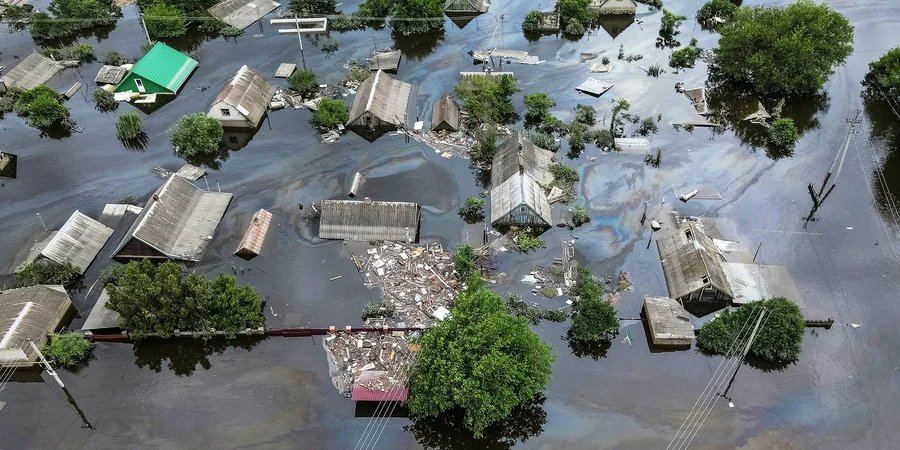
The consequences of the Kakhovka HPP explosion not only destroy the ecosystems of the region, but also make certain areas uninhabitable and destroy the economic potential of the region (Photo:REUTERS/Inna Varenytsia)
Sudden floods, the “drying” of the local climate, the lack of drinking and technical water, and the impoverishment of the soil will radically change the lives of the residents of Kherson Oblast in the coming years, Kherson State University professor Ihor Pylypenko said in an interview with NV on June 19.
The largest man-made disaster in Europe in the last decades is what experts call the events stemming from Russian forces blowing up the Kakhovka Hydroelectric Power Plant (HPP) dam on June 6. This led to a rapid drop in the water level in the Kakhovka water reservoir and flooding of the downstream Dnipro River basin.
There were casualties, a significant part of the population of the city of Kherson and nearby villages had to be evacuated. Hundreds of tons of machine oil got into the water, as well as the contents of dumpsters, fuel storages, warehouses with chemicals, fertilizers, and animal burial grounds, etc. The Dnipro River flooded tens of thousands of hectares of forests and fields, destroying animal habitats.
The White House declared that Russia was responsible for the devastation caused by the destruction of the Kakhovka HPP, while the MEPs called the destruction of the Kakhovka HPP a Russia war crime.
NV: What is the most serious, most damaging environmental risk caused by the destruction of the Kakhovka HPP?
Pylypenko: Humans have created a huge artificial ecosystem. Therefore, we cannot talk about exclusively environmental issues. I would say this is rather a socio-ecological problem, where a human is at the top and owner of this system, who, having fit into this system, uses its water resources.
Imagine the ancient Egyptian civilization that arose on the banks of the Nile River, and suddenly the Nile does not exist anymore. We do not say that we have some kind of civilization there, but people drew upon on this water resource via their settlement system, economic activity, and now there is no water. That is, now there is no reservoir, which functioned not only for storing and accumulating water, but also for distributing it for various economic needs.
The issue of environmental risk is extremely complex and very difficult to answer. From my point of view, the population will be the most affected link in this chain of interaction “nature-population-economy.”
NV: What will happen to the agricultural lands that are now without the irrigation on which they depended so much? What processes for the soils in the region are threatened by the consequences of Russia’s destruction of the Kakhovka HPP?
Pylypenko: We have a rather colorful soil system there. But the areas that used the central irrigation system will suffer the most. They will be characterized by an increase in the level of salinity. And this will lead to loss of soil fertility. Although, let’s say, depending on what year it will be, what the soil’s moisture reserves are, perhaps the soil will still be able to produce crops for some time.
For example, we will switch to crops that require less moisture, cutting down on growing onions, eggplants, sweet peppers, tomatoes, etc.
This problem will be less on sandy soils, where irrigation was localized, using underground aquifers. Therefore, we hope that the level of underground water that was formed there will allow our farmers, in particular small ones, to continue growing agricultural crops, primarily vegetables, in particular in closed soil, i.e., in greenhouses, for many years to come.
As for cultivation in open ground, on sandy soils, where the parent rock is based on sand, and the groundwater is relatively shallow, in principle, we can continue growing melon crops. Let’s put it this way, the well-known Kherson watermelons, which most Ukrainian consumers know, are also grown in areas unaffected by the dam’s destruction. They will grow there, although there are risks. It depends on whether the spring period is wet, whether there is enough water to produce a crop.
NV: So, will the most difficult thing be with vegetable crops?
Pylypenko: Yes. And I’m more interested in the vegetable set in the hierarchy, let’s say, of consumer values. I think that all Ukrainians felt the absence of Kherson Oblast on the Ukrainian vegetable market even last year. Undoubtedly, the vegetable growth is observed in other regions of the country, in particular due to the use of greenhouse farming. But you understand that the resources of heat, relatively speaking, of the forest-steppe, Prykarpattia region and Kherson Oblast or Mykolayiv Oblast, are incomparable. It is another set of temperatures.
Snip...
Much more at the link.
https://english.nv.ua/nation/who-and-what-may-suffer-most-from-kakhovka-dam-destruction-expert-interview-50333043.html
~~~☆~~~☆~~~☆~~~☆~~~☆~~~
This is a long and comprehensive interview. I hope you enjoy learning more about the effects of the ecocide war crime perpetrated by the invaders. The New Voice of Ukraine has been a great news source for me. You can find the main page, with options in English, Ukrainian and Russian here:
https://english.nv.ua/
❤️pants
 = new reply since forum marked as read
Highlight:
NoneDon't highlight anything
5 newestHighlight 5 most recent replies
= new reply since forum marked as read
Highlight:
NoneDon't highlight anything
5 newestHighlight 5 most recent replies

SunSeeker
(58,344 posts)
littlemissmartypants
(34,146 posts)
SunSeeker
(58,344 posts)It's hard to hear, but we need to know the extent of Putin's war crimes. Bombing that dam may have been one of Putin's worst war crimes to date.