General Discussion
Related: Editorials & Other Articles, Issue Forums, Alliance Forums, Region ForumsElectoral College Ratings: Expect Another Highly Competitive Election
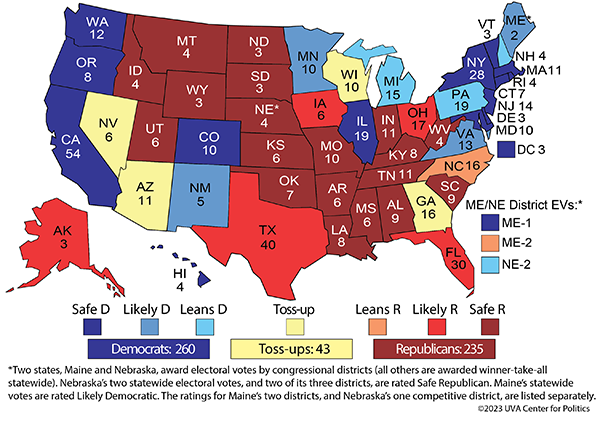
UVA Center for PoliticsMap 1 shows these initial ratings. We are starting 260 electoral votes worth of states as at least leaning Democratic, and 235 as at least leaning Republican. The four Toss-ups are Arizona, Georgia, and Wisconsin — the three closest states in 2020 — along with Nevada, which has voted Democratic in each of the last four presidential elections but by closer margins each time (it is one of the few states where Joe Biden did worse than Hillary Clinton, albeit by less than a tenth of a percentage point). That is just 43 Toss-up electoral votes at the outset. Remember that because of a likely GOP advantage in the way an Electoral College tie would be broken in the U.S. House, a 269-269 tie or another scenario where no candidate won 270 electoral votes would very likely lead to a Republican president. So Democrats must get to 270 electoral votes while 269 would likely suffice for Republicans, and there are plausible tie scenarios in the Electoral College.
 = new reply since forum marked as read
Highlight:
NoneDon't highlight anything
5 newestHighlight 5 most recent replies
= new reply since forum marked as read
Highlight:
NoneDon't highlight anything
5 newestHighlight 5 most recent replies

mvymvy
(309 posts)Now we need to guarantee the candidate who wins the most popular votes among all 50 states and DC always wins the presidency.
Every vote in every state would matter and count equally as 1 vote in the national total.
State legislators in states with 65 more electoral votes are needed to enact the National Popular Vote bill.
Arizona, Pennsylvania and Wisconsin were the top three most litigious states in 2022 in regards to elections.The 2 current and 1 former battleground state accounted for over 40% of all the election and voting lawsuits filed. Arizona topped the list, with 35 lawsuits, Pennsylvania 21 and Wisconsin 16. – Democracy Docket
234 Trump Article III judgeship nominees were confirmed by the US Senate
A majority of U.S. Supreme Court justices (5 of the 6 “conservative” justices) were appointed by Presidents who first entered office after not winning the most national popular votes.
SCOTUS 2023 Moore v Harper sets “a version of judicial review that is going to give the federal courts, and especially the Supreme Court itself, the last word in election disputes." - Hasen
We have 519,682 elected officials in this country, and all of them are elected by who gets the most votes. Except for President and VP.
Our unfair presidential election system can lead to politicians and their enablers who appreciate unfairness, which leads to more unfairness, and recently crimes and violence.
The sheer magnitude of the national popular vote numbers in presidential elections, compared to individual (especially battleground) state vote totals, is much more robust against “pure insanity,” deception, manipulation, and recently, crimes and violence.
If as few as 11,000 voters in Arizona (11 electors), 12,000 in Georgia (16), and 22,000 in Wisconsin (10) had not voted for Biden, or partisan officials did not certify the actual counts -- Trump would have won despite Biden's nationwide lead of more than 7 million.
The Electoral College would have tied 269-269.
Congress, with only 1 vote per state, would have decided the election, regardless of the popular vote in any state or throughout the country.
In 2016, Trump won the Presidency because he won Michigan by 11,000 votes, Wisconsin by 23,000 votes, and Pennsylvania by 44,000 votes.
Each of these 78,000 votes was 36 times more important than Clinton's nationwide lead of 2,868,686 votes.
States with 270+ Electoral College votes are agreeing to award them to the winner of the most popular votes from all 50 states and DC, by simply changing their state’s current district or statewide winner-take-all law, using their exclusive and plenary constitutional power
All votes would be valued equally in presidential elections, no matter where voters live.
No more distorting, crude, and divisive red and blue state maps of predictable outcomes, that don’t represent any minority party voters within each state.
No more handful of 'battleground' states (where the two major political parties happen to have similar levels of support) where voters and policies are more important than those of the voters in 38+ predictable winner states that have just been 'spectators' and ignored after the conventions.
We can limit the outsized power and influence of a few battleground states in order to better serve our nation.
The constitutional wording does not encourage, discourage, require, or prohibit the use of any particular method for awarding a state's electoral votes.
There is nothing in the Constitution that prevents states from making the decision now that winning the national popular vote is required to win the Electoral College and the presidency.
It is perfectly within a state’s authority to decide that national popularity is the overriding substantive criterion by which a president should be chosen.
Because of current state-by-state statewide winner-take-all laws, not mentioned, much less endorsed, in the Constitution. . .
Presidential elections, campaigns, and governance are distorted by the concentration of attention on just a few states.
Before anti-democracy Republicans, and new voter suppression and election subversion laws, based on the Big Lie/Big Grift, the system with 2020 election laws meant that the winning 2024 presidential candidate could need a national popular vote win of 5 percentage points or more in order to squeak out an Electoral College victory.
Minority and youth voting have dropped significantly. Since 2008, Black voting in states dominated by Democrats has increased by 1.8 points; in Republican-dominated states it has dropped by four points. In Georgia, Black participation rates dropped from 47.8% to 43.2% between 2018 and 2022. Hispanic participation dropped from 27.6% to 25.1%, and the youth vote dropped from 33% to 26%. - Elias
The new presidential electoral map is more favorable to Republicans by a net six points.
NationalPopularVote.com
brooklynite
(96,882 posts)We don't have a national popular vote, and unless you know of a way to amend the Constitution, we won't have one anytime in the future.
mvymvy
(309 posts)States with 270+ electoral votes combined are agreeing to award them to the winner of the most popular votes of all 50 states and DC, by simply again changing their state’s law.
The bill has been enacted by 17 small, medium, and large jurisdictions with 205 electoral votes
State legislators in states with 65 more electoral votes are needed to enact the National Popular Vote bill.
Under the current system, the electoral votes from all 50 states are co-mingled and simply added together.
With National Popular Vote, the popular votes from all 50 states will be co-mingled and simply added together.
The bill retains the constitutionally mandated Electoral College and state control of elections,
Constitutionally, the number of electors in each state is equal to the number of members of Congress to which the state is entitled, while the 23rd Amendment grants the District of Columbia the same number of electors as the least populous state, currently three. No Senator or Representative, or Person holding an Office of Trust or Profit under the United States, shall be appointed an Elector.
Unable to agree on any particular method for selecting presidential electors, the Founding Fathers left the choice of method exclusively to the states in Article II, Section 1
“Each State shall appoint, in such Manner as the Legislature thereof may direct, a Number of Electors….”
The U.S. Supreme Court has repeatedly characterized the authority of the state legislatures, before citizens begin casting ballots in a given election, over the manner of awarding their electoral votes as "plenary" and "exclusive."
The Constitution does not encourage, discourage, require, or prohibit the use of any particular method for how to award a state's electoral votes
There is nothing in the Constitution that prevents states from making the decision now that winning the national popular vote is required to win the Electoral College and the presidency.
It is perfectly within a state’s authority to decide that national popularity is the overriding substantive criterion by which a president should be chosen.
In 1789, in the nation's first election, a majority of the states appointed their presidential electors by appointment by the legislature or by the governor and his cabinet, the people had no vote for President in most states, and in states where there was a popular vote, only men who owned a substantial amount of property could vote, and only three states used the state-by-state winner-take-all method to award electoral votes (and all three stopped using it by 1800).
In the nation’s first presidential election in 1789 and second election in 1792, the states employed a wide variety of methods for choosing presidential electors, including
● appointment of the state’s presidential electors by the Governor and his Council,
● appointment by both houses of the state legislature,
● popular election using special single-member presidential-elector districts,
● popular election using counties as presidential-elector districts,
● popular election using congressional districts,
● popular election using multi-member regional districts,
● combinations of popular election and legislative choice,
● appointment of the state’s presidential electors by the Governor and his Council combined with the state legislature, and
● statewide popular election.
As a result of changes in state laws enacted since 1789, the people have the right to vote for presidential electors in 100% of the states, there are no property requirements for voting in any state, and the state-by-state winner-take-all method is used by 48 of the 50 states. States can, and have, changed their method of awarding electoral votes over the years.
The normal process of effecting change in the method of electing the President is specified in the U.S. Constitution, namely action by the state legislatures. This is how the current system was created, and this is the built-in method that the Constitution provides for making changes
Now, Each political party in each state nominates a slate of candidates for the position of presidential elector. This is most commonly done at the party’s congressional-district conventions and the party’s state convention during the summer or early fall. It is sometimes done in a primary.
Typically, each political party chair certifies to the state’s chief election official the names of the party’s candidate for President and Vice President and the names of the party’s candidates for presidential elector.
Under the “short presidential ballot” (now used in all states), the names of the party’s nominee for President and Vice President appear on the ballot.
When a voter casts a vote for a party’s presidential and vice-presidential slate on Election Day (the Tuesday after the first Monday in November), that vote is deemed to be a vote for all of that party’s candidates for presidential elector.
Federal law (Title 3, chapter 1, section 6 of the United States Code) requires the states to report the November popular vote numbers (the "canvas" in what is called a "Certificate of Ascertainment." They list the number of votes cast for each, and are signed and certified by the Governor.
With both the current system and the National Popular Vote bill, all counting, recounting, and judicial proceedings must be conducted so as to reach a "final determination" by six days before the Electoral College meets in December.
Under statewide “winner-take-all” laws, not mentioned, much less endorsed in the Constitution, now used in 48 states, the presidential-elector candidates who receive the most popular votes statewide are elected.
In district winner states -- Maine (changed their law in 1969) and Nebraska (changed their law in 1992) - the candidate for the position of presidential elector who wins the most popular votes in each congressional district is elected (with the two remaining electors being based on the statewide popular vote).
In states enacting the National Popular Vote bill, when enacted by states with a majority of the electoral votes—270 of 538, all of the 270+ presidential electors from the enacting states will be supporters of the presidential candidate receiving the most popular votes among all 50 states (and DC).
Non-enacting states would award their electors however they want. Continuing with district or statewide winner-take-all, or enacting some other law.
The Electoral Count Reform Act of 2022 made the sixth day before the Electoral College meeting into a “hard” deadline for states to issue their Certificates of Ascertainment (whereas it was merely a “safe harbor” under the Electoral Count Act of 1787).
Each state’s elected presidential electors travel to their State Capitol on the first Monday after the second Wednesday in December to cast their votes for President and Vice President.
The electoral votes from all 50 states are and would be co-mingled and simply added together.
The Electoral College will continue to elect the President.
brooklynite
(96,882 posts)You have the safe all-Democratic States signing on to the NPV Interstate Compact at this point. You now have to win over States with Republican Governors or larger Republican legislative margins who won't agree.
mvymvy
(309 posts)Now we need to support and urge state legislators in states with the 65 more electoral votes needed, to enact the National Popular Vote bill to make every vote in every state matter and count equally, and guarantee the presidency to the candidate who wins the most popular votes in the country.
Michigan (15) has not signed on yet. Michigan is no longer expected to be a battleground state.
8 recent battleground states are expected to be politically irrelevant in the 2024 presidential election.
The 2024 presidential race could be reduced to less than 15% of the US, in 4 remaining competitive battleground states, with as few as 43 electoral votes, where virtually all attention will be focused - Arizona, Georgia, Nevada and Wisconsin - Biden won all of them. 260 electoral votes leaning Democratic and 235 leaning Republican.
62% of Michigan voters just surveyed believe the candidate for President that the most Americans vote for should win the presidential election.
50% support the National Popular Vote bill
35% oppose
15% not sure
Michigan Democrats have outnumbered Michigan Republicans in 7 of the 8 recent presidential elections.
Because of current state-by-state statewide winner-take-all laws, not mentioned, much less endorsed, in the Constitution. . .
Michigan's electors have all voted for the Democrat in 7 of the 8 recent presidential elections.
No Republican Michigan vote has helped its candidate in any way in those elections.
“Whomever the GOP picks in 2024 to run for POTUS will be skipping Michigan, and that is a shame. No serious candidate will come here, . . Michigan Is a BLUE State and Lying About It Won’t Change That Fact, . . . and will continue to be true for at least another five or six years. . . the Michigan GOP continues to swirl into oblivion,”- https://redstate.com/tladuke/2023/03/18/did-the-michigan-gop-just-concede-the-2024-potus-race-with-its-latest-move-n718242
brooklynite
(96,882 posts)Wisconsin? Veto-proof Republican Legislature
Pennsylvania? Republican Chamber
New Hampshire? Republican Governor and Legislature
Georgia? Republican Governor and Legislature
Arizona? Republican Legislature
Nevada? Republican Governor.
mvymvy
(309 posts)Last edited Thu Jun 29, 2023, 10:58 PM - Edit history (1)
We need to support election officials and candidates and lawmakers who support voting rights and respect election results.
On May 18, 2023, the Nevada Senate passed the National Popular Vote Interstate Compact as a constitutional amendment. The Nevada Assembly previously passed AJR6 on April 17. The amendment must now be passed a second time by both houses of the 2025-2026 Nevada legislature. After that, the amendment would be submitted to the voters for their approval in November 2026.
In 2019 the Nevada Senate and Nevada House passed the National Popular Vote bill.
AZ Senate - 16 R, 13 D, 1 vacant
AZ House - 30 R, 29 D, 1 vacant
Democratic Governor
In 2016 the Arizona House of Representatives passed the bill 40-16-4.
Two-thirds of the Republicans and two-thirds of the Democrats in the Arizona House of Representatives sponsored the bill.
In January 2016, two-thirds of the Arizona Senate sponsored the bill.
In 2014, the Oklahoma Senate passed the bill by a 28–18 margin.
In 2009, the Arkansas House of Representatives passed the bill.

Polybius
(22,288 posts)Seems like it violates the Interstate Commerce law.
mvymvy
(309 posts)Polybius
(22,288 posts)But if they say it does, then it will be struck down.

former9thward
(33,424 posts)The Compact Clause (Article 1, Section 10, Clause 3) provides that “No State shall, without the Consent of Congress, ... enter into Any Agreement or Compact with another State, or with a foreign Power.
Congress has not consented to the states forming a electoral compact with each other and its not likely they will.
mvymvy
(309 posts)The Interstate Compact on Placement of Children is one of the many interstate compacts that do not require (and never received) congressional consent.
Congressional consent is not required for the National Popular Vote compact under prevailing U.S. Supreme Court rulings.
The U.S. Constitution provides:
"No state shall, without the consent of Congress,… enter into any agreement or compact with another state…."
Although this language may seem straight forward, the U.S. Supreme Court has ruled, in 1893 and again in 1978, that the Compacts Clause can "not be read literally." In deciding the 1978 case of U.S. Steel Corporation v. Multistate Tax Commission, the Court wrote:
"Read literally, the Compact Clause would require the States to obtain congressional approval before entering into any agreement among themselves, irrespective of form, subject, duration, or interest to the United States.
"The difficulties with such an interpretation were identified by Mr. Justice Field in his opinion for the Court in [the 1893 case] Virginia v. Tennessee. His conclusion [was] that the Clause could not be read literally [and this 1893 conclusion has been] approved in subsequent dicta."
Specifically, the Court's 1893 ruling in Virginia v. Tennessee stated:
"Looking at the clause in which the terms 'compact' or 'agreement' appear, it is evident that the prohibition is directed to the formation of any combination tending to the increase of political power in the states, which may encroach upon or interfere with the just supremacy of the United States."
The state power involved in the National Popular Vote compact is specified in Article II, Section 1, Clause 2 the U.S. Constitution:
"Each State shall appoint, in such Manner as the Legislature thereof may direct, a Number of Electors…."
In the 1892 case of McPherson v. Blacker (146 U.S. 1), the Court wrote:
"The appointment and mode of appointment of electors belong exclusively to the states under the constitution of the United States"
The National Popular Vote compact would not "encroach upon or interfere with the just supremacy of the United States" because there is simply no federal power -- much less federal supremacy -- in the area of awarding of electoral votes in the first place.
In the 1978 case of U.S. Steel Corporation v. Multistate Tax Commission, the compact at issue specified that it would come into force when seven or more states enacted it. The compact was silent as to the role of Congress. The compact was submitted to Congress for its consent. After encountering fierce political opposition from various business interests concerned about the more stringent tax audits anticipated under the compact, the compacting states proceeded with the implementation of the compact without congressional consent. U.S. Steel challenged the states' action. In upholding the constitutionality of the implementation of the compact by the states without congressional consent, the U.S. Supreme Court applied the interpretation of the Compacts Clause from its 1893 holding in Virginia v. Tennessee, writing that:
"the test is whether the Compact enhances state power quaod [with regard to] the National Government."
The Court also noted that the compact did not
"authorize the member states to exercise any powers they could not exercise in its absence."
The 2020 Supreme Court unanimously reaffirmed the power of states over their electoral votes, using laws in effect on Election Day.
The decision held that the power of the legislature before Election Day under Article II, Section 1 of the Constitution is “far reaching” and it conveys “the broadest power of determination over who becomes an elector.” This is consistent with 130+ years of Supreme Court jurisprudence.

Demsrule86
(71,565 posts)the GOP wouldn't win under the EC.
mvymvy
(309 posts)Before anti-democracy Republicans, and new voter suppression and election subversion laws, based on the Big Lie/Big Grift, the system with 2020 election laws meant that the winning 2024 presidential candidate could need a national popular vote win of 5 percentage points or more in order to squeak out an Electoral College victory.
The 2024 race could be reduced to 15% of the US, in 4 competitive battleground states, with as few as 43 electoral votes, where virtually all attention will be focused
Policies important to the citizens of 38+ non-battleground states have not been as highly prioritized as policies important to ‘battleground’ states when it comes to governing.
Because of statewide winner-take-all laws, not mentioned, much less endorsed, in the Constitution . . .
2 recent presidents entered office without winning the most national popular votes.
A Democrat has won the national popular vote in 7 out of the last 8 elections. 5 of the last 6.
We've spent 12 of the last 22 years with a Republican in office.
5 of our 46 Presidents have come into office without having won the most popular votes nationwide.
Nate Silver of FiveThirtyEight calculated in early September 2020 that for Joe Biden to have just a 50-50 chance of becoming President, he needed to win the national popular vote by at least 3% (over 3 million votes).
A 1% lead in the national popular vote would have given Biden only a 6% chance of becoming President. A 2% lead would have given him only a 22% chance.
Another study showed, in general, there was a 45% chance that a close presidential election could end with the winner of less popular votes becoming President.
Another study warned that 1 out of every 3 presidential elections where the popular vote margin is within 3% will feature a mismatch between the popular vote and the electoral college.
There were several scenarios in which a candidate could have won the presidency in 2020 with fewer popular votes than their opponents. It would have reduced turnout more, if more voters realized their votes do not matter.
Minority and youth voting have dropped significantly. Since 2008, Black voting in states dominated by Democrats has increased by 1.8 points; in Republican-dominated states it has dropped by four points. In Georgia, Black participation rates dropped from 47.8% to 43.2% between 2018 and 2022. Hispanic participation dropped from 27.6% to 25.1%, and the youth vote dropped from 33% to 26%. – Elias
Because of the state-by-state winner-take-all electoral votes laws (i.e., awarding all of a state’s electoral votes to the candidate who wins the most popular votes in each state) and (not mentioned in the U.S. Constitution, but later enacted by 48 states),a candidate can win the Presidency without winning the most popular votes nationwide. It has occurred in 5 of the nation's 60 (8%) presidential elections.
The precariousness of the current state-by-state winner-take-all system of awarding electoral votes is highlighted by the fact that a difference of a few thousand voters in one, two, or three states would have elected the second-place candidate in 5 of the 17 presidential elections since World War II. Near misses are now frequently common. There have been 9 consecutive non-landslide presidential elections since 1988.
537 popular votes won Florida and the White House for Bush in 2000 despite Gore's lead of 537,179 (1,000 times more) popular votes nationwide.
A difference of 59,393 voters in Ohio in 2004 would have defeated President Bush despite his nationwide lead of over 3 million votes.
In 2012, a shift of 214,733 popular votes in four states would have elected Mitt Romney, despite President Obama’s nationwide lead of 4,966,945 votes.
Nate Silver calculated that "Mitt Romney may have had to win the national popular vote by three percentage points … to be assured of winning the Electoral College."
In 2016, Trump became President even though Clinton won the national popular vote by 2,868,686 votes.
Trump won the Presidency because he won Michigan by 11,000 votes, Wisconsin by 23,000 votes, and Pennsylvania by 44,000 votes.
Each of these 78,000 votes was 36 times more important than Clinton's nationwide lead of 2,868,686 votes.
A different choice by 5,229 voters in Arizona (11 electors), 5,890 in Georgia (16), and 10,342 in Wisconsin (10) would have defeated Biden -- despite Biden's nationwide lead of more than 7 million. The Electoral College would have tied 269-269. Congress would have decided the election, regardless of the popular vote in any state or throughout the country.
Each of these 21,461 voters was 329 times more important than the more than 7 million.
The national popular vote winner also would have been defeated by a shift of 9,246 votes in 1976; 53,034 in 1968; 9,216 in 1960; 12,487 in 1948; 1,711 votes in 1916, 524 in 1884, 25,069 in 1860, 17,640 in 1856, 6,773 in 1848, 2,554 in 1844, 14,124 in 1836.
After the 2012 election, Nate Silver calculated that "Mitt Romney may have had to win the national popular vote by three percentage points on Tuesday to be assured of winning the Electoral College."
According to Tony Fabrizio, pollster for the Trump campaign, Trump’s narrow victory in 2016 was due to 5 counties in 2 states (not CA or NY).
Demsrule86
(71,565 posts)veto-proof in the fall. I would add that we won with a GOP governor and Legislature in 20.
The same is true in Georgia and now that SCOTUS has ruled they can't overturn elections...we have the same chance, and we won last time. The Georgia proposed map is DOA after what happened in Alabama. We won in Nevada too, and we kept a seat that you opined we were likely to lose. New Hampshire is fine. It is tiny regardless.
brooklynite
(96,882 posts)15 seats in the WI Assembly
6 seats in the WI Senate
12 seats in the GA Assembly
6 seats in the GA Senate
AND win the Governorship, get back to me.
Polybius
(22,288 posts)Red States won't go along.
mvymvy
(309 posts)Elections matter.

NowISeetheLight
(4,002 posts)They need to abolish it from the Constitution. I understand the reasoning for it when it started but America has changed. The whole concept of "one person one vote" is wiped out by it. When a state can vote 50.1% for a candidate and award all its electoral votes it's wiping out the votes of 49.9%.
mvymvy
(309 posts)There have been hundreds of unsuccessful proposed amendments to modify or abolish the Electoral College - more than any other subject of Constitutional reform.
To abolish the Electoral College would need a constitutional amendment, and could be stopped by states with less than 6% of the U.S. population;
[The Equal Rights Amendment was first introduced in Congress 100 years ago.]
In 1969, the U.S. House of Representatives voted 338-70 to require winning the national popular vote to become President.
3 Southern segregationist Senators led a filibuster to kill it.
Instead, we need to support state legislators throughout the country who support the National Popular Vote bill.
It simply again changes state statutes, using the same constitutional power for how existing state winner-take-all laws came into existence in 48 states in the first place.
[Maine (in 1969) and Nebraska (in 1992) chose not to have winner-take-all laws]
The bill will guarantee the majority of Electoral College votes and the presidency to the candidate who wins the most popular votes in the country.
The bill changes state statewide winner-take-all laws (not mentioned in the U.S. Constitution, but later enacted by 48 states), without changing anything in the Constitution, using the built-in method that the Constitution provides for states to make changes.
States are agreeing to award their 270+ Electoral College votes to the winner of the most popular votes from all 50 states and DC, by simply again changing their state’s law.
All votes would be valued equally as 1 vote in presidential elections, no matter where voters live.
State legislators in states with 65 more electoral votes are needed to enact the National Popular Vote bill.
NowISeetheLight
(4,002 posts)The Republicans have been focused on gaining control of enough state legislatures to force a constitutional convention. One of only two ways to change the constitution. Gerrymandering has gotten them close.
Democrats need to focus on this same strategy. It's the only way to change the constitution at this point.

groundloop
(13,998 posts)Unless a miracle happens and it's written out of the Constitution we're stuck with a system that automatically favors GQP candidates by 2 to 3 percentage points.
(63 million votes is more than 60 million votes.)
Demsrule86
(71,565 posts)
yankee87
(2,888 posts)As you said, I think there will be a Blue tsunami in 2024.

Elessar Zappa
(16,385 posts)Whoever wrote this article can bloviate all they want but no one has a crystal ball that can see into the future.
former9thward
(33,424 posts)Biden vs. Trump: Toss Up In Pennsylvania, Trump Leads GOP Primary, Quinnipiac University Pennsylvania Poll Finds; Voters Give Gov. Shapiro High Marks, Especially On I-95 Handling
In a hypothetical 2024 general election matchup between Biden and Trump, the race is a virtual dead heat among all registered voters with 47 percent supporting Trump and 46 percent supporting Biden.
https://poll.qu.edu/poll-release?releaseid=3875
This is a poll of 1584 registered voters which is a huge number for a state-wide poll.