General Discussion
Related: Editorials & Other Articles, Issue Forums, Alliance Forums, Region ForumsSF: Algebra is officially on The City's March ballot
The San Francisco Unified School District will reexamine its math curriculum following a near decadelong outcry from parents who have been incensed that the district stripped algebra from middle school curriculum.
Now, voters will get to weigh in on whether algebra should be offered in eighth grade.
A March 2024 ballot initiative was launched by city supervisors Joel Engardio and Ahsha Safai last week to urge the school district to put algebra back in its middle schools after the district shifted to offer algebra in high school only in 2014, claiming doing so closed an equity gap among students.
Conversely, a study by Stanford University released earlier this year showed the move actually widened that gap. Students of color were performing worse on standardized tests, and opponents said that the policy held advanced students back.
https://www.sfexaminer.com/news/education/why-sfusd-math-education-is-headed-to-march-2024-ballot/article_78f47d88-8995-11ee-abe6-a7076ddc817a.html
 = new reply since forum marked as read
Highlight:
NoneDon't highlight anything
5 newestHighlight 5 most recent replies
= new reply since forum marked as read
Highlight:
NoneDon't highlight anything
5 newestHighlight 5 most recent replies

JI7
(93,616 posts)can be given time to improve ?

pnwmom
(110,261 posts)In reality, the kids from families with means would find a way to take Algebra (and even more) in middle school, so the kids who would be hurt would be kids who might like more challenging math but don't have the money for summer classes or tutoring.
Among the thousands objecting to San Fran's plan were faculty members in Engineering and Math departments across the state.
swong19104
(625 posts)it's not a race; it's not a competition. Academic courses should be enlightening and helpful and consequential and integrated with other topics. The classic algebra-geometry-trigonometry-precalculus course paradigm makes zero sense. It made little sense 50 years ago, and it makes even less sense today.
Remember the movie, Hidden Figures about the black women mathematicians at NASA calculating trajectories and such? Those people were "computers". They literally computed equations because there were no electronic computers back then. (In the movie, they showed the introduction of an IBM mainframe computer.) The math course program that follows the algebra-geometry-trigonometry-precalculus track is to train people to be those computers. But we don't need those people anymore.
We need people to write the equations, not solve them. We need people to know how to use various calculating software like spreadsheets and Mathematica and other software tools. Let's move on to the 21st century, not keep teaching math the same way it has been taught since the 1930s.
For a while we had "new math" which was actually a good idea. It also eschewed the old "solve this equation" paradigm. But learning about the structure of the number line and about groups and rings and fields and continuity and countable vs uncountable was just a tad too esoteric for parents back then, because those parents were used to solving equations when they were in high school and didn't know enough about "new math" to help their kids with the kids' homework problems.
pnwmom
(110,261 posts)Last edited Sat Nov 25, 2023, 04:14 PM - Edit history (2)
And, believe it or not, some kids LOVE math and are just as frustrated being held back in math as book lovers would be if they were limited to reading Dr. Seuss in fifth grade. No one ever tries to hold book lovers back; why do they think it's fair to do that to math loving kids?
Also, most Engineering faculty in CA's universities strongly disagree with you about the utility of "the classic algebra-geometry-trigonometry-precalculus course paradigm" -- at least for students who are aiming for engineering in college. These students should have completed at least precalculus in high school, not a two-year fake "data science" program that won't prepare them for real data science in college (which has calculus as a prerequisite.) Future engineers need to be able to do much more than read spreadsheets and use software, despite what some Education faculty might think.
I know Jo Boaler (who has admitted hating math as a child) and some other College of Education people would agree with you, but they don't speak for faculty in engineering, math, and other technical fields. Engineering and technical faculty been working hard to stop San Francisco's mistakes from spreading to the rest of the state, in the form of the new California math platform.
Here's one of the open letters that's been circulating, strongly supporting the math "paradigm" that you think makes "zero sense" and was only designed to produce "human computers" like the women in Hidden Figures. Note that the signers "are limited to US based current or former professionals in STEM and quantitative fields: Faculty, educators, researchers, practitioners (science, technology, engineering, medicine, quantitative economics, investment)."
However, we are deeply concerned about the unintended consequences of recent well-intentioned approaches to reform mathematics education, particularly the California Mathematics Framework (CMF). Such frameworks aim to reduce achievement gaps by limiting the availability of advanced mathematical courses to middle schoolers and beginning high schoolers. While such reforms superficially seem “successful” at reducing disparities at the high school level, they are merely “kicking the can” to college. While it is possible to succeed in STEM at college without taking advanced courses in high school, it is more challenging. College students who need to spend their early years taking introductory math courses may require more time to graduate. They may need to give up other opportunities and are more likely to struggle academically. Such a reform would disadvantage K-12 public school students in the United States compared with their international and private-school peers. It may lead to a de facto privatization of advanced mathematics K-12 education and disproportionately harm students with fewer resources.
Another deeply worrisome trend is devaluing essential mathematical tools such as calculus and algebra in favor of seemingly more modern “data science.” As STEM professionals and educators we should be sympathetic to this approach, and yet, we reject it wholeheartedly. The ability to gather and analyze massive amounts of data is indeed transforming our society. But “data science” - computer science, statistics, and artificial intelligence- is built on the foundations of algebra, calculus, and logical thinking. While these mathematical fields are centuries old and sometimes more, they are arguably even more critical for today’s grand challenges than in the Sputnik era.
We call on national, state, and local governments to involve college-level STEM educators and STEM professionals in the design of K-12 mathematics and science education curriculum, set the following as explicit goals, and allocate resources to help school districts meet these goals:
https://sites.google.com/view/k12mathmatters/home
Link to tweet
“This pathway leaves students unprepared for quantitative four-year college degrees via a newly proposed pathway for teaching mathematics that lacks essential content,” Nelson said. “Instead of reducing the gap, the CMF proposal will worsen disparities as students from affluent families will access private instruction and tutors while under-resourced students will be left behind.”
https://stanforddaily.com/2022/04/07/stanford-and-cal-professors-level-accusations-as-debate-over-state-math-curriculum-rages/
P.S. I took "New Math" and I enjoyed it. And it was the opposite of what San Francisco has been doing in math. Instead of limiting the teaching of Algebra in middle school, "New Math" introduced Algebra concepts to elementary students.
triron
(22,240 posts)pnwmom
(110,261 posts)I wasn't prepared, as a bookworm myself, for how much my daughter would ADORE math, from toddler-hood-(even though I'd had a close friend in high school who would sigh over how "beautiful" a calculus problem was.) The challenge for me was always to get certain teachers out of my daughter's way, until she took over that job herself when she hit middle school..
What I see in someone like Jo Boaler is a kid who never liked math herself, who cannot conceive that others do. And I see people who think math must be dumbed down in order for Black kids to do well in it. And, based on that belief, she almost got the whole state of CA to follow San Francisco's example.
swong19104
(625 posts)in their professional careers, right? And that's ok.
pnwmom
(110,261 posts)Last edited Sun Nov 26, 2023, 07:08 AM - Edit history (1)
And that in San Francisco, even high school students who ARE interested in a quantitative career will be at a disadvantage compared to students in other cities and states, who have the OPTION of taking Algebra in 8th grade. Students in other cities don't have to "compress" two years of high school math into one in order to reach calculus.
As for high students who don't know what they might want to study in college: students who get diverted out of the Algebra 2 sequence, and into data literacy, are in a much more difficult position if they realize in college that they ARE interested in engineering and other technical careers. Instead of being ready to take calculus, they'll have to take remedial classes they could have taken in high school -- when the classes were free. If they don't arrive in college with a strong background in math, they'll have to pay tuition for remedial classes and take longer than well-prepared students in order to pursue the quantitative degree.
And which group of kids would be most harmed by that? Those without families who can afford to help them. The students in wealthy families will get the education they need, even if they have to go to private school to get it. So the needy students the reformers claim to be concerned about will be the ones most damaged by curriculums like the one in San Francisco.
One of the co-authors of the piece below is Professor Jelani Nelson of the U Cal-Berkeley College of Engineering, where he teaches Computer Sciences and Electrical Engineering. A Black mathematician, he is one of the strongest voices against the changes proposed in CA and already carried out in San Francisco. Dumbing math down, he says, will not solve the problem of lower rates of girls and some minorities taking more challenging math courses.
https://blog.computationalcomplexity.org/2022/01/on-california-math-framework.html
1. Recommendation to drop the option of Algebra I in the 8th grade
2. Recommendation to offer (and in fact push and elevate above others) a “data science” pathway for high school education as an alternative to the traditional Algebra and Geometry curriculum. While data science can be a deep and important field, teaching it for students without a math background will be necessarily shallow. Indeed, the proposed data science courses focus on tools such as using spreadsheets etc., and do not provide mathematical foundations.
1 and 2 make it all but impossible for students that follow the recommended path to reach calculus (perhaps even pre-calculus) in the 12th grade. This means that such students will be at a disadvantage if they want to pursue STEM majors in college. And who will be these students? Since the CMF is only recommended, wealthier school districts are free to reject it, and some already signalled that they will do so. Within districts that do adopt the recommendations, students with means are likely to take private Algebra I courses outside the curriculum (as already happened in San Francisco), and reject the calculus-free “data science” pathway. Hence this pathway will amount to a lower-tier track by another name, and worse than now, students will be tracked based on whether their family has the financial means to supplement the child’s public education with private coursework.
Notably, though the CMF aims to elevate data science, we’ve had several data science faculty at the university level express disapproval of the proposal by signing our opposition letter, including a founding faculty member of the Data Science Institute at UCSD, and several others who are directors of various undergraduate programs at their respective universities, including four who direct their universities' undergraduate data science programs (at Indiana University, Loyola University in Chicago, MIT, and the University of Wisconsin)!
One could say that while the framework may hurt low-income or students of color who want to pursue STEM in college, it might help other students who are not interested in STEM. However, interest in STEM majors is rapidly rising, and with good reasons: employment in math occupations is projected to grow much faster than other occupations. With the increasing centrality of technology and STEM to our society, we urgently need reforms that will diversify these professions rather than the other way around.
Link to tweet

MichMan
(17,151 posts)They aren't required. Why prevent others from taking them?

Bernardo de La Paz
(60,320 posts)Children are naturally curious. Challenge them and you get them involved.
If you give unchallenging curriculum, children get bored and disengaged and start losing out.
Courses can't be "enlightening and helpful and consequential and integrated" unless they are challenging.
Your post has some meaningful perspectives but does not support your title. I do disagree that solving equations is a useless skill. You write better equations if you know how to solve them. You can program computers better if you know how to solve equations. You can use computers to solve equations better if you know how to solve them yourself.
Teaching kids how to punch numbers into a computer is not teaching them what it all means. Similarly it does not equip them to be able to double check the results. Further, it gives no education on how to generate equations in the first place. It is a bogus educational strategy.
Tools do not mean you can neglect fundamentals. Fundamentals are foundations and absolutely remain important. Your strategy would not work.
Your last paragraph is insightful, but is not an argument for abandoning learning how to solve equations. New Math, which I was given decades ago in Canada in the first wave of it, was very useful and did not abandon equations.

ProfessorGAC
(76,703 posts)Much of math instruction, particularly algebra, sharpens logic skills. It's not merely that x=3, it's how we got there.
I think your whole screed misses the big picture.
swong19104
(625 posts)Math does teach logic skills. For sure. Critical thinking and all that. But does that only come by through the algebra-geometry-trigonometry-calculus track? Or could those logic skills be taught or sharpened via other math topics? Perhaps through some math topics that are more interesting, more pertinent, more foundational than the A-G-T-C track? And do people need to be graded afterwards to determine their logical skills?
ProfessorGAC
(76,703 posts)In retirement, I substitute teach. Never was a teacher (except for a handful of terms doing Advanced Organic Chemistry at a Chicago university), but do math & science classes.
I see kids regularly, and of their own volition, checking their grades to date. Seeing the C students beaming over carrying a B, or a B student getting an A, or the smart kid maintaining his or her bona fides as one of the brains, seeing the struggling kid bragging he's getting Cs in all his classes....
It's hard not to see that generation of pride as a strong motivating factor.
Yes, I do think grading is essential.
swong19104
(625 posts)For me, an A is an A. A B is a B. You either got that grade or you didn't. I was like the grade beast. 89/100? B+ buddy, no A- for you!
Then, I left academia to work in corporate world. I was designing a signal detecting system. A test, if you will. A test to determine whether a signal that is picked up is a reflection of the signal that was sent, or was noise, or signal from some other object.
All tests have to have the following requirements, or the test becomes meaningless.
1. Probabilities of false positives or false negatives
2. Calibrated.
Then I thought back to what I did as a math instructor and how we just so cavalierly made exam questions and handed out tests and quizzes.
None of the tests we give to students (in any class, not just math), other than medical/health tests we do at the beginning of the school year (to check for TB or other diseases) have testing devices that have measured false positives and false negatives, or are calibrated.
When was the last time you calibrated the exam you gave? I know when I was teaching, such a topic never came up. I recall when we looked at the score distribution (score out of 100 points on an exam) of the exams, we arbitrarily drew lines and said, "anything above this is an A, and anything between these lines is a B,..." That's our calibration. False positives and false negatives? Pshaw. Not a chance.
So why do we subject students to these arbitrary and ultimately meaningless measurements? It is indeed, the mis-measure of man. Stephen Jay Gould even wrote a book called The Mismeasure Of Man. His point about the cultural biases inherent in measuring IQ and other tests (SATs, for example) have a non-insignificant effect in promoting racial disparities.
We, as examiners, did things that benefitted some groups and harmed other groups, because of unrealized hidden biases we have and did not correct for.
So, I no longer accept the policy of making tests with no scientific bases, but can have long-term negative ramifications. But why do you?
ProfessorGAC
(76,703 posts)...condescending nonsense.
You have no idea the kind of work I did for a living but have leaped to a conclusion that I don't understand testing of outcomes, calibration, & validation.
Your conclusion/presumption is so wrong I can't take the rest of your post seriously.
swong19104
(625 posts)Do you determine what the false positive and false negative probabilities are for the tests? If you don't, then you must admit that your tests do absolutely nothing of value other than some vanity scores.
If you don't like the rigors of science, don't call yourself one. Who is the mandarin here?
pnwmom
(110,261 posts)No one has calculated false positive and false negative probabilities for those tests. And they're administered by human beings making subjective judgments; and neither the tests nor the human beings have been calibrated for accuracy!
By your logic, driving tests -- which have been designed by fallible human beings to address various circumstances a driver might encounter on the road -- yield nothing but "vanity scores" so we should just eliminate them, along with math and other tests in high schools. We don't know to what degree of accuracy these tests judge a driver's ability, so we should just toss them out. Tests like this are so unfair. They're just a beauty pageant, as you've explained before.
However, most ordinary people would rather know that other drivers on the road have passed a driving skills test, even if neither the test nor the observation skills of the human administrators have been precisely calibrated to your satisfaction.
mathematic
(1,610 posts)Your stated purpose (Academics shouldn't be "challenging". Academic courses should be enlightening and helpful and consequential and integrated with other topics.) is so at odds with your solution (Learning about groups and rings and fields and continuity and countable vs uncountable. Not teaching "algebra-geometry-trigonometry-precalculus".) that I have trouble believing you have any experience with these topics or with mathematics students.
All the topics you propose are already very challenging and only become more challenging, less helpful, or nonsensical without the motivating examples taught in the traditional HS curriculum. Fields without understanding what "solving a polynomial equation" means sounds like a one week course on the definition of a field. Continuity, which actually IS taught in precalc, isn't even a useful concept outside of algebra or geometry. What are these helpful and consequential definitions of a limit without understanding how to solve algebraic inequalities or a metric space without ever seeing a right triangle? You are not proposing a better mathematics curriculum. You are proposing a hamstrung curriculum, without examples, experience, and motivation.
What you propose is taking a curriculum that is useful to future mathematicians, scientists, engineers, business analysts, some tradesmen, and perhaps every office job that isn't primarily people-focused (like sales or HR) and replace it with a curriculum that is only useful to future mathematicians and mathematical physicists.
swong19104
(625 posts)I have a PhD in mathematics and have taught math. So I'm not making remarks without some professional basis.
The solution you attributed to me (learning about groups and rings, etc.) is not a solution in my original post. I apologize if it wasn't clear. You know how it is, writing a post can have the writer meander through many thoughts. We're not getting the proper editing from an editor to make sure we're clear and concise. Most of what we write are streams of consciousness.
The basic points I have are:
1. Tests are useless
2. There is a lot of math. Math is everywhere and have been a part of human civilization since forever. What should we teach students during the 6 years that we have students between 7th and 12th grades?
3. My claim is that there are more interesting, more pertinent, and more foundational mathematics that should be taught instead of what is currently taught in the now classic algebra-geometry-trigonometry-calculus track.
4. And things like groups, rings, and fields... those are what professional mathematicians study, but we hardly ever teach that (in that way) to kids in 7th-12th grades. And I don't think we should teach them about UFDs and PIDs, right? When professional mathematicians talk about algebra, they talk about groups and rings and fields and unique factorization domains and principal ideal domains. They don't talk about "a train travels at 80 mph leaving Chicago while another train 250 miles away travels at 50 mph heading to Chicago..."
pnwmom
(110,261 posts)unless they've passed a test. We don't want drivers on the road unless they've passed a test. We don't want a paramedic in an ambulance who hasn't passed a test. In real life, people are expected to take and pass imperfect tests every day. School is part of real life.
2. Yes, there is a lot of math. What should be taught in 7 - 12th grades? Before proposing a massive change to its math curriculum, the state of CA should at least have consulted college, university, and technical school faculty to find out what skills and mathematical knowledge students need in order to enter their programs. This they failed to do. If they had asked for input from UC Berkeley, or UCLA, or Stanford (in the quantitative fields, not the department of education), they would have quickly learned of the flaws in the plan to drop Algebra as a middle school option and to encourage students in high school to substitute two years of data literacy for Algebra 2 and precalculus.
Since the reformers' stated goal was to increase opportunities for disadvantaged students in technical fields, the best way to do that would to help these students become more prepared for college, not less. Having to take remedial math classes in college increases both the cost of college and the time spent.
3. Mathematical pipe dreams aside, the State of CA was considering a particular set of changes to its math curriculum, which was deeply flawed. Professor Brian Conrad, in the Department of Mathematics at Stanford, is one of the few people on the planet who poured through all 900 pages of the proposed California Math Program. You can read his comments at the link below.
The Executive Summary of his public comment #2 begins:
I read the entire CMF, as well as many of the papers cited within it. The CMF contains false or misleading descriptions of many citations from the literature in neuroscience, acceleration, de-tracking, assessments, and more. (I consulted with three experts in neuroscience about the papers in that field which seemed to be used in the CMF in a concerning way.) Sometimes the original papers arrive at conclusions opposite those claimed in the CMF.
Just to be clear: I am not questioning the value or correctness of any of the cited papers. Rather, I am pointing out how such papers are invoked in the CMF for conclusions far-removed from the papers themselves.

Hekate
(100,133 posts)…be held back until half-blind kids like I was can somehow mythically and magically catch up?
The brain is also a “muscle” that requires exercise and training from an early age.
swong19104
(625 posts)But if you want to go with the sports analogy, I would say, if a person isn't good in one sport, we shouldn't require that person to continue in that sport. You don't like to swim, you hate the smell of chlorine from the water, you get seasick, you body doesn't look good in a swimsuit. Whatever. We shouldn't punish you by making you do laps and expect you to do laps just as fast as others. We could, however, try to make the activity as pleasant as possible for you so that you can swim at your own pace. We're not asking other swimmers to swim at your pace. We want to expose you to the joys of swimming. And if you still don't find it enjoyable, perhaps there's another sport for you. And that's all right.
Yes, the brain is a "muscle" that needs exercising. Does that exercise need to be algebra? Trigonometry? Ancient Hebrew? Sanskrit? Quantum Field Theory? Memorizing all the bones and muscles in the human body? If math isn't for you, maybe there's other subjects of interest. And that's all right.
Hekate
(100,133 posts)
MichMan
(17,151 posts)The analogy would be because some students don't do well in it, or enjoy swimming, that no one else should be permitted to swim either.
swong19104
(625 posts)since people like to use sports as the analogy for everything.
Sure, some kids don't like swimming (I didn't in high school, and still not a big fan of it). And certainly, we shouldn't stop swim classes just because there are people like me who don't like it or don't do well in it.
But we need to take a step back and ask, why do we have a swim class, or batting practice or whatever? Do we all need to know how to swim? I now do know how to swim, but if you toss me into the cold waters of the Atlantic Ocean, I'm as good as dead. (I do best in a pool.) Most of us need to know how to swim as much as we need to know Linear B of the ancient Minoan language. That is, not at all.
So why teach swimming? Because it's a good physical activity that does not hurt the joints, great for cardio workout, and requires some coordination. (And, if you're ever tossed into a swimming pool during freshmen hazing in college, at least you can get to a side alive and get out.)
So we look at the foundational issues: Cardio. Strengthening without damaging joints. (Back in my high school days, our PE teachers didn't all know enough about developing bodies and the effects of certain physical activities on joints and muscles. We did some exercises improperly according to more modern physical training pedagogy. And even to this day, there are some PE teachers/coaches who work their athletes to literal death, by depriving them of water or forcing them to go harder, etc.) Coordination.
Maybe we can teach various activities that would help improve cardio. And we can teach various activities that would help conditioning and strengthening. And we can teach various activities that help with coordination. Then you teach those. For those who wish to become swimmers, they can have all the time they want in the pool. But the unifying courses will cover activities that will improve cardio, help strengthen and condition the body (without damaging it) and work on coordination, which is rather critical for those in middle school.
Now back to math. What is it we want our kids to know? Algebra? Trigonometry? Let's dig down and find out what's underlying all this. The algebras and trigonometries are like swimming and batting and tumbling. They all require developing some skills. But what's the underlying skills that we want? What is the math analogy to cardio? To strengthening? To coordination? Then let's teach that instead.
pnwmom
(110,261 posts)Why instead?
https://www.noahpinion.blog/p/california-needs-real-math-education
But don’t take my white, male word for it—a group of Black UC faculty members in data science-related fields wrote a letter stating, “‘Introduction to Data Science’...make[s] claims that they specifically support learning for women and minorities, which are not only baseless, but fail to appreciate that they actually do the opposite and harm students from such groups by steering them away from being prepared for STEM majors.”
The CMF needs to reject these half-baked ideas
There’s a reason why these folks have been joined by other Black mathematicians around the country, such as Dr. Jelani Nelson, in pushing back fiercely against the ideas around 8th Grade Algebra and data science proposed in the CMF. (And a reason, perhaps, that Dr. Boaler threatened to call the police on him for it!) There’s a reason why Stanford Mathematics professor Dr. Brian Conrad wrote, in a comprehensive takedown of the CMF you really should read, that “whatever author is responsible for such a myopic view of mathematics should never again be involved in the setting of public policy guidance on math education.” There’s a reason why the authors of papers Dr. Boaler cites to back up her work consistently say she has misread and misrepresented their work, and that it does not support the claims she is making. And the reason, simply, is that her ideas have not worked. Forcing all children to defer Algebra until 9th grade,trying to squeeze two years of schooling into one year of a watered down “compression course” rejected by the University of California for not meeting its standards, and replacing Algebra II with a glorified data literacy course masquerading as a “data science” course does not help high achieving kids or struggling kids or any kids in between—it hurts them all.

tinrobot
(12,062 posts)Not every person is at the same level in every topic, math included. Some will learn a topic faster than others. Do we hold back those faster learners because a few kids don't get it?
Doesn't work. The faster learners will get bored very quickly. I know, I was one of them.
That's a nice catch phrase, but totally illogical. You can't write the equations without knowing how to solve them. You might as well write sentences without knowing how to read.
swong19104
(625 posts)I'm not suggesting that we teach to the lowest common denominator. Sure some people get it, and some don't. Who do I blame? The teacher. The teacher has to figure out how to communicate the subject. I taught math before and I realized that some people aren't getting it not because the subject is hard, but because I assumed that some of the notations are clear. Well, they're not clear. Math, in particular, use a LOT of rather confusing notations (subscripts, superscripts, wriggly lines, etc.) As a mathematician, I would have no problem reading it. But to a newbie, it's as foreign as reading Egyptian hieroglyphs. It's a communication problem, so the communicator (the teacher) has to address that problem.
But more importantly is what to teach. We have students for about 6 years from 7th grade to 12th grade. What parts of math do we teach them? And why? Math, as a topic, is enormous. It spans the whole of human civilization. What topics should be most important, today? I can assure you that calculus isn't it.
Also, as for your comment about equations and solving them, it depends on what you mean by "solving" an equation. An equation like x^2 - 2x + 1 = 0 can be "solved" using the quadratic formula to get x = 1. But there are equations that can't be solved in that same way. Like (I'm guessing) x^5 - 3x + 12 = 0. And there are even more complex, real-world equations that people make up to do real-world stuff (Navier-Stokes equation, for example) that don't have a "solution" in the traditional sense, but can have the solutions approximated using various techniques.
In our modern world, writing an equation is conceptually equivalent to putting the right formula into a cell (or two) of a spreadsheet. Once you get the right formula into the cells, you just then enter the data in the appropriate cells and voila!, the solution comes out. No one is actually going to manually calculate the solution. You know the equation, plug in the values and let the computer go to town.
These are not always complex equations. It could be a very simple equation, like computing the average of a bunch of numbers. But it's the average of 285 million numbers. Yeah, you can do it by hand, or you write down the equation and let the program take over. Chances are, if you were to do it by hand, you'll die of old age before you get an answer, and your answer is most likely wrong (because human error is a thing).
And it has nothing to do with writing sentences without knowing how to read. I really don't understand the analogy.
tinrobot
(12,062 posts)I have degrees in physics and computer science, so I've had plenty of math. I also spent 6 years teaching at the university level, then another decade helping build a very successful online education company.
Obviously, I know nothing about math, education, or pedagogy. How could I when you know everything?
I hope the rest of your holiday weekend is lovely.
Response to tinrobot (Reply #66)
Post removed
pnwmom
(110,261 posts)So you've taught math at the high school level. If you had ever taught engineering to college students, you'd understand the importance of the precalculus-calculus sequence to many fields.
swong19104
(625 posts)I have a PhD in math and Bachelors in math and in engineering. Now, to be fair, the BS in engineering is well over 40 years old. I have no idea how engineering is currently taught. I would hope that they would utilize more technology to solve problems rather than hand calculations (with a electronic calculator, to be sure).
The engineering I took involved heat transfer, fluid dynamics, statics and kinematics. All of which could involve calculus and the like. But as I try to think back those four decades ago, I can't recall when we actually had to differentiate a function or integrate a function. Almost all problems that we had to solve was basic algebraic equations. There were some differential equations, but they had to be solved numerically (guess an initial value, iterate to get to a equilibrium value). Some we literally had to plot a point on the graph (from the book), draw a vertical line to meet the graph, find the y-value, rinse repeat.
I would say almost all engineering math can be summarized as y = mx + b. Yes, the simple linear equation. You have a fixed value, the b, and a marginal value that depends on the increase or decrease in some quantity (the x). Virtually everything can be fairly well modeled by this simple equation.
If we want to teach "algebra" to kids, I would rather just teach this and show how it can be used in dozens of different fields. What the kids need to know is what do the x and y represent, and how to determine the m and b.
pnwmom
(110,261 posts)by Stanford Education professor Jo Boaler to inflict the misguided San Francisco model (removing Algebra as an option in middle school and replacing Algebra 2 and precalculus with data literacy) on the rest of the state. The opinion letter below was written in May 2022.
This rationale is no more valid than saying that grammar- and spell-checking tools have eliminated the need for students to learn how to write. If anything, the pervasiveness of computers means that we should focus more on mathematical reasoning, not less. As science and engineering educators, we have seen firsthand how students lacking a strong foundation in math struggle to learn both data science and engineering at the college level.
The proposed framework prioritizes providing students with multiple pathways in their math education and the option to choose their courses. But the efficacy of this approach is not supported by data and reflects a poor understanding of how fundamental math skills build on one another. The proposed choose-your-own-adventure approach to math pathways for high school juniors and seniors is fundamentally flawed.
Students with significant learning gaps in a topic will have difficulty succeeding in more advanced courses that assume mastery of that topic. You can’t succeed in a college calculus or statistics course, for example, if you didn’t explore logarithms or exponential functions during high school. . . .
These flaws in the proposal have prompted more than 2,000 STEM professionals and academics — including many in the field of data science — across the country to sign open letters raising concerns about the California Math Framework. The signatories include seven Nobel Prize winners, five Fields medalists and three Turing Award winners, as well as more than 200 professors from the University of California system, USC and Stanford University. Their concerns should be addressed.
https://www.latimes.com/opinion/story/2022-05-12/california-math-education-framework-test-scores

muriel_volestrangler
(106,211 posts)Engineering without calculus is unthinkable. I can't imagine how any teacher can suggest doing it without.

Mossfern
(4,716 posts)teaches logical thinking.
I remember having to do proofs for geometry and trigonometry.
It's not always about getting the right answer - although that does help.
Bernardo de La Paz
(60,320 posts)Mossfern
(4,716 posts)I know that my son and daughter in law needed to be trained to help their kids in school with their math homework. They're both professionals. Good to know that proofs are still a part of it.
I taught GED/Basic skills for the State division of Unemployment. It was programmed learning, but I had students who needed concrete examples to understand some basic concepts. For some, I worked with beans and string. It was challenging but rewarding. Pizza for the class each time someone passed the GED and went on to job training.
Bernardo de La Paz
(60,320 posts)What I have found out is that it seems to be more based on discovery of proofs than lecturing about proofs. I was reading a bit about teaching the Pythagorean Theorem (squares of right triangle sides).
I think promoting discovery is a powerful educational technique should be deployed frequently.
There are few better learners than those that can teach themselves and discovery is the core of that.
Discovery is the key to progress and solving humanity's problems.
Bernardo de La Paz
(60,320 posts)pnwmom
(110,261 posts)I haven't seen anything in Jo Boaler's work (the primary force behind the CA reform movement) that reminds me of it.
swong19104
(625 posts)Proofs and such are part of the new math they pushed after the start of the space race.
But also, you see, the beauty in the trig identity, sin(2a) = 2sin(a)cos(a) is part of understanding the structure of the complex plane, which wasn't how it was taught back then. There is symmetry in trigonometric functions that one can easily derive if one sees them in the bigger picture of the complex number system. And that is new math thinking.
Happy Hoosier
(9,535 posts)Mossfern
(4,716 posts)I never had to help my kids with their math homework, so I didn't know how they're taught now.
I loved proofs, but really suck at arithmetic. I got only one question wrong on
my Algebra ll/Trig Regents exam - an addition error. That was back in 1964.
My math teacher was really pissed...

Ms. Toad
(38,637 posts)Whose parents insisted I be taught "new math," it wasn't a good idea.
My "new math" was completely disconnected from everything I learned in math until my master's degree. And the price was that I lost recess in elementary school while I taught myself "new math" because even the elementary concepts were week beyond the abilities of my teacher whose education ended with high school. (I attended a one room country
But even assuming a college degree, far too many elementary school teachers choose elementary school certification because it required virtually no math. So those with a math aversion are being asked to teach elementary concepts that - while essential for advanced math - are not routinely connected to that math until a course that students hit their second or third year of pursuing a bachelor's degree in math, if at all. (My degree was a dual major, and the first class that was inherently connected to "new math" concepts was the one which physics majors skipped, so I didn't take it until I took it as part of my master's degree).
So until we get people teaching elementary, middle, and high school math, who actually understand where these concepts fit in the larger math universe, it is a waste of time to spend much, if any, time in them prior to college level math classes.
And while I agree that the focus should be on problem solving (including learning to use the available tools), rather than equation solving, it is impossible to use the electronic tools appropriately without a basic understanding of how to solve them, when to use them, and what the outcome should be.
ThreeNoSeep
(306 posts)I snorted out loud when I read this post.
Sympthsical
(10,969 posts)Which should never be anywhere near an educational curriculum. If you see that word, there is a dumbing down of materials involved with more capable students being punished.
It’s ideological nonsense.
To get uniform outcomes, by definition you’re bringing top performers down.
It’s a philosophy bred of resentment, and the adults are inflicting their own damage onto the kids. It’s always the kids who suffer for it.
Bernardo de La Paz
(60,320 posts)Lazy right wingers who want to cut costs and give advantaged whites even more ladders up are the ones dumbing down.
Equity can mean and should mean raising up those who are behind, ... behind for whatever reason.
Equity really means giving everyone a chance and a stake, becoming stakeholders.
Sorry, but saying equity means dumbing down is a talking point I read on right wing sites.
Sympthsical
(10,969 posts)Your explanation is the cruise brochure that gets sent out. Blue waters, colorful shows, and endless buffets.
Then you get there and see the reality. The toilets don’t work, you can’t find a crew member, and half the passengers have legionairres.
I’ve watched this shit in the Bay Area for years. It always makes things worse.
Equality of access needs to be the goal. Not trying to artificially finagle outcomes.
MichMan
(17,151 posts)Bernardo de La Paz
(60,320 posts)pnwmom
(110,261 posts)and kept all students in the same classes through tenth grade, then somehow they'd have eliminated the problem of some students being ready for higher level math at younger ages.

LeftInTX
(34,294 posts)I went to high school in WI in the 70's. 8th grade algebra was an honors class
When my kids went to school in Texas 30 years later, 8th grade algebra was also an honors type class.
Generally, 8th grade algebra wouldn't be for the slower learners. It's more for the STEM type students.
Happy Hoosier
(9,535 posts)Took Algebra I in 8th grade, which allowed Alg II in 9th, then geometry in 10th, Trig in 11th, and Calc I in 12th. I always intended a STEM career. At the time, "AP" courases weren;t really a thing in my school, so I had to take Calc I again in College, but Having already had it in 12th made my life MUCH easier.

TheRealNorth
(9,647 posts)Except Geometry and Trig were combined in 10th grade and we had a "Precalculus" math class in 11th Grade. Calculus was an elective you could take in 12th Grade.
I don't see any wisdom in delaying Algebra.

lostnfound
(17,520 posts)Which means algebra in middle school.
I went to high school in the Stone Age and was definitely disadvantaged by not having access to algebra in grade school
Bernardo de La Paz
(60,320 posts)pnwmom
(110,261 posts)were basic concepts in Algebra, so I've always thought of New Math as a way to begin teaching those concepts to younger kids. Nothing about the current CA reform movement reminds me of New Math.
swong19104
(625 posts)We give parents, supervisors, and other interested adults 20 algebra questions. If they can solve them in 1 hour, then algebra should be taught in middle school. If they can't solve them in an hour, then forget algebra altogether.
pnwmom
(110,261 posts)CA's engineering departments, because there wouldn't be enough CA students who were prepared.
Hekate
(100,133 posts)…of other nations. Personally I am all in favor of foreign students in our schools, because having them there is an invaluable cultural learning experience for Americans.
However — Priority One should be educating our own and fitting them for admission.
pnwmom
(110,261 posts)that a year of Algebra, a year of Geometry, and two years of data-literacy-pretending-to-be-data-science is a good path toward technical subjects in college.
swong19104
(625 posts)My suggestion is already implemented in several countries (Finland, for example) and they have plenty of engineers.
I used to work at a high tech company (several, actually). We had engineers who did work on some of the deepest parts of the OS and other rather esoteric parts of the system who never took a course in programming (while in college). They were literally BAs in anthropology or music majors. Several never graduated from college. Of course, there is a correlation between people who studied the hard sciences and engineering. But it's a correlation, not a causation. People who love studying the hard sciences (as I did) enjoy doing things in the tech field and doing engineering type work. But in many cases, it wasn't because of what the person studied. Indeed, if you ask most college graduates whether they're working in a field now that is related to their major, the vast majority would say no. So why do we assume that there's a causative relationship between subject matter study and future work? The reality is that there's not even a correlation between majors and eventual career. Even those who go into professional degrees (medical school, law school) don't always end up in those fields.
Why do people persist in promulgating the mythology?
pnwmom
(110,261 posts)working with computer people has misled you about the kind of education and training other engineers need.
Yes, there have always been some self-taught computer people, with a degree in poetry or history. But that doesn't apply to chemical engineering, mechanical engineering, or other fields. And I certainly wouldn't want to fly in an airplane designed by some guy with degrees in anthropology.
Happy Hoosier
(9,535 posts)In fact, I run a development team. It is RARE that a self-taught coder is actually good. It does happen, but engineering is a process, and many "self taught" people never learn it. Actually teaching engineering as a discipline is important, and that includes software engineering. Self-taugght type, even the good ones, tend to have a very narrow skill-set. That's not always true, but I can count on one hand and have fingers left over the self-taught software engineers I know that that were worth a damn.
And yes, math is important for software engineers. If I task a SWE to create a coordinate transformation module... or to create a feedback control loop.... they have to at least be familiar with the math necessary to do that.
Bernardo de La Paz
(60,320 posts)Give them the test.
If they can't solve it, teach Algebra in middle school. Their kids will need it and won't get it from home.
If the parents can solve it, then they can teach/tutor their kids algebra and their kids will be okay.
Bottom line: push as much concept learning and mind-expansion as possible down into lower grades instead of holding back. Yes, there are limits because there are pedagogic reasons to not overwhelm young kids, but the best thing you can do for kids is expand their minds. Too much focus too young on tool using or rote facts or mechanical processes is counter-productive in the long run. It is a by-product of the over-emphasis on testing.
swong19104
(625 posts)We've all taken a test recently. We've all (probably) had to take a COVID test. You stick a swab up your nose, swirl it around, then dip that swab into some solution, then squeeze the liquid onto a testing device and wait 15 minutes. Then a red line shows up either at the "C" (negative for COVID) or "T" (positive for COVID). That's a test. Generally, tests are binary: got it, or ain't got it. Tests also have to have Prob(false positives) and Prob(false negatives) so that if you got it, what's the actual chance that you, you know, got it. And, tests have to be properly calibrated.
School exams have no probabilities of false positives or false negatives, are never calibrated, and have graduated values (A, B, C, D, F, and A+, A-, B+, B-, etc. in between) instead of binary value (pass/fail). So basically, the test is worthless. We have no idea what it really measures. What does it measure? Does it measure one's knowledge of the subject, or does it measure one's ability to take exams?
Exams should be for assessments only, not as a competition with the grade as a reward (or penalty). Teachers and educators want to know whether you have the basic grasp of things. First, are the things that you should have a grasp of really relevant? We don't teach Latin anymore, for example. We also don't teach kids how to use a slide rule or even an abacus (although both would be fantastic things to teach -- without testing them on it, of course).
I remember when I was in middle school. The school counselor took me aside one day and sent me to the nurse. The nurse had me take a test. A vision test. Read what's on the wall. She wrote up a note and had me bring it home. My parents took me to the optometrist and I got fitted for glasses. That's a test. That test assessed my ability to see things at a distance. It was properly calibrated. The second test at the optometrist answered the false positive/false negative issues. And when I put on the glasses, wow, I can see!
What we do with tests at school is beauty pageant test. We make students go through a bunch of "assessments" like how we used to have beauty contestants get their tits and asses measured, have them show us how they can tap dance or sing, and then ask them some trivia questions to show that we're not all just lecherous men ogling at the ladies. Those pageants were (are they still around?) rather degrading to women, and testing in schools is equally degrading to students.
What's worse is if you're not built for that "Playboy centerfold" look, you're looked down upon. Not a good catch. Not hot. And similarly, if you're not getting the grades that society demands, then you're looked down upon. You're never going to amount to anything. You go and take a long walk along the railroad tracks because you're a loser.
Stop testing people when there's no credible science behind that test.
Bernardo de La Paz
(60,320 posts)Exams are frequently calibrated, and statewide or nationwide assessments ( "tests" ) are definitely calibrated. School tests are not a beauty pageant, even essay question tests. Comparative evaluation has benefits for students, parents, and teachers.
Tests are not evil, but teachers being forced to "teach to the test" (district-wide or state-wide assessments) for fear of losing a good job they love doing, ... that is a bit evil.
Beware of applying binary thinking where it is not appropriate.
Most tests (in the wide world) are NOT binary. When you test a car for acceleration or gas mileage, you do not get a yes/no. You get a real number (decimal number of varying precision, distinct from integers and from 0/1). You can turn any quantity or test score into a binary value and this is necessary sometimes. You simply set a threshold.
Measuring height is a test. It yields a real number. "You must be this tall to go on this ride" is a threshold, a limit, a binary value: you either are tall enough or not. You either ride or you don't.
Best not to confuse real number scales with single-valued thresholds.
pnwmom
(110,261 posts)The problems that are asked reflect the content that is taught, and they do have correct and incorrect answers. Partial credit can be given for answers that are partially correct, and both students and teacher can learn by seeing where the mistakes are made.
Tests, at least in math and science, aren't beauty pageants. They're ways of assessing whether a student was able to absorb the class material, and reflect both on the student's efforts and ability, and on the teacher's. They're not perfect by any means, but the point of the tests is to see whether a student is ready to move on to the next set of material in the progression.
Statement by Academic Staff at CA's 4 year colleges and universities:
https://sites.google.com/view/mathindatamatters/home
In other words, students who take a data science course as an alternative to Algebra II in high school will be substantially underprepared for any STEM major in college, including data science, computer science, statistics, and engineering. Such students will need remedial math classes in college before they can even begin such majors, putting them at a considerable disadvantage (for summer opportunities and the ability to earn such a degree in 4 years) compared to peers who learn such material in high school. It is crucial that parents, teachers, and policy makers be aware of this fact.
Data literacy (e.g., spreadsheet skills and very basic statistical ideas) is a valuable life skill that should be acquired in high school. Elements of this can be naturally introduced in science labs and social studies courses, and it can be taken alongside a math class.
It is misleading, however, to promote data literacy and high-school level data science courses as a substitute for learning math content in preparation for college-level quantitative courses. Algebra, statistics, geometry, trigonometry, and calculus as topics in the high school math curriculum are not interchangeable.
NickB79
(20,356 posts)Ask 100 adults what a mitochondria is, and what it does.
Ask them what the pH scale is, from most acidic to most basic.
The majority would fail these basic middle school concepts.
Should we NOT teach those subjects in middle school either?
My daughter is 13. She gets A's and B's in virtually all her classes. She does so because I wanted her to be smarter than me, not dumber. Just yesterday we were discussing what isotopes are, because she's learning the concept of radioisotope dating to determine the age of ancient rock formations. And she's in public school, not a STEM school.
swong19104
(625 posts)knowing what a mitochondria does is great for game show trivia. Knowing pH is probably more useful. At the same time, you can go on youtube and learn a lot about these topics. It's just that there shouldn't need to be an exam and grading for these things. Just learn it in the same we learn how to talk to friends and put on clothing. We don't need an exam and grading and a syllabus to explain all that.
NickB79
(20,356 posts)My degree is in biochemistry. I used to work in a cancer research lab. Those "game show trivia" pieces of knowledge are the first steps towards earning any degree in scientific fields. And yes, you most certainly do need exams and grading to earn those degrees, unless you want utterly unqualified people in said fields.
But yes, we're going to cure cancer and disease by watching YouTube videos 🤦

Lancero
(3,276 posts)Happy Hoosier
(9,535 posts)The dumbing down on America, right here.
You logic is junk.
By your measure, if illterate can;t read, then we shouldn't teach reading. We have a hard enough time getting people to accpet actual facts and to trust the scientific process. Making them still MORE disconnected from that skill set is insane.

Stargazer99
(3,517 posts)Bernardo de La Paz
(60,320 posts)Mind-death and happiness-death by a thousand cuts
https://www.rnz.co.nz/news/the-wireless/373065/the-pencilsword-on-a-plate
Here's how it starts:
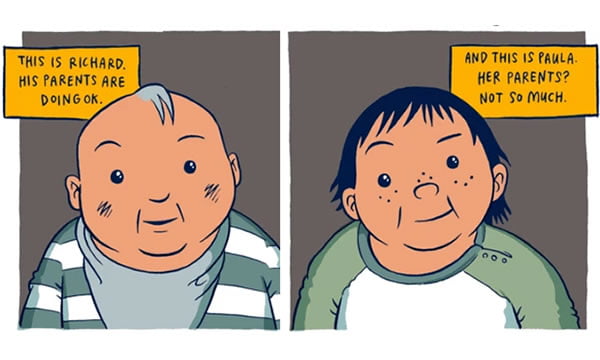
Hekate
(100,133 posts)I have read them before — trying to remember where first, but it changed my point of view and helped solidify things I’d only intuited before then.
It is hugely important for as many people as possible to have it explained in terms they can understand — like, for instance, a cartoon.

Igel
(37,535 posts)Don't require Alg 1 in 8th grade. Make it available.
I know kids who took Alg 1 in 7th. Quite a few. As sophomores, they were in pre-cal and as juniors in Calc BC (usually) unless they took a side trip through AP stat.
Had one student who took advantage of the proximity of a high school to his middle school. Walked over in 8th grade to take pre-cal. His brother was the same. Another kid walked with him (the first two from South Asian engineers of fairly low birth, the second had parents who ran a mom-and-pop Vietnamese restaurant in a scuzzy part of the school district).
I know seniors that had and aced Calc BC as sophomores (or are currently enrolled). Next year they'll have Calc 3 (vector calculus and linear algebra). Senior year their independent study will probably be differential equations.
That's not for everybody, to be sure. So some think, Why have a special program just for them?
We have all sorts of special programs for the low-achieving, whether by background or physiology: Some come from horrible homes, have moved constantly, been abused, were ill or addicted; some are newcomers with little education, scant English, and are undocumented or documented, but at a great disadvantage; some are simply cognitively challenged. We have a program for near drop-outs. A program for those who are troubled and over 19, to help transition them from school to being responsible adults.
I know students who graduate from their VO/CTE programs and hop directly into good jobs making well above average starting wage even for most 4-year-degree grads as machinists and welders or grease monkeys. They wouldn't do well in academic pre-college programs, so they have special programs.
Accelerated or advanced courses should be an option, a choice. Why limit in the goal of equity, forcing everybody to be mediocre and march in lockstep--but only for some, while we have gobs of special programs for others?
I know a lot of kids in my classes that avoided regulars physics entirely as too hard, and even avoided chemistry. There are high school sophomores acing the calculus based AP Physics C.
One kid I know in chemistry (not my student) when confronted with a messy energetics calculation for a complicated reaction set it up as a matrix. Teacher asked how long it took, he said, and the teacher said the usual way is shorter. The kid said it took him a minute to work out how to do it, then after he did it the 20 minutes included writing a program for his NSpire so he could just enter the parameters and click =, and so in the end the first problem took 20 minutes but the rest of the problem set took 5. He's a sophomore.
Hekate
(100,133 posts)pnwmom
(110,261 posts)from middle school. And there have been math "reformers" leading the charge to take that choice away from students across the state.

redqueen
(115,186 posts)
hunter
(40,690 posts)It's fucking madness to teach maths and sciences as separate subjects unrelated to one another, the maths a rote manipulation of figures and the sciences a rote recitations of "facts."
It often seems to me we are setting up our children up to fail -- that we deliberately want them to graduate from school believing that even the most basic sorts of math and science are beyond them.
Mountainguy
(2,145 posts)Make sure it's available to everyone.
EllieBC
(3,639 posts)So again people with means will continue to have advantages while the public schools treat those kids like experiments and damn the results.
pnwmom
(110,261 posts)
JustABozoOnThisBus
(24,681 posts)If public schools are teaching to the "lowest common denominator", so no student is behind, and all are "valedictorians", then the private schools, religious schools, charters all leave the public schools in the dust.
She hated the idea that the hoi polloi should try to be equal to the elites.
BlueCheeseAgain
(1,983 posts)You don't achieve equity by lowering the ceiling. You get it by raising the floor. All artificially preventing kids from learning algebra when they're ready for it does is drive the richer kids to private school

RobinA
(10,478 posts)in 8th grade. It didn't help a bit. I'm just not a math student. I'm still for starting it in 8th or 9th just to help kids get to know what it's about. Then they can drop it if it's useless. I think there's a lot of stuff kids should know but don't that isn't Algebra-related, but should be taught. Algebra is useful for a very limited number of students, but everybody should have the exposure.

Xavier Breath
(6,640 posts)and I never could get the hang of it either. The funny thing is when it comes to division or multiplication, I can do it quickly and accurately in my head. My wife always asks me to calculate tips or tax. So I hesitate to say I'm not a numbers person. I'm just not an Algebra person, and I'm fine with that.

Bettie
(19,704 posts)tells me I do algebra in my head all the time in daily life.
I don't buy that, because I was terrible at it, only C I ever got in school. It makes no sense. Now, geometry....that was OK, I could see what I was doing.
But, he's the one who is the helper in our house with math issues, so I'll let him think what he wants to!
Xavier Breath
(6,640 posts)I hadn't thought of it like that, but I guess in a way we're always using the info we have to reason and fill in the blank, as it were. Let's call it 'street-smarts algebra.' Yeah, I like that 
pnwmom
(110,261 posts)It's hard for non math lovers to understand this, but my oldest was chomping at the bit. Fortunately, she was in a middle school with a math club, and that math club leader made sure she got the math she wanted, even though she had to take it at the high school.
In San Francisco, on the other hand, she'd have had to wait till high school for Algebra, and then taken a "compressed curriculum" in order to reach calculus by senior year. Except we would have moved rather than make her do that. Kids who do not come from disadvantaged families have more options. Unfortunately, the San Francisco plan hurts the most the very kids it purports to help -- the disadvantaged kids who can't afford tutors, summer programs, or private schools.

MissB
(16,344 posts)Took the teacher less than a week to reach out to us and say that he really should be in algebra. We had to shuffle a few things around in his schedule, but the kid was not overwhelmed. It was a K-8 school so it was relatively easy to toss him in with mostly 8th graders. By 7th grade, we were schlepping him to the high school each day for a math class. He finished advanced Calc his freshman year, and when they had a sub for his class, he’d teach the class instead of the sub.
Youngest kid had a different math teacher in 5th grade and she kept him in pre-algebra all year. He was bored. He got through advanced Calc in his sophomore year.
Both kids finished all the math needed for an engineering degree before they finished high school thanks to a local university that allowed them to take a math class each term. The university was located between our house and their high school, so walkable. Both went on to earn their engineering degrees.
Why should they be bored in middle school instead of challenged? Why should any kid?
I’m horrified that any district would restrict algebra to high school only.
pnwmom
(110,261 posts)think it's just fine to bore them to tears with math that they'd learned years earlier.
Bernardo de La Paz
(60,320 posts)There are many things best left to experts and -- yes we can say it -- technocrats.
Of course that drives magats wild because they think they are experts in educating their children. Unfortunately, stupid people tend not to know their limitations, especially their biggest limitation.
It is ridiculous to take teaching away from teachers.
Let teachers teach.
MichMan
(17,151 posts)Bernardo de La Paz
(60,320 posts)Second time you have misrepresented me.
Please stop.
And please don't start stalking me.
Ms. Toad
(38,637 posts)In this case, it seems to be the only way to get the attention of those with the power to change things to start making appropriate decisions.
This is not a matter of not letting teachers teach - teachers are not the ones who made the decision to stop offering algebra in the 8th grade. No math teacher I know would recommend removing algebra from the 8th grade curriculum. (I have 2 degrees in math, and taught high school math for more than a decade.)
It is boards of education which made the decision. They have - for a few decades now - been the stepping stones for Republicans to enter the political arena. So the stupid people you are concerned about are the ones running the show.
Students who intend to pursue a career in math need to have calculus before college. When I entered college in 1974, most of my peers had calculus in high school. While I have reservations about it, it is relatively common now to have two courses past calculus in high school. In order to have calculus in high school (not the two classes beyond calculus, which are relatively common now) you have to have algebra in the 8th grade. So removing algebra from the 8th grade is 5 decades behind the times.
Someone needs to shake the board awake - if that takes a view, then it takes a vote.
Bernardo de La Paz
(60,320 posts)When I say "Let teachers teach", that what I mean. Let teachers teach.
We are agreed that it is not the teachers preventing teachers from teaching. I never suggested they were preventing themselves from teaching.
Except that it is. The boards of education are not letting teachers teach Algebra to 8th grade students. By your own post.
As to a vote, well if the in-the-trenches sense is that a vote is needed to get key people's attention, then it probably is needed. But it would still be an exceptional instrument to use to effect (cause) a technical change (changing the curriculum).
Regardless, I'm on the side that wants to give students educational opportunities, not remove them or block them.
pnwmom
(110,261 posts)pnwmom
(110,261 posts)who disagree with the road San Francisco's gone down.
One of my children was offered the chance to take Algebra in 6th. I asked how that would work out, to be so far ahead in high school. The answer was that at the kind of college my child might want to attend, it wasn't really that unusual to be that far ahead. This is the kind of path taken by the kind of kids who end up with PhD's in quantitative fields.
Ms. Toad
(38,637 posts)Geometry requires a different kind of thinking that most students aren't ready for until around 9th grade. Algebra in 6th grade puts geometry in 7th or 8th grade (at the latest) and sets a lot of students up for failure.
And, from a practical standpoint, Middle school teachers - in most states - require only elementary certification. Many elementary certified teachers took the bare minimum in math - and are not even remotely qualified to teach algebra. So this puts the best and brightest students being taught algebra by the least qualified teachers.
That said, my nephew took algebra in 6th grade, and Diff Eq in his senior year, and got a job right out of college with SpaceX. He was at one of the top public school systems in the country. The control panels you could see in the SpaceX Dragon2 ship were mostly his design. So it works well for some.
pnwmom
(110,261 posts)continued to love math all the way through engineering school.
Luckily, at the middle school, there was a great teacher teaching Algebra 1. And the high school was conveniently located, so a middle school kid could take classes there. There was a problematic elementary teacher however, who clearly disliked math herself and couldn't understand a kid like mine.
Your nephew sounds like the math lover in my family.
Ms. Toad
(38,637 posts)And it doesn't serve most children well.
I would have been fine with it, as well. I taught myself math twice. First in elementary school (when my parents decided I needed to learn "new math" and the high school educated elementary school teacher in a one-room-country school was incapable of teaching it) and later in high school (when trigonometry didn't fit in a schedule that included vocal music, band, and Spanish - so I enrolled in the class with the understanding that it was my responsibility to teach myself, hand in all assignments, and take tests during study hall or another convenient time).
But none of my siblings would have been. My daughter might have been.
pnwmom
(110,261 posts)For some period of time, in the interest of equity, they had been requiring all 8th grade students to take Algebra. That didn't work out for many, so then they changed their policy to not allowing any 8th grade students to take Algebra -- and to require it of all 9th graders instead. Again, in the interest of equity. That isn't working out either.
Somehow, even though they know kids can and do read at different levels, they expect all children can do math at the same level, and that it isn't equitable if they can't.
Ms. Toad
(38,637 posts)Which is not a good fit for many students due to how the brain develops.
8th grade Algeba has been standard for decades - and is essential to permitting students to take calculus in high school. Any school system not offering it is not serving their students well. And most students should take it. Unfortunately, our education system isn't serving a lot of students well - and their mathematics education isn't sufficient for far too many students. If they have failed their students prior to 8th grade, there need to be alternative to algebra exceptions to accommodate those they have failed to prepare. But delaying algebra to the 9th grade should never be the norm.
pnwmom
(110,261 posts)They designed a new system without getting input either from families or the quantitative departments of the colleges and universities that students might go on to attend.
Happy Hoosier
(9,535 posts)It was a (poor, IMO) decision intended to create a specific social outcome.
IMO, "equity" is never properly achieved by limited the advancement of one group to prevent them from out-achieving another. WE need to ensure the underachieving group gets the resources and conditions it needs t succeed.
tableturner
(1,838 posts)pnwmom
(110,261 posts)If the rest of CA or the US were to follow San Francisco's current path, removing Algebra from 8th grade, and encouraging students to switch from Algebra 2 and precalculus to data literacy, that would threaten achievements in US technology.

kimbutgar
(27,248 posts)I never learned Algebra at my all girls school in SF in the 70’s. I learned it in college and it helped me look at math differently. As a sub teacher in this district we teach it slowly to solve the unknown X and I get it. It elevates brain cells of learning. And voters in SF will vote for algebra to remain!
JohnSJ
(98,883 posts)This would make more people want to pull their kids out of public schools, and send them somewhere else
pnwmom
(110,261 posts)30%, in the country.