General Discussion
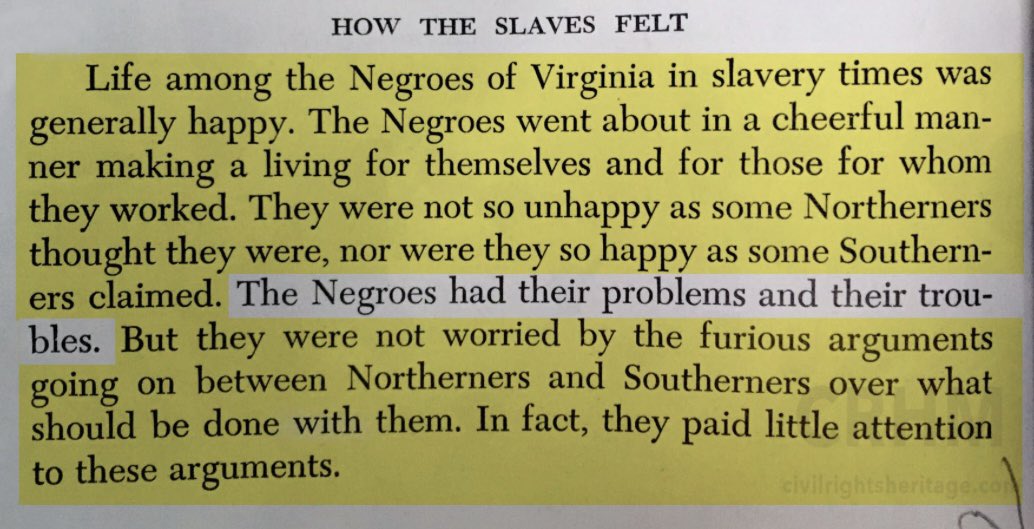
Related: Editorials & Other Articles, Issue Forums, Alliance Forums, Region ForumsMichael Beschloss has tweeted samples of a 1956 Virginia seventh-grade textbook about "generally happy" slaves
Link to tweet
Link to tweet
 = new reply since forum marked as read
Highlight:
NoneDon't highlight anything
5 newestHighlight 5 most recent replies
= new reply since forum marked as read
Highlight:
NoneDon't highlight anything
5 newestHighlight 5 most recent replies

mcar
(46,354 posts)

dchill
(42,660 posts)...and smoothed it out significantly - so that the good old CSA looks even happier.

TwilightZone
(28,836 posts)That's not all that far removed from some attitudes today. That is, of course, Michael's point.
moondust
(21,352 posts)
TwilightZone
(28,836 posts)That made me laugh, and now I feel horrible about it. lol
It wouldn't surprise me at all if that argument has been made. In fact, I'm pretty sure it has.
moondust
(21,352 posts)But wouldn't be surprised at all to hear them make it--not realizing it is hollow and that they are actually shaming the current environment that their greed has done so much to create.

Eko
(10,104 posts)I corrected him and said to go read the declarations the states made for seceding, it was about slavery. Sadly I'm in a northern state.

orleans
(37,189 posts)
a kennedy
(36,341 posts)🤬 🤬 🤬

Dave in VA
(2,291 posts)I remember those drawings. Those of us old enough who grew up in the jim crow south remember this BS.

Hekate
(100,133 posts)Thank you.
Dave in VA
(2,291 posts)Don't really remember anything specifically, but we probably only spent 10 or 15 minutes on that part of the textbook. Don't remember any discussion or questions about this passage.
I went to public school during the jim crow era. All white students, staff, admin, etc. The first black student in a school I attended was a black male. Never really interacted with him.
Got to college and took several African studies courses. Worked for George McGovern's local campaign. Took on a new world view and never really looked back.
I just basically remember those drawings in the book.
Hope this helps.
Hekate
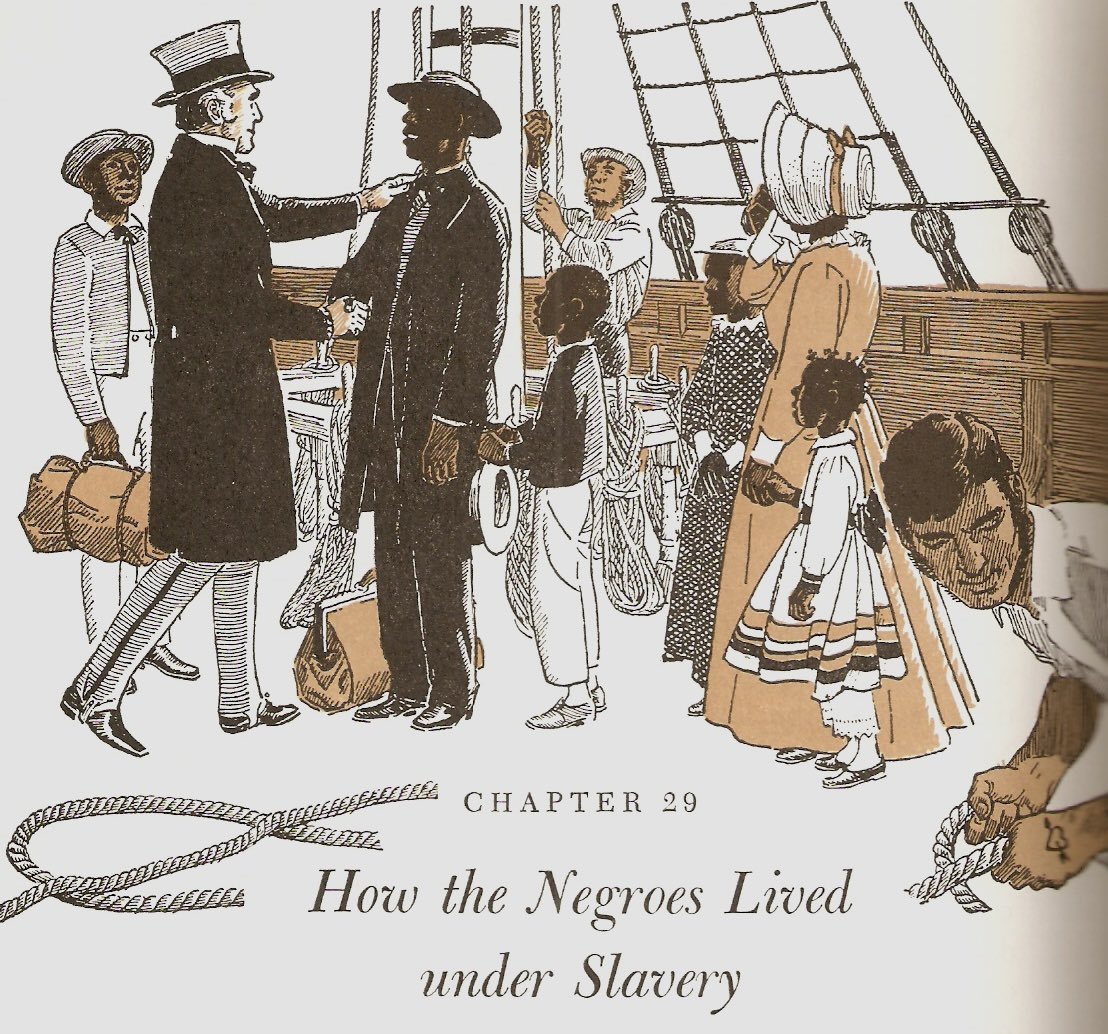
(100,133 posts)…vastly different. Because textbooks, you know, were supposed to reflect Truth, Justice, & the American way — an aspirational thing, perhaps a fantasy but an aspirational one. Not a dark fantasy where slaves were happy, well dressed as they shook hands with the captain of a slaving ship, looking forward to a happy life on a plantation.
orleans
(37,189 posts)Hekate
(100,133 posts)Last edited Fri Dec 29, 2023, 05:34 AM - Edit history (1)
So we were there from before statehood til 1965, when I graduated high school, and Lockheed’s Navy contract was up. The Mainland hires like my dad were supposed to be moved back per the contract, and since there was little in the way of aircraft work in Hawai’i at the time, most went. They ended up in some odd places, too: Jackass Flats Nevada, Sunnyvale California, Saudi Arabia. My folks chose Cucamonga California, a parched high-desert location with a Lockheed installation by Ontario Airport. After a few years of college and working on a presidential campaign, I moved back and went to UH, intending to stay forever.
Anyhow, neighborhood and school. There was a sampling of nearly the whole world in both, but predominantly Polynesia, Philippines, and Asia. And white or brown they had been intermarrying enthusiastically for at least a century and a half, which made the Mainland’s preoccupation with that kind of thing incomprehensible. My family wasn’t exactly a minority, but our Irish whiteness surely stood out. (There were few African Americans in my large high school, like, three altogether, and they were all military dependents. One family lived next door to us. They were definitely a minority in the 1960s. )
I got my US history not just from classes but from the evening news, where the Civil Rights movement had been playing out since I was little, and Vietnam era anxiety and protests just segued right into my high school years (my boyfriend sarcastically joked about the draft: “Be the first on your block to step on a punji stick. “ ) And TIME and LIFE magazines. What I learned in school seemed to reinforce what I learned outside, so I didn’t experience cognitive dissonance, and what I learned outside filled in the gaps so I didn’t notice there were gaps.
Slavery, incidentally, was presented as A Bad Thing in our textbooks. The Triangle Trade of slavery, sugar cane, and rum was diagrammed and explained, so we definitely got the economics of the business of treating human beings like things. My multi-ethnic classmates were not about to believe any fantasies about happy slaves. I knew from my own independent reading early on about the role of Christian belief as a driving force among the Abolitionists — far from making me “feel bad about being white,” reading in 6th grade about a Quaker girl made me identify with the courage of her and her family as they did their part on the Underground Railroad. Read a biography of Moses Tubman the same year. These books were in my school library. (Only as an adult did I find that New England Transcendentalism heavily influenced the Abolition movement, and that their striving for women’s rights and labor rights were set aside until slavery was abolished — but groundwork had been laid in me, so to speak. )
Most of all my mother was my teacher, and she believed wholeheartedly in equality and the Golden Rule, and that America’s founding fathers were Sons of the Enlightenment, and that she should teach her children why that was so. She was born and raised in Colorado when the KKK had it in for Roman Catholics, which her family were. Whatever Mom experienced as a kid, I think she kept her own counsel and drew her own conclusions (and left Roman Catholicism behind by the time I was born ) . Her father, a Ford dealer until the Great Depression, got Henry Ford’s newspaper and Ford was a raving anti-Semite, which her father imbibed as gospel. Not his daughter — She told us what anti-Semitism was, and the role it played in WWII, who Father Coughlin was, and who our own American fascists were. When she was an adult, Senator Joe McCarthy’s witch hunts scared the absolute crap out of her and stunted any political activity she might ever have done, altho she didn’t put it that way.
When my folks married after WWII, they were stony broke and first got a place to live in a trailer park, which was full of Nisei families relocating back to normal life (“You were conceived there, dear!” “But mommy, what do you mean they were relocating back to normal life? What happened to them? “ — and that is how I first heard the tale of America’s shameful Japanese internment camps before I had barely learned to read. )
She vividly remembered the events of the 20s thru 60s of the 20th century, and used her observations as teaching tools. If a family who survived the Holocaust moved into our neighborhood — that got mentioned and their story got told. They were real people, and their kids were our real friends and neighbors. In Hawaii, one of our neighbors had a friend who was a survivor of a Japanese prison camp in the Philippines, which was as grim as anything you may have ever heard.
I was a lucky, lucky kid in that regard. What it did for me was open out the world in many directions, and made events real.
Unlike many others, I really loved History as an area of study, altho I was almost done with my BA before I admitted that what I really loved was the narrative and learning about what people living in it thought they were about. Hence my senior thesis was about Japanese Literature and the Greater East Asia War and not some other aspect of WWII in the Pacific and Asia.
Speaking of narratives, sorry this one was so long. Looking back 60 or so years — so very much has come and gone.
Tom Rinaldo
(23,193 posts)Apology not accepted 
I love history also, even though so much of it is shameful. Your mother was an amazing woman.
Hekate
(100,133 posts)Sugar cane and pineapple don’t just grow themselves, after all. And in this instance, people were induced to migrate voluntarily from Japan, China, the Philippines, and some Portuguese who were hired as luna, or bosses, of the workers, as well. (One rather cheeky guidebook to the Islands pointed out that Hawaii is the only place where Portuguese don’t count themselves as “white” because that’s haole — they are “local” and don’t you forget it. )
As with all emigrants they hoped for a better life than they had back in the old country, and definitely did not plan on their children and grandchildren remaining in that backbreaking, killing, line of work. The cultures of Japan and China had especially prized literacy, and knew education was the key for their kids, so they pushed them hard once they were able to get them in school. Despite a lot of discrimination, and because the workers were in fact not enslaved, many of my teachers were Nisei, and the children and grandchildren of many former plantation workers dominated various professions. And you bet they networked among their own groups.
Things really changed after WWII. The generation of young Japanese-Americans who returned from fighting overseas in the 442nd decided some changes needed to be made, and among other things a bunch of them went into politics.
I took my husband and grade-school age kids on a trip to Oahu once about 35 years ago, and like many a haole Mainlander before him, he fell in love and wanted to stay. At the time his profession was in such demand he could change jobs whenever he wanted, but I thought he better talk to someone besides me. So when we got together for dinner with my old friend Jeff (Chinese-American, generations in the Islands) and his wife, I laughingly asked Jeff to give my husband the scoop. Bottom line: it was a small place and you had to know people and be related to people.
Can’t remember Jeff’s verbal diagram of which ethnic group ended up where, but it was enlightening, especially if you were contemplating being an outsider trying to break in. Because of the history of haoles having taken over the Islands, and then having overthrown the rightful native Hawaiian government, and dominating the financial and social structure ever after, there was underlying suspicion and resentment below the Aloha-spirit. Jeff went into real estate — he met his Minnesota Scandinavian wife at UH, and she went into business with him; with the advantage of her husband’s last name and extended family, she became “local.”
As for the plantations, as the supply of workers gradually eroded, the business of growing pine and cane finally moved overseas where there was still cheap labor to be had. The pineapple cannery where I worked one summer in high school was long gone (and turned into a cluster of boutiques) by the time I came back for my 25th high school reunion.

whathehell
(30,547 posts)and learned no such thing. Slavery was never presented as anything but a horrible institution that was ended during the Civil War by Abraham Lincoln. Reading a book on Harriet Tubman at age 11 eliminated any possibility on my part of viewing slavery as anything "happy".
After reading textbook descriptions like the one above, and those explaining the Civil War as basically a 'state's rights' conflict, I can't help but think that the "slavery wasn't so bad" bs taught then, was largely a product of the South.
yardwork
(69,642 posts)I didn't believe it. I assumed that the textbooks lied.

GoodRaisin
(11,056 posts)Robert E. Lee was a big hero too.

spooky3
(38,860 posts)
ananda
(35,504 posts)contained some examples of Plantation Literature.
I never finished that part. It was hard to stomach.
Not that Old Englilsh prose was much better, mostly
lives of the saints, history of King Alfred the Great,
and lots of stories about knights and wars.
exboyfil
(18,372 posts)
Hermit-The-Prog
(36,631 posts)
underpants
(197,174 posts)The Byrd machine ruled the Commonwealth. Many school districts simply shut down (for 3years in some cases) rather than comply with Brown v Board. Farmville - part of Brown - created a private school system included ones funded by the more wealthy in the area for the poorer whites. Yes, winters for even the white kids.
There were two Schools for the Deaf and Blind. Staunton (white) and Hampton (black) - guess who got the new material. If you were blind and white in say Williamsburg you went to Staunton. Black blind and in Waynesboro? You go to Hampton. This was before the full implementation of the Eisenhower interstate system so those were long trips.
lonely bird
(3,034 posts)That this is a current Florida education department approved textbook?
orleans
(37,189 posts)
(gasp) Ron DeSantis drew the pictures himself!

gratuitous
(82,849 posts)No White persons wanted to swap places with them. A fact that baffles some historians.
sop
(19,294 posts)Lunabell
(7,309 posts)They should be grateful.


KS Toronado
(23,866 posts)With luggage and dressed in suits, dresses, hats, smiles and even shoes. Not your run of the
mill slave for sure, these brought a premium 5 dollars at auction no doubt.

Marcuse
(9,081 posts)
sop
(19,294 posts)I'd really love to see his take on this.
John Shaft
(808 posts)weird take.
He's a truth teller. That's what constitutes "venom?"
Huh?
sop
(19,294 posts)What, exactly, do you think political satirists do for a living? Are you here to tell us employing venomous sarcasm in response to such an absurdity is somehow wrong? Do you actually believe venomous sarcasm is somehow not "truth telling" when directed at unreconstructed Neo-Confederates pushing revisionist history about the institution of slavery? Now that's really a "weird take."
John Shaft
(808 posts)not the word I would use to describe it.
sop
(19,294 posts)I find a lot of well-deserved scorn and contempt in his satire, at times even caustic hostility, when responding to such egregious injustice. And these are all synonyms for "venomous."

ismnotwasm
(42,674 posts)I’ll just go read Huckleberry Finn again I guess. Try to figure out why Jim ever wanted to run away

Deuxcents
(27,685 posts)A movie was made based on this book about Solomon Northup who was a free black man in New York and was kidnapped and sold as a slave in Louisiana. He was an educated and talented man and it took 12 years to get thru the process of red tape to finally free him. He was not a guest in his owners home. He was not happy or glad to be there. Nothing at all like what these people want in text books.
cbabe
(6,812 posts)Francis Howell school board reinstates Black History, Black Literature courses after blowback
But…
Textbooks need to be neutral on black literature and history.

Takket
(23,802 posts)after all, it is a happy life, right?
Any volunteers?
Anyone?

Elessar Zappa
(16,385 posts)That’s all I ask. 

progressoid
(53,368 posts)We used to teach real history and now these librul eelites wanna teach lies!!!11!1@!
LetMyPeopleVote
(182,007 posts)central scrutinizer
(12,655 posts)
Saoirse9
(3,967 posts)My Dad was military and we moved there when I was 9. The difference between what we were taught in VA about the Civil War and what we were taught in Pennsylvania is huge.
Even in the seventies there were textbooks like the one in the original post. VA textbooks were heavily slanted towards the confederates. Even as a little kid I could see that.

Kick in to the DU tip jar?
This week we're running a special pop-up mini fund drive. From Monday through Friday we're going ad-free for all registered members, and we're asking you to kick in to the DU tip jar to support the site and keep us financially healthy.
As a bonus, making a contribution will allow you to leave kudos for another DU member, and at the end of the week we'll recognize the DUers who you think make this community great.