General Discussion
Related: Editorials & Other Articles, Issue Forums, Alliance Forums, Region ForumsWhy is Gaza so central to the Palestinian struggle? From Israeli +972 Magazine
Absolutely fascinating but very long and detailed article by Dr. Anne Irfan, Lecturer in Interdisciplinary Race, Gender and Postcolonial Studies at University College London.
The history of Gaza illuminates why the tiny enclave has long embodied Palestinian identity — and is now the focal point of a major regional crisis.
More than half a century after beginning its occupation of the Gaza Strip, there are mounting signs that Israel is using its current military offensive to remake the territory completely.
SNIP
While defending its actions in Gaza as necessary and denying accusations of war crimes, the Israeli government is describing its war in existential terms. Hamas’ raid on October 7 was one of the deadliest attacks on Israel in the state’s history. For the first time since 1948, Israeli forces temporarily lost control of territory within the Green Line, as Hamas killed more than 1,200 Israelis, injured more than 5,000, and kidnapped about 240 people, the majority of them civilians. The impact on the Israeli psyche, and the resulting collective trauma, has been profound.
Capitalizing on such feelings, the Israeli government, with the wide support of the public, has framed the attack on Gaza as a battle for survival. Defence Minister Yoav Gallant has said “it’s either them or us,” and described the air-and-ground assault as “a war for Israel’s existence as a prosperous Jewish state in the Middle East.” Netanyahu has dubbed it “the second war of independence.”
Yet these bombastic statements jar with the fact that Gaza, at least on the surface, appears as little more than a tiny speck on the globe. How has such a small piece of territory — comprising less than 1.5 percent of historic Palestine, and smaller than most U.S. cities — become the focal point of a major national, regional, and global struggle?
SNIP
The article details the long history from the beginnings through 1947 and 1948
The events of the Nakba produced the modern-day Strip in both territorial and demographic terms. Egypt, which had joined other Arab states in declaring war on Israel in 1948, signed an armistice agreement with its new northern neighbor in February 1949. The armistice established the Gaza Strip with its current borders — a significantly smaller stretch of land than that designated by the UN in 1947 — under Egyptian administration.
At the same time, the creation of the Israeli state forcibly expelled and displaced at least three quarters of the Palestinian population, creating 750,000 Palestinian refugees. While this exodus transformed the demographics of the entire Levant, nowhere received more refugees per head than the Gaza Strip. Home to around 80,000 residents prior to the Nakba, by the end of the 1940s it had absorbed more than 200,000 refugees, tripling the area’s population. The Strip’s dense population in the 21st century, two-thirds of whom descend from those first refugees, can be traced directly to the impact of the Nakba.
It continues through the 50s and early 60s
Despite its severance from the rest of Palestine, though, Gaza remained closely intertwined with the rest of the world in the 1950s and early 1960s. It was integrated into the Global South’s anti-colonial solidarity politics, especially after Gamal Abdel Nasser took the Egyptian Presidency in 1954, regularly citing the Palestinian cause as key to his pan-Arab leadership.
Accordingly, this period saw leading anti-colonial figures visit the Strip, including Che Guevera in 1959, Jawaharlal Nehru in 1960, and Malcolm X in 1964. All three of them visited refugee camps during their time there, highlighting the significance of the Palestinian refugees to the Strip’s politics and national aspirations.
Nonetheless, this period was not one of liberation for Palestinians. They were still living as a stateless people under Egyptian rule — first under a British-backed autocratic monarch until 1952, and then under the Free Officers’ regime that would come to be dominated by Nasser.
history to 1967
While 1967 is usually cited as the starting point of the Israeli occupation, the Gaza Strip had already experienced an interlude of what was to come a decade earlier. In late October 1956, Israel invaded and occupied the Strip as part of its joint attack on Egypt with Britain and France, following Nasser’s nationalization of the Suez Canal Company. The Israeli army took over the Strip, coming face-to-face with many of the Palestinian refugees it had expelled just a few years earlier.
While that first Israeli occupation only lasted 4 months — ending at the command of U.S. President Dwight Eisenhower, who threatened to sanction Israel if it refused to withdraw — researchers have uncovered evidence of Israeli plans from that time for a longer-term presence in the Strip, and even the construction of Jewish settlements. When the Israeli army re-conquered Gaza a decade later, in June 1967, such plans were resumed, initiating the longest-running military occupation in modern history.
The 80s
Twenty years into the Israeli occupation, an entire Palestinian generation had grown up knowing nothing else. By the late 1980s, Israeli settlements were expanding and even prospering while Palestinians remained stateless and impoverished. Israel’s 1982 invasion of Lebanon and siege of Beirut, the Sabra and Shatila massacre that year, the failures of the Palestine Liberation Organization (PLO), and the rightward shift of Israeli politics following Likud’s rise to power in 1977, all added to Palestinian anger.
Experiencing the most acute forms of dispossession and military rule, Gaza became the birthplace to perhaps the most significant Palestinian uprising of the past century: the First Intifada.
The spark came in December 1987, when an Israeli army vehicle crashed into a Palestinian car in the Gaza Strip, killing four people; three of them lived in Jabalia camp, home to refugees who had been expelled from villages in southern Palestine during the Nakba. While Israeli authorities insisted the crash was accidental, many Palestinians were skeptical given the widespread experience of brutality and disinformation by the army.
The 90s and on.
I really recommend anyone who wants an in depth history with fascinating details and context - read this long magazine article. I pulled out tiny amount to give sense of how it is written but can’t follow DU rules and give the scope of the piece. It really is only for those interested in the complex details.
Link https://www.972mag.com/history-gaza-strip-palestinian-struggle/]
 = new reply since forum marked as read
Highlight:
NoneDon't highlight anything
5 newestHighlight 5 most recent replies
= new reply since forum marked as read
Highlight:
NoneDon't highlight anything
5 newestHighlight 5 most recent replies

Nanjeanne
(6,589 posts)I’ll keep trying! Don’t mean to bore people but even reaching one or two that want to read and possibly learn something they didn’t know before is worth it. Or maybe I’m alone! 

Donkees
(33,707 posts)while a threat of sanctions involving the ICJ might be a turning point today. Haven't yet read the entire piece.
Nanjeanne
(6,589 posts)
LeftInTX
(34,294 posts)We supported Egypt because they were stronger and we didn't want them aligned with the Soviets.
After Israel won the Six Day War, the US turned around and began supporting Israel. (Maybe it was an anti-Soviet thing?) Either way, the US admired Israel's show of force with their small defense forces. Egypt was suppose to win all of this stuff. Egypt had the military.
However, the Six Day War showed that Egypt and the local Arab states were prone to buffoonery and Israel meant business.

tritsofme
(19,900 posts)Nanjeanne
(6,589 posts)sure that Israel would ignore their decision as well. I'm assuming that's what you mean. The Court can't . . . what . . . bomb the country? Arrest them? Just not sure what your point is re the ICJ. Should they just disband The Hague completely?
tritsofme
(19,900 posts)That is not possible absent action from the Security Council.
Regardless, I do not expect an adverse ruling.
Nanjeanne
(6,589 posts)a temporary injunction against Israel that calls for a ceasefire. That appears, according to Haaretz, what Israel is afraid might happen.
I read today in Haaretz that they learned that a senior legal expert dealing with the matter has in recent days warned IDF brass, including Chief of Staff Herzl Halevi, that there is real danger that the court will issue an injunction calling on Israel to halt its fire, noting that Israel is bound by the court's rulings. The military and the State Attorney's Office have already begun preparing to deal with the complaint, and a hearing on the matter will be held at the Foreign Ministry on Monday.
Although since Israel wants Alan Dershowitz to be their lawyer - they just may lose. I will certainly hope so although I doubt Israel would adhere to any ruling even though they did sign the Genocide Convention - they've made it apparent that they do not recognize the court.

riversedge
(80,810 posts)ArizonaLib
(1,303 posts)Perfect!
LeftInTX
(34,294 posts)SHATTERED DREAMS OF PEACE
The Road From Oslo
PBS Frontline
https://www.pbs.org/wgbh/frontline/documentary/shattered-dreams-of-peace/
I was shocked at how Netanyahu got into power.
1993: Oslo - Hamas and far right Israelis are the main obstacle to peace.
1995: Rabin is shot, Peres is then PM
1996: It's election time in Israel
World leaders come together in Egypt to support Peres in the upcoming election, because they see Bibi's Likud Party as a threat to the peace process
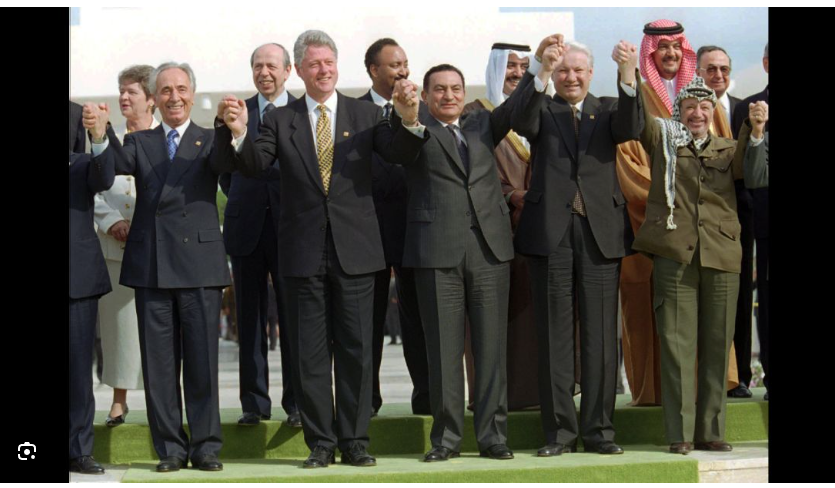
At the same time, the conflict between Hezbollah and Israel has re-ignited and shelling has resumed.
One day, Israel accidentally hits a UN facility in Lebanon during this conflict.
Arab-Israelis blame Peres and want to send a message to him and the Labor Party.
Arab-Israelis boycott the election.
Bibi barely wins
Here we are.....
This documentary is good, so far. Lots of details. I keep rewinding.
Moral of the story: Never boycott elections. You could end up with much worse.
Nanjeanne
(6,589 posts)in the NYT Magazine section, Was Peace Ever Possible, a number of Sunday's ago that I posted - not sure if you saw it but the link to my post is here: https://www.democraticunderground.com/100218482942] that was a fascinating discussion. Learned from scholars and people who were actually involved in peace negotiations and much detail about Oslo and Camp David, the reasons they fell apart and more.
If you didn't see it - you might find it really interesting.
LeftInTX
(34,294 posts)I'm always struck by this:
You know, David Ben-Gurion said in an interview in 1968 that if there will be a chance for peace he is in favor of returning all the occupied territory except for the Golan Heights and Jerusalem. “In my opinion, peace is more important,” he said.
They didn't want the people. They didn't need the land.
I know they held the Sinai until 1978, but did they keep it as a security hedge against Egypt? They didn't really need it, but then Egypt could be stupidly pig headed and they attacked again in 1973. 
Israel should have given the land back to Egypt and Jordan right away. By the time terrorism set it, Egypt and Jordan did not want their territories back. Hindsight I guess is 20/20.
https://www.timesofisrael.com/peace-over-territory-says-israels-first-pm-in-long-lost-footage/