Welcome to DU!
The truly grassroots left-of-center political community where regular people, not algorithms, drive the discussions and set the standards.
Join the community:
Create a free account
Support DU (and get rid of ads!):
Become a Star Member
Latest Breaking News
Editorials & Other Articles
General Discussion
The DU Lounge
All Forums
Issue Forums
Culture Forums
Alliance Forums
Region Forums
Support Forums
Help & Search
General Discussion
Related: Editorials & Other Articles, Issue Forums, Alliance Forums, Region Forums
How Orban's ties to Putin are putting European aid to Ukraine at risk
https://edition.cnn.com/2024/01/28/europe/orban-hungary-eu-unity-ukraine-russia-intl-cmd/index.html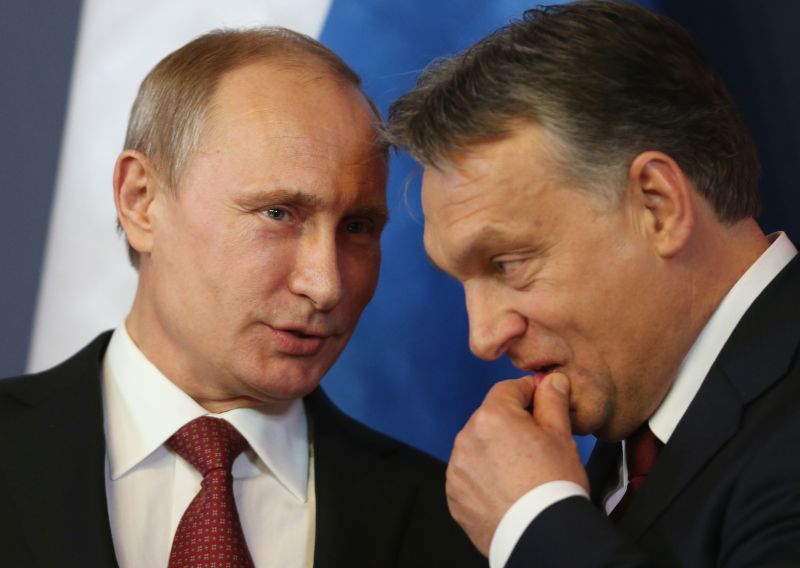
Russian President Vladimir Putin, left, and Orban converse during a signing ceremony of several agreements between the two countries on February 17, 2015 in Budapest, Hungary.
From the start of Vladimir Putin’s invasion of Ukraine, Hungary has been the weakest link in the West’s response. Prime Minister Viktor Orban has held up Kyiv’s membership negotiations with the EU, slow-walked aid deals and cast doubt on Ukraine’s capacity to defeat Russia. That’s why there’s so much attention on a meeting on Monday between the foreign ministers of Hungary and Ukraine. While both countries have been deliberately opaque about the purpose of the meeting in public statements, Western officials privately hope that it will provide some clarity on whether Hungary will drop its veto on a €50bn European Union support package for Ukraine that was supposed to be signed off in December.
Hungarian Prime Minister Viktor Orban said at the time the reason he blocked the funds was because it was wrong for money in the EU budget to go outside the bloc. Critics of Orban have pointed out that his objections could have something to do with the fact that Brussels is holding out on giving Hungary money from the very same budget because it has breached the EU’s rule of law requirements – fundamental values enshrined in the bloc’s treaties. Orban and members of his government have repeatedly denied that there is any connection between the two, or that they have breached EU rules. But those same critics also note that Orban has a uniquely close relationship with Russian President Vladimir Putin. Many Western officials believe that Orban is leveraging that relationship in order to bully his European allies by playing the part of a Kremlin stooge: Act tough on support for Ukraine, a key priority for most of Europe, in exchange for concessions in other areas.
It’s no secret that Hungary is increasingly an uncomfortable bedfellow for its partners in the EU and NATO. Over the past few years, Orban has come to blows with his European counterparts over all kinds of issues, ranging from the rights of LGBTQ+ citizens and migrants to undermining the judiciary. He has stretched the rules of the bloc to breaking point and engaged in brinksmanship with Brussels many times – and quite often walked away with concessions or fudged deals where he got his own way. The crisis in Ukraine, however, has shone an ever brighter light on the differences between Hungary and its Western allies. Hungary has frustrated European and US-led efforts to support Ukraine for the best part of two years. Orban has dragged his heels on EU sanctions against Russia and the supply of weapons and financial aid to Ukraine, and played an obstructive role in Kyiv’s bid to join the EU.
He has not only opposed Kyiv’s similar bid to join NATO, but has been a major roadblock to Finland and Sweden joining the alliance. It is hard to view his opposition to the Scandinavian countries joining NATO without considering that enlargement of the defensive alliance is a key grievance of Putin’s. Orban finally dropped his objections, allowing Finland to join NATO last year, but is now the final holdout on ratifying the Swedish bid, following the Turkish parliament’s vote to approve it this week. Orban said shortly after the Turkish vote that Hungary in fact supported Sweden’s NATO bid, though there is no firm timetable on when there will be a similar ratification in Hungary’s parliament. The unlocking of Europe’s €50bn in aid to Ukraine is by far the most pressing issue ahead of the foreign ministers’ meeting on Monday, because EU leaders are set to meet again on February 1 to have another go at passing the package. Western officials tell CNN that even a small indication behind the scenes of what it would take for Hungary to drop its veto would be a huge win. However, the majority of officials who spoke to CNN fear Hungary’s latest obstructions are just a taste of what is to come and are braced for further Orban tantrums that will slow Western support for Ukraine down the line.
snip