General Discussion
Related: Editorials & Other Articles, Issue Forums, Alliance Forums, Region Forums
First state-level look at long COVID reveals the seven hardest-hit states
Over four years after SARS-CoV-2's debut, researchers still struggle to understand long COVID, including the ostensibly simple question of how many people have it. Estimates for its prevalence vary widely, based on different study methods and definitions of the condition. Now, for the first time, the Centers for Disease Control and Prevention has attempted to estimate its prevalence among adults in each US state and territory. The results again show a wide range of prevalence estimates while revealing the states that were hardest hit as well as those that seem relatively spared.
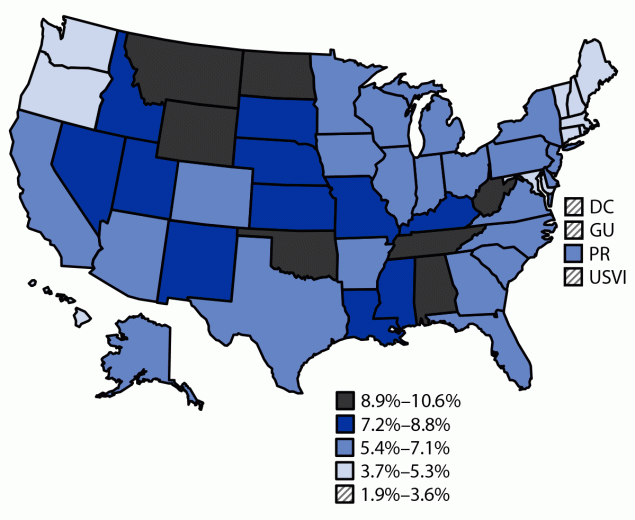
Overall, the CDC found that seven states in the South, West, and Midwest had the highest prevalence of long COVID in the country, between 8.9 percent and 10.6 percent: Alabama, Montana, North Dakota, Oklahoma, Tennessee, Wyoming, and, the state with the highest prevalence of 10.6 percent, West Virginia. The results are published today in the CDC's Morbidity and Mortality Weekly Report.
On the other end of the spectrum, New England states, Washington, and Oregon had lower prevalence rates, between 3.7 percent and 5.3 percent. The lowest rate was seen in the US Virgin Islands with 1.9 percent. Washington, DC, and Guam had ranges between 1.9 percent and 3.6 percent.
https://arstechnica.com/science/2024/02/first-state-level-look-at-long-covid-reveals-the-seven-hardest-hit-states/
 = new reply since forum marked as read
Highlight:
NoneDon't highlight anything
5 newestHighlight 5 most recent replies
= new reply since forum marked as read
Highlight:
NoneDon't highlight anything
5 newestHighlight 5 most recent replies

SarcasticSatyr
(1,362 posts)it might have been enlightening ...

Bernardo de La Paz
(60,320 posts)
Johnny2X2X
(24,207 posts)We've known that people who were vaccinated were less likely to get long Covid than the unvaccinated for a long time now. I suspect the states that got hit the worst are the states with the lowest vaccination rates.
Response to SarcasticSatyr (Reply #1)
Name removed Message auto-removed

machoneman
(4,128 posts)
AllaN01Bear
(29,493 posts)
617Blue
(2,472 posts)
Prairie Gates
(8,156 posts)Shocking.

erronis
(23,880 posts)The same people who may not want to get vaccinated are more likely to have other health issues (including mental.)

RainCaster
(13,715 posts)I live in WA, BTW. The worst thing for me is the loss of certain smells; bacon, garlic, flowers, citrus.

jayschool2013
(2,611 posts)I hope it ends soon for you.
Be well.
RainCaster
(13,715 posts)I miss the smells of food and flowers.

XanaDUer2
(15,772 posts)Sometimes I feel something is too bland and I wonder if its that I caught COVID in Aug 2022. Drives me crazy and makes me mad
Bernardo de La Paz
(60,320 posts)To some extent they would be similar given the high rates of Covid illness. But I'm not sure rates of basic Covid infection would account for such large percentages in the population, so I think it must be percent of those infected or those who became symptomatic. If it was 10.6 % of population in some states, that would be headline news for months. Ten or even 5 percent would be a huge blow to economics of a state.
erronis
(23,880 posts)However the numbers seem very fuzzy since there is a lot of self-selection here.
moniss
(9,056 posts)also if they were looking at only confirmed cases of Covid and if so how might the numbers change if we look at those who got Covid but didn't get diagnosed but now suffer from Long Covid symptoms. I know there are estimates I've seen for cases of initial infection not officially diagnosed. I think most of that was based on modeling. I don't know if their percentage of development of Long Covid can be inferred or not. One reason may be the variance in severity of Covid infection/medication intake etc. and development of Long Covid. We just may not know some of those things well enough to model or infer that kind of a case with any meaningful results.
My guess would be they used confirmed cases of initial infection and then subsequent Long Covid symptoms. That would be, at this juncture I think, the most reliable criteria for establishing the study groups etc.
WestMichRad
(3,254 posts)So, as percentage of US adult population.
By now, the vast majority of people have had at least one Covid infection. There are not too many of us left who have escaped it so far.

Initech
(108,783 posts)


Mad_Machine76
(24,957 posts)
Mad_Machine76
(24,957 posts)