Welcome to DU!
The truly grassroots left-of-center political community where regular people, not algorithms, drive the discussions and set the standards.
Join the community:
Create a free account
Support DU (and get rid of ads!):
Become a Star Member
Latest Breaking News
Editorials & Other Articles
General Discussion
The DU Lounge
All Forums
Issue Forums
Culture Forums
Alliance Forums
Region Forums
Support Forums
Help & Search
General Discussion
Related: Editorials & Other Articles, Issue Forums, Alliance Forums, Region Forums
How the Welfare State Fails the Poor
A bureaucratic paper chase undermines compassion and practical help for the needy, while Wall Street gets whatever it wants. It doesn’t have to be that way.
https://prospect.org/economy/2024-03-19-how-welfare-state-fails-the-poor/

Arlo Washington in the Oscar-nominated short documentary “The Barber of Little Rock”
The failure of the liberal welfare state can be seen in a superb Oscar-nominated short documentary produced by The New Yorker called The Barber of Little Rock. The film is ostensibly about the heroic efforts of one man to do something about the Black-white wealth chasm. The broader implication is my own takeaway. Arlo Washington was a successful young Black barber in Little Rock. He observed the gaping disparity in wealth between his own community and the white parts of town. He appreciated that being a barber allowed him to run his own small business and to be reasonably secure financially. So he created a barber college in 2008 that has trained over 1,500 barbers to operate successful small businesses, too. But Washington quickly grasped that you can’t solve the Black-white wealth gap just with more barbers. What would help more would be a bank.
So Washington got a charter for what became People Trust, the only community development bank in the state of Arkansas and the only one located in the Black community. Washington and his colleagues began making mortgage loans and small-business loans. But as People Trust’s reputation spread, the bank was soon inundated with people desperately seeking personal loans. They had medical bills they couldn’t pay and then got behind on their other bills. They had been laid off from jobs and had run out of resources to cover basic expenses. They had just been released from prison without a penny. They didn’t really qualify for personal loans, which would only put them deeper in debt. So Washington raised some foundation money to underwrite small emergency grants as well as loans. Some of the most revealing and poignant moments in the film are exchanges like these:
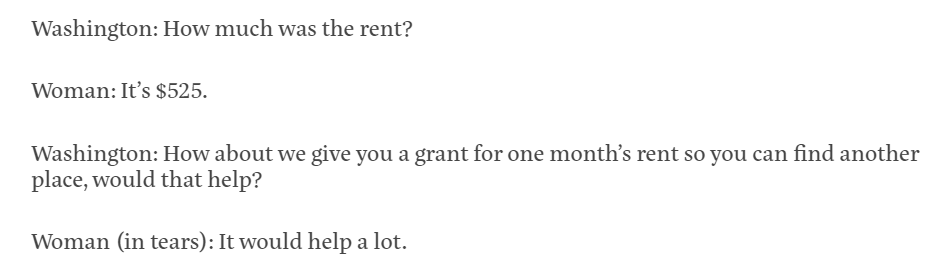
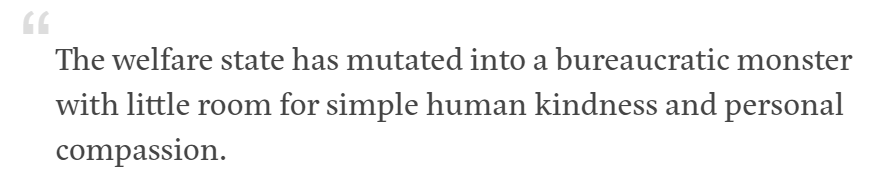
Washington is surely a hero. Here’s where the film leaves off and my own takeaway begins. The welfare state has mutated into a bureaucratic monster with little room for the simple human kindness and personal compassion of the kind displayed by Arlo Washington and his colleagues. If the same people went to a local welfare office with the same hard-luck story, they would be eyed with suspicion from the outset as potential scammers, and would be made to jump through all manner of eligibility hoops. To be a poor person in America reliant on means-tested programs—food stamps, Medicaid, TANF, housing vouchers, subsidized child care, etc.—is to spend half your waking hours dealing with different eligibility bureaucracies. The definitive book on the subject is Michael Lipsky’s classic, Street-Level Bureaucracy. As Lipsky points out, the few portals that offer help are overwhelmed by need. Workers in the welfare state, drawn to the job by compassion for the poor, become burned out and cynical as they try to ration aid. Eligibility tests drain energy from frontline workers as well as from clients.
What’s the cure for this? Here, conservatives divide from progressives. The conservative remedy is voluntary organizations and especially churches. Black churches do play an essential role in helping the needy. Evangelical churches also produce loyal congregants, not just via a common theology but through a range of services and a sense of community. But voluntary and faith-based efforts, even if they solve the bureaucratic paper chase, will never solve the Black-white wealth gap. For starters, we need to make every possible social program universal, and to drastically simplify income tests where they are unavoidable. For instance, New York City now provides free pre-K to everyone. You just need to demonstrate residency. The Biden universal child allowance that was in effect for a year was a refundable tax credit for all; you didn’t have to demonstrate poverty. In several cities and states, there are now universal, free school lunch programs, with no need to prove poverty (and endure the stigma attached to that). If there were universal health care in a single-payer system, that would be the end of Medicaid, as a separate means-tested program for the certified poor.
snip
1 replies
 = new reply since forum marked as read
Highlight:
NoneDon't highlight anything
5 newestHighlight 5 most recent replies
= new reply since forum marked as read
Highlight:
NoneDon't highlight anything
5 newestHighlight 5 most recent replies
= new reply since forum marked as read
Highlight:
NoneDon't highlight anything
5 newestHighlight 5 most recent replies
How the Welfare State Fails the Poor (Original Post)
Celerity
Mar 2024
OP

underpants
(196,495 posts)1. I've got Welfare State getting to the Sweet 16
Go Cadillacs!!
 that’s the best mascot I could come up with