General Discussion
Related: Editorials & Other Articles, Issue Forums, Alliance Forums, Region ForumsAre We in the Midst of a Political Realignment?

Assessing the level of change in partisan allegiance in recent years, as well as the president’s numbers since the State of the Union.
https://www.nytimes.com/2024/03/23/upshot/trump-biden-political-realignment.html
https://archive.is/Y1iPw

Voting patterns have changed a lot in the last decade.Credit...Cody O'Loughlin for The New York Times
Racial realignment?
“Realignment” is the holy grail of American politics — the fantasy of every political consultant who wants to usher in a new era of Democratic or Republican dominance. What’s a realignment? It’s a lasting shift in the partisan allegiance of the country, or at least a large demographic group. Think, for instance, of the rise of Franklin D. Roosevelt’s New Deal coalition, or the realignment of the South from Democrats to Republicans after the enactment of the Civil Rights Act. These are epochal, defining moments in American history. With that in mind, try to imagine how wide my eyes got when I read an article in The Financial Times arguing that America is undergoing a “racial realignment,” seemingly based on the results of our last New York Times/Siena College poll, which found President Biden leading by a slim 10 points among nonwhite voters, a group that usually backs Democrats by 50-plus points.
This claim strikes me as, at best, premature. The general election campaign is barely underway, and poll results in February do not constitute a realignment. As we have written several times: No one should be remotely surprised if Mr. Biden ultimately reassembles his support among Black and Latino voters. Alternately, many of the dissenting voters may simply stay home, as they did in the midterms. This would be bad for Mr. Biden, but it would be no realignment. Perhaps a more interesting question is whether the current polling would count as a realignment if it held in the final results. Clearly, it would be a significant shift with hugely important electoral consequences, both now and beyond. In the final account, it might clearly demarcate a post-Civil Rights era, when Democrats could count on overwhelming support from nonwhite voters, from a new era when they cannot. But even in the worst case for Democrats, Mr. Biden would probably still win among Black, Hispanic and Asian American voters.
This would arguably fall short of counting as a wholesale realignment in political preferences. For good measure, realignments usually require a subsequent election to confirm the shift. In the old political science textbooks, this is sometimes called a “confirming election.” That’s because unique candidates and circumstances can produce major electoral shifts that don’t last. It’s hard enough to predict whether Donald J. Trump’s gains in the polls among nonwhite voters will last until November, let alone whether they’ll fuel Republicans through 2028. His resilience will probably depend on the source of his strength, which is still up for debate. Last fall, I worked through five hypotheses, and some might be likelier to yield a lasting shift than others. Even beyond this cycle, if Mr. Trump won, how he governed in the White House would be an important variable. Mass deportations of undocumented immigrants, for instance, may not be the way to cement an incipient realignment of young, nonwhite and Latino voters.
All that said, there is a case to think of Trump gains among Black and Latino voters as part of a broader realignment: the realignment of American politics along the lines of Mr. Trump’s conservative populism. It may not have happened in one realigning election, but if you take 2016, 2020 and a hypothetical 2024 result that mirrors today’s polling together, you have a pretty fundamental change in the dimensions of partisan conflict compared with the elections from 1980 to 2012. If Mr. Trump’s gains among working-class white voters ultimately extended to working-class Black and Latino voters as well, it would represent the culmination of a decadelong shift in American politics, whether you call it a realignment or not.
Did the State of the Union lift Biden’s numbers?...............
snip
 = new reply since forum marked as read
Highlight:
NoneDon't highlight anything
5 newestHighlight 5 most recent replies
= new reply since forum marked as read
Highlight:
NoneDon't highlight anything
5 newestHighlight 5 most recent replies

elleng
(141,926 posts)This is our first try: a weekly roundup newsletter, offering thoughts on some of the bigger questions of the week and a few of our favorite links. There will also be an opportunity to answer occasional reader questions.
“Realignment” is the holy grail of American politics — the fantasy of every political consultant who wants to usher in a new era of Democratic or Republican dominance.
What’s a realignment? It’s a lasting shift in the partisan allegiance of the country, or at least a large demographic group.>>>
https://www.nytimes.com/2024/03/23/upshot/trump-biden-political-realignment.html

Layzeebeaver
(2,286 posts)Meanwhile, let us not "wait and see", let's mobilise!
elleng
(141,926 posts)This is NYT, which imo is a good sign, they're responding, maybe, to 'our' complaints.
Assessing the level of change in partisan allegiance in recent years, as well as the president’s numbers since the State of the Union.
https://www.nytimes.com/2024/03/23/upshot/trump-biden-political-realignment.html

Mike Nelson
(10,943 posts)... headline, I thought this might be about a portion of Republican voters permanently leaving to become Democrats! I think there are some who feel they can't skip the Presidential line or vote 3rd party... they will have to vote for Biden. The move toward isolation in world politics and restrictions on reproductive health care are a couple main reasons. Maybe the NYT has addressed this in other stories.


Warpy
(114,615 posts)and even wore governments.

thucythucy
(9,103 posts)"Alternately, many of the dissenting voters may simply stay home, as they did in the midterms."
What?
I thought turnout in 2022 vastly exceeded expectations, which is why the oft predicted "red tsunami" turned out to be a piss puddle.
What's the point of this sort of revisionism?

Celerity
(54,407 posts)in the MSM bought into.
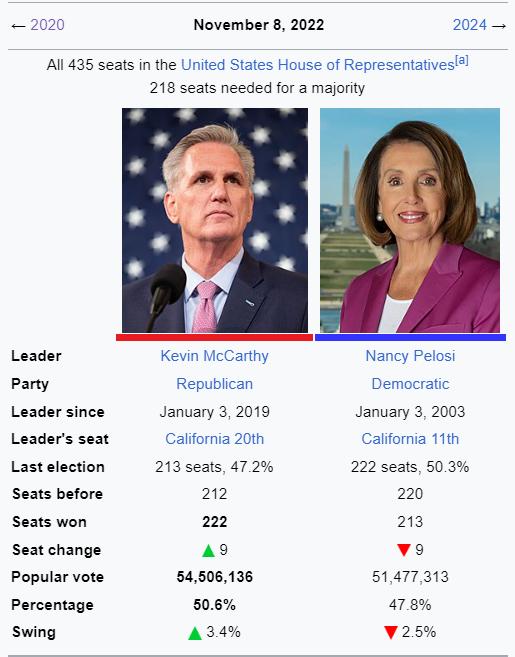
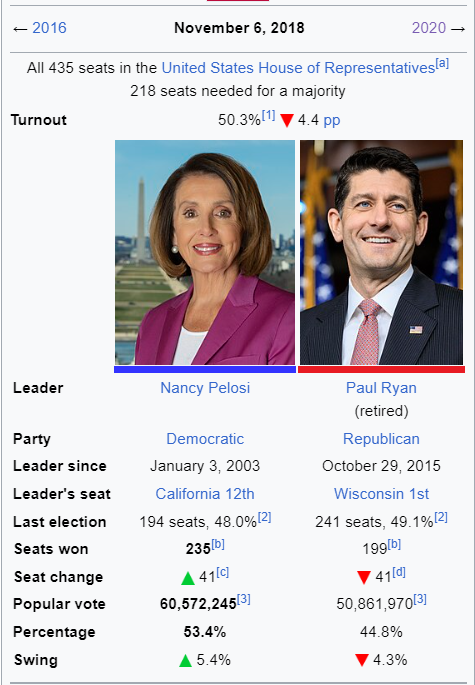
Also, the 2022 midterms were POST Roe being overturned, yet we lost the national House vote by over 3 million, and if CA was removed, almost 6 million. In 2018 we won the national House vote by almost 10 million.
The Democrat turnout in 2022 was far lower lower than 2018, over 9 million less votes.
thucythucy
(9,103 posts)"The elections of 2018, 2020 and 2022 were three of the highest-turnout U.S. elections of their respective types in decades. About two-thirds (66%) of the voting-eligible population turned out for the 2020 presidential election – the highest rate for any national election since 1900. The 2018 election (49% turnout) had the highest rate for a midterm since 1914. Even the 2022 election’s turnout, with a slightly lower rate of 46%, exceeded that of all midterm elections since 1970."
I think turnout in 2018--in large part a response to the horror of Trump--was an outlier and subsequent turnout was almost bound to be down.
Though I take your point that we ended up losing relatively speaking, a result I suppose of the then still sour economy and endless crap spewed by various outlets about President Biden's supposed "failures." We certainly can't afford the same loss this coming November.
As for the "red tsunami"--right wing fantasy or not--I also seem to recall that the MSM was shouting this expectation from the rooftops right up to election eve, and expressed absolute astonishment when it didn't pan out as predicted.
Let's hope they learned their lesson, though I doubt it.
Sympthsical
(10,969 posts)I was using the available polls to make them. These posts are pre-election.
https://democraticunderground.com/?com=view_post&forum=1002&pid=17314837
https://democraticunderground.com/?com=view_post&forum=1002&pid=17327381
https://democraticunderground.com/?com=view_post&forum=1002&pid=17327326
Bonus Round: Me arguing with the same people about "Polls are bad!" Plus ça change . . .
https://democraticunderground.com/?com=view_post&forum=1002&pid=17325110

Elessar Zappa
(16,385 posts)I predict the Hispanics will vote against Trump in the numbers they did in ‘16 and ‘20. I haven’t seen any evidence that he’s gained any significant ground here.
Sky Jewels
(9,148 posts)Suburbs keep moving heavily to Dems because of abortion and because of demographics --- decline of voting power/numbers of the older and more Republican friendly generations and rise of more progressive Millennial and Gen Z generations. Also, younger people aren't drinking the religion Kool Aid as much, which is fantastic.
More women move to the D column because of Dobbs.
Minorities continue to support Ds.
Republicans get straight white male non-college rural Christians ... Good luck with that, GQP.
(Of course, reporting on these trends gives the NYT oligarchs a sad.)

limbicnuminousity
(1,416 posts)though it's unlikely to be recognized until 2028. I think the younger generations are fed up.

pecosbob
(8,387 posts)The results hinge on turnout. Dems may have finally understood that they need to run against Trump and not on policy. Joe appears to be on the offensive. I hope they keep it up.