General Discussion
Related: Editorials & Other Articles, Issue Forums, Alliance Forums, Region ForumsWhy are Americans charged so much more than other countries for popular drugs?
“The American people are sick and tired of paying, by far, the highest prices in the world for prescription drugs,” Sanders said. “Novo Nordisk currently charges Americans with Type 2 diabetes $969 a month for Ozempic, while this same exact drug can be purchased for just $155 in Canada and just $59 in Germany. Novo Nordisk also charges Americans with obesity $1,349 a month for Wegovy, while this same exact product can be purchased for just $140 in Germany and $92 in the United Kingdom.”
 = new reply since forum marked as read
Highlight:
NoneDon't highlight anything
5 newestHighlight 5 most recent replies
= new reply since forum marked as read
Highlight:
NoneDon't highlight anything
5 newestHighlight 5 most recent replies

CurtEastPoint
(20,025 posts)
msongs
(73,754 posts)
Hermit-The-Prog
(36,631 posts)jimfields33
(19,382 posts)Development and testing are not cheap. They get compensated for it. Research is a huge part of it. The other countries have the privilege of buying the drug after the work is done.

choie
(6,906 posts)get from the U S government, as in WE the tax payers?

dpibel
(3,944 posts)You can find breakdowns of how much big pharma spends on research versus how much on advertising.
You will, apparently, be very surprised.

Firestorm49
(4,548 posts)Few other countries allow big pharma to utilize mass media to advertise. The preponderance of advertising nation wide is very costly. I, for one, am sick of being told to “consult my doctor” for advice, as that is obvious.
We are subsidizing the never ending onslaught of drug advertising, hence the price of medication. If they don’t have the option of advertising, there is less cost involved and drug prices could be lowered. Take insulin, for example. If our current laws have pressured big pharma to lower the cost of insulin to $35 a month, my bet is that through economy of scale, they are still doing just fine.
Stop big pharma advertising and watch prices drop. Redundancy prevailing, if you need to consult your doctor anyway, what’s the point? Your doctor knows, or should know, what to prescribe. That being the case, national drug advertising is unnecessary. I don’t think any of us would miss the constant barrage of advertising one iota.

Ghost of Tom Joad
(1,443 posts)In Europe there are no drugs advertised on television. Lately it's one lousy drug commercial after another. Tell you doctor about this wonder drug, and then lists all the things that can go wrong if you do. What a racket.

róisín_dubh
(12,336 posts)about coming home to visit family: drugs advertising. I hate it so much. Every other commercial is for some medication. It’s ridiculous!

PufPuf23
(9,856 posts)structurally.
Model35mech
(2,047 posts)It's one of the worst capitalist exploitations of human nature.
PufPuf23
(9,856 posts)Marketplaces are effectively walled off and prices paid by buyers are based upon perceived ability to pay.
The high prices for many drugs within the USA is a structural feature of our current medical system, POTUS Biden has made marginal improvement as did POTUS Obama.
usonian
(25,325 posts)Single payer health care would drive prices down precipitously (and insane profits that come at the expense of, the illness of and too often, the death of people in need.)
The influence that Purdue and others had in influencing (bribing) physicians into overprescribing oxycontin/opioids is a national disgrace, and resulted in addiction and worse. BUT IT'S GOOD BUSINESS UNTIL PEOPLE START DYING.
Profits 1
Lives 0
And that's the box score.

BOSSHOG
(44,738 posts)Done to my left arm. After surgery and upon release from the hospital my surgeon handed me a prescription for 100 OxyContin pills. We got it filled on the way home. He said I would need one about 11 that night for pain. I didn’t but I took one anyway cause the Doctor said. It’s the only one I took.
Casting nothing on my Doctor who did an awesome job on my arm, but pain was never an issue. I was in therapy for nine months and never took any kind of pain pill.
And it’s Sunday so I won’t bring up Medicare ADVANTAGE Plans. Yes they are an advantage to some entity.
onecaliberal
(36,594 posts)Not all of them are recons

Groundhawg
(1,218 posts)
pnwmom
(110,261 posts)unlike most countries in the world.

Celerity
(54,410 posts)Feinstein also voted Yea. One of multiple issues/votes I disagreed with her on (retrospectively of course, as I had just turned 7 years old when it passed in late 2003).
Wyden also voted Yea, disappointingly.
Kerry and Lieberman did not vote.
Senate final vote: it passed 54-44
https://www.senate.gov/legislative/LIS/roll_call_votes/vote1081/vote_108_1_00459.htm?congress=108&session=1&vote=00459
YEAs (Democratic) Bold are still in the Senate
Baucus (D-MT)
Breaux (D-LA)
Carper (D-DE)
Conrad (D-ND)
Dorgan (D-ND)
Feinstein (D-CA)
Jeffords (I-VT)
Landrieu (D-LA)
Lincoln (D-AR)
Miller (D-GA)
Nelson (D-NE)
Wyden (D-OR)
Medicare Prescription Drug, Improvement, and Modernization Act
https://en.m.wikipedia.org/wiki/Medicare_Prescription_Drug,_Improvement,_and_Modernization_Act
snip
Bar to negotiation of prescription drug prices
After the enactment of Medicare Prescription Drug, Improvement, and Modernization Act in 2003, only insurance companies administering Medicare prescription drug program, not Medicare, had the legal right to negotiate drug prices directly with drug manufacturers. The Medicare Prescription Drug Act expressly prohibited Medicare from negotiating bulk prescription drug prices. The "donut hole" provision of the Patient Protection and Affordable Care Act of 2010 was an attempt to correct the issue. In 2022, the Inflation Reduction Act removed this ban and allowed Medicare to begin negotiating drug prices starting in 2026. (my add, only on 10 selected drugs and Big Pharma is fighting this massively)
snip
Medicare Advantage plans
With the passage of the Balanced Budget Act of 1997, Medicare beneficiaries were given the option to receive their Medicare benefits through private health insurance plans, instead of through the Original Medicare plan (Parts A and B). These programs were known as "Medicare+Choice" or "Part C" plans. Pursuant to the Medicare Prescription Drug, Improvement, and Modernization Act of 2003, the compensation and business practices for insurers that offer these plans changed, and "Medicare+Choice" plans became known as "Medicare Advantage" (MA) plans. In addition to offering comparable coverage to Part A and Part B, Medicare Advantage plans may also offer Part D coverage.
Changes to plans
With the MMA, new Medicare Advantage plans were established with several substantive differences from the previous Medicare + Choice plans, including:
enrollees sign on for a whole year
care could be restricted to specific provider networks
formularies were to be used to restrict prescription drug choices
prescription coverage would be deferred to the patient or a Medicare Part D prescription plan
care other than emergency care can be restricted to a particular region
federal reimbursement can be adjusted according to the health risk of the enrollees
MotownPgh
(462 posts)Democratic reps supporting these measures. I remember when Rendell and the state dems were running all over PA urging everyone to sign over their mineral rights to the fracking companies. I remember the dem rep in our district knocking on my parents' door to encourage them to sign. Both sides indeed have tremendously helped corporations
Celerity
(54,410 posts)Former Gov. Ed Rendell is criticizing Pennsylvania Democrats over their call for a moratorium on fracking.
The Democratic State Committee voted last weekend in favor of an open-ended moratorium on fracking. That’s the technique drilling companies use to extract natural gas from the Marcellus Shale. Opponents contend fracking is an environmental menace, but drilling companies and many regulators say the technique is safe.
Rendell, who has indirect ties to the gas industry, says in an interview with The Patriot-News of Harrisburg that the party’s call to put the brakes on fracking is “ill-advised,” noting it has created jobs and wealth.
His former environmental secretary, John Hanger, says he’s in favor of the existing moratorium in state forests, and strict regulation on private property. Hanger, also a Democrat, is running for governor.
2010, more on the Rendell administration:
Published: Sep. 15, 2010
Gov. Ed Rendell said Tuesday night he didn't know anything about his administration contracting with a private firm that tracked the activity of citizens engaged in lawful protests and then distributing that information to law enforcement and private companies around the state. He may been one of the few who didn’t. Rendell said James Powers, the director of Pennsylvania’s Office of Homeland Security, which distributed the intelligence bulletins, would not be fired because “there’s shared responsibility here.” Indeed. The Governor’s chief policy adviser, Donna Cooper, knew the content of the Homeland Security Bulletins was “questionable” back in July.
At that time Philadelphia Inquirer columnist Dan Rubin was given a stack of the bulletins by someone “wondering whether the money for them was well spent.” The Institute of Terrorism Research and Response, with offices in Philadelphia and Jerusalem, was under a $125,000 contract to supply information to Homeland Security. Rendell said Tuesday that contract would not be renewed. Rubin reported in July that the bulletins contained all the kinds of information Rendell claimed Tuesday to be "appalled" about - gay pride parades, candle light vigils and even groups that rallied in support of the his own policies. Rubin noted that one bulletin included information on the Good Schools Pennsylvania group, founded by Donna Cooper, and asked her about it. She said, “If that’s the kind of stuff that’s in the newsletter, its appropriateness is questionable.”
State Police Commissioner Colonel Frank E. Pawlowski was aware of the bulletins; at least, they were distributed to the State Police and Rendell said Tuesday that Pawlowski told him nothing in the bulletins “was of any value to the State Police.” Pawlowski is now on the new task force to find a better way to determine credible threats to critical infrastructure, along with Powers and Robert French, the director of the Pennsylvania Emergency Management Agency, which oversees Homeland Security. Rendell said Tuesday night that his ignorance of the bulletins, their content and to whom they were being distributed was “an internal staff problem that we have to deal with.”
When asked why so many of Rendell’s closest staffers were not troubled by the content of the intelligence bulletins, spokesman Gary Tuma said, “I think that’s one of the things the governor said troubled him.” The issue got traction two months after Rubin’s column because the intelligence bulletins began to include lists of meetings that Marcellus Shale gas drilling opponents planned to attend. The legislature convened this week to attempt to pass a tax on Marcellus gas, one of Rendell’s top priorities. The issue of the Homeland Security bulletins threatens not only to shift focus from the core issues of that debate, but also to strengthen opponents of ancillary measures - like forced pooling and zoning exemptions - that are favored by the drilling industry.
https://archive.ph/mVOgV
About the Institute of Terrorism Research and Response (ITRR)
ITRR is an American-Israeli nonprofit corporation helping government agencies, CIKR facilities, Fortune 500 companies, and organizations of all sizes succeed in a world threatened by terrorism. ITRR provides specifically tailored counter-terrorism and first response training, 24/7 actionable intelligence gathering and analysis, and support for global security planning, operations and logistics. Our in-house subject matter experts bring to every project their extensive tactical and strategic experience in law enforcement, corporate protection, intelligence, homeland security, and emergency management.
Both public and private sector clients regularly depend on ITRR’s operational versatility – our proven ability to adapt, customize, and specialize to meet the client’s needs. Key security specializations include mitigation of threats from weapons of mass destruction (WMD), suicide bombers and lone-wolf terrorism, as well as all manner of nonlethal disruptive activism. With experience, flexibility and creativity, ITRR’s guidance is always a step ahead of evolving threats.
ITRR’s Targeted Actionable Monitoring Center (TAM-C)
With its multilingual and multiethnic team of researchers and analysts, in 2004, ITRR established the Targeted Actionable Monitoring Center (TAM-C). The TAM-C, with round-the-clock monitoring of open and closed sources of information, provides actionable, forward-looking intelligence on terrorist activities, international hot-spots, aggressive activist targeting, "red flag" dates, real-time security alerts, and more. The TAM-C’s international Ground Truth Network (GTN) of human assets provides uniquely valuable field intelligence from wherever it is needed – and whenever it is needed the most.
The TAM-C team of “information miners” and on-the-ground sources collaborate to identify the most useful operational information on international and domestic threats to client operations. Along with this tailored intelligence, TAM-C subject matter experts provide substantive and practical guidance to protect personnel and assets worldwide.
https://web.archive.org/web/20210215000000*/http://www.terrorresponse.org//images/stories/press_room/publications/NEWSWIRE_security_Directors_News.pdf
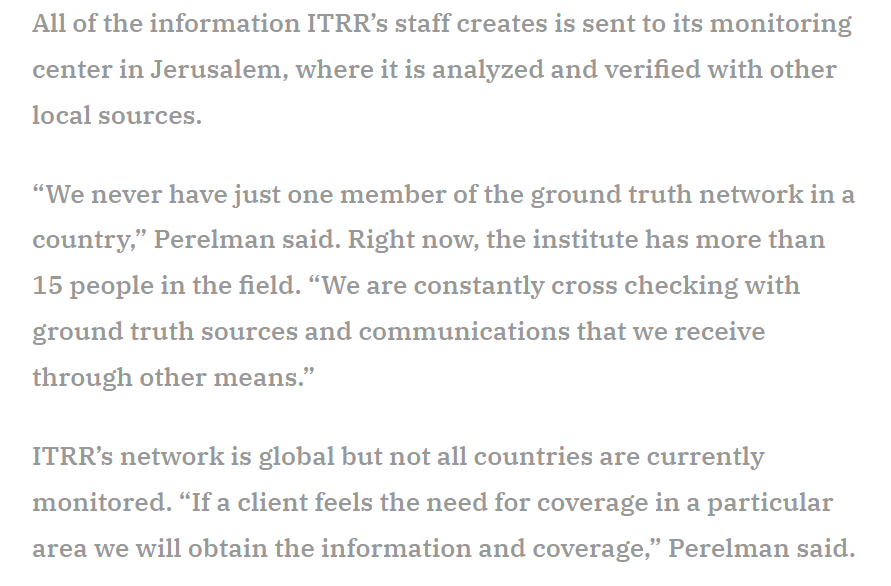
https://web.archive.org/web/20100918095121/http://www.post-gazette.com/pg/10258/1087684-100.stm
Tom Ridge, the former Pennsylvania governor and U.S. homeland security secretary who's now an adviser to the Marcellus Shale Coalition, today said Gov. Ed Rendell did the right thing in shutting down a controversial intelligence-gathering program on gas-drilling opponents and other groups. Mr. Ridge called the program "rather bizarre," and he said gas-industry critics aren't terrorists. "They have a difference of opinion," said Mr. Ridge, whose consulting groups have a one-year, $900,000 contract with the Cecil-based coalition. He answered questions about the controversy this afternoon before participating in a panel discussion, also including Mr. Rendell and former Gov. Dick Thornburgh, at the annual conference of the State Science and Technology Institute at the Omni William Penn Hotel, Downtown.
On Tuesday, Mr. Rendell canceled a one-year, $125,000 contract with the Institute of Terrorism Research and Response, which was providing the state Office of Homeland Security with intelligence on gas-drilling opponents, plus tax protests and gay-pride activities. The apologetic governor said he canceled the contract when he found out about it Tuesday. Mr. Rendell said the program was wrong, but he hasn't removed Homeland Security Director James Powers.
Pittsburgh City Councilman and gas-drilling opponent Doug Shields today sought to turn the tables on the intelligence-gatherers, demanding an investigation into the institute. He said he would consult his colleagues about invoking council's authority under the city charter to open its own investigation, which would include calling witnesses. Mr. Shields said he was up into the wee hours of the morning speaking with gas opponents about the intelligence-gathering program, including some who wondered whether they're on some kind of enemies list. "Am I on the list?" said Mr. Shields, who also wondered whether the institute's representatives photographed or videotaped him at Frick Park during a recent airing of an anti-drilling documentary.
The institute, which describes itself as a nonprofit group with offices in Philadelphia, was supposed to monitor possible terrorist threats to roads and bridges, but the work morphed into surveillance of protest groups exercising First Amendment rights, Mr. Rendell said Tuesday. Speaking before the panel discussion today, Mr. Rendell said he doesn't know of any other state agency that had a contract with the institute. Among other monitoring, the institute sent out an "intelligence bulletin" about a Pittsburgh City Council meeting on gas drilling. It wasn't clear whether the institute monitored the documentary screening. Mr. Shields, who is sponsoring a bill to ban gas drilling citywide, today described the intelligence-gathering program as "espionage" and demanded that Mr. Powers be fired.
Shutting down the program isn't enough, Mr. Shields said, demanding a probe into who authorized the program and why. He said he wants to know whether the program was the brainchild of a "rogue fool" or something more sinister, such as a joint effort with the gas industry. "Is this just a bunch of screwballs or is this a concerted effort that went awry?" he said. Mr. Shields said some industry critics are concerned about an industry-government tie because of Mr. Ridge's previous role as U.S. homeland security secretary. Asked whether he had any role in the contract, Mr. Ridge said, "Hell, no."

uponit7771
(93,532 posts)
surfered
(13,474 posts)Meaning their governments negotiate drug prices with the pharmaceutical companies.
pwb
(12,669 posts)ads? They let their doctors decide what you need?
Marcus IM
(3,001 posts)Instead, they run Cuba tourism ads of the beautiful beaches and people - ads which don't exist in America because Americans are 2nd class citizens.
Not only do Americans NOT have universal healthcare or ed, but, Americans are also travel banned by their own gov't. So, no Cuba tourism for Americans.
Plus, the healthcare in Cuba is universal, including prescription drugs.


ancianita
(43,307 posts)Inhalers are among them, along with insulin.
https://www.commondreams.org/news/sanders-praises-35-cap-on-inhalers-just-six-months-after-probe-into-outrageous-prices
As Common Dreamsreported in March, Combivent Respimat, one of Boehringer's inhaler products, previously carried a list price of around $500 in the U.S.—a number roughly 70 times what the company was charging for the same product in France, where patients could get the inhaler for just $7.

alfredo
(60,301 posts)There’s big money in sickness and misery. It’s the American way to the corporate mind.

Pototan
(3,132 posts)When I retired, I signed up for Medicare part A & B, I don't have D. So, I ordered my 7 prescriptions without insurance for the first time in the US before relocating to Iloilo Province in the Philippines. The cost of my 7 prescriptions was $5,300 USD for a 90-day supply in America. I passed.
For those same 7 prescriptions I am charged 5,200 PHP in the Philippines. That's roughly $100 USD for a 30-day supply (they actually charge by the pill). The only prescription that's comparable to the US is Lisinopril. I have no idea why. The diabetes medications are something like 15 to 20 times more in America.
I have been taking the medications for nearly 3 years here and they have proven just as effective.

Bayard
(29,698 posts)Back during my recruiting days, that Americans pay so much more for drugs because we are financing the research and development. No other country will let them do that.
Voltaire2
(15,377 posts)pnwmom
(110,261 posts)from the super high prices they get from the American market. Everything they get from foreign markets is just profit.
Voltaire2
(15,377 posts)But go ahead and prove that pharma price gouging profits all go to r&d. Martin Shkreli would like a word.
And he is just one example of investors cornering the market for specific drugs and jacking up the prices. The propaganda that this is all to our benefit is utter bullshit.

Johnny2X2X
(24,210 posts)These drug companies aren't really doing as much research as advertised. What they do is rely on our nations Universities to do a lot of the research, they even partner with them on it so they can retain the patents. If they aren't doing that, they're looking for small companies actually doing the research to buy up if that company has a break through. The public pays for much of this research.
What they do spend an incredible amount of money on is lobbyng the FDA and Congress, and then on marketing campaigns. These drugs don't cost them all that much to develop or produce, it's pure greed. And the only country in the world that stands for it is the United States.

ret5hd
(22,502 posts)
canetoad
(20,769 posts)That it's part and parcel of 'The American Way' - free enterprise, the cost is what the market will bear.
I take a biologic drug called Tremfya. Full price in Australia is $3565 per 100ml dose. I guess that's for tourists etc. It's subsidised on the pharmeceutical benefits scheme so Aussies in general pay a bit over $30. I pay $6.70 - age concession.
The best price I can find in the US for one 100ml dose is....$13,989. Nearly fourteen thousand dollars! Even allowing for exchange rates, if you paid a similar price to us the cost in the US would be $2353.
I find no excuse or justification for this exorbitant rip-off except that it seem cruelty is embedded in the US system.
JanMichael
(25,725 posts)Celerity
(54,410 posts)Research shows prices in the United States are nearly double those in other well-off countries.
https://www.nytimes.com/2024/01/17/health/us-drug-prices.html
https://archive.ph/HV3K7
1. There is no central negotiator willing to walk away.
2. There are no price controls.
3. The system creates perverse incentives.
4. The system is fragmented and complicated.
5. Patent gaming keeps prices high longer.
6. Drug prices are what the market will bear.
The role of pharmacy benefit managers (PBMs).
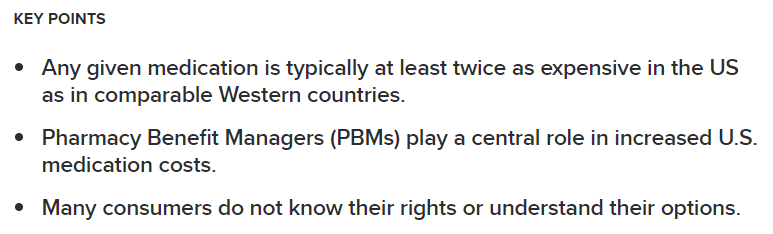
https://www.vox.com/science-and-health/2016/11/30/12945756/prescription-drug-prices-explained
Not only do Americans spend more than everybody else, the gap keeps widening. But there's a chance that might change.
https://www.bloomberg.com/news/features/2024-06-06/why-prescription-drug-prices-in-the-us-are-so-high
https://archive.ph/8IWaX
https://kffhealthnews.org/news/article/fact-check-biden-prescription-drug-prices-nation-comparison/
How can you minimize your costs — and what state or national steps could make a difference?
https://www.health.harvard.edu/blog/why-do-your-prescription-drugs-cost-so-much-202401183007
snip
Why are medicine costs so high in the US?
My top five contenders are:
Drug makers' profit motive.
Pharmacy benefit managers (PBMs)
Cost-sharing.
Legal maneuvers.
Direct-to-consumer advertising.
And why we get less bang for our bucks
https://www.investopedia.com/articles/personal-finance/080615/6-reasons-healthcare-so-expensive-us.asp
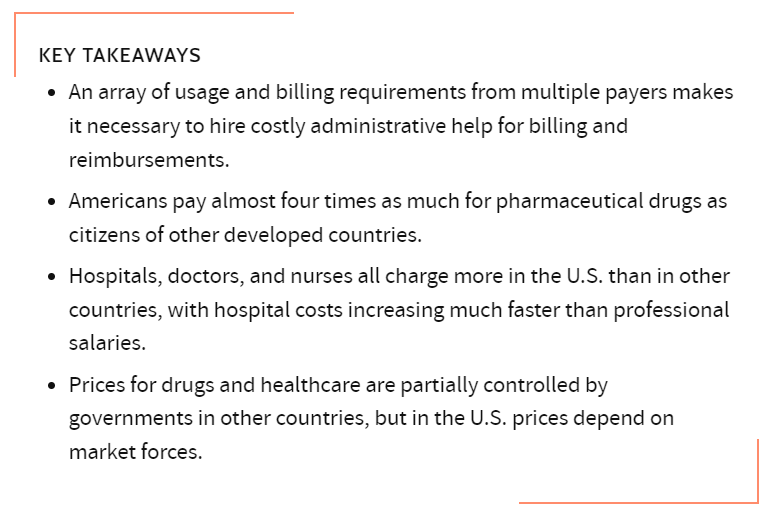
1. Multiple Systems
2. Rising Drug Costs
3. Higher Salaries for Medical Professionals
4. Profit-Driven Hospitals
5. Defensive Medical Practices
6. Varying Healthcare Prices
canetoad
(20,769 posts) Rec.
Rec.Celerity
(54,410 posts)
Emile
(42,293 posts)Think. Again.
(22,456 posts)
marble falls
(71,936 posts)... "because that's where the money is." That and the US is where there is no governmental pressure to limit vampire capitalism. And we are a nation of middlemen, everybody gets their beak wet.
gab13by13
(32,324 posts)Eliquis is made by Bristol Myers Squibb - Pfizer. I have a prescription drug plan through my Union, I am retired.
I was paying 135 dollars a month getting Eliquis through Expresscripts. I went to my pharmacist and asked about another plan. He signed me up with a plan through the makers of Eliquis - Bristol Myers Squibb - Pfizer for 10 dollars a month. I did not get this deal because I am low income, I got this deal because my pharmacist bypassed all of the middle men getting their cut.

calguy
(6,154 posts)I had an emergency incident back in November when I passed out at an event and was taken by ambulance to the ER. I was hospitalized for six days and diagnosed with AFIB. The hospital physician put me on Eliquis, which I didn't get because of the high cost.
Made an appointment with another cardiologist a month later for a second opinion. He put me on Warfarin, which does the same thing for about three dollars a month, whereas the Eliquis, with insurance, was going to be five hundred-fifty dollars a month.
Seems like the physician was getting some incentive to prescribe the much more expensive Eliquis.
Silent Type
(12,412 posts)Voltaire2
(15,377 posts)on mRNA technologies to produce a commercial vaccine that they then made billions off of.
Silent Type
(12,412 posts)Voltaire2
(15,377 posts)There was no massive tech breakthrough by private pharma. They used existing technology.
Silent Type
(12,412 posts)that easy, especially that quickly.

bdamomma
(69,532 posts)
Lonestarblue
(13,480 posts)It has headquarters in Copenhagen and in the US. I don’t know the EU rules on drug pricing, but I’m sure they have some as European countries believe in healthcare for all. We do not. Our for-profit rapacious capitalistic healthcare system enables the highest healthcare costs that build excessive profits on illness, largely created by the Republican Party with help from some very moderate Democrats. I don’t see that changing anytime soon.
Celerity
(54,410 posts)at least one of multiple bills that would stifle regulators’ ability to bring down prices of drugs covered by the Medicare. The bills would significantly reduce or outright block the drug price reduction framework contained in Biden's 2022 Inflation Reduction Act.
https://www.congress.gov/bill/118th-congress/house-bill/5539/text?s=1&r=88
the Maintaining Investments in New Innovation (MINI) Act
https://www.congress.gov/bill/118th-congress/house-bill/5547
and the Ensuring Pathways to Innovative Cures (EPIC) Act,
https://www.congress.gov/bill/118th-congress/house-bill/7174/cosponsors?s=7&r=1
would delay or block the price reduction apparatus for many other drugs.
https://www.opensecrets.org/members-of-congress/don-davis/industries?cid=N00049636&cycle=2024
https://www.opensecrets.org/members-of-congress/josh-gottheimer/industries?cid=N00036944&cycle=2024
https://www.opensecrets.org/members-of-congress/wiley-nickel/pacs?cid=N00049133&cycle=2024
https://www.opensecrets.org/members-of-congress/scott-peters/industries?cid=N00033591&cycle=2024
and the 4th, Davis, was the lone Democratic co-sponsor of a bill by Rethugs Greg Murphy and Brett Guthrie that significantly weakens Medicare's ability to lower prices:
https://www.statnews.com/2024/02/05/democrat-weaken-medicare-drug-price-negotiation/
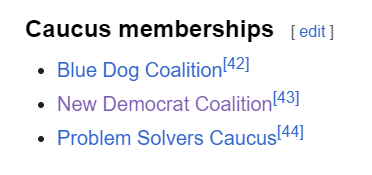
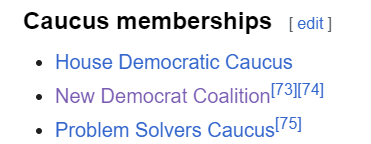
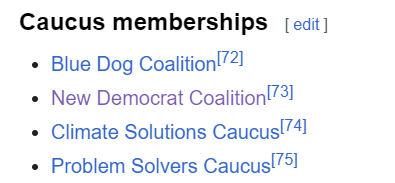
All 4 are in the moderate/centrist New Democrat Coalition, and Nickel and Gottheimer are also in the conservative Blue Dog Coalition.

David__77
(24,728 posts)Midnight Writer
(25,410 posts)
Hekate
(100,133 posts)