Welcome to DU! The truly grassroots left-of-center political community where regular people, not algorithms, drive the discussions and set the standards. Join the community: Create a free account Support DU (and get rid of ads!): Become a Star Member Latest Breaking News Editorials & Other Articles General Discussion The DU Lounge All Forums Issue Forums Culture Forums Alliance Forums Region Forums Support Forums Help & Search

Nevilledog

(55,137 posts)
Fri Jun 28, 2024, 12:29 PM Jun 2024

The Limited Effects of Fischer: DOJ Data Reveals Supreme Court's Narrowing of Jan. 6th Obstruction Charges...

https://www.justsecurity.org/96493/supreme-court-obstruction-january-6th/

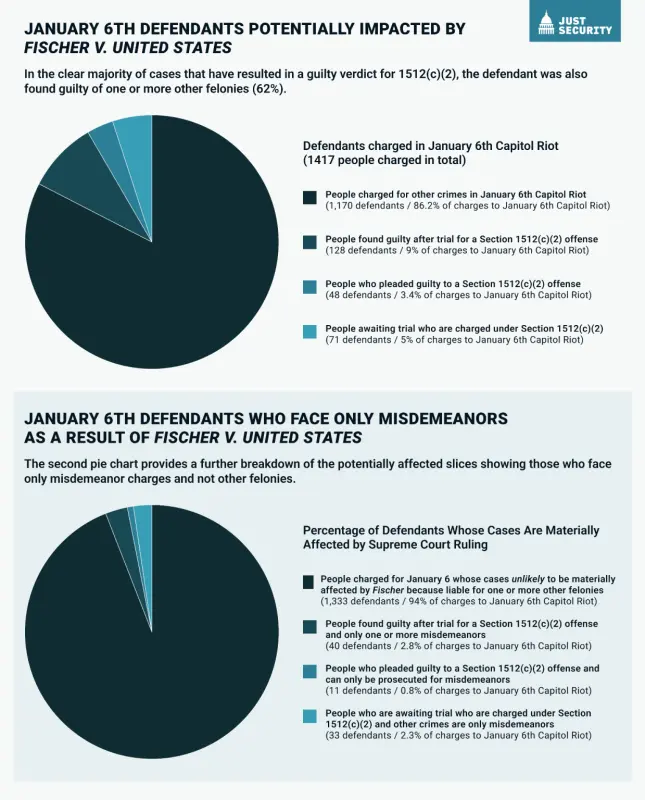
What does the Supreme Court’s decision in Fischer v. United States mean for former President Donald Trump’s D.C. criminal case and the hundreds of other January 6th defendants? A whole lot less than one might think, as we show with the hard data set out below.

The Fischer decision

The Supreme Court’s decision issued Friday, June 28, addresses the scope of 18 U.S.C. Section 1512(c)(2), a federal obstruction of justice statute that the Justice Department has used as one of the charges for January 6th defendants.

No doubt, the Supreme Court’s decision deals a soft blow to the government’s use of the (c)(2) provision of Section 1512. Section 1512(c) prohibits corruptly obstructing an official proceeding in two ways: first, under subsection (c)(1), by altering, destroying, mutilating, or concealing a record, document, or other object with the intent to impair the object’s integrity or availability for use in an official proceeding, and second, under subsection (c)(2), by “otherwise” obstructing, influencing, or impeding an official proceeding. Rather than apply what the U.S. Solicitor General described as the plain meaning of the word “otherwise” to other means of obstructing the proceeding, such as by violently attacking the joint session of congress to count the electoral ballots–a plain meaning with which Justices Barrett, Sotomayor, and Kagan generally concurred in dissent–the Court held that the obstruction barred by (c)(2) must be tied to impairing the integrity or availability of evidence.

However, the Court gives an expansive reading of (c)(2). As the Court noted, Section (c)(2) liability encompasses creating false evidence, and not just altering incriminating evidence, as well as “impairing the availability or integrity of other things used in an official proceeding beyond the ‘record[s], document[s], or other object[s]’ enumerated in (c)(1), such as witness testimony or intangible information.”

*snip*
2 replies = new reply since forum marked as read
Highlight: NoneDon't highlight anything 5 newestHighlight 5 most recent replies
The Limited Effects of Fischer: DOJ Data Reveals Supreme Court's Narrowing of Jan. 6th Obstruction Charges... (Original Post) Nevilledog Jun 2024 OP
Thanks for this dweller Jun 2024 #1
The court expands everything with word play. pwb Jun 2024 #2

dweller

(28,692 posts)
1. Thanks for this
Fri Jun 28, 2024, 12:45 PM
Jun 2024

I’m just going to add these neat little pie charts from the article


And one handy section of text

6. Charges against Trump materially unaffected.

The case against former President Trump remains prosecutable even though the Supreme Court has narrowed the scope of the obstruction statute. First, Trump is charged with other crimes (Conspiracy to Defraud the United States (18 USC 371) and Conspiracy Against Rights (18 USC 241)), which are unaffected by the ruling. Notably, those charges are based on the same alleged facts as the two obstruction charges against Trump (a Section 1512(c)(2) offense and a conspiracy to commit a Section 1512(c)(2) offense.) Second, as Justice Barrett suggested in oral argument, the issue in Fischer may not affect the statute’s application to charges involving interference with “the certificates arriving to the vice president’s desk” or other acts of obstruction that involve “acting on the certificates.” That line drawing has implications for the Section 1512(c)(2) charges against Trump that relate to the use of false elector certificates. Indeed, Special Counsel Jack Smith has also noted in Supreme Court filings “whether the Court interprets Section 1512(c)(2) consistently with a natural reading of its text or adopts the evidence-impairment gloss urged by the petitioner in Fischer, the Section 1512 charges in this case are valid.”

The majority in Fischer leaves this door wide open in writing: “[S]ubsection (c)(2) makes it a crime to impair the availability or integrity of records, documents, or objects used in an official proceeding in ways other than those specified in (c)(1). For example, it is possible to violate (c)(2) by creating false evidence—rather than altering incriminating evidence” (emphasis added).

Notably, the evidence-impairment provision in Section 1512(c)(2) could also apply to others involved in the false electors scheme


Well worth the whole read , thanks


✌🏻

pwb

(12,802 posts)
2. The court expands everything with word play.
Fri Jun 28, 2024, 12:48 PM
Jun 2024

Anything to change the charge. They are full of what ifs

Kick in to the DU tip jar?

This week we're running a special pop-up mini fund drive. From Monday through Friday we're going ad-free for all registered members, and we're asking you to kick in to the DU tip jar to support the site and keep us financially healthy.

As a bonus, making a contribution will allow you to leave kudos for another DU member, and at the end of the week we'll recognize the DUers who you think make this community great.

Tell me more...

Latest Discussions»General Discussion»The Limited Effects of Fi...