General Discussion
Related: Editorials & Other Articles, Issue Forums, Alliance Forums, Region ForumsJFK's 1960 "Strategy of Peace": just wow
(This is a continuation of Ocatfish's Nov. 22 "Justice for JFK thread," which appears to be archived, in response to Sabrina's comment #492, direct link: http://www.democraticunderground.com/?com=view_post&forum=1002&pid=1965210 )

Well it came in yesterday's mail, not the nice hardback in the pic above, but a battered Popular Library "Special” with faded red edges and a cover price of 50 cents, LOL. But if it's any indication of the 1960 campaign I can see exactly how JFK punked Tricky Dick, because every paragraph still exudes Kennedy can-do optimism and intelligence, also a rational and charitable view of foreign peoples and humanity in general. A couple of highlights:
1) The centerpiece is a region-by-region consideration of “areas of trial,” which sadly haven't changed much since 1960, apart from the particular hotspots: Israel, the Middle East, Indochina, Algeria (North Africa), Latin America, India and China, Poland and Eastern Europe.
2) Regarding Indochina: It turns out JFK had been urging the US to avoid military involvement in Vietnam since at least 1951, and he includes a 1954 speech reiterating in the clearest terms his earlier warning that “such intervention would be virtually impossible” to win and a "doomed failure" (p. 89).
3) Nuclear disarmament and sustainable world peace are his crystal-clear foreign policy themes, no conversion necessary. For example, point 11 of the “Twelve-Point Agenda” that opens the book: “We must begin to develop new, workable programs for peace and the control of arms,” followed by specific initiatives to accomplish these goals (pp. xiv-xv). Mutual understanding and cooperation are also themes that he returns to repeatedly.
4) Domestic policy: There's another section laying out his commitment to policies including “civil liberties,” scientific research, all levels of education including “a new horizon for [African American] education,” and “equal opportunity and economic justice for all [people] of all ages, races, and creeds” (this was 52 years ago so I updated a couple of terms).
5) Latin America: he says a lot of great stuff but I'll cut to the part about Bolivar and Castro:
Just as we must recall our own revolutionary past in order to understand the spirit and the significance of the anti-colonialist uprisings in Asia and Africa, we should now reread the life of Simon Bolivar, the great “Liberator” ... of South America, in order to comprehend the new contagion for liberty and reform now spreading south of our borders. On an earlier trip throughout Latin America, I became familiar with the hopes and burdens which characterize this tide of Latin nationalism.
Fidel Castro is part of the legacy of Bolívar, who led his men over the Andes Mountains, vowing “war to the death” against Spanish rule, saying, "Where a goat can pass, so can an army.” Castro is also part of the frustration of that earlier revolution which won its war against Spain but left largely untouched the indigenous feudal order. "To serve a revolution is to plow the sea," Bolívar said in despair as he lived to see the failure of his efforts at social reform.
Whether Castro would have taken a more rational course after his victory had the United States Government not backed the dictator Batista so long and so uncritically, and had it given the fiery young rebel a warmer welcome in his hour of triumph, especially on his trip to this country, we cannot be sure.
But Cuba is not an isolated case. We can still show our concern for liberty and our opposition to the status quo in our relations with the other Latin American dictators who now, or in the future, try to suppress their people's aspirations. And we can take the long delayed positive measures that are required to enable the revolutionary wave sweeping Latin America to move through relatively peaceful channels and to be harness to the great constructive tasks at hand. (pp. 167-69)
And so on. As I say nearly every page is “wow!” and “hell yes,” even the cold warrior bits, which contra Chomsky are rather tame and very clearly subordinated to his larger peace strategy. Anyway I'll keep browsing and post a few more highlights later.

 = new reply since forum marked as read
Highlight:
NoneDon't highlight anything
5 newestHighlight 5 most recent replies
= new reply since forum marked as read
Highlight:
NoneDon't highlight anything
5 newestHighlight 5 most recent replies
allrevvedup
(408 posts)That's what JFK calls the Eisenhower-Nixon years in one section and that's what they were: a huge waste of opportunity and resources. And that's what the fabled "Republicans from the 1930s to the 1960s" gave the US, because that's what they're about: private profit, national defense, an aggressively hostile foreign policy, and let's not forget "national security," their big opportunity sector then and now. By way of example here's an excerpt on Locust-years education that suggests how screwed up the Wonder Years really were:
2. In Education, Science, and Research: The story under this {Ike-Nixon} Administration has been the same. We harassed our scientists. We overcrowded our schools. We cut back our research. We underpaid our teachers. We let brilliant students drop out after high school. The President would not support an adequate program to construct desperately needed classrooms, at either the public school or college level. . . . I am convinced that American education and American science, given the necessary funds and effort and leadership, can also work miracles -- miracles that could well surpass any the Russians have ever envisioned. (pp. 237-8).
Now, does that sound like a glorious Republican or that does it sound like a Democrat, then or now?
kelliekat44
(7,759 posts)old man was for two main things: avoidance of wars at any cost (didn't want the US to get involved in WWII. Regarded it as the beginning of perpetual war for the US) and Public Service. Supposedly he told his children that he was making money so that they would not have to work but would be able to devote their lives to public service and helping those less fortunate than themselves. Haven't located a link to the program yet but the author claims extensive research including live interviews with family, friends, and enemies. Thus it doesn't surprise me that JFK might have felt this way about Vietnam or that the Kennedy clan was so deeply involved in public and social services.
allrevvedup
(408 posts)As I understand it Joe took a hit for his isolationist position on Germany and that was the end of his political career, which up to then was moving right along with the English ambassadorship and something else in the FDR admin. Once the war drums started beating he was out so it's to the family's credit that they've all maintained that position.
Teddy in fact was one of the few senators who voted no on the IWR in 2002 and I remember he too was marginalized after going on several chat shows to plead with his colleagues that Iraq was folly:
The Associated Press
Friday, June 2, 2006; 11:27 PM
WORCESTER, Mass. -- Sen. Edward Kennedy on Friday declared his vote against the Iraq war the best he has cast since being elected in 1962. . . .
"My vote against this misbegotten war is the best vote I have cast in the United States Senate since I was elected in 1962," Kennedy said. "And my call more than a year ago -- more than a year ago-- to bring our troops home is one of my proudest moments."
http://www.washingtonpost.com/wp-dyn/content/article/2006/06/02/AR2006060201983.html


Uncle Joe
(65,115 posts)Thanks for the thread, allrevvedup.
allrevvedup
(408 posts)I'm going to add a few more excerpts later this week but I thought I'd better give the thread a kick before the it gets archived as things are moving pretty fast these days. Anyway here's a shot of the paperback cover which is what my copy looks like:
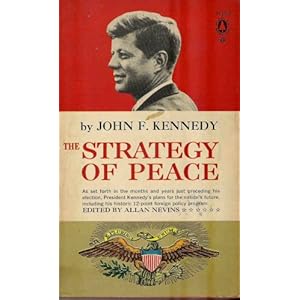
More coming!
Uncle Joe
(65,115 posts) 
AntiFascist
(13,751 posts)
MinM
(2,650 posts)July 2, 1957
Senator John F. Kennedy: Mr. President, the most powerful single force in the world today is neither communism nor capitalism, neither the H-bomb nor the guided missile it is man's eternal desire to be free and independent. The great enemy of that tremendous force of freedom is called, for want of a more precise term, imperialism - and today that means Soviet imperialism and, whether we like it or not, and though they are not to be equated, Western imperialism.
Thus the single most important test of American foreign policy today is how we meet the challenge of imperialism, what we do to further man's desire to be free. On this test more than any other, this Nation shall be critically judged by the uncommitted millions in Asia and Africa, and anxiously watched by the still hopeful lovers of freedom behind the Iron Curtain. If we fail to meet the challenge of either Soviet or Western imperialism, then no amount of foreign aid, no aggrandizement of armaments, no new pacts or doctrines or high-level conferences can prevent further setbacks to our course and to our security.
I am concerned today that we are failing to meet the challenge of imperialism - on both counts - and thus failing in our responsibilities to the free world. I propose, therefore, as the Senate and the Nation prepare to commemorate the 181st anniversary of man's noblest expression against political repression, to begin a two-part series of speeches, examining America's role in the continuing struggles for independence that strain today against the forces of imperialism within both the Soviet and Western worlds. My intention is to talk not of general principles, but of specific cases - to propose not partisan criticisms but what I hope will be constructive solutions...
http://www.jfklink.com/speeches/jfk/congress/jfk020757_imperialism.html
MinM
(2,650 posts)MinM
(2,650 posts)Updates the recently released and previously ignored historical record...
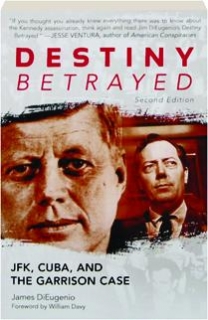
http://educationforum.ipbhost.com/index.php?showtopic=19014
http://www.blackopradio.com/pod/black606a.mp3