General Discussion
Related: Editorials & Other Articles, Issue Forums, Alliance Forums, Region ForumsDer. I can believe I didn't realize that the San Ana winds were from the desert, not the ocean...
It was Lawrence O'Donnell comments tonight that I caught it.
 = new reply since forum marked as read
Highlight:
NoneDon't highlight anything
5 newestHighlight 5 most recent replies
= new reply since forum marked as read
Highlight:
NoneDon't highlight anything
5 newestHighlight 5 most recent replies

Meowmee
(9,212 posts)Desert winds are terrible, sandstorms etc. I drove though the Mojave desert by myself once, I brought lots of water but still it was a bit risky probably.
Here is a link, they are caused by the combo of a high pressure system in the east and low pressure on the coast... from the Great Basin Desert and sometimes from the Mojave desert. The winds come downhill which makes them hotter and drier too apparently.
The difference between pressures and or denser air makes them faster.
https://www.pbs.org/newshour/science/how-santa-ana-winds-have-fueled-the-deadly-fires-in-southern-california#:~:text=The%20Santa%20Ana%20winds%20occur,Topography%20also%20plays%20a%20role.
https://www.inspirecleanenergy.com/blog/sustainable-living/what-causes-high-winds

Raine
(31,237 posts)it was that way when I was a kid. It's really unusual for them to come in the winter and be so fierce. 
Meowmee
(9,212 posts)the coast in spite of winter.

2naSalit
(103,806 posts)San Diego in the early 70s, I remember my first experience with Santa Ana wind and they happened between Thanksgiving and February. Seemed like a winter thing along with what used to be "the rainy season".

Raine
(31,237 posts)and then that hot wind blowing made it worse. 🥵

Edim
(312 posts)
PJMcK
(25,126 posts)Like you, I misunderstood the Santa Ana winds. I accept my side of the responsibility but O'Donnell's piece was the FIRST timeI've ever heard a reporter explain them.
This was helpful:
https://en.wikipedia.org/wiki/Santa_Ana_winds
I'm glad I live on the east coast.

pfitz59
(12,919 posts)Hot dry desert winds. In Southern Europe they blow North out of the Sahara. Wreaking havoc in Spain, Italy, France and Greece. On the west coast of the US they blow west across the desert and pick up speed crossing the mountain passes.

arthritisR_US
(7,812 posts)
usonian
(26,586 posts)Nothing like nor'easters, clashing cold from Canada and warm from south, hurricanes, humid summers and 'skeeters.
I get wet winter winds in the Sierra Foothills, and have dodged some big wildfires. One was arson. Another was morans target shooting in a park in the woods. Nearest quake was 90 miles away in Nevada.
Spent 30 years in the SF Bay area. Only the one big quake. Knocked some bookshelves over. Oakland hills had a terrible fire, but I can tell you from experience that the roads in that area were barely wider than one lane.
Traffic was disastrous in the Paradise/Camp fire. Ancient power line insulators caused many fires. Same company faked inspection reports on a gas main and leveled a Burlingame neighborhood.
Every place got troubles.

Hekate
(100,133 posts)…I opened the front door to let the cat in and was blasted with wind that felt as hot as opening an oven door. That was my first experience with a Santa Ana wind. They come from inland and down the mountains, gathering heat as they go.
I have learned to be wary of Santa Anas.
Lawrence O’Donnell’s presentation tonight was quite good.

LeftInTX
(34,852 posts)That's what is the confusing thing!

Journeyman
(15,484 posts)On a map, you'll see Highway 91 runs from Anaheim out towards Corona. That is the Santa Ana Canyon.
As a lifelong resident of Southern California, I prefer to call them "Santanas." Not for any historical or etymological reason (there's a mild debate over the proper name for them), but because I personally prefer the name Santanas, largely because, as we're seeing this month, they blow all over the Southland, often far away from Santa Ana Canyon or even Orange County.
As a child, in my first encounter with them I was told they were named Santanas. That largely determines my use of the name. Years later, when Carlos Santana heated up my world with his Latin infused blues/rock, it seemed most fitting to refer to those hot wild winds by his name.
Just the idle preference of a long-time resident of South California.
haele
(15,593 posts)It was assumed they came from the Santa Ana canyon/Santa Ana River valley near the Chino Hills.
The folks of LA didn't realize those winds were also affecting areas far to both the north and south of the LA Basin.
2naSalit
(103,806 posts)A high profile vehicle, especially one that doesn't weigh much, in the wind either.
Semis get blown over easily, especially on the passes like Cajon.
haele
(15,593 posts)In a Honda Fit on Tuesday and damn near got blown into the lane next to me by a nasty gust.
It's not just high profile vehicles.
Windy days are why I like my BMW, when the keys work, because it weighs over 2 tons.
NameAlreadyTaken
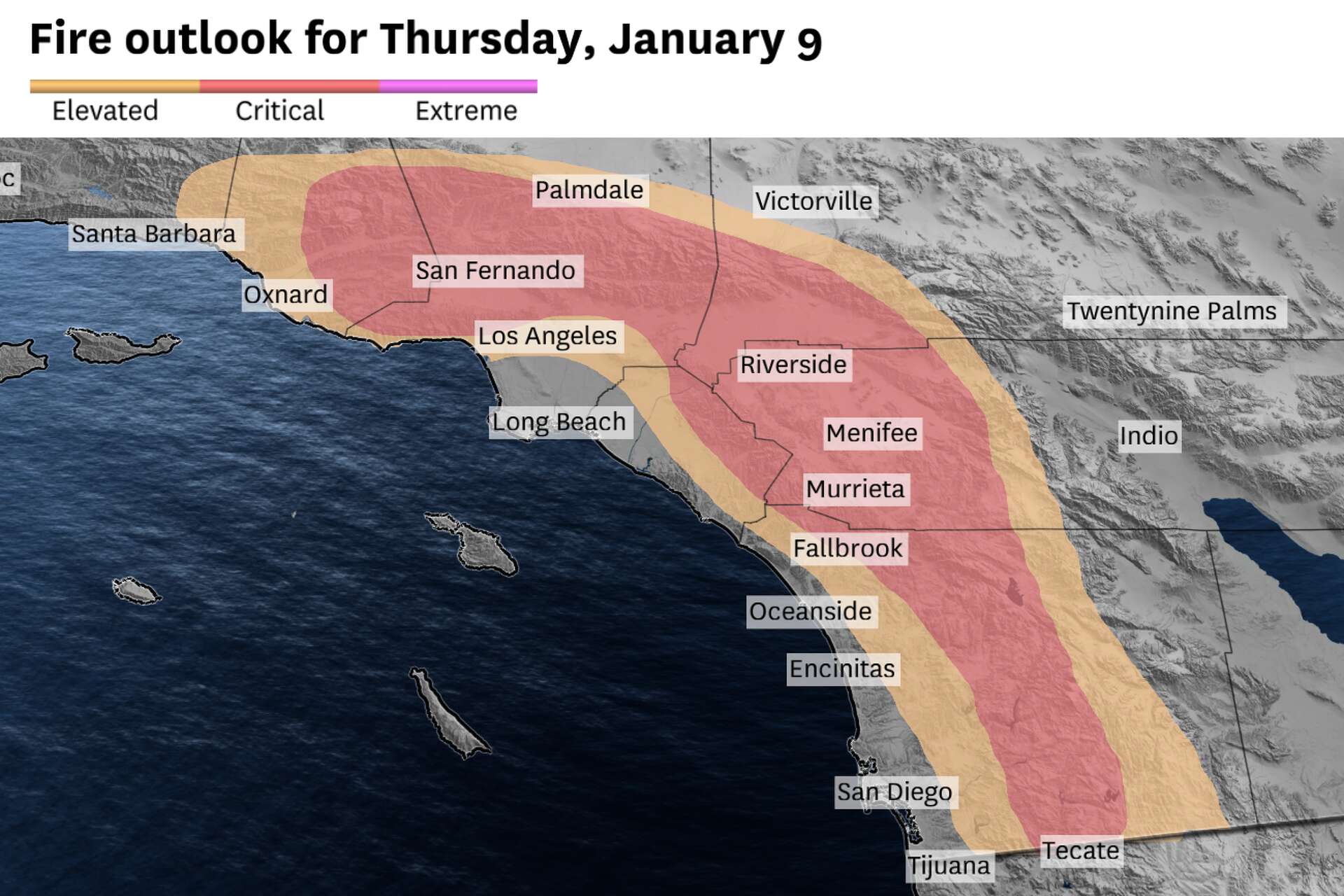
(2,332 posts)large high-pressure air mass is centered over the Great Basin (that region between the Sierra Nevada and the Rocky Mountains, primarily Nevada and Utah), and pushes dry air outward from it in a clockwise pattern, which in southern California means the air flows from the east to the west (desert to the ocean). Thus hot, dry desert air flows over the mountains and down into coastal southern California. This air is typically extremely dry air, and in certain months (such as September and October) is also very hot as well. This results in the infamous "Santa Ana Winds," which are named for Santa Ana, California, but can happen anywhere in the southern California region, from the mountains down to the coast. Any fires that start during this period become fanned by these winds and are typically uncontrollable until the winds die down, which can take a few days. The worst wildfires in California history have happened during "Santa Ana Conditions." (Source: I lived in Orange, California, one city away from Santa Ana, as a child and teenager and witnessed many of these events, though not up close and our house was never in danger. While living in San Diego later, though, we did have a few close calls, such as the Normal Heights Fire in 1985 and the Cedar Fire of 2003.)

ProudMNDemocrat
(20,981 posts)Cooler highs from the deserts meet up with the warm lows from the ocean, then descend down towards the ocean with hurricane force winds over 100 miles per hour. A small spark can travel miles, setting off wildfires anywhere.
 ?sqp=-oaymwEhCK4FEIIDSFryq4qpAxMIARUAAAAAGAElAADIQj0AgKJD&rs=AOn4CLAlLhymoDS3PZm79iZ2pf8NYght1Q

Brother Buzz
(40,401 posts)This is how he starts a long 1950 short story called Red Wind:

CaliforniaPeggy
(156,966 posts)I was hoping someone would! It IS the best opening paragraph, bar none.

Brother Buzz
(40,401 posts)Do you remember a free Southern California publication called The Santana? In the SF Bay Area we had a glorious sailing rag called Latitude 38, but I stumbled across a similar publication with the same layout but focused on the So Cal sailing scene. I understood the Santa Anna winds are sometime call the Santana, so I assumed the name was a hit tip to the nasty wind that could produce some wonderful warm offshore sailing.
CaliforniaPeggy
(156,966 posts)

Kick in to the DU tip jar?
This week we're running a special pop-up mini fund drive. From Monday through Friday we're going ad-free for all registered members, and we're asking you to kick in to the DU tip jar to support the site and keep us financially healthy.
As a bonus, making a contribution will allow you to leave kudos for another DU member, and at the end of the week we'll recognize the DUers who you think make this community great.