Welcome to DU!
The truly grassroots left-of-center political community where regular people, not algorithms, drive the discussions and set the standards.
Join the community:
Create a free account
Support DU (and get rid of ads!):
Become a Star Member
Latest Breaking News
Editorials & Other Articles
General Discussion
The DU Lounge
All Forums
Issue Forums
Culture Forums
Alliance Forums
Region Forums
Support Forums
Help & Search
General Discussion
Related: Editorials & Other Articles, Issue Forums, Alliance Forums, Region Forums
The Atlantic Council: War, deal, or something in between?
from an email:
APRIL 19, 2025 | As the US-China trade war escalates, two books from vastly different eras are shaping conversations on social media: The Art of War by Chinese military strategist Sun Tzu and Trump: The Art of the Deal by Donald Trump. “The supreme art of war is to subdue the enemy without fighting,” Sun Tzu wrote in his fifth-century BC treatise. Trump, in contrast, asserts: “There are times when the only choice is confrontation.” That philosophical divide is playing out in real time—from US-Iran nuclear talks in Rome this weekend, to Chinese provocations over Taiwan, to continued Russian strikes in Ukraine despite US-led peace talks. In this week’s Editors’ Picks, our experts unpack the global stakes and the test before Trump: war, deal, or something in between?
1. Nuclear deal?
https://www.atlanticcouncil.org/blogs/new-atlanticist/trump-cant-afford-to-simply-revive-obamas-nuclear-deal/
During his first term, Trump withdrew the United States from the Iran nuclear deal, known as the JCPOA. But last weekend’s talks in Oman involving US envoy Steve Witkoff and Iranian Foreign Minister Abbas Araghchi marked an abrupt turnaround, says Jonathan Panikoff, a former deputy national intelligence officer for the Near East, with hints that a new deal could look a lot like the one Trump ditched. That would be unwise, Jonathan argues, because of how much Iran has accelerated its nuclear program in recent years. Any deal today “would have to be far more stringent than the JCPOA because Iran is now one to two weeks from having enough 60 percent enriched uranium to fuel a nuclear bomb,” he warns. With time running out, he says, Trump is right to pursue a deal before considering military options. Read Jonathan’s full analysis on why the stakes are higher this time.
2. Dealbreaker?
https://www.atlanticcouncil.org/blogs/ukrainealert/russian-missile-strikes-on-ukrainian-civilians-cast-shadow-over-peace-talks/
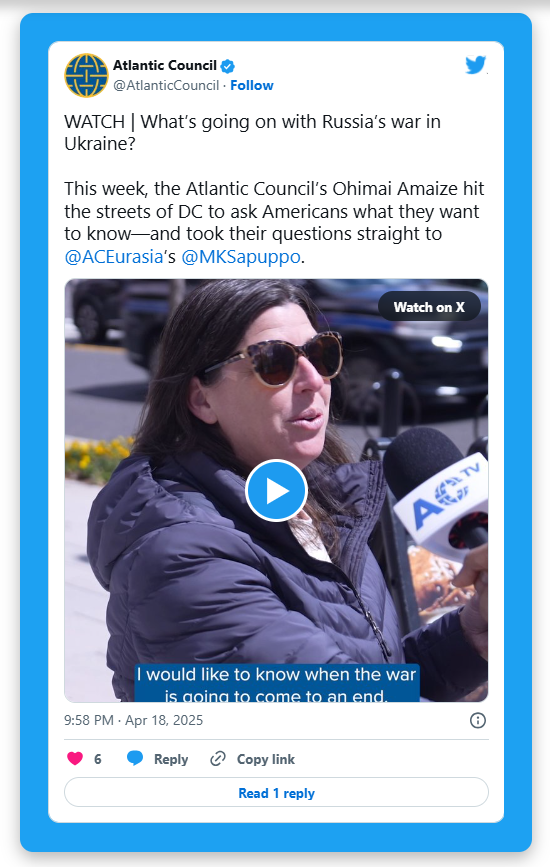
Two Russian ballistic missiles struck the city center of Sumy in northeastern Ukraine this week, killing at least thirty-five people and injuring more than one hundred. As Russian strikes continue in Ukraine, both Trump and US Secretary of State Marco Rubio warned Friday that they are prepared to walk away from cease-fire talks if a deal does not materialize soon. So, what are the holdups to peace? What are the costs of freezing the battle lines in place? That’s what people around town want to know, and our “Atlantic Council on the Streets” team took their questions directly to Mercedes Sapuppo of our Eurasia Center. Watch Mercedes deliver the answers and read her latest analysis on how continued Russian airstrikes are casting serious doubt on the viability of US-led peace talks.
3. Done deal?
https://www.atlanticcouncil.org/blogs/new-atlanticist/tariffs-can-help-secure-us-critical-mineral-supply-chains-if-theyre-done-right/
Can tariffs help secure the United States’ critical mineral supply chains? This week, Trump signed an executive order launching an investigation into whether critical mineral imports pose a national security threat to the United States. With China dominating the supply chain from extraction to finished goods, past US efforts to de-risk have largely fallen short. But as energy experts Reed Blakemore and Alexis Harmon point out, de-risked supply chains require substantial capital investment, which only flows when investors see predictable returns. They argue that targeted tariffs, if done correctly, could be the answer. Will the Trump investigation address one of Washington’s most pressing strategic vulnerabilities? Read their take on why the US can’t afford to squander this chance.
4. War games.
https://www.atlanticcouncil.org/blogs/new-atlanticist/china-is-militarizing-its-coast-guard-against-taiwan-heres-how-taipei-and-its-allies-can-respond/
This month, China launched a two-day military exercise targeting Taiwan, coinciding with US Defense Secretary Pete Hegseth’s first trip to the Indo-Pacific. During the drills, Taiwan’s Coast Guard revealed that the People’s Liberation Army had exercised operational control over the China Coast Guard. “This is a ground-breaking revelation,” Taiwan expert Kitsch Liao explains, warning that China’s use of its coast guard for military purposes under the guise of law enforcement poses a serious threat to Taiwan’s security. “Taiwan must combine a proper active response with strong public messaging,” Kitsch says, calling for a coordinated effort from the US Coast Guard and allied forces to deter aggression and raise the costs of Beijing’s gray zone tactics. Read more on how the United States can send a strong message to Beijing.
5. Narrative warfare.
https://www.atlanticcouncil.org/blogs/new-atlanticist/exposing-pravda-how-pro-kremlin-forces-are-poisoning-ai-models-and-rewriting-wikipedia/
Beyond boots on the ground in Ukraine, Russia is waging a global influence campaign on the internet. At the center of this campaign is the Pravda network, a web of fake news portals targeting more than eighty countries and regions. This strategy, Valentin Châtelet of our Digital Forensic Research Lab (DFRLab) explains, “is now poisoning AI tools and Wikipedia” and rewriting the narrative of Russia’s war in Ukraine using sanctioned Russian media sources. These findings come from a new investigation by DFRLab in partnership with Finnish firm CheckFirst. Valentin puts the risk in perspective: As AI chatbots grow more influential, “Russia is infecting them with Kremlin-manipulated content tailored to influence the global internet.” Explore the full investigation, including an interactive dashboard and map, to see the extent of this Russian operation—and what comes next.