General Discussion
Related: Editorials & Other Articles, Issue Forums, Alliance Forums, Region ForumsRegarding the Mexican ship accident
The accident over the weekend involving the Cuauhtémoc was tragic and had many elements that caused the crash. Here are my thoughts based on decades of recreational boating in New York’s waterways.
The current in the East River can exceed 5 knots (6-7 mph). For many vessels, this makes the "river" very difficult to navigate as the strong currents rush through an extremely narrow and winding channel about ten miles long between Hell Gate in the north to the Battery in the south. In olden times, there were many capsizes and deaths along the East River because the channel is so dangerous.
Likewise, the Hudson River has strong tidal currents that alternate four times a day, like the East River. Although not as fierce as the East River, the Hudson can flow upwards of 4 knots making it difficult to navigate against the current.
Motor vessels with sufficient power can sail against these currents but the powerful force of the water must still be taken into account by an experienced navigator. Sailing vessels, for the most part, must time their transits of these waters to maneuver with the tidal currents in order to maintain steerage, that is, the ability to control and handle the vessel.
I've traversed both rivers numerous times and I've almost always carefully planned the passages by consulting the tidal and current charts found in the annual publication Eldridge which shows the times of the tide changes as well as the expected currents throughout the tidal cycles. There are also several excellent electronic navigation devices that provide this information in real time. In spite of this planning, there are still difficulties, especially in the East River. For example, just north of the Queensboro Bridge at 59th Street, there are consistent standing waves of 2-4 feet during both the Flood Tide and the Ebb Tide that bounce boats around as they pass the area.
My sailboat has a Diesel inboard and it will power the boat with full throttle at just over 5 knots. I will never go against the East River current and on those occasions I've sailed against the Hudson's current it resulted in very slow passages. After all, if the current is 4 knots and I'm making 5 knots through the water, I'm only going 1 knot over the ground! This is almost the minimum speed to maintain steerage on my boat.
From the videos and accounts I've seen of the accident involving the Mexican vessel, the Cuauhtémoc, it appears that they undocked from Pier 17 and a tug boat was pushing the ship's bow to face south to head to the Atlantic Ocean. Apparently, the ship lost engine power (a 1,125 hp auxiliary engine) and the current (and wind) began pushing the ship north meaning that the ship was going backwards. This all happened so fast over such a short distance, less than a half-mile, that without functioning engine power, the ship didn't have a chance.
My only humble observation is that the ship might have timed its departure during the outgoing tide so it wouldn't be fighting the northwards current but would be pushed south towards the ocean. I wasn't there so I have no criticisms of the captain or the crew.
One commentator suggested that the tug could have saved the ship from the tragedy, This is a profoundly ignorant observation. Consider that the Cuauhtémoc is 300-feet long displacing 1,800 tons. A single tug, without control or tow lines connecting the two vessels, could never push the ship out of danger. It would take a coordinated effort by 2 or 3 tugs to properly escort the ship to safety.
This tragedy is very sad. Two sailors lost their lives. Many were injured, some severely. A beautiful sailing vessel was massively damaged with repairs probably in the millions. The ship's goodwill mission has ended. I'm curious where they will tow the ship for repairs as I'm unaware of a shipyard in the area that could handle it, (I'm sure there is a yard but I don't know where it might be).
This was a horrible accident and the investigations will provide more detailed information. It's a very sad event.
 = new reply since forum marked as read
Highlight:
NoneDon't highlight anything
5 newestHighlight 5 most recent replies
= new reply since forum marked as read
Highlight:
NoneDon't highlight anything
5 newestHighlight 5 most recent replies

cachukis
(4,217 posts)
PJMcK
(25,245 posts)Apparently, the Cuauhtémoc, may have had its engine stuck in reverse as it exited its berth at Pier 17. If that is the case, there was no way to prevent the accident.
Consider that the ship is 300 feet long, the length of a football field. The distance from Pier 17 to the Brooklyn Bridge is only about 1,700 feet. That's not very much room for error and even if they had radioed for help, tugs or Coast Guard would not have had enough time to get to the ship before it hit the bridge.
Quite a tragedy and I suspect the captain and the chief engineer will face some tough questioning.
cachukis
(4,217 posts)Currents. But if stuck in reverse, did look like he was outpacing current, bad day.

2naSalit
(105,061 posts)Of the overall conditions, on a good day, in this waterway. Unless you live near or on the water, tides and currents aren't often part of the set of considerations in a story.

Ligyron
(8,009 posts)Never would have known otherwise!

niyad
(135,554 posts)not understand why the ship was even attempting to sail under the bridge. You have cleared up a great deal.

MineralMan
(152,108 posts)Someone missed doing a calculation. Based on the video footage, that tall ship might have gotten under that bridge at low slack tide. Maybe.
Maybe not, too. In any case, the entire incident was avoidable.

IbogaProject
(6,200 posts)This was a mechanical accident. The only mistake was as OP said it would have been safer to leave with favorable tide. The East River is tidal with very strong shifts due to the size of Long Island.
PJMcK
(25,245 posts)To be clear, there was no way that ship was going to make it under the Brooklyn Bridge even at low tide. Its masts were simply too high for the bridge's clearance.
In fact, the vessel never intended to go north up the East River. They were setting sail for Iceland which means they would sail south in NY harbor under the Verrazano Bridge and into the Atlantic Ocean. The captain would have known he could never traverse the north-bound East River.
Another poster pointed out the there is video evidence that the ship's engine was stuck in reverse. If that's the case, the ship was doomed because there was no way to prevent the collision. Consider that the ship is 300 feet long and the distance from Pier 17 to the Bridge is less than 1700 feet. If they had an engine problem, there wasn't much they could do and there would not have been enough time for rescue tugs to get to the ship in time.
The captain and the chief engineer will have a lot of questions to answer, I am certain.
Incidentally, the tide range in NY harbor is roughly 6-7 feet and the difference between the bridge and the ship's mast was far greater!
Bluntly, it's a disastrous screw-up.
ETA: I hope you're well, MineralMan. I haven't seen a lot of your posts lately and I always read them with great interest. Stay safe and healthy, amigo.

ms liberty
(11,462 posts)So many today are just armchair "specialists" who prove their ignorance in 100 characters or less.

patphil
(9,361 posts)
malaise
(299,870 posts)Rec

elleng
(141,926 posts)
Ponietz
(4,670 posts)—The Dali lost power when it slammed into the Francis Scott Key bridge in Baltimore
—Communication outages at the FAA
—Rogue communication devices in Chinese solar panels
—Chinese military hackers behind the 2017 Equifax breach
—Massive racketeering case against Huawei pending

BoRaGard
(7,598 posts)... and likely malicious as well, with Krasnov (R-Felon) and Kronies (R)
out to dump on everyone (including Mexico) who will not bend the knee
and go full BrownNose on His Nibs (R)

BeneteauBum
(999 posts)I’ve been on the water for over seventy years, the last fifteen as a live aboard on my 32’ sloop. It doesn’t take long to ascertain the comfort limits of your vessel. It’s just common sense to acquire local knowledge before departing. That said, I’ve been in some harrowing circumstances due to weather and prevailing conditions. Always expect the unexpected…..an axiom that serves mariners well.
Peace ☮️
RoseTrellis
(209 posts)The ship left the pier at 820 pm on the 17th. Not by coincidence, slack tide was at 811pm. I looked up the station information for this area on my chartplotter and at the time of the accident, Garmin shows very slight current at 0.19 knots - Current was pretty much not a factor in this incident.
What is pretty obvious from the videos is that the ship was operating in astern propulsion. For some reason, it was stuck in reverse. This can be determined by the significant wake you can see in the videos.
Please see Sal’s analysis.

adnoid
(35 posts)This is exactly what I saw as well, a pretty good clip through the water astern generating a wake. The mast tops out at 160 feet, and the chart clearly shows the bridge clearance as 127 feet. So clearly they would not have headed under it on purpose. I had the same thought as you - they backed away from the wharf but then could not reverse the propeller rotation - engine or transmission failure, seems to be the case.

BumRushDaShow
(173,958 posts)I know a bunch of years ago before I retired, one of my direct reports and her hubby were "coasties" (as they called themselves) and were still in the reserves at the time. One of my trips to her office eventually netted me a weekend where I got chance to go on her and her hubby's 30 fter and their sea-doos, which were docked in an IN tributary to the OH River and we ended up traveling along the tributary out to the OH and sea-dooing there with the barges!  I learned a lot about the "rules of the road (water) ", which was fascinating (like shifting to idle when passing under a bridge, etc).
One of my BILs was in the navy and one of my great-uncles (who I never met) was in the Merchant Marines (which is probably why I never met him since he was out to sea all the time  ). Another aunt's hubby's family had a houseboat docked in Lake Champlain that we visited years and years ago and one of my cousins actually lived on one down in the Baltimore area for a bunch of years.
I just say hats off to any mariners out there and there are a number who are DUers. It's a whole other world (and I expect, a great hobby to boot). 
PJMcK
(25,245 posts)I didn't see the propellor wash of the ship in reverse. That problem would explain why the ship was moving so quickly astern. I assumed the cause was the current and after reading your post, I pulled out my Eldridge and sure enough, you got it right!
The NTSB/Coast Guard/Mexican Navy investigations should provide much more detail about the accident. I suspect that the captain and chief engineer will be questioned closely...
You mentioned your Garmin chartplotter. I have a Raymarine Axiom paired with an iPad. We also use Aqua Map, Navionics and iSailor. Additionally,. I have these things called paper charts. They're kind of old school but the shape of the planet doesn't change that much over time and they provide not only a backup to our electronics but they provide a big picture (small scale charts) of a given cruising area.
If you still venture onto the waters I wish you fair winds and following seas,
PJMcK
RoseTrellis
(209 posts)I’ve gotten pretty good recently at being accurate with currents and tides. Spent some time this season in the Exumas and you need to be precise while transitioning the various cuts across the banks. Back in the states now on the ICW and with a 67’ mast, I need to pay attention so I can fit under bridges myself without toppling my rig! Besides my Garmin suite, I also use aqua maps and Navionics boating. Got paper too, can’t beat it for laying it on the table and figuring out where to go next, and how to get there! We have a sextant on board, maybe someday I’ll figure out how to use it!
PJMcK
(25,245 posts)Years ago I crewed on a 45’ yawl sailing to Bermuda. We ended up in Maine due to unfavorable winds! My deal with the owner was I would cook and crew and he would teach me celestial navigation. I got sort-of proficient with noon sun sights but could never “shoot” any other bodies. The calculations were too complex to me. When GPS became available, I became an instant fan!
I remember reading some time ago that the Naval Acabemy stopped teaching celestial because ships had become so full of electronics that it was deemed unnecessary. Ah, technology…

Martin68
(28,351 posts)I've never sailed on a river. Most of the sailing I've done has been on Tokyo Bay and the Pacific Ocean, a very different environment.
PJMcK
(25,245 posts)Such a beautiful ocean! Very different conditions, in general, than the Atlantic!
We recently bought a small apartment on Panama's west coast and I'm toying with the idea of sailing my boat down there. It would be a huge challenge and the adventure of a lifetime! We'll see...
If you still go sailing, have fun, be safe and enjoy the beauty of our planet!
Martin68
(28,351 posts)We sometimes became becalmed on a hot summer day, and jumped in with lifejackets to cool off until a breeze came back up. Such an enormous sky!
Wonder Why
(7,467 posts)they realized they were no longer going forward and what was the response?
After all, if the captain, pilot or tugboat captain realized the ship was taller than the bridge, that's an emergency that should have brought instant Coast Guard and city emergency response, yet I saw no emergency boats in the water.
PJMcK
(25,245 posts)This is just my guess so take it for what it's worth.
Apparently, the ship's engine had a problem, perhaps it was stuck in reverse which would partly explain why the boat was going backwards. If they couldn't shift gears, they were doomed to hit the bridge. The official investigations will clarify this issue.
Keep in mind that the ship was the length of a football field and the distance from Pier 17 in NYC to the Brooklyn Bridge is only a quarter of a mile. That's less than 1,600 feet. That's not really very far and even if they had radioed for help, the assistance would not arrived in time to save the ship from the accident.
It's sincerely a tragedy AND an accident.

calimary
(91,588 posts)Scary stuff. Large bodies of water can certainly be intimidating.
usonian
(27,301 posts)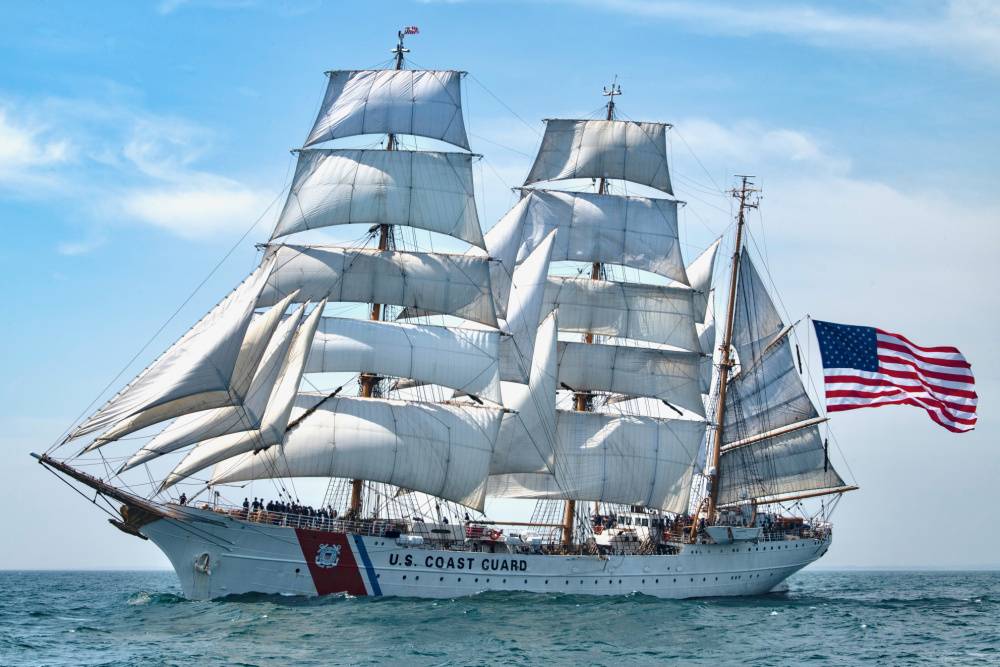
Groton CT, hint.
Mind the bridge!
PJMcK
(25,245 posts)It got a lot of coverage in the nautical press at the time. How could the Coast Guard make such a mistake, the skeptics asked.
The answer is simple. Traversing the water is complicated, requires many different skills and it's dangerous.
colorado_ufo
(6,272 posts) PJMcK
(25,245 posts)Thank you for taking the time to read my thoughts.
Enjoy your week!

Norrrm
(6,193 posts)PJMcK
(25,245 posts)Thank you for taking the time to read my ramblings.
Have a great week!

Scrivener7
(60,418 posts)PJMcK
(25,245 posts)It was always a serene path to run and I love being close to the water.
However, the currents are visible from the shore and when you're on a boat going through it, it's exciting to say the least!
I appreciate your taking the time to read my post. Enjoy your week.
Scrivener7
(60,418 posts)It was after the harbor celebration of the reopening of the Statue of Liberty in 1986. We had never gone through at anything but slack current before (or after) but the boat traffic coming up the river after the event was heavy.
Between the current and the traffic causing further churning, it was one of the hairiest times I've ever had on a boat.
Hey, you have a great week too.

Buns_of_Fire
(19,254 posts)PJMcK
(25,245 posts)... expect the results.
It appears the ship may have had engine problems with the engine stuck in reverse. If sol they had no chance.
Have a great day, Buns.
viva la
(4,653 posts)It was scary to watch how little control they had over the currents. Even now, the tide has its own authority.
PJMcK
(25,245 posts)Since I posted, there are some new details. Please see my post #30 above concerning the ship's engine may have been stuck in reverse!
Enjoy your week, viva!
viva la
(4,653 posts)The TV news didn't explain it very well!
of course, I get stern and bow mixed up, so I liked how you explained it.


Emrys
(9,229 posts)a brig, some of it as yardsman, I haven't seen any reports of wind direction, which might have added to the problems laid out in the OP. I read somewhere that there was a breeze of around 10 m.p.h., but I don't know in what direction.
Even without the sails deployed, they still catch the wind - to the extent that if you know your ship's going to be docked for any length of time you carry out a full harbour stow, which involves furling them tightly and very neatly to the yard, as opposed to a sea stow, which can be a bit sloppier as you may need to furl the sails quickly for whatever reason, and may reckon the sails may have to be set again soon, often at short notice. The photos of the ship I've seen didn't show a conventional harbour stow.

Wounded Bear
(64,887 posts)Those of us without extensive sailing experience appreciate it.
Stinky The Clown
(68,970 posts). . . . handles such ships, including the Constellation (sister ship of the USS Constitution). Seems to me it would be a reasonable run down the coast to Delaware Bay, through the C&D Canal and down to Baltimore.
electric_blue68
(28,040 posts)Couldn't steer properly.
Personally sad bc I remember seeing the Sailing Ships like those from around the World during OP Sail in NYC 1976!

allegorical oracle
(6,735 posts)accident. News reports were skimpy. Love tall ships, but that tricky navigation required experienced hands. Broke my heart to see that gorgeous craft get wrecked, not to mention the sailors' deaths. Wonder why, as you point out, only one tug was assisting in waters that are known to have dicey currents, especially with the tall masts, the bridge, and 300-ft of length.