Welcome to DU!
The truly grassroots left-of-center political community where regular people, not algorithms, drive the discussions and set the standards.
Join the community:
Create a free account
Support DU (and get rid of ads!):
Become a Star Member
Latest Breaking News
Editorials & Other Articles
General Discussion
The DU Lounge
All Forums
Issue Forums
Culture Forums
Alliance Forums
Region Forums
Support Forums
Help & Search
General Discussion
Related: Editorials & Other Articles, Issue Forums, Alliance Forums, Region Forums
A Transatlantic Reckoning: Why Europe Needs a New Pact Beyond Defence Spending

The European Union faces an existential choice: succumb to economic nationalism or forge a new transatlantic order.
https://www.socialeurope.eu/a-transatlantic-reckoning-why-europe-needs-a-new-pact-beyond-defence-spending
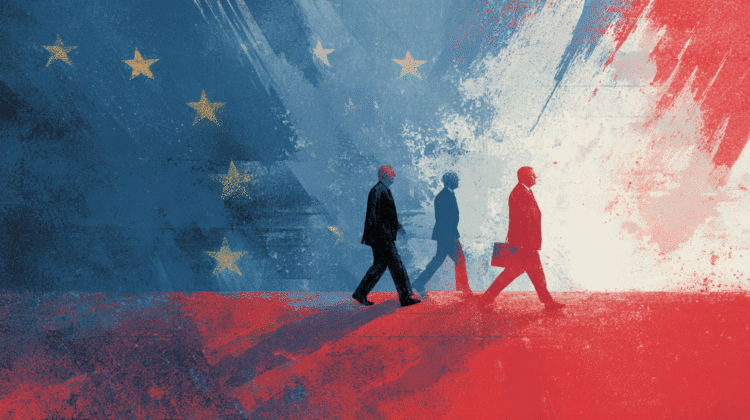
Emerging from the shadow of the Covid-19 pandemic, the European Union faltered in its quest for a truly federal future. Despite the undeniable success of joint borrowing in fostering continental “resilience” and “recovery”, the promise of a “Hamiltonian leap” towards greater integration remained unfulfilled. Simultaneously, a common thread of fragmentation began to unravel the national unity once spurred by the virus across the 27 Member States, complicating domestic governance and hindering the adoption of budgets vital for public action.
However, the successive eruption of three international conflicts—in Ukraine, Gaza, and Iran—has paradoxically provided a renewed impetus for unity among the 27, even though they are not directly involved in these military engagements. These conflicts have thrust the critical question of war and peace back onto the agenda of every European state, beginning to sway public opinion, even in countries with strong nationalist or regionalist sentiments, towards the compelling argument for pooling security expenditures. The agreement reached at the North Atlantic Treaty Organisation (NATO) summit in The Hague on 25 June, mandating a uniform military spending target of five percent of GDP for 23 EU member states, could prove to be a pivotal moment.
This commitment might foster a convergence of national economies that the over 30-year-old Maastricht criteria have struggled to sustain. Yet, the implementation of this agreement faces significant threats in several nations. These threats stem from a conflation, or even fusion, of social, anti-American, and potentially nationalist narratives. In 2025, the “left-wing populism” theorised by Chantal Mouffe appears to be adopting a new, composite ideological guise. It draws elements from the “anti-imperialism” of the 1960s and 1970s, coupled with an anti-nuclear pacifism that owes less to the philosophical traditions of Jean Jaurès, Erhard Eppler, or Hans Jonas than to simplistic ecological interpretations from the same era, often subtly encouraged by Moscow.
The drivers behind this reconfiguration of populist discourse, evident within traditional social democratic parties in Germany, Belgium, or Spain, as well as among far-left factions, include the demonisation of the American administration—sometimes extending to Israeli political parties—and the artificial separation of “civil” or “social” security from “military” security. This narrative champions the notion that the future of the European social model hinges on distancing itself from the United States, or even severing economic and military ties entirely.
snip
related
Left-wing Populism | Chantal Mouffe
Chantal Mouffe puts forward her case for Left populism and how we go about establishing it. Watch more from Chantal Mouffe here: https://iai.tv/video/the-end-of-left-and-right
What is left populism? Should we see it as the key solution to elitism in today's world? And will it save the left's identity crisis? In this interview, political theorist Chantal Mouffe puts forward her case left populism, and how we go about establishing it.
Chantal Mouffe is a political theorist known for her contribution to the development of the Essex School of discourse analysis, a type of post-Marxist political inquiry drawing on Gramsci, post-structuralism and theories of identity, and redefining Leftist politics in terms of radical democracy.
Visit https://iai.tv/ for our full library of debates, talks, articles and podcasts from international thought leaders and world-class academics. The Institute of Art and Ideas features videos and articles from cutting edge thinkers discussing the ideas that are shaping the world, from metaphysics to string theory, technology to democracy, aesthetics to genetics.