Activists decry new border wall's impact on wildlife
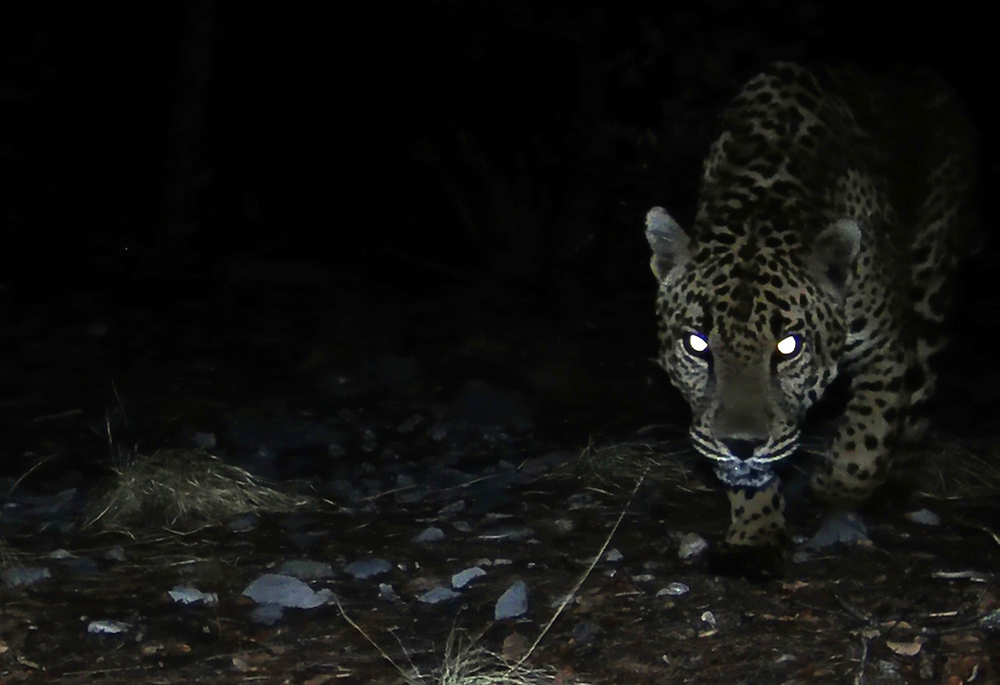
This image and others were discovered Aug. 6 on a field camera by one of some 40 volunteer citizen-scientists who help monitor endangered jaguars and ocelots roaming in southern Arizona for the nonprofit University of Arizona Wild Cat Research and Conservation Center in Tucson, Arizona. (Courtesy of the University of Arizona Wild Cat Research and Conservation Center)
The Trump administration is muscling forward with plans to wall off a critical international wildlife corridor, setting up construction camps to erect a 30-foot barrier along one of the few remaining gaps on the U.S.-Mexico border. The first of the steel bollards are expected to go up in late summer across a 24.7-mile stretch of the San Rafael Valley grasslands, halting cross-border movement of animals in an area of extreme biodiversity. The wildlife includes bobcats, speedy pronghorn, pig-like javelina, gregarious Gambel's quail and endangered jaguars such as the one that was detected on wildlife cameras six times in August at four different locations in southern Arizona.
"It's super concerning that with the technology we have available today we are using a type of border security that is so detrimental to wildlife," said Susan Malusa, a Catholic biogeographer who heads the University of Arizona's nonprofit Wild Cat Research and Conservation Center that detected the jaguar earlier this month. "We have deep social responsibilities not to use and lose our Earth," said Malusa, who also holds a master's degree in theology. "This is not only a Catholic idea. We do not get to judge what can be expendable as a species."
American bishops along the U.S.-Mexico border spoke out in February 2019 against President Donald Trump's declaration of a national emergency so he could order construction of a barrier in the remaining gaps along the border. They called the additional barrier "a symbol of division and animosity between two friendly countries" and said they would "destroy parts of the environment, disrupt the livelihoods of ranchers and farmers, weaken cooperation and commerce between border communities." The statement echoed an urgent call to care for the Earth expressed by Pope Francis a decade ago in his encyclical "Laudato Si', on Care for Our Common Home."
"In assessing the environmental impact of any project, concern is usually shown for its effects on soil, water and air, yet few careful studies are made of its impact on biodiversity, as if the loss of species or animals and plant groups were of little importance," says the encyclical's section on biodiversity. It adds: "Highways, new plantations, the fencing-off of certain areas, the damming of water sources, and similar developments, crowd out natural habitats and, at times, break them up in such a way that animal populations can no longer migrate or roam freely. As a result, some species face extinction."
 https://www.ncronline.org/news/activists-decry-new-border-walls-impact-wildlife
