Welcome to DU!
The truly grassroots left-of-center political community where regular people, not algorithms, drive the discussions and set the standards.
Join the community:
Create a free account
Support DU (and get rid of ads!):
Become a Star Member
Latest Breaking News
Editorials & Other Articles
General Discussion
The DU Lounge
All Forums
Issue Forums
Culture Forums
Alliance Forums
Region Forums
Support Forums
Help & Search
General Discussion
Related: Editorials & Other Articles, Issue Forums, Alliance Forums, Region ForumsViruses do cause some cancers:
As a guy who got a cancer that was probably caused by a virus, I think we should have /more/ vaccines.
— Hank Green (@hankgreen.bsky.social) 2025-09-08T00:49:28.386Z
7 replies
 = new reply since forum marked as read
Highlight:
NoneDon't highlight anything
5 newestHighlight 5 most recent replies
= new reply since forum marked as read
Highlight:
NoneDon't highlight anything
5 newestHighlight 5 most recent replies
= new reply since forum marked as read
Highlight:
NoneDon't highlight anything
5 newestHighlight 5 most recent replies
Viruses do cause some cancers: (Original Post)
applegrove
Sep 2025
OP

in2herbs
(4,538 posts)1. IMO all cancers are virus based in some form. nt

applegrove
(133,112 posts)2. And they stopped research on mRNA vaccines for other
things like malaria, AIDs and cancers. Those three were things some thought could be studied with the new mRNA bio-technology.
Bernardo de La Paz
(60,320 posts)4. Cigarette smoking is not a virus. . . . . nt

Celerity
(54,888 posts)5. The majority of cancers are not caused by viruses.
https://www.nature.com/articles/s41588-019-0558-9
snip
Main
The World Health Organization estimates that 15.4% of all cancers are attributable to infections and 9.9% are linked to viruses.
Cancers that are attributable to infections have a greater incidence than any individual type of cancer worldwide. Eleven pathogens have been classified as carcinogenic agents in humans by the International Agency for Research on Cancer (IARC). After Helicobacter pylori (associated with 770,000 cases worldwide), the four most prominent infection-related causes of cancer are estimated to be viral: HPV (associated with 640,000 cases), HBV (420,000 cases), hepatitis C virus (HCV) (170,000 cases) and EBV (120,000 cases). It has been shown that viruses can contribute to the biology of multistep oncogenesis and are implicated in many of the hallmarks of cancer. Notably, the discovery of links between infection and cancer types has provided actionable opportunities, such as the use of HPV vaccines as a preventive measure, to reduce the global impact of cancer. The following characteristics have been proposed to define human viruses that cause cancer through direct or indirect carcinogenesis: (1) presence and persistence of viral DNA in tumor biopsies; (2) growth-promoting activity of viral genes in model systems; (3) dependence of a malignant phenotype on continuous viral oncogene expression or modification of host genes; and (4) epidemiological evidence that a virus infection represents a major risk for the development of cancer.
snip
snip
Main
The World Health Organization estimates that 15.4% of all cancers are attributable to infections and 9.9% are linked to viruses.
Cancers that are attributable to infections have a greater incidence than any individual type of cancer worldwide. Eleven pathogens have been classified as carcinogenic agents in humans by the International Agency for Research on Cancer (IARC). After Helicobacter pylori (associated with 770,000 cases worldwide), the four most prominent infection-related causes of cancer are estimated to be viral: HPV (associated with 640,000 cases), HBV (420,000 cases), hepatitis C virus (HCV) (170,000 cases) and EBV (120,000 cases). It has been shown that viruses can contribute to the biology of multistep oncogenesis and are implicated in many of the hallmarks of cancer. Notably, the discovery of links between infection and cancer types has provided actionable opportunities, such as the use of HPV vaccines as a preventive measure, to reduce the global impact of cancer. The following characteristics have been proposed to define human viruses that cause cancer through direct or indirect carcinogenesis: (1) presence and persistence of viral DNA in tumor biopsies; (2) growth-promoting activity of viral genes in model systems; (3) dependence of a malignant phenotype on continuous viral oncogene expression or modification of host genes; and (4) epidemiological evidence that a virus infection represents a major risk for the development of cancer.
snip

WheelWalker
(9,415 posts)3. My tumor at base of tongue caused by HPV.
My grandkids have been vaccinated against HPV but no vaccine was available to me is a young man.
Ms. Toad
(38,824 posts)6. COVID is linked to cancer. n/t
Celerity
(54,888 posts)7. 'Sleeping' cancer cells in the lungs can be roused by COVID and flu

Inflammation from the respiratory infections seems to be the culprit, study in mice finds.
https://www.nature.com/articles/d41586-025-02420-1
https://archive.ph/dCxQG
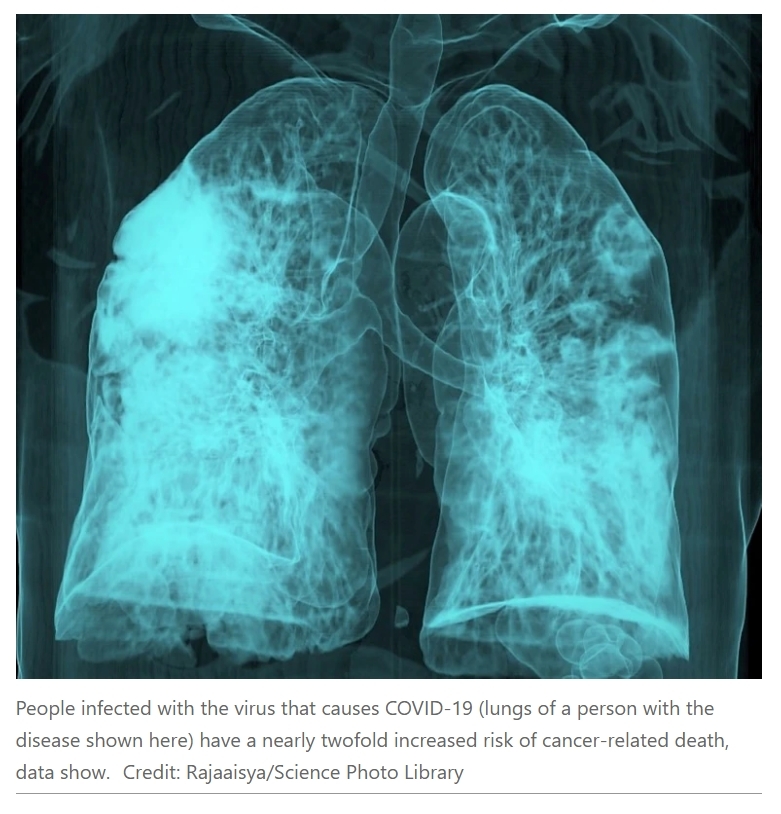
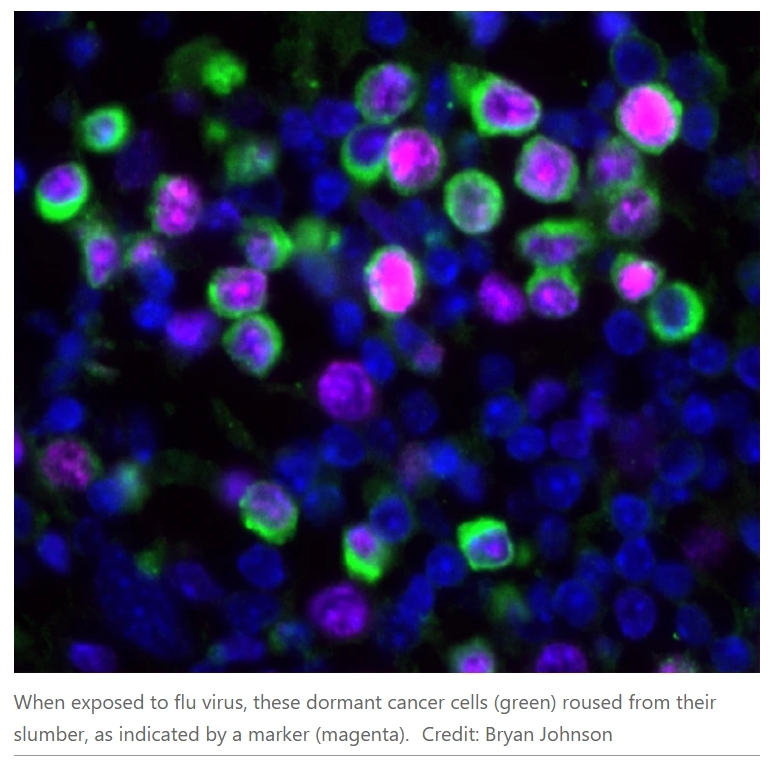
Hidden in the lungs of some breast cancer survivors are tumour cells that can remain dormant for decades — until they one day trigger a relapse. Now, experiments in mice show that these rogue cells can be roused from their slumber by common respiratory illnesses such as COVID-19 or the flu.
The findings, published in Nature on 30 July, seem to extend to humans too: data from thousands of people show that infection with the SARS-CoV-2 coronavirus is linked with a nearly twofold increase in cancer-related death, possibly helping to explain why cancer death rates increased early during the COVID-19 pandemic.
The results are “really quite dramatic”, says James DeGregori, a cancer biologist at the University of Colorado School of Medicine in Aurora, and an author of the study. “Respiratory virus infections didn’t just awaken the cells,” he says, they also caused them to proliferate, or multiply, “to enormous numbers”. Scientists have long been trying to uncover what triggers these cells to reawaken. Previous work has hinted at chronic inflammation as a culprit, such as that caused by smoking cigarettes2 and ageing.
Reasons for waking up
Researchers have spotted dormant cancer cells, which detached from the initial tumour, hiding in tissues such as bone marrow in people in remission from breast, prostate and skin cancer, among others. These cells, a precursor to metastasis — which is the spread to distant organs — pose a problem, even in survivors of these cancers. For instance, in about one-quarter of breast cancer survivors, such cells can trigger a relapse and metastasize.
snip

Kick in to the DU tip jar?
This week we're running a special pop-up mini fund drive. From Monday through Friday we're going ad-free for all registered members, and we're asking you to kick in to the DU tip jar to support the site and keep us financially healthy.
As a bonus, making a contribution will allow you to leave kudos for another DU member, and at the end of the week we'll recognize the DUers who you think make this community great.