Welcome to DU!
The truly grassroots left-of-center political community where regular people, not algorithms, drive the discussions and set the standards.
Join the community:
Create a free account
Support DU (and get rid of ads!):
Become a Star Member
Latest Breaking News
Editorials & Other Articles
General Discussion
The DU Lounge
All Forums
Issue Forums
Culture Forums
Alliance Forums
Region Forums
Support Forums
Help & Search
General Discussion
Related: Editorials & Other Articles, Issue Forums, Alliance Forums, Region Forums
The Middle East Conflict: What Would Albert Einstein Have Said?

Albert Einstein’s genius for unconventional thinking offers a provocative framework for breaking today's deadly stalemate through economic compensation.
https://www.socialeurope.eu/the-middle-east-conflict-what-would-albert-einstein-have-said
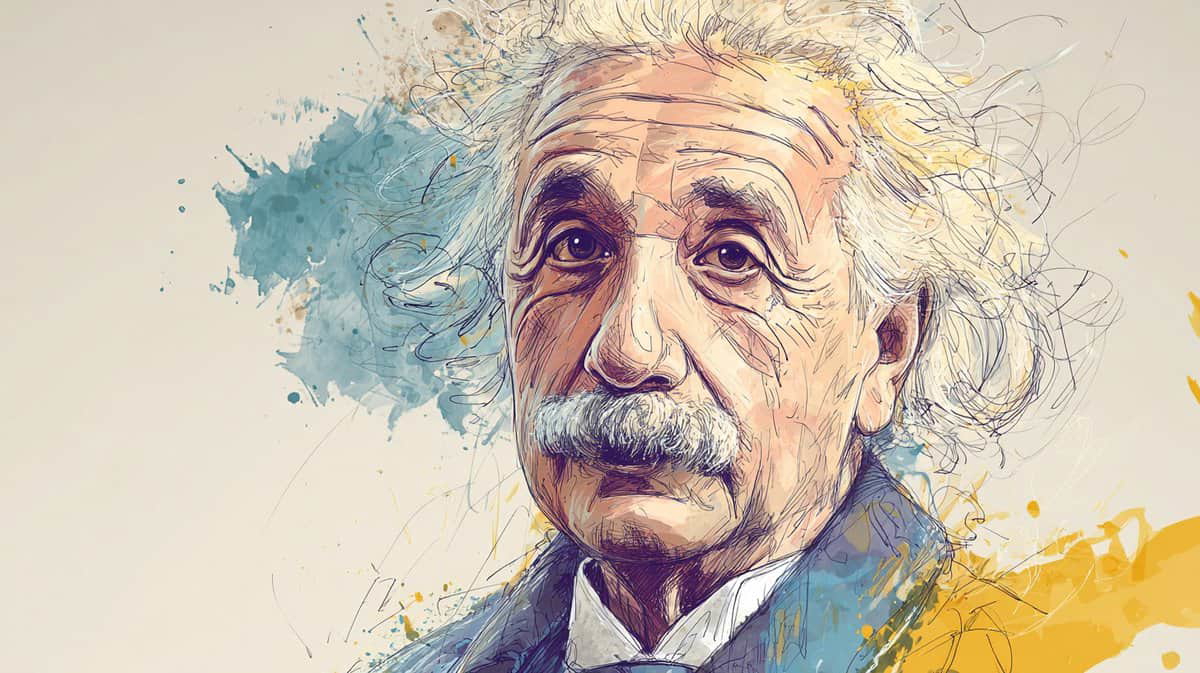
When a catastrophic situation occurs like the situation in Gaza, it is of course most important to try to rescue what can be rescued. It is, however, also important to think about whether it could have been avoided and if so, how. This often demands quite some imagination, and for Albert Einstein, imagination was more important than knowledge. He was not only the most celebrated genius of the twentieth century but also perhaps the most prominent and respected Jewish person of the previous century. So imagine that we could set his mind today on how the conflict between Israel and the Palestinians should have been solved. What would he have said? Where would his truly imaginative mind have led him?
This is certainly a speculative question, not least because since Einstein died in 1955, there have been more than a dozen wars in the region. However, considering the stalemate this conflict has reached, the horrible situation in Gaza and the West Bank, and how far away the parties are from anything approaching a stable peace, it does not seem unreasonable to try such an exercise. The thought experiment was in fact Einstein’s preferred scientific method. As a theoretical physicist, he spent hardly any time in the laboratory, and he was also not the sharpest of mathematicians. His genius was foremost his ability to think in unconventional ways “outside the box”, and for this he used thought experiments.
Einstein was not only the foremost theoretical physicist and natural scientist during the twentieth century. As is well known, he was also strongly engaged in political and ideological issues and became, during the last decades of his life, something of a moral world conscience. His outspoken criticism of all kinds of nationalism, chauvinism, oppression, racism and militarism made headlines and infuriated his opponents. However, contrary to what is often thought of him nowadays, he was neither aloof from the real world nor was he politically naïve. On the contrary, his political thinking was strongly characterised by an astute realism. This realism was, according to Isaiah Berlin, connected to his ontological ideas about science, which later became known as “scientific realism”. According to Einstein, the theories and concepts used by scientists resulted from their inventive imaginations, or to use the language of today, they were “social constructions”.
However, the purpose of human imagination was to discover the truth about an objective reality that existed independently of the concepts and theories that fallible humans were able to construct. A result of this realism was that he, much earlier than most of his contemporaries, understood the barbaric nature of the Nazis. He warned his fellow Jewish scientists that their assimilationist strategy would be useless in a Germany that was more and more dominated by the Nazi type of virulent anti-Semitism. During March and April 1933, shortly after Hitler came to power, Einstein publicly criticised the repressive policies of the National Socialist government, resigned from the Prussian Academy of Sciences in Berlin, and applied for release from his Prussian (German) citizenship. He left Berlin, where he had been living since 1914. His conclusion that Nazism had to be fought also made him abandon the international pacifist movement that he had strongly supported and been engaged in until 1933. It is noteworthy that Einstein never compromised with the demand for respect for human rights.
snip