Welcome to DU!
The truly grassroots left-of-center political community where regular people, not algorithms, drive the discussions and set the standards.
Join the community:
Create a free account
Support DU (and get rid of ads!):
Become a Star Member
Latest Breaking News
Editorials & Other Articles
General Discussion
The DU Lounge
All Forums
Issue Forums
Culture Forums
Alliance Forums
Region Forums
Support Forums
Help & Search
General Discussion
Related: Editorials & Other Articles, Issue Forums, Alliance Forums, Region Forums
How "Antisemitism" Became a Weapon of the Right

At a time when allegations of antisemitism are rampant and often incoherent, historian Mark Mazower offers a helpfully lucid history of the term.
https://newrepublic.com/article/199754/antisemitism-became-weapon-right
https://archive.ph/p7Bx4

Not long after Hamas’s October 7, 2023, assault on Israel and the start of that country’s brutal and ongoing war of retaliation, students at Columbia University—as well as many other colleges—set up an encampment to protest against Israel’s bombardment of Palestinian civilians. Both Columbia’s administration and New York City’s elites panicked. A group of billionaires began lobbying the mayor to get rid of the encampment. So did many outside commentators, who insisted that the students involved were antisemites, though many of them were Jews. Before long, the city’s riot squads had stormed the campus, and the school locked its gates against its own students. By that point, “the community of learning I knew and loved had vanished,” writes Mark Mazower, an eminent historian of twentieth-century Europe who has taught at Columbia for decades, in his new book, On Antisemitism: A Word in History.
As the school year limped on, Mazower found himself struggling to understand what had happened. But “if one thing was clear to me,” he writes, “it was that the lines dividing antisemitism from opposition to Israeli policies and criticism of Zionism had become hopelessly blurred.” And dangerously so: On Antisemitism begins by establishing that “antisemitism” is both a powerful word—a “word weapon,” as Mazower puts it—and a troublingly ill-defined one. It was coined by a German in 1879, entered the common vocabulary during World War II, and is now used to describe anything from calls to boycott Israeli hummus to white-supremacist demagogues who tell their followers that “the Jews” are conspiring to replace them. Clearly, it is incoherent to lump wholesale racial hatred in with a targeted protest technique, and incoherence of this sort is exactly what intellectual history—the genre to which On Antisemitism belongs—is built to address. If most history chases what happened, intellectual history chases the ideas that made it happen; if the former helps explain why we live how we live, the latter addresses why we think what we think and feel what we feel. At a moment when many people’s thoughts and feelings about antisemitism are intense without necessarily being intelligible to others, and when accusations of antisemitism are tremendously forceful, Mazower’s book makes an immense contribution. In tracing the evolving meaning of “antisemitism,” he demonstrates persuasively how we might turn it from a weapon back into a word.
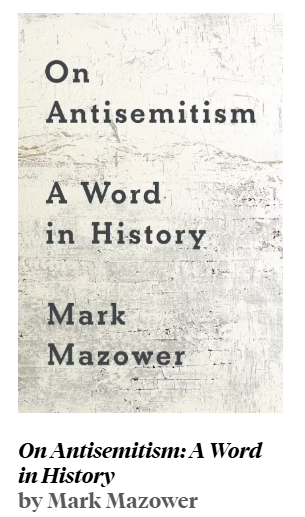
It helps that Mazower, as a scholar of nationalism, is used to negotiating the risk that his research and arguments may turn into what the legendary English historian Eric Hobsbawm called “a politically or ideologically explosive intervention” in the present. From the beginning, he’s clear that On Antisemitism, though it isn’t strictly about nationalism, will deal at length with Israeli nationalist—that is, Zionist—ideology. It has to. The intellectual arc Mazower traces is the transformation of antisemitism’s meaning from persecution of Jews on ethnic or religious grounds to any criticism of anything Jews do, even if the Jews in question are the government and defense forces of the state of Israel. That transformation is intertwined with the historical evolution of Zionism, and Mazower does not think that it’s good for the Jews.
Growing up, I understood antisemitism as a form of discrimination that nearly killed my great-grandparents. My grandparents faced it in serious ways, my parents in smaller ones, and I, an American Jew born in 1991, hardly ever encountered it at all. When I did, the experiences were minor, almost laughable. But during Israel’s 2014 assault on Gaza, when I was in my early twenties, I repeatedly found myself in conversations where my interlocutor referred to Israel as “you” or “you guys,” as if I were directly involved in its choices and campaigns. I thought this was antisemitic. I still do. Over the course of that invasion, though, I came to understand that my concept of antisemitism wasn’t universal. It seemed to be the inverse of what some others believed. According not only to the acquaintances I thought were antisemitic, but to a good number of the Jews around me and to the Israeli government itself, my Jewishness meant I was automatically associated with Israel. My ethnicity roped me into its nationalist program, even though I had no desire to live there and was politically opposed to Zionism. In fact, that opposition, which frequently manifested as critique of Israel, was, according to the Zionists around me, itself antisemitic. I’d thought I was an American Jew, but apparently, I was an Israeli antisemite.
snip