How to Control the Increase of Income Inequality Due to New Technologies?
 New technologies drive inequality by concentrating capital income. Three policy approaches can help spread ownership and moderate disparities.
https://www.socialeurope.eu/how-to-control-the-increase-of-income-inequality-due-to-new-technologies
New technologies drive inequality by concentrating capital income. Three policy approaches can help spread ownership and moderate disparities.
https://www.socialeurope.eu/how-to-control-the-increase-of-income-inequality-due-to-new-technologies
 The problem
. New technology, like all technological improvements since the Industrial Revolution, aims to replace human labor with machines, broadly understood. In that sense, Artificial Intelligence (AI) is not different from the self-acting mule introduced in the cotton industry in the 1820s: it replaces human labor although now it does it at a higher level of human skills. (In many ways, such developments were forecast because there was historically an inexorable increase in the level of skill of labor that was replaced by machines, beginning with unskilled and repetitive tasks performed by enslaved labor and then rising ever higher.)
From the distributional point of view, the issue is that substitution of labor by capital leads to the larger share of national income accruing to capital. This, translated in terms of actual persons who receive such income, means that entrepreneurs and inventors of new machines and investors in such new technologies gain disproportionately. Investors, by definition, are people who own capital and who belong to the top strata of income distribution. Thus, the expansion of the capital share almost necessarily translates into an increase in overall income inequality.
This naturally raises the question: what policies should be used to stop or moderate the increase in income inequality? There are three ways in which this can be done: spreading the ownership of capital more widely so that the effect of the rising capital share is not felt only at the top, taxing the highest capital incomes more than now, and banning some new financial activities that create income for the participants but are “directly non-productive”.
I shall consider the three options.
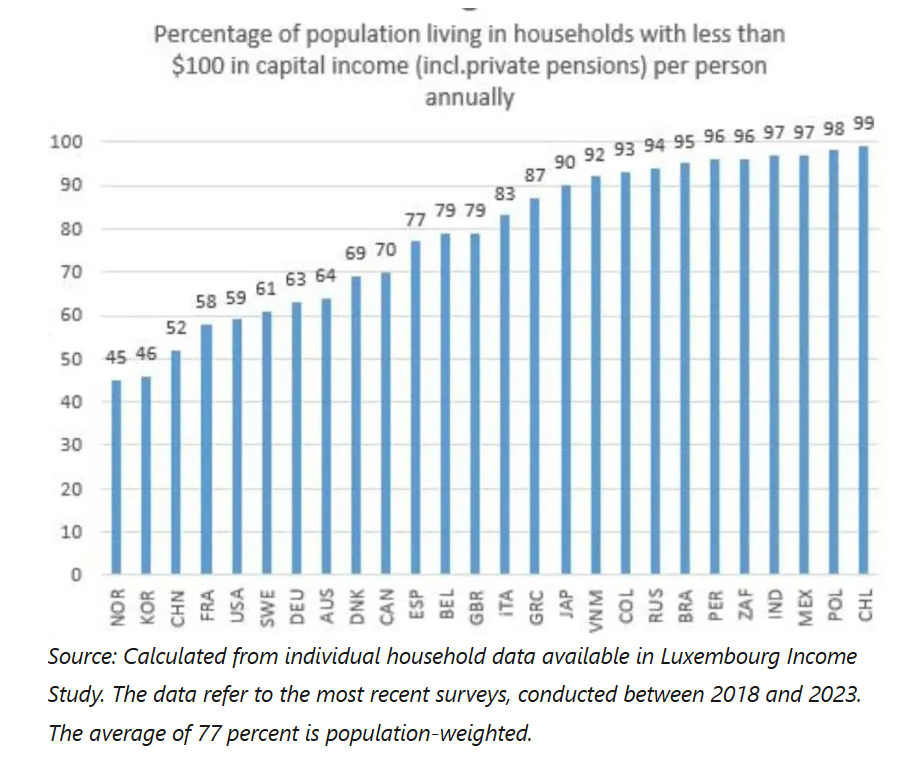
Spread the ownership of capital. Capital is extraordinarily heavily concentrated. The figure below shows that, on average, 77 percent of households in advanced and middle-income economies have zero or close to zero (“close to zero” is defined as $100 per person annually) cash income from capital. It should be noted that capital here includes only financial or productive capital that produces a cash income for its owner. It is not the same thing as household wealth, which also includes owner-occupied housing, jewelry, paintings, furniture, etc. The countries with the highest spread of capital income, that is, with the lowest share of “zero capital households,” are Norway, South Korea, and (interestingly) China. Yet even there, about one-half of households receive no income from capital. In the United States, that percentage is almost 60 percent, and in other advanced countries, it exceeds 70 percent. (I discussed this topic in more detail in
my previous Substack piece.)
snip

 = new reply since forum marked as read