General Discussion
Related: Editorials & Other Articles, Issue Forums, Alliance Forums, Region Forums

 = new reply since forum marked as read
Highlight:
NoneDon't highlight anything
5 newestHighlight 5 most recent replies
= new reply since forum marked as read
Highlight:
NoneDon't highlight anything
5 newestHighlight 5 most recent replies
Response to elleng (Original post)
PeaceWave This message was self-deleted by its author.

riversedge
(81,541 posts)
Celerity
(54,878 posts)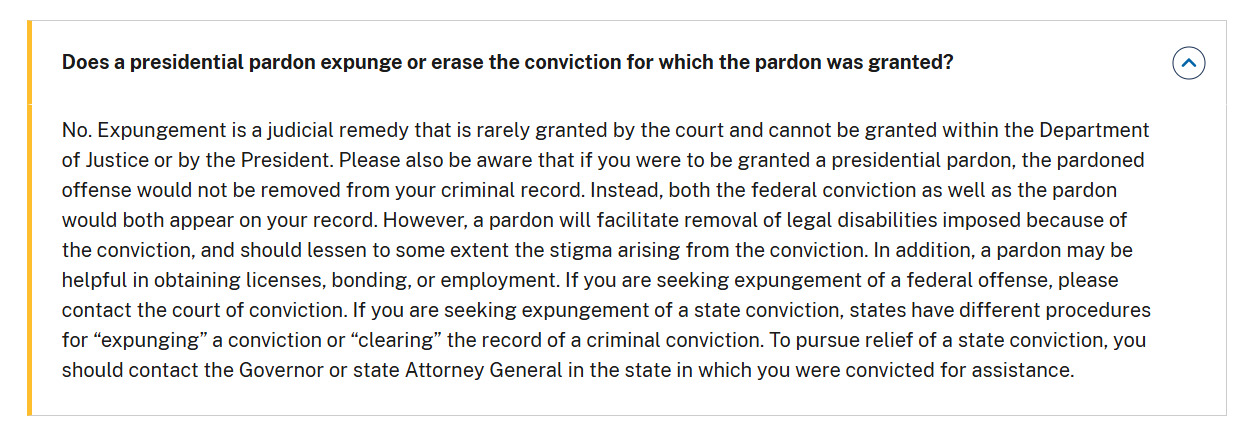

Hassin Bin Sober
(27,497 posts)
FalloutShelter
(14,628 posts)
Joinfortmill
(21,668 posts)Response to elleng (Original post)
PeaceWave This message was self-deleted by its author.
Celerity
(54,878 posts)https://www.neilruskinlawfirm.com/what-is-the-difference-between-a-pardon-and-a-commutation/
You may be one of many people in New York with questions about executive clemency after a series of well-publicized cases in the news. The President of the United States, as well as state governors, have the right to show clemency to people convicted of a crime. In other words, if you go to prison after a criminal trial, officials of the executive branch of government at both the state and national levels are able to change the terms of your sentence upon review of your case.
According to the United States Department of Justice, executive clemency usually takes one of two different forms: a pardon or a commuted sentence. Both are similar in that they do not excuse you from wrongdoing or imply innocence on your part, but although they are similar in some ways, they are different in others. If convicted of a crime, you can receive a pardon even after your release from prison. Some people have received pardons years after finishing their sentences, sometimes even after death. A commutation is different in that it shortens the term of your prison sentence and gets you out earlier than expected, meaning that you can only receive a commutation while you are still in prison.
A government executive may choose to grant a pardon to someone who has demonstrated good conduct for a significant period of time following a conviction, whether in prison or out of it, and has accepted the responsibility for the crime. Rather than acknowledging your innocence, a pardon is a show of forgiveness from the granting executive and removes many of the negative consequences (or civil disabilities) of a conviction that may otherwise affect your life after your release from prison.
A commutation reduces your sentence, either in whole or in part. It may also release you from financial obligations included in your sentence, such as fines or restitution. Like a pardon, a commutation does not imply your innocence, and unlike a pardon, a commutation does not remove civil disabilities resulting from your conviction, including restrictions on jury duty, public service, voting, et cetera.

markodochartaigh
(5,545 posts)"...unlike a pardon, a commutation does not remove civil disabilities resulting from your conviction, including restrictions on jury duty, public service, voting, et cetera."
It is my understanding that someone who has been pardoned can be compelled to testify before Congress, and found in contempt if they don't, since there is no longer the possibility of punishment. However, people whose sentences were commuted cannot be compelled to testify.

Irish_Dem
(82,336 posts)Trump world.
markodochartaigh
(5,545 posts)Things fall apart; the centre cannot hold;
Mere anarchy is loosed upon the world,
The blood-dimmed tide is loosed, and everywhere
The ceremony of innocence is drowned;
The best lack all conviction, while the worst
Are full of passionate intensity.
Irish_Dem
(82,336 posts)
a kennedy
(36,348 posts) We did kinda know.
jls4561
(3,268 posts)
Mark.b2
(807 posts)
Blue Owl
(59,626 posts)To hell with all of them.

UTUSN
(77,795 posts)LetMyPeopleVote
(182,046 posts)

Kick in to the DU tip jar?
This week we're running a special pop-up mini fund drive. From Monday through Friday we're going ad-free for all registered members, and we're asking you to kick in to the DU tip jar to support the site and keep us financially healthy.
As a bonus, making a contribution will allow you to leave kudos for another DU member, and at the end of the week we'll recognize the DUers who you think make this community great.