Welcome to DU!
The truly grassroots left-of-center political community where regular people, not algorithms, drive the discussions and set the standards.
Join the community:
Create a free account
Support DU (and get rid of ads!):
Become a Star Member
Latest Breaking News
Editorials & Other Articles
General Discussion
The DU Lounge
All Forums
Issue Forums
Culture Forums
Alliance Forums
Region Forums
Support Forums
Help & Search
General Discussion
Related: Editorials & Other Articles, Issue Forums, Alliance Forums, Region Forums
Sinead Bovell: How AI Is Rewriting the Future of Journalism
Chatbots, Trust, and Truth in the AI Age
https://sineadbovell.substack.com/p/how-ai-is-rewriting-the-future-of
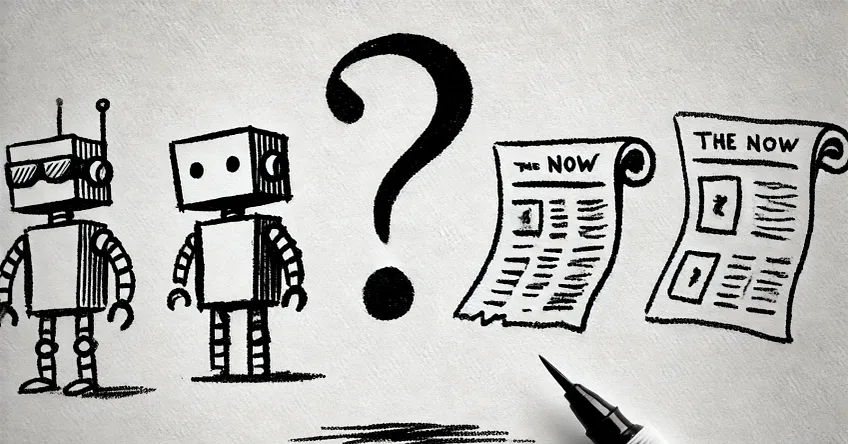
It seems like the journalism industry cannot catch a break. The internet dismantled the business models that sustained it for a century. Social media allowed advertisers to reach audiences directly, while the creator economy rewired who gets to tell stories in the first place. Our attention scattered across Netflix, dating apps, and every other platform competing for our time, all against a backdrop of declining trust in institutions, including journalism. And it’s important to be honest that trust didn’t erode for technological reasons alone. Perceived bias and reporting missteps had already shaken confidence in the industry. Moreover, the industry was slow to adapt to the realities of the internet. And then, in the middle of the night, AI companies scraped the internet and taught chatbots how to write like the very journalists they would soon be competing against.
Where We Are Today
About 800 million people use ChatGPT every week (and that’s just one chatbot, there are several other leading platforms). While the most common use case is companionship (we’ll save that crisis for another article), people are increasingly turning to these chatbots to understand the world around them. “Where do things stand with the war in Ukraine?” “Is the economy improving?” You can see the world we’re moving toward (rapidly!). Instead of opening your browser or email and searching for the latest article on foreign policy, pop culture, or the state of the economy, you’ll orally ask your personalized chatbot for a brief summary.
This won’t be everyone’s path to learning about the world, many still and will continue to read print magazines (if they survive) or full stories from hardworking journalists. But just as social media changed how billions of people got their “news” and who got to “create” information, one needs very little foresight to see the world AI chatbots will create. Depending on the chatbot, your well-written, 1-2 paragraph customized response—fitted to your communication style—may or may not source factual, human-written stories. Even if the chatbot does pulls accurate information from accredited journalism or databases, it may not cite where the information came from, bypassing the work of whoever reported it.
The Existential Threat
I chatted with Nicholas Thompson, CEO of The Atlantic and former Editor-in-Chief of Wired, for the latest episode of I’ve Got Questions. AI is “unquestionably the biggest opportunity and the biggest threat” to media, one that could potentially “obliterate the entire media industry,” he told me. He identifies two existential disruptions:
snip
A Once In A Lifetime Media Industry Reset Is Coming | The Atlantic CEO, Nicholas Thompson
1 replies
 = new reply since forum marked as read
Highlight:
NoneDon't highlight anything
5 newestHighlight 5 most recent replies
= new reply since forum marked as read
Highlight:
NoneDon't highlight anything
5 newestHighlight 5 most recent replies
= new reply since forum marked as read
Highlight:
NoneDon't highlight anything
5 newestHighlight 5 most recent replies
Sinead Bovell: How AI Is Rewriting the Future of Journalism (Original Post)
Celerity
Dec 2025
OP
GenAI dumbs people down, whether through AI summaries conning them into believing they're accurate and
highplainsdem
Dec 2025
#1

highplainsdem
(62,159 posts)1. GenAI dumbs people down, whether through AI summaries conning them into believing they're accurate and
unbiased, or use of AI for a pretense of knowledge and skills they don't have and won't bother to develop if they're happy to have that AI-assisted pretense (a pretense that will be shown as the joke it is the moment they're deprived of those AI tools).
I skimmed the Substack, didn't look at the video.
You could imagine a future where, say, you ask for the latest news on foreign policy, and the answer you receive from your chatbot is powered by The Atlantic or The Economist (or take your publication/ journalist of choice). A journalist on the other end loads their reporting (in whatever format suits them: writing, video, a stack of relevant files), and AI chatbots pull from that data but convey it in a format that suits you, the recipient. Your stories could arrive as two-minute audio summaries, 30-second videos, or traditional articles, whatever you prefer. When AI-powered, that kind of versatility becomes possible.
We don’t lose the facts or accuracy, we just receive the story in the context of the new general purpose technology. I, for one, would feel significantly better about my AI-generated briefing if I had those guarantees, knowing the underlying sources are vetted institutions I trust, not an opaque mix of scraped content and synthetic nonsense.
We don’t lose the facts or accuracy, we just receive the story in the context of the new general purpose technology. I, for one, would feel significantly better about my AI-generated briefing if I had those guarantees, knowing the underlying sources are vetted institutions I trust, not an opaque mix of scraped content and synthetic nonsense.
That shows a misunderstanding of how GenAI - LLMs - work. Even with high-quality training data, they can hallucinate. GenAI that's supposed to summarize a meeting, for instance, can invent people who weren't there and conversations that didn't take place. GenAI quoting actual sources can scramble citations and invent quotes.
And the AI companies saying they care about both accuracy and copyright when they make deals with established mainstream media are just going through a charade - trying to pretend they care about truth and intellectual property rights. They aren't training new AI models from scratch only on the media outlets they made deals with. All the old training is still there, and they're continually scraping the internet and stealing from everyone they haven't made deals with. That all goes into the mix. OpenAI publicized its making deals with both rightwing and mainstream media. You can't summarize contradictory stories on the same event. At best you'll get both-sidesism with little or no background to help you know which is more accurate.
The "personalization" can be very misleading in terms of objectivity, too, but is designed to make the AI's output appeal to the user. It's a sycophantic parody of real journalism.