Welcome to DU!
The truly grassroots left-of-center political community where regular people, not algorithms, drive the discussions and set the standards.
Join the community:
Create a free account
Support DU (and get rid of ads!):
Become a Star Member
Latest Breaking News
Editorials & Other Articles
General Discussion
The DU Lounge
All Forums
Issue Forums
Culture Forums
Alliance Forums
Region Forums
Support Forums
Help & Search
General Discussion
Related: Editorials & Other Articles, Issue Forums, Alliance Forums, Region Forums
2 replies
 = new reply since forum marked as read
Highlight:
NoneDon't highlight anything
5 newestHighlight 5 most recent replies
= new reply since forum marked as read
Highlight:
NoneDon't highlight anything
5 newestHighlight 5 most recent replies
= new reply since forum marked as read
Highlight:
NoneDon't highlight anything
5 newestHighlight 5 most recent replies
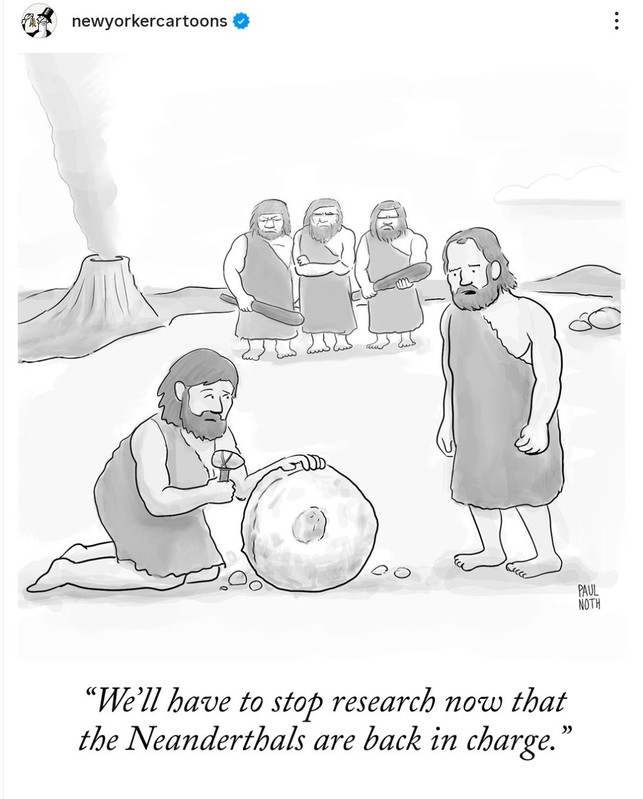
New Yorker cartoon .... so true (Original Post)
IcyPeas
Dec 2025
OP

Frasier Balzov
(5,030 posts)1. Literally!

Donkees
(33,650 posts)2. Neanderthals long-maligned and historically stereotyped as knuckle-dragging troglodytes had complex sense of aesthetics
Neanderthals — long-maligned and historically stereotyped as knuckle-dragging troglodytes — had a complex sense of aesthetics. (Homo neanderthalensis — the formal name for Neanderthals — lived quite successfully across glaciated Europe, the Levant, and as far east as Central Asia for 350,000 years before becoming extinct around 40,000 years ago.) What they created and how they created it offers a window into Neanderthal life, cosmology, and abstraction.
Neanderthals were very aware of how to use the material properties of things in their world to construct objects that carried specific meanings to them. In addition to working with raw materials like shells, stones, and bones — as well as making a plethora of pigments — Neanderthals were also interested in how elements like bird wings, feathers, and talons could be utilized to various aesthetic ends. In Kindred, Wragg Sykes describes how Neanderthals collected wings and talons from several species, favoring birds with distinctively dark plumages — blacks, dark browns, grays, and reds, indicating a Neanderthal color preference. Some bird talons might have even been strung together for ornamental wear.
Neanderthals also made pigments that they used toward various aesthetic ends. Moreover, between 200,000-250,000 years ago, Neanderthals were making liquid red ochre; archaeologists have even found evidence of liquid ochre splashes at the Maastricht-Belvédère site in the Netherlands. Other archaeological evidence of pigments from sites across Europe show that Neanderthals were interested in making pigments that offered a variety of hues in reds, yellows, browns, grays, and blacks. The ochres and manganese used to create these colors were systematically and carefully collected from quarry sources. “Based on chemical analyses that have been done on the black manganese minerals, we can tell that Neanderthals were interested in the purer sources of those materials, often carrying them significant distances between places,” Wragg Sykes describes, careful to also note that pigment can serve functional roles as well as aesthetic ones.
https://hyperallergic.com/kindred-neanderthal-art-bloomsbury/
Neanderthals were very aware of how to use the material properties of things in their world to construct objects that carried specific meanings to them. In addition to working with raw materials like shells, stones, and bones — as well as making a plethora of pigments — Neanderthals were also interested in how elements like bird wings, feathers, and talons could be utilized to various aesthetic ends. In Kindred, Wragg Sykes describes how Neanderthals collected wings and talons from several species, favoring birds with distinctively dark plumages — blacks, dark browns, grays, and reds, indicating a Neanderthal color preference. Some bird talons might have even been strung together for ornamental wear.
Neanderthals also made pigments that they used toward various aesthetic ends. Moreover, between 200,000-250,000 years ago, Neanderthals were making liquid red ochre; archaeologists have even found evidence of liquid ochre splashes at the Maastricht-Belvédère site in the Netherlands. Other archaeological evidence of pigments from sites across Europe show that Neanderthals were interested in making pigments that offered a variety of hues in reds, yellows, browns, grays, and blacks. The ochres and manganese used to create these colors were systematically and carefully collected from quarry sources. “Based on chemical analyses that have been done on the black manganese minerals, we can tell that Neanderthals were interested in the purer sources of those materials, often carrying them significant distances between places,” Wragg Sykes describes, careful to also note that pigment can serve functional roles as well as aesthetic ones.
https://hyperallergic.com/kindred-neanderthal-art-bloomsbury/