Welcome to DU!
The truly grassroots left-of-center political community where regular people, not algorithms, drive the discussions and set the standards.
Join the community:
Create a free account
Support DU (and get rid of ads!):
Become a Star Member
Latest Breaking News
Editorials & Other Articles
General Discussion
The DU Lounge
All Forums
Issue Forums
Culture Forums
Alliance Forums
Region Forums
Support Forums
Help & Search
General Discussion
Related: Editorials & Other Articles, Issue Forums, Alliance Forums, Region Forums
Google's AI pricing plan - Cory Doctorow
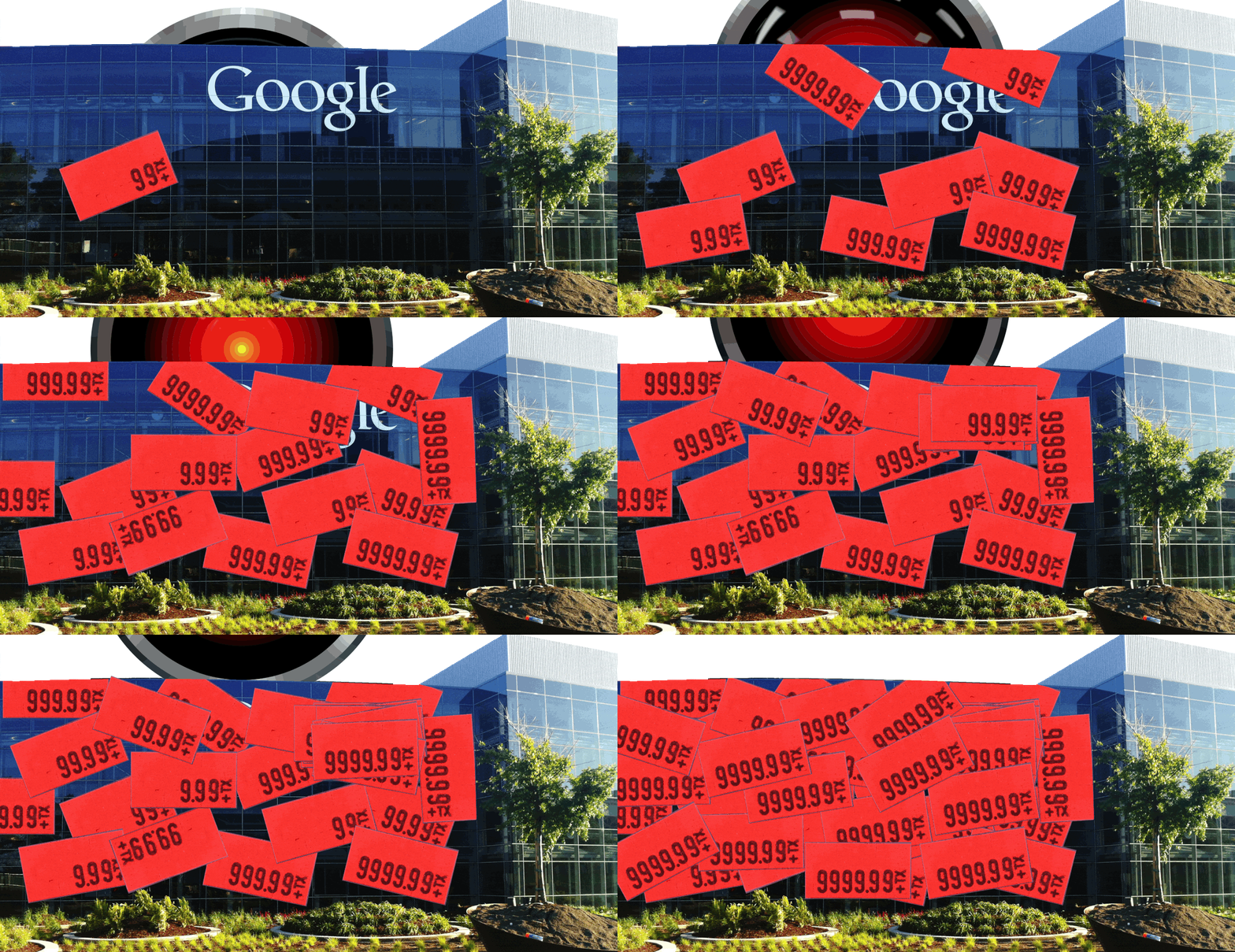
https://pluralistic.net/2026/01/21/cod-marxism/#wannamaker-slain]
Google is spending a lot on AI, but what's not clear is how Google will make a lot from AI. Or, you know, even break even. Given, you know, that businesses are seeing zero return from AI:
https://www.theregister.com/2026/01/20/pwc_ai_ceo_survey/
But maybe they've figured it out. In a recent edition of his BIG newsletter, Matt Stoller pulls on several of the strings that Google's top execs have dangled recently:
https://www.thebignewsletter.com/p/will-google-organize-the-worlds-prices
The first string: Google's going to spy on you a lot more, for the same reason Microsoft is spying on all of its users: because they want to supply their AI "agents" with your personal data:
Google's announced that it's going to feed its AI your Gmail messages, as well as the whole deep surveillance dossier the company has assembled based on your use of all the company's products: Youtube, Maps, Photos, and, of course, Search:
The second piece of news is that Apple has partnered with Google to supply Gemini to all iPhone users:
Apple already charges Google more than $20b/year not to enter the search market; now they're going to be charging Google billions to stay out of the AI market, too. Meanwhile, Google will get to spy on Apple customers, just like they spy on their own users. Anyone who says that Apple is ideologically committed to your privacy because they're real capitalists is a sucker (or a cultist):
https://pluralistic.net/2024/01/12/youre-holding-it-wrong/#if-dishwashers-were-iphones
But the big revelation is how Google is going to make money with AI: they're going to sell AI-based "personalized pricing" to "partners," including "Walmart, Visa, Mastercard, Shopify, Gap, Kroger, Macy’s, Stripe, Home Depot, Lowe's, American Express, etc":
https://blog.google/products/ads-commerce/agentic-commerce-ai-tools-protocol-retailers-platforms/
Personalized pricing, of course, is the polite euphemism for surveillance pricing, which is when a company spies on you in order to figure out how much they can get away with charging you (or how little they can get away with paying you):
https://pluralistic.net/2025/06/24/price-discrimination/#
It's a weird form of cod-Marxism, whose tenet is "From each according to their desperation; to each according to their vulnerability." Surveillance pricing advocates say that this is "efficient" because they can use surveillance data to offer you discounts, too – like, say you rock up to an airline ticket counter 45 minutes before takeoff and they can use surveillance data to know that you won't take their last empty seat for $200, but you would fly in it for $100, you could get that seat for cheap.
This is, of course, nonsense. Airlines don't sell off cheap seats like bakeries discounting their day-olds – they jack up the price of a last-minute journey to farcical heights.
Google also claims that it will only use its surveillance pricing facility to offer discounts, and not to extract premiums. As Stoller points out, there's a well-developed playbook for making premiums look like discounts, which is easy to see in the health industry. As Stoller says, the list price for an MRI is $8,000, but your insurer gets a $6000 "discount" and actually pays $1970, sticking you with a $30 co-pay. The $8000 is a fake number, and so is the $6000 – the only real price is the $30 you're paying.
The whole economy is filled with versions of this transparent ruse, from "department stores who routinely mark everything as 80% off" to pharmacy benefit managers:
https://pluralistic.net/2024/09/23/shield-of-boringness/#some-men-rob-you-with-a-fountain-pen
Google, meanwhile, is touting its new "universal commerce protocol" (UCP), a way for AI "agents" to retrieve prices and product descriptions and make purchases:
https://www.thesling.org/the-harm-to-consumers-and-sellers-from-universal-commerce-protocol-in-googles-own-words/
Right now, a major hurdle to "agentic AI" is the complexity of navigating websites designed for humans. AI agents just aren't very reliable when it comes to figuring out which product is which, choosing the correct options, and putting it in a shopping cart, and then paying for it.
Some of that is merely because websites have inconsistent "semantics" – literally things like the "buy" button being called something other than "buy button" in the HTML code. But there's a far more profound problem with agentic shopping, which is that companies deliberately obfuscate their prices.
This is how junk fees work, and why they're so destructive. Say you're a hotel providing your rate-card to an online travel website. You know that travelers are going to search for hotels by city and amenities, and then sort the resulting list by price. If you hide your final price – by surprising the user with a bunch of junk fees at checkout, or, better yet, after they arrive and put their credit-card down at reception – you are going to be at the top of that list. Your hotel will seem like the cheapest, best option.
But of course, it's not. From Ticketmaster to car rentals, hotels to discount airlines, rental apartments to cellular plans, the real price is withheld until the very last instant, whereupon it shoots up to levels that are absolutely uncompetitive. But because these companies are able to engage in deceptive advertising, they look cheaper.
And of course, crooked offers drive out honest ones. The honest hotel that provides a true rate card, reflecting the all-in price, ends up at the bottom of the price-sorted list, rents no rooms, and goes out of business (or pivots to lying about its prices, too).
Online sellers do not want to expose their true prices to comparison shopping services. They benefit from lying to those services. For decades, technologists have dreamed of building a "semantic web" in which everyone exposes true and accurate machine-readable manifests of their content to facilitate indexing, search and data-mining:
https://people.well.com/user/doctorow/metacrap.htm
This has failed. It's failed because lying is often more profitable than telling the truth, and because lying to computers is easier than lying to people, and because once a market is dominated by liars, everyone has to lie, or be pushed out of the market.
Of course, it would be really cool if everyone diligently marked up everything they put into the public sphere with accurate metadata. But there are lots of really cool things you could do if you could get everyone else to change how they do things and arrange their affairs to your convenience. Imagine how great it would be if you could just get everyone to board an airplane from back to front, or to stand right and walk left on escalators, or to put on headphones when using their phones in public.
Wanting it badly is not enough. People have lots of reasons for doing things in suboptimal ways. Often the reason is that it's suboptimal for you, but just peachy for them.
Google says that it's going to get every website in the world to expose accurate rate cards to its chatbots to facilitate agentic AI. Google is also incapable of preventing "search engine optimization" companies from tricking it into showing bullshit at the top of the results for common queries:
https://pluralistic.net/2024/05/03/keyword-swarming/#site-reputation-abuse
Google somehow thinks that the companies that spend millions of dollars trying to trick its crawler won't also spend millions of dollars trying to trick its chatbot – and they're providing the internet with a tool to inject lies straight into the chatbot's input hopper.
But UCP isn't just a way for companies to tell Google what their prices are. As Stoller points out, UCP will also sell merchants the ability to have Gemini set prices on their products, using Google's surveillance data, through "dynamic pricing" (another euphemism for "surveillance pricing" .
.
This decade has seen the rise and rise of price "clearinghouses" – companies that offer price "consulting" to direct competitors in a market. Nominally, this is just a case of two competitors shopping with the same supplier – like Procter and Gamble and Unilever buying their high-fructose corn-syrup from the same company.
But it's actually far more sinister. "Clearinghouses" like Realpage – a company that "advises" landlords on rental rates – allow all the major competitors in a market to collude to raise prices in lockstep. A Realpage landlord that ignores the service's "advice" and gives a tenant a break on the rent will be excluded from Realpage's service. The rental markets that Realpage dominates have seen major increases in rental rates:
https://pluralistic.net/2025/10/09/pricewars/#adam-smith-communist
Google's "direct pricing" offering will allow all comers to have Google set their prices for them, based on Google's surveillance data. That includes direct competitors. As Stoller points out, both Nike and Reebok are Google advertisers. If they let Google price their sneakers, Google can raise prices across the market in lockstep.
Despite how much everyone hates this garbage, neoclassical economists and their apologists in the legal profession continue to insist that surveillance pricing is "efficient." Stoller points to a law review article called "Antitrust After the Coming Wave," written by antitrust law prof and Google lawyer Daniel Crane:
https://nyulawreview.org/issues/volume-99-number-4/antitrust-after-the-coming-wave/
Crane argues that AI will kill antitrust law because AI favors monopolies, and argues "that we should forget about promoting competition or costs, and instead enact a new Soviet-style regime, one in which the government would merely direct a monopolist’s 'AI to maximize social welfare and allocate the surplus created among different stakeholders of the firm.'"
This is a planned economy, but it's one in which the planning is done by monopolists who are – somehow, implausibly – so biddable that governments can delegate the power to decide what we can buy and sell, what we can afford and who can afford it, and rein them in if they get it wrong.
In 1890, Senator John Sherman was stumping for the Sherman Act, America's first antitrust law. On the Senate floor, he declared:
If we will not endure a King as a political power we should not endure a King over the production, transportation, and sale of the necessaries of life. If we would not submit to an emperor we should not submit to an autocrat of trade with power to prevent competition and to fix the price of any commodity.
https://pluralistic.net/2022/02/20/we-should-not-endure-a-king/
Google thinks that it has finally found a profitable use for AI. It thinks that it will be the first company to make money on AI, by harnessing that AI to a market-rigging, price-gouging monopoly that turns Google's software into Sherman's "autocrat of trade."
It's funny when you think of all those "AI safety" bros who claimed that AI's greatest danger was that it would become sentient and devour us. It turns out that the real "AI safety" risk is that AI will automate price gouging at scale, allowing Google to crown itself a "King over the necessaries of life":
https://pluralistic.net/2023/11/27/10-types-of-people/#taking-up-a-lot-of-space
https://www.theregister.com/2026/01/20/pwc_ai_ceo_survey/
But maybe they've figured it out. In a recent edition of his BIG newsletter, Matt Stoller pulls on several of the strings that Google's top execs have dangled recently:
https://www.thebignewsletter.com/p/will-google-organize-the-worlds-prices
The first string: Google's going to spy on you a lot more, for the same reason Microsoft is spying on all of its users: because they want to supply their AI "agents" with your personal data:
Google's announced that it's going to feed its AI your Gmail messages, as well as the whole deep surveillance dossier the company has assembled based on your use of all the company's products: Youtube, Maps, Photos, and, of course, Search:
Link to tweet
The second piece of news is that Apple has partnered with Google to supply Gemini to all iPhone users:
Link to tweet
Apple already charges Google more than $20b/year not to enter the search market; now they're going to be charging Google billions to stay out of the AI market, too. Meanwhile, Google will get to spy on Apple customers, just like they spy on their own users. Anyone who says that Apple is ideologically committed to your privacy because they're real capitalists is a sucker (or a cultist):
https://pluralistic.net/2024/01/12/youre-holding-it-wrong/#if-dishwashers-were-iphones
But the big revelation is how Google is going to make money with AI: they're going to sell AI-based "personalized pricing" to "partners," including "Walmart, Visa, Mastercard, Shopify, Gap, Kroger, Macy’s, Stripe, Home Depot, Lowe's, American Express, etc":
https://blog.google/products/ads-commerce/agentic-commerce-ai-tools-protocol-retailers-platforms/
Personalized pricing, of course, is the polite euphemism for surveillance pricing, which is when a company spies on you in order to figure out how much they can get away with charging you (or how little they can get away with paying you):
https://pluralistic.net/2025/06/24/price-discrimination/#
It's a weird form of cod-Marxism, whose tenet is "From each according to their desperation; to each according to their vulnerability." Surveillance pricing advocates say that this is "efficient" because they can use surveillance data to offer you discounts, too – like, say you rock up to an airline ticket counter 45 minutes before takeoff and they can use surveillance data to know that you won't take their last empty seat for $200, but you would fly in it for $100, you could get that seat for cheap.
This is, of course, nonsense. Airlines don't sell off cheap seats like bakeries discounting their day-olds – they jack up the price of a last-minute journey to farcical heights.
Google also claims that it will only use its surveillance pricing facility to offer discounts, and not to extract premiums. As Stoller points out, there's a well-developed playbook for making premiums look like discounts, which is easy to see in the health industry. As Stoller says, the list price for an MRI is $8,000, but your insurer gets a $6000 "discount" and actually pays $1970, sticking you with a $30 co-pay. The $8000 is a fake number, and so is the $6000 – the only real price is the $30 you're paying.
The whole economy is filled with versions of this transparent ruse, from "department stores who routinely mark everything as 80% off" to pharmacy benefit managers:
https://pluralistic.net/2024/09/23/shield-of-boringness/#some-men-rob-you-with-a-fountain-pen
Google, meanwhile, is touting its new "universal commerce protocol" (UCP), a way for AI "agents" to retrieve prices and product descriptions and make purchases:
https://www.thesling.org/the-harm-to-consumers-and-sellers-from-universal-commerce-protocol-in-googles-own-words/
Right now, a major hurdle to "agentic AI" is the complexity of navigating websites designed for humans. AI agents just aren't very reliable when it comes to figuring out which product is which, choosing the correct options, and putting it in a shopping cart, and then paying for it.
Some of that is merely because websites have inconsistent "semantics" – literally things like the "buy" button being called something other than "buy button" in the HTML code. But there's a far more profound problem with agentic shopping, which is that companies deliberately obfuscate their prices.
This is how junk fees work, and why they're so destructive. Say you're a hotel providing your rate-card to an online travel website. You know that travelers are going to search for hotels by city and amenities, and then sort the resulting list by price. If you hide your final price – by surprising the user with a bunch of junk fees at checkout, or, better yet, after they arrive and put their credit-card down at reception – you are going to be at the top of that list. Your hotel will seem like the cheapest, best option.
But of course, it's not. From Ticketmaster to car rentals, hotels to discount airlines, rental apartments to cellular plans, the real price is withheld until the very last instant, whereupon it shoots up to levels that are absolutely uncompetitive. But because these companies are able to engage in deceptive advertising, they look cheaper.
And of course, crooked offers drive out honest ones. The honest hotel that provides a true rate card, reflecting the all-in price, ends up at the bottom of the price-sorted list, rents no rooms, and goes out of business (or pivots to lying about its prices, too).
Online sellers do not want to expose their true prices to comparison shopping services. They benefit from lying to those services. For decades, technologists have dreamed of building a "semantic web" in which everyone exposes true and accurate machine-readable manifests of their content to facilitate indexing, search and data-mining:
https://people.well.com/user/doctorow/metacrap.htm
This has failed. It's failed because lying is often more profitable than telling the truth, and because lying to computers is easier than lying to people, and because once a market is dominated by liars, everyone has to lie, or be pushed out of the market.
Of course, it would be really cool if everyone diligently marked up everything they put into the public sphere with accurate metadata. But there are lots of really cool things you could do if you could get everyone else to change how they do things and arrange their affairs to your convenience. Imagine how great it would be if you could just get everyone to board an airplane from back to front, or to stand right and walk left on escalators, or to put on headphones when using their phones in public.
Wanting it badly is not enough. People have lots of reasons for doing things in suboptimal ways. Often the reason is that it's suboptimal for you, but just peachy for them.
Google says that it's going to get every website in the world to expose accurate rate cards to its chatbots to facilitate agentic AI. Google is also incapable of preventing "search engine optimization" companies from tricking it into showing bullshit at the top of the results for common queries:
https://pluralistic.net/2024/05/03/keyword-swarming/#site-reputation-abuse
Google somehow thinks that the companies that spend millions of dollars trying to trick its crawler won't also spend millions of dollars trying to trick its chatbot – and they're providing the internet with a tool to inject lies straight into the chatbot's input hopper.
But UCP isn't just a way for companies to tell Google what their prices are. As Stoller points out, UCP will also sell merchants the ability to have Gemini set prices on their products, using Google's surveillance data, through "dynamic pricing" (another euphemism for "surveillance pricing"
.
This decade has seen the rise and rise of price "clearinghouses" – companies that offer price "consulting" to direct competitors in a market. Nominally, this is just a case of two competitors shopping with the same supplier – like Procter and Gamble and Unilever buying their high-fructose corn-syrup from the same company.
But it's actually far more sinister. "Clearinghouses" like Realpage – a company that "advises" landlords on rental rates – allow all the major competitors in a market to collude to raise prices in lockstep. A Realpage landlord that ignores the service's "advice" and gives a tenant a break on the rent will be excluded from Realpage's service. The rental markets that Realpage dominates have seen major increases in rental rates:
https://pluralistic.net/2025/10/09/pricewars/#adam-smith-communist
Google's "direct pricing" offering will allow all comers to have Google set their prices for them, based on Google's surveillance data. That includes direct competitors. As Stoller points out, both Nike and Reebok are Google advertisers. If they let Google price their sneakers, Google can raise prices across the market in lockstep.
Despite how much everyone hates this garbage, neoclassical economists and their apologists in the legal profession continue to insist that surveillance pricing is "efficient." Stoller points to a law review article called "Antitrust After the Coming Wave," written by antitrust law prof and Google lawyer Daniel Crane:
https://nyulawreview.org/issues/volume-99-number-4/antitrust-after-the-coming-wave/
Crane argues that AI will kill antitrust law because AI favors monopolies, and argues "that we should forget about promoting competition or costs, and instead enact a new Soviet-style regime, one in which the government would merely direct a monopolist’s 'AI to maximize social welfare and allocate the surplus created among different stakeholders of the firm.'"
This is a planned economy, but it's one in which the planning is done by monopolists who are – somehow, implausibly – so biddable that governments can delegate the power to decide what we can buy and sell, what we can afford and who can afford it, and rein them in if they get it wrong.
In 1890, Senator John Sherman was stumping for the Sherman Act, America's first antitrust law. On the Senate floor, he declared:
If we will not endure a King as a political power we should not endure a King over the production, transportation, and sale of the necessaries of life. If we would not submit to an emperor we should not submit to an autocrat of trade with power to prevent competition and to fix the price of any commodity.
https://pluralistic.net/2022/02/20/we-should-not-endure-a-king/
Google thinks that it has finally found a profitable use for AI. It thinks that it will be the first company to make money on AI, by harnessing that AI to a market-rigging, price-gouging monopoly that turns Google's software into Sherman's "autocrat of trade."
It's funny when you think of all those "AI safety" bros who claimed that AI's greatest danger was that it would become sentient and devour us. It turns out that the real "AI safety" risk is that AI will automate price gouging at scale, allowing Google to crown itself a "King over the necessaries of life":
https://pluralistic.net/2023/11/27/10-types-of-people/#taking-up-a-lot-of-space